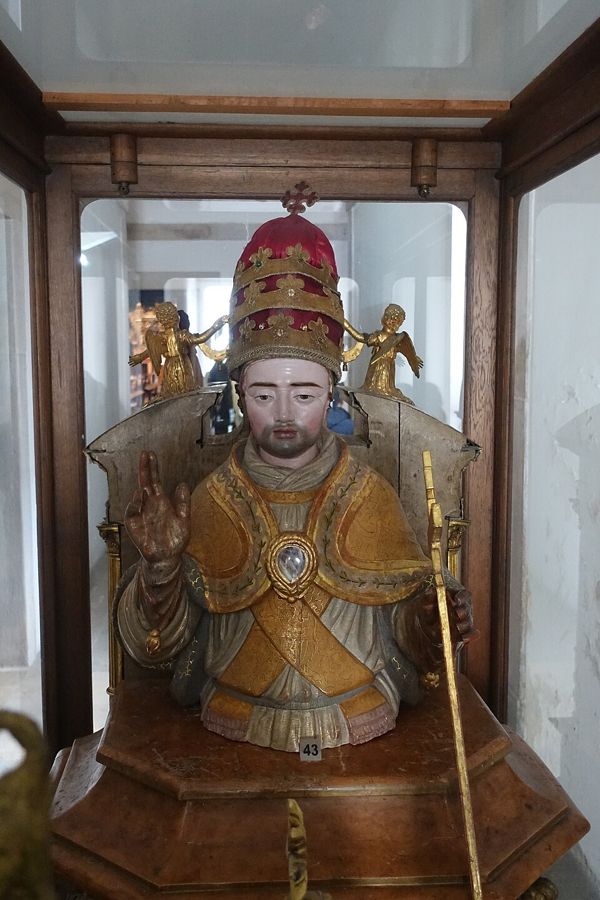
St. Bede the Venerable, Ml

Bede (the English monk-historian, d. 735) was born in 672 or 673.

Read the essentials →
May 27 · Deacon

St. Bede the Venerable

St. Bede the Venerable, Ml

Bede (the English monk-historian, d. 735) was born in 672 or 673.

Traditional feast

May 27
1914 / pre-1969 calendar, per Baring-Gould (1897)

Current feast

May 25
Verified · General Roman Calendar

Represents

Deacon

Their story

Adapted in modern English from the Catholic Encyclopedia (1913) · original text below

Bede (the English monk-historian, d. 735) was born in 672 or 673. Almost everything known about his life comes from a few lines he wrote himself at the end of his 'Ecclesiastical History of the English People' in 731. He was born on the lands of the monastery of Sts Peter and Paul at Wearmouth and Jarrow. At seven his relatives gave him to Abbot Benedict Biscop, and later to Ceolfrid, to be educated, and he spent his whole life in that monastery. 'Amid the observance of monastic discipline and the daily charge of singing in the Church,' he wrote, 'it has been ever my delight to learn or teach or write.' St John of Beverley ordained him deacon in his nineteenth year and priest in his thirtieth.

Apart from rare short visits to friends, his life was a peaceful round of study and prayer. He was the most learned man of his age. He wrote commentaries on Scripture, works on chronology, grammar and science, Lives of St Cuthbert, and above all the 'Ecclesiastical History', the foundation of all knowledge of early English history. Unusually for his time, he carefully noted the passages he borrowed from others. For all his learning he held that every study must serve the understanding of Scripture.

His disciple Cuthbert left an account of his death. During his last illness the monks kept reading aloud at his bedside, often breaking off in tears. On the eve of the Ascension in 735 he was still dictating a translation of St John's Gospel. In the evening the boy Wilbert told him, 'There is still one sentence, dear master, which is not written down.' When it was done Bede said, 'It is finished,' and asked to be held facing the place where he used to pray. Sitting on the floor of his cell and singing 'Glory be to the Father and to the Son and to the Holy Ghost', he breathed his last. Leo XIII declared him a Doctor of the Church (a title the pope gives to a saint whose teaching is of special value to the whole Church) in 1899.

Early life

The book says little or nothing about early life. This is how the account begins.

The remainder of Bede’s life appears to have passed in the tranquillity of study. He clung through life to the dear retreat that was his home, and within its peaceful walls composed his numerous books. But occasionally he went forth to other religious houses for brief visits.

What they represent

How they teach us to live

Drawn from themes in the original account

Feed your mind with Scripture and good books. Learning and the Scriptures matter in this life.

Build up the community you belong to. This life was lived with and for a community.

Pray a little every day. Prayer runs all through this account.

From the Catholic Encyclopedia

1913 · 2083 words

Historian and Doctor of the Church, born 672 or 673; died 735. In the last chapter of his great work on the "Ecclesiastical History of the English People" Bede [English monk and historian (d. 735)] has told us something of his own life, and it is, practically speaking, all that we know. His words, written in 731, when death was not far off, not only show a simplicity and piety characteristic of the man, but they throw a light on the composition of the work through which he is best remembered by the world at large. He writes:

Thus much concerning the ecclesiastical history of Britain, and especially of the race of the English, I, Baeda, a servant of Christ and a priest of the monastery of the blessed apostles St. Peter and St. Paul, which is at Wearmouth and at Jarrow (in Northumberland), have with the Lord's help composed so far as I could gather it either from ancient documents or from the traditions of the elders, or from my own knowledge. I was born in the territory of the said monastery, and at the age of seven I was, by the care of my relations, given to the most reverend Abbot Benedict [St. Benedict Biscop], and afterwards to Ceolfrid, to be educated. From that time I have spent the whole of my life within that monastery, devoting all my pains to the study of the Scriptures, and amid the observance of monastic discipline and the daily charge of singing in the Church, it has been ever my delight to learn or teach or write. In my nineteenth year I was admitted to the diaconate, in my thirtieth to the priesthood, both by the hands of the most reverend Bishop John [St. John of Beverley], and at the bidding of Abbot Ceolfrid. From the time of my admission to the priesthood to my present fifty-ninth year, I have endeavored for my own use and that of my brethren, to make brief notes upon the holy Scripture, either out of the works of the venerable Fathers or in conformity with their meaning and interpretation.

After this Bede inserts a list or Indiculus, of his previous writings and finally concludes his great work with the following words:

Read the rest of the article

And I pray thee, loving Jesus, that as Thou hast graciously given me to drink in with delight the words of Thy knowledge, so Thou wouldst mercifully grant me to attain one day to Thee, the fountain of all wisdom and to appear forever before Thy face.

It is plain from Bede's letter to Bishop Egbert that the historian occasionally visited his friends for a few days, away from his own monastery of Jarrow, but with such rare exceptions his life seems to have been one peaceful round of study and prayer passed in the midst of his own community. How much he was beloved by them is made manifest by the touching account of the saint's last sickness and death left us by Cuthbert, one of his disciples. Their studious pursuits were not given up on account of his illness and they read aloud by his bedside, but constantly the reading was interrupted by their tears. "I can with truth declare", writes Cuthbert of his beloved master, "that I never saw with my eyes or heard with my ears anyone return thanks so unceasingly to the living God." Even on the day of his death (the vigil of the Ascension, 735) the saint was still busy dictating a translation [the solemn moving of a saint’s relics to a new shrine] of the Gospel of St. John. In the evening the boy Wilbert, who was writing it, said to him: "There is still one sentence, dear master, which is not written down." And when this had been supplied, and the boy had told him it was finished, "Thou hast spoken truth", Bede answered, "it is finished. Take my head in thy hands for it much delights me to sit opposite any holy place where I used to pray, that so sitting I may call upon my Father." And thus upon the floor of his cell singing, "Glory be to the Father and to the Son and to the Holy Ghost" and the rest, he peacefully breathed his last breath.

The title Venerabilis seems to have been associated with the name of Bede within two generations after his death. There is of course no early authority for the legend repeated by Fuller of the "dunce-monk" who in composing an epitaph on Bede was at a loss to complete the line: Hac sunt in fossa Bedae . . . . ossa and who next morning found that the angels had filled the gap with the word venerabilis. The title is used by Alcuin, Amalarius and seemingly Paul the Deacon, and the important Council of Aachen in 835 describes him as venerabilis et modernis temporibus doctor admirabilis Beda. This decree was specially referred to in the petition which Cardinal Wiseman and the English bishops addressed to the Holy See in 1859 praying that Bede might be declared a Doctor of the Church. The question had already been debated even before the time of Benedict XIV, but it was only on 13 November, 1899, that Leo XIII decreed that the feast of Venerable Bede with the title of Doctor Ecclesiae should be celebrated throughout the Church each year on 27 May. A local cultus of St. Bede had been maintained at York and in the North of England throughout the Middle Ages, but his feast was not so generally observed in the South, where the Sarum Rite was followed.

Bede's influence both upon English and foreign scholarship was very great, and it would probably have been greater still but for the devastation inflicted upon the Northern monasteries by the inroads of the Danes [Viking raiders from Scandinavia] less than a century after his death. In numberless ways, but especially in his moderation, gentleness, and breadth of view, Bede stands out from his contemporaries. In point of scholarship he was undoubtedly the most learned man of his time. A very remarkable trait, noticed by Plummer (I, p. xxiii), is his sense of literary property, an extraordinary thing in that age. He himself scrupulously noted in his writings the passages he had borrowed from others and he even begs the copyists of his works to preserve the references, a recommendation to which they, alas, have paid but little attention. High, however, as was the general level of Bede's culture, he repeatedly makes it clear that all his studies were subordinated to the interpretation of Scripture. In his "De Schematibus" he says in so many words: "Holy Scripture is above all other books not only by its authority because it is Divine, or by its utility because it leads to eternal life, but also by its antiquity and its literary form" (positione dicendi). It is perhaps the highest tribute to Bede's genius that with so uncompromising and evidently sincere a conviction of the inferiority of human learning, he should have acquired so much real culture. Though Latin was to him a still living tongue, and though he does not seem to have consciously looked back to the Augustan Age of Roman Literature as preserving purer models of literary style than the time of Fortunatus or St. Augustine, still whether through native genius or through contact with the classics, he is remarkable for the relative purity of his language, as also for his lucidity and sobriety, more especially in matters of historical criticism. In all these respects he presents a marked contrast to St. Aldhelm who approaches more nearly to the Celtic type.

No adequate edition founded upon a careful collation of manuscripts has ever been published of Bede's works as a whole. The text printed by Giles in 1884 and reproduced in Migne (XC-XCIV) shows little if any advance on the basic edition of 1563 or the Cologne edition of 1688. It is of course as an historian that Bede is chiefly remembered. His great work, the "Historia Ecclesiastica Gentis Anglorum", giving an account of Christianity in England from the beginning until his own day, is the foundation of all our knowledge of British history and a masterpiece eulogized by the scholars of every age. Of this work, together with the "Historia Abbatum", and the "Letter to Egbert", Plummer has produced an edition which may fairly be called final (2 vols., Oxford, 1896). Bede's remarkable industry in collecting materials and his critical use of them have been admirably illustrated in Plummer's Introduction (pp. xliii-xlvii). The "History of the Abbots" (of the twin monasteries of Wearmouth and Jarrow), the Letter to Egbert", the metrical and prose lives of St. Cuthbert, and the other smaller pieces are also of great value for the light they shed upon the state of Christianity in Northumbria [the Anglo-Saxon kingdom of northern England and south-east Scotland] in Bede's own day. The "Ecclesiastical History" was translated into Anglo-Saxon at the instance of King Alfred. It has often been translated since, notably by T. Stapleton who printed it (1565) at Antwerp as a controversial weapon against the Reformation divines in the reign of Elizabeth. The Latin text first appeared in Germany in 1475; it is noteworthy that no edition even of the Latin was printed in England before 1643. Smith's more accurate text saw the light in 1742.

Bede's chronological treatises "De temporibus liber" and "De temporum ratione" also contain summaries of the general history of the world from the Creation to 725 and 703, respectively. These historical portions have been satisfactorily edited by Mommsen in the "Monumenta Germaniae historica" (4to series, 1898). They may be counted among the earliest specimens of this type of general chronical and were largely copied and imitated. The topographical work "De locis sanctis" is a description of Jerusalem and the holy places based upon Adamnan and Arculfus. Bede's work was edited in 1898 by Geyer in the "Itinera Hierosolymitana" for the Vienna "Corpus Scriptorum". That Bede compiled a Martyrologium we know from his own statement. But the work attributed to him in extant manuscripts has been so much interpolated and supplemented that his share in it is quite uncertain.

Bede's exegetical writings both in his own idea and in that of his contemporaries stood supreme in importance among his works, but the list is long and cannot fully be given here. They included a commentary upon the Pentateuch as a whole as well as on selected portions, and there are also commentaries on the Books of Kings, Esdras, Tobias, the Canticles, etc. In the New Testament he has certainly interpreted St. Mark, St. Luke, the Acts, the Canonical Epistles, and the Apocalypse. But the authenticity of the commentary on St. Matthew printed under his name is more than doubtful. (Plaine in "Revue Anglo-Romaine", 1896, III, 61.) The homilies of Bede take the form of commentaries upon the Gospel. The collection of fifty, divided into two books, which are attributed to him by Giles (and in Migne) are for the most part authentic, but the genuineness of a few is open to suspicion. (Morin in "Revue Bénédictine", IX, 1892, 316.)

Various didactic works are mentioned by Bede in the list which he has left us of his own writings. Most of these are still preserved and there is no reason to doubt that the texts we possess are authentic. The grammatical treatises "De arte metricâ" and "De orthographiâ" have been adequately edited in modern times by Keil in his "Grammatici Latini" (Leipzig, 1863). But the larger works "De naturâ rerum", De temporibus", De temporium ratione", dealing with science as it was then understood and especially with chronology, are only accessible in the unsatisfactory texts of the earlier editors and Giles. Beyond the metrical life of St. Cuthbert and some verses incorporated in the Ecclesiastical History" we do not possess much poetry that can be assigned to Bede with confidence, but, like other scholars of his age, he certainly wrote a good deal of verse. He himself mentions his "book of hymns" composed in different meters or rhythms. So Alcuin says of him: Plurima versifico cecinit quoque carmina plectro. It is possible that the shorter of the two metrical calendars printed among his works is genuine. The Penitential ascribed to Bede, though accepted as genuine by Haddan and Stubbs and Wasserschleben, is probably not his (Plummer, I, 157).

Venerable Bede is the earliest witness of pure Gregorian tradition in England. His works "Musica theoretica" and "De arte Metricâ" (Migne, XC) are found especially valuable by present-day scholars engaged in the study of the primitive form of the chant.

Read more

The full original · 1959 words

Read Baring-Gould’s full account

Baring-Gould’s sources: Bede died on May 26th, but his festival has been transferred to May 27th, because of the former day being the festival of S. Augustine, the apostle of England. Salisbury Kalendar, Reformed Anglican Kalendar. Some copies of Usuardus, Wyon, Menardus, the Anglican Kalendar of Wilson, Roman Martyrology. ' The 10th of May is noted in some Kalendars as the day of his deposition at Durham. Authorities; — His life by Turgot, prior of Durham, d. 1 1 1 5, in his History of Durham. But the only accurate information relating to the life of Bede is given by Bede himself, at the end of his Ecclesiastical History. To this must be added Cuthbert’s account of his last moments. Notices more or less detailed are found in William of Malmesbury, and other historians.] Bede was born in 672 or 6 73, 2 near the place where Benedict Biscop (January 12th), soon afterwards founded 1 Dom. Guerin, Vies des Saints, T. V., p.514. 2 The Ecclesiastical History was finished in 731, and at the end of it Bede states himself to be at that time 59 years of age. May z7.] S. Bede the Venerable. 399 the religious house of Wearmouth, perhaps in the parish of Monkton, which appears to have been one of the earliest endowments of the monastery. As soon as he had reached his seventh year, Bede was sent to Wearmouth, and then to Jarrow, to profit by the teaching of Biscop, from which period to his death he continued to be an inmate of the later monastery. After the death of Benedict Biscop, Bede pursued his studies under his successor Ceolfrid, and at the age of nineteen, about a.d. 692, was admitted to deacon’s orders by S. John of Beverley, then newly restored to his see of Hexham; and in his thirtieth year he was ordained to the priesthood by the same prelate. The early age at which Bede received holy orders, shows that he was then already distinguishing himself by his learning and piety; and there can be little doubt that his fame was widely spread before the commencement of the eighth century. At that period, according to that account which has been generally received, Bede was invited to Rome by Pope Sergius I., to advise with that pontiff on some difficult points of church discipline. The authority for this circumstance is a letter of the pope to Ceolfrid, expressing his wish to see Bede at Rome, which has been inserted by William of Malmesbury in his History of England. It seems, however, nearly certain that Bede did not go to Rome on this occasion; and reasons have been stated for supposing the whole story, as far as Bede was concerned in it, to be a misrepresentation. If Bede was invited, we may suppose that the death of the pope the same year in which the letter was sent, released him from the labours of the journey.

The remainder of Bede [English monk and historian (d. 735)]’s life appears to have passed in the tranquillity of study. He clung through life to the dear retreat that was his home, and within its peaceful walls composed his numerous books. But occasionally he went forth to other religious houses for brief visits. In 733 he spent some days in the monastery of York in company with his friend, Archbishop Egbert • but he declined another invitation from the same prelate, towards the close of 734, on the plea of ill health, in a letter still preserved. Bede was at this time labouring under an asthmatic complaint, which shortly afterwards carried him from the scene of his mortal labours.

It is evident from various passages of his works that his days and nights were divided between the studies and researches which he pursued to his last hour, and the instructions he gave to the six hundred monks of Wearmouth and Jarrow. An existence more completely occupied it would be difficult to imagine. Except during the course of his last illness, he had no assistant in his work. “ I am my own secretary/' he said, “ I dictate, I compose, I copy all myself.”

His greatest work, that most precious to Englishmen, is unquestionably his Ecclesiastical History of England, our chief, almost our only authority for the early history of Christianity in our island. He was urged to undertake this by Albinus, abbot of S. Augustine's, Canterbury. Albinus furnished him with memoranda of all that had happened in Kent and the neighbouring counties in the time of the missionaries sent by S. Gregory; he even sent a priest to Rome, to search the archives of the Roman Church, with the permission of Gregory II., for the letters of his predecessors and other documents relative to the mission to England. All the bishops of England also assisted in the work by transmitting to the author what information they could collect concerning the origin of the faith in their dioceses. The abbots of the most important monasteries also furnished their contingent. S. Bede the Venerable. 401 This pleasant and glorious life was not, however, without a cloud. He excited the criticism of narrow spirits; they even went so far as to treat him as a heretic, because he had in his Chronology combated the general opinion that the world would last only six thousand years. He grew pale with surprise and horror, as he says to one of his friends, in an apologetic letter, which he charges his correspondent to read to Wilfrid, bishop of York, who seems to have given a certain encouragement to the slander by suffering it to pass in his hearing unrebuked. If, however, he had some enemies, he had more friends. Among these, in the first rank, it is pleasant to find the Keltic monks of Lindisfarne, Bede asks that his name should be inscribed on the roll of monks in the monastery founded by S. Aidan [Irish monk, founder of Lindisfarne (d. 651)]. He especially desired this favour in order that his soul after death might have a share in the masses and prayers of that numerous community, as if he had been one of themselves.

The details of his last sickness and death have been revealed to us in minute detail by an eye-witness, the. monk Cuthbert. “Nearly a fortnight before Easter (17th April, 734) he was seized by an extreme weakness, in consequence of his difficulty of breathing, but without great pain. He continued thus till the Ascension (26th May), always joyous and happy, giving thanks to God day and night, and even every hour of the night and day. He gave us our lessons daily, and employed the rest of his time in chanting psalms, and passed every night, after a short sleep, in joy and thanksgiving, but without closing his eyes. From the moment of awaking he resumed his prayers and praises to God, with his arms outstretched as a cross. O happy man ! He sang sometimes texts from S. Paul and other scriptures, sometimes lines in our own language, for he was very able in English poetry, to this effect: — None is wiser than him needeth, ere his departure, than to ponder ere the soul flits, what good, what evil it hath wrought, and how after death it will be judged.

44 He also sang antiphons according to our ritual and his own, one of which is, 4 O glorious King, Lord of all power, who, triumphing this day, didst ascend up above the heavens, leave us not orphans 3 but send down on us from the Father the.Spirit of Truth which Thou hast promised. Hallelujah.’ And when he came to the words, 4 leave us not orphans,’ he burst into tears, and continued weeping. But an hour after he rallied himself and began to repeat the antiphon he had begun. By turns we read, and by turns we wept — nay, we wept whilst we read. In such joy we passed the days of Lent [the forty days of fasting before Easter], till the aforesaid day. He often repeated, 4 The Lord scourgeth every son whom He receive th,’ and much more out of Scripture; as also this sentence from S. Ambrose [bishop of Milan (d. 397)], 4 I have not lived so as to be ashamed to live among you, nor do I fear to die, for our God is gracious.’ During these days he laboured to compose two works, besides his giving us our lessons, and singing psalms. He was engaged on translating the Gospel of S. John into the vulgar tongue, for the benefit of the Church, and had got as far as the words, 4 But what are these among so many’ (S. John vi. 9)3 and he was also making some notes out of the book of Bishop Isidore 3 for he said, fi I will not have my pupils read what is untrue, nor labour on what is profitless after my death.’ On the Tuesday before the Ascension, his breath became much affected, and his feet swelled 3 but he passed all that day cheerfully, and continued his dictation, saying, 4 Be quick with your writing, for I shall not hold out much longer.’ So he spent the night, awake, giving thanks, and when morning broke, that is Wednesday, he ordered us to write with all speed what he had begun 3 and there was one of us who said to him, 4 Most dear master, there is still one chapter wanting; will it trouble you if I ask a few questions ? 5 for the rest of us had gone to make the Rogation procession. He answered, 4 It is no trouble. Take your pen, and write fast.’ And when it came to the ninth hour he said to me, c There are some articles of value in my chest, as peppercorns, napkins, and incense; run quickly, and bring the priests of the monastery to me, that I may distribute among them the gifts which God has bestowed on me.’ And when they were come he spoke to each of them in turn, and entreated them to pray and offer the Holy Sacrifice for his soul, which they all readily promised, but they were all weeping, for he said 4 Ye shall see my face again no more in this life. It is time for me to return to Him who formed me out of nothing. The time of my dissolution is at hand; I desire to be dissolved, and to be with Christ.1 “ Now when even came on, the boy above mentioned said, 4 Dear master, there is yet one sentence not written.' He answered, ‘ Then write it quickly now.' Soon after the boy said, ‘ It is finished. The sentence is now written.’ He replied, 4 It was well said, it is finished. Raise my old head in your arms, that I may look once more at the happy, holy place, where I was wont to pray, that sitting up in my bed, I may call on my Father.' And thus on the pavement of his little cell, singing 4 Glory be to the Father, and to the Son, and to the Holy Ghost,5 he breathed his last, as he uttered the name of the Holy Ghost, and so departed to the heavenly kingdom. All who were present thought they had never seen any one die with so much devotion, and in so peaceful a state of mind." The monastic sanctuary towards which the dying look of Bede was turned still remains in part, if we may believe the best archaeologists, in the recently -restored parish church of Jarrow, which has been carefully renovated in honour of England’s first great historian, every relic of the ancient building as old as Bede being carefully preserved. An old oak chair is still shown, which the saint is pretended to have used. Like all the other saints of the period, without exception, he was canonized by popular veneration,tacitly approved by the Church. Many pilgrims came to Jarrow to visit his tomb. His relics [the bodily remains of a saint, or objects they used, kept with honor] were stolen in the nth century, and carried to Durham, where they were placed with those of S. Cuthbert [bishop of Lindisfarne (d. 687)]. They were an object of veneration to the faithful up to the general profanation under Henry VIII., who pulled down the shrine and buried them with those of all the other holy apostles and martyrs of Northumbria [the Anglo-Saxon kingdom of northern England and south-east Scotland].

Towards the 9th century Bede received the appellation of the Venerable, which has ever since been attached to his name. As a specimen of the fables by which his biography was gradually obscured, we may cite the legends invented to account for the origin of this latter title. According to one, the Anglo-Saxon scholars were on a visit to Rome, and there saw a gate of iron, on which was inscribed the letters P.P.P., S.S.S., R.R.R.,- F.F.F., which no one was able to interpret. Whilst Bede was attentively considering the inscription, a Roman who was passing by said to him rudely, “What seest thou there, English ox?” to which Bede replied, “ I see your confusion,” and he immediately explained the character thus: — Pater Patriae Perditus, Sapientia Secum Sublata, Ruet Regnum Romse, Ferro Flamma Fame.1 The Romans were astonished at the acuteness of their English visitor, and decreed that the title of Venerable should be thenceforth given to him. 1 “ The father of his country lost, wisdom carried away with him, the realm of Rome will fall by sword, by flame, by famine.’' The story is evidently altered and adapted from that of Virgil, and the famous lines, ** Sic vos non vobis mellificatis apes, &c."

S. Frederick. According to another story, Bede, having become blind in his old age, was walking abroad with one of his disciples for a guide, when they arrived at an open place, where there was a large heap of stones, and Bede's companion persuaded his master to preach to the people who, as he pretended, were assembled to hear him. Bede delivered a moving discourse, and when he uttered the concluding words, “per ssecula sseculorum,” to the great admiration of his disciple, the stones immediately cried out “Amen, Venerable Bede !” There is also a third legend on this subject, which informs us that, soon after Bede’s death, one of his disciples was appointed to compose an epitaph in Latin leonines, and carve it on. his monument, and he began thus — Hac sunt in fossa Bedse ossa, intending to introduce the word sancti or presbyteri; but as neither of these words would suit the metre, he left it blank and fell asleep. On awaking he found that an angel had completed the line, and that it stood thus — Hac sunt in fossa Bedtu Venerabilis ossa.
Feast days

Feast: May 25
Traditional: May 27

Nine days · Free

Pray the novena
with us.

One short email a day for nine days. The day's prayer, a line from St. Bede the Venerable's story, and a nudge to keep going.

Also on May 27
St. Julius

St. Julius

May 27 · Martyr
St. John I., Pope

St. John I.

May 27 · Martyr
F

St. Frederick of Liege

May 27 · Bishop
← All 1726 saints in the library
Sources & notes

Feast-day sources

Story sources

Sources

Credits

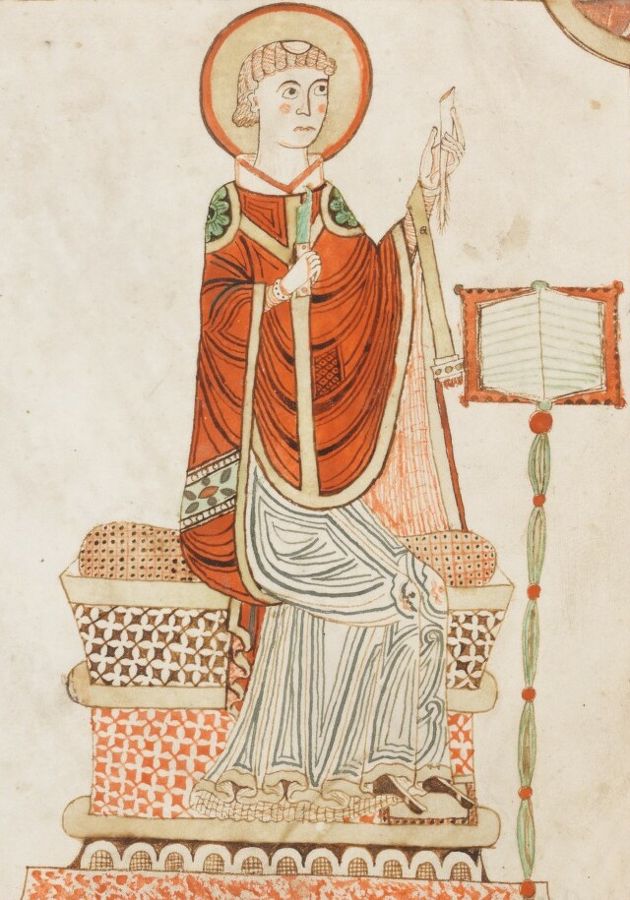
Image: E-codices bke-0047 001v medium (cropped).jpg · http://www.e-codices.unifr.ch/de/bke/0047/1v · Public domain, via Wikimedia Commons

From Sabine Baring-Gould, The Lives of the Saints, new edition in 16 vols. (London: John C. Nimmo, 1897–98); text from the Internet Archive scan (OCR, lightly cleaned; errors possible). Public domain.

Image: http://www.e-codices.unifr.ch/de/bke/0047/1v, Wikimedia Commons (Public domain)

From “Catholic Encyclopedia (1913)/Ven. Bede,” The Catholic Encyclopedia (New York: Robert Appleton Company, 1907–1914), via Wikisource. Public domain. Matched by name and feast date; text unedited except for our bracketed notes in grey.

From Sabine Baring-Gould, The Lives of the Saints, new edition in 16 vols. (London: John C. Nimmo, 1897–98); text from the Internet Archive scan (OCR, lightly cleaned; errors possible). Public domain in the United States. Reproduced unedited, except for short bracketed notes in grey that we added to explain names and terms (“S.” is the old abbreviation for Saint). Some history and judgments reflect 19th-century scholarship.