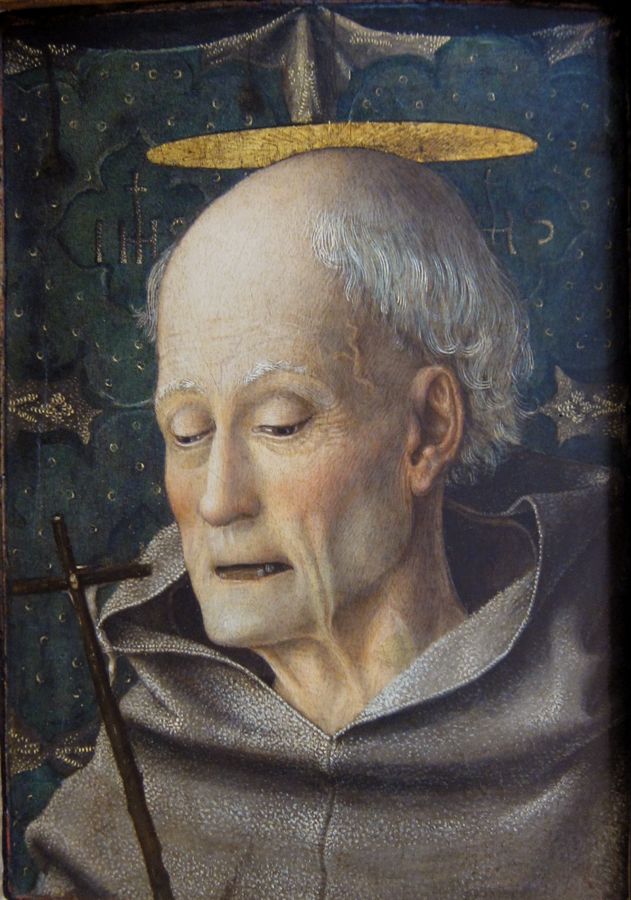
Friar Minor, missionary, and reformer, often called the "Apostle of Italy", b. of the noble family of Albizeschi at Massa, a Sienese town of which his father was then governor, 8 September, 1380; d. at Aquila in the Abruzzi, 20 May, 1444. Left an orphan at six Bernardine was brought up with great care by his pious aunts. His youth was blameless and engaging. In 1397 after a course of civil and canon law, he joined the Confraternity of Our Lady attached to the great hospital of Santa Maria della Scala. Three years later, when the pestilence revisited Siena, he came forth from the life of seclusion and prayer he had embraced, to minister to the plague-stricken, and, assisted by ten companions, took upon himself for four months entire charge of this hospital. Despite his youth Bernardine proved fully equal to this task, but the heroic and unremitting labour it involved so far shattered his health that he never completely recovered. Having distributed his patrimony in charity, Bernardine received the habit of the Friars Minor at San Francesco in Siena, 8 September, 1402, but soon withdrew to the Observantine convent of Columbaio outside the city. He was professed 8 September, 1403 and ordained 8 September, 1404. About 1406 S. Vincent Ferrer, while preaching at Alexandria in Piedmont, foretold that his mantle should descend upon one who was then listening to him, and said that he would return to France and Spain leaving to Bernardine the task of evangelizing the remaining peoples of Italy.
Nearly twelve years passed before this prediction was fulfilled. During this period, of which we have no details, Bernardine seems to have lived in retirement at Capriola. It was in 1417 that his gift of eloquence was made manifest and his missionary life really began at Milan at the close of that year. Thenceforth, various cities contended for the honour of hearing him, and he was often compelled to preach in the market places, his auditors sometimes numbering thirty thousand. Bernardine gradually gained an immense influence over the turbulent, luxurious Italian cities. Pius II, who as a youth had been a spellbound auditor of Bernardine, records that the saint was listened to as another Paul, and Vespasiano da Bisticci, a well-known Florentine biographer, says that by his sermons Bernardine "cleansed all Italy from sins of every kind in which she abounded". The penitents, we are told, flocked to confession "like ants", and in several cities the reforms urged by the saint were embodied in the laws under the name of Riformazioni di frate Bernardino. Indeed, the success which crowned Bernardine's labours to promote morality and regenerate society, can scarcely be exaggerated. He preached with apostolic freedom, openly censuring Visconti, Duke of Milan, and elsewhere fearlessly rebuking the evil in high places which undermined the Quattrocento. In each city he denounced the reining vice so effectively that bonfires were kindled and "vanities" were cast upon them by the cartload. Usury was one of the principal objects of the saint's attacks, and he did much to prepare the way for the establishment of the beneficial loan societies, known as Monti di Pietà. But Bernardine's watchward, like that of St. Francis, was "Peace". On foot he traversed the length and breadth of Italy peacemaking, and his eloquence was exercised with great effect towards reconciling the mutual hatred of Guelphs and Ghibellines. At Crema, as a result of his preaching, the political exiles were recalled and even reinstated in their confiscated possessions. Everywhere Bernardine persuaded the cities to take down the arms of their warring factions from the church and palace walls and to inscribe there, instead, the initials I. H. S. He thus gave a new impulse and a tangible form to the devotion to the Holy Name of Jesus which was ever a favourite topic with him and which he came to regard as a potent means of rekindling popular fervour. He used to hold a board in front of him while preaching, with the sacred monogram painted on it in the midst of rays and afterwards expose it for veneration. This custom he appears to have introduced at Volterra in 1424. At Bologna Bernardine induced a card-painter, who had been ruined by his sermons against gambling, to make a living by designing these tablets, and such was the desire to possess them that the man soon realized a small fortune.
In spite of his popularity — perhaps rather on account of it — Bernardine had to suffer both opposition and persecution. He was accused of heresy, the tablets he had used to promote devotion to the Holy Name being made the basis of a clever attack by the adherents of the Dominican, Manfred of Vercelli, whose false preaching about Antichrist Bernardine had combated. The saint was charged with having introduced a profane, new devotion which exposed the people to the danger of idolatry, and he was cited to appear before the pope. This was in 1427. Martin V received Bernardine coldly and forbade him to preach or exhibit his tablets until his conduct had been examined. The saint humbly submitted, his sermons and writings being handed over to a commission and a day set for his trial. The latter took place at St. Peter's in presence of the pope, 8 June, St. John Capistran having charge of the saint's defence. The malice and futility of the charges against Bernardine were so completely demonstrated that the pope not only justified and commended the saint's teaching, but urged him to preach in Rome. Martin V subsequently approved Bernardine's election as Bishop of Siena. The saint, however, declined this honour as well as the Sees of Ferrara and Urbino, offered to him in 1431 and 1435, respectively, saying playfully that all Italy was already his diocese. After the accession of Eugene IV Bernardine's enemies renewed their accusations against him, but the pope by a Bull, 7 January 1432, annulled their highhanded, secret proceedings and thus reduced the saint's calumniators to silence, nor does the question seem to have been reopened during the Council of Basle as some have asserted. The vindication of Bernardine's teaching was perpetuated by the feast of the Triumph of the Holy Name, conceded to the Friars Minor in 1530 and extended to the Universal Church in 1722.
Read the rest of the article
In 1433 Bernardine accompanied the Emperor Sigismund to Rome for the latter's coronation. Soon after he withdrew to Capriola to compose a series of sermons. He resumed his missionary labours in 1436, but was forced to abandon them in 1438 on his election as Vicar-General of the Observants throughout Italy. Bernardine had laboured strenuously to spread this branch of the Friars Minor from the outset of his religious life, but it is erroneous to style him its founder since the origin of the Observants may be traced back to the middle of the fourteenth century. Although not the immediate founder of this reform, Bernardine became to the Observants what St. Bernard was to the Cistercians [strict Benedictine reform begun at Cîteaux in 1098] their principal support and indefatigable propagator. Some idea of his zeal may be gathered from the fact that, instead of the one hundred and thirty Friars constituting the Observance in Italy at Bernardine's reception into the order, it counted over four thousand before his death. In addition to the number he received into the order, Bernardine himself founded, or reformed, at least three hundred convents of Friars. Not content with extending his religious family at home, Bernardine sent missionaries to different parts of the Orient and it was largely through his efforts that so many ambassadors from different schismatical nations attended the Council of Florence in which we find the saint addressing the assembled Fathers in Greek. Having in 1442 persuaded the pope to accept his resignation as vicar-general so that he might give himself more undividedly to preaching, Bernardine resumed his missionary labours. Although a Bull was issued by Eugene IV, 26 May, 1443, charging Bernardine to preach the indulgence for the Crusade against the Turks, there is no record of his having done so. There is, moreover, no good reason to believe that the saint ever preached outside Italy, and the missionary journey to Palestine mentioned by one of his early biographers may perhaps be traced to a confusion of names.
In 1444, notwithstanding his increasing infirmities, Bernardine, desirous that there should be no part of Italy which had not heard his voice, set out to evangelize the Kingdom of Naples. Being too weak to walk, he was compelled to ride an ass. But worn out by his laborious apostolate of forty years the saint was taken down with fever and reached Aquila in a dying state. There lying on the bare ground he passed away on Ascension eve, the 20th of May, just as the Friars in choir were chanting the anthem: Pater manifestavi nomen Tuum hominibus . . . ad Te venio. The magistrates refused to allow Bernardine's body to be removed to Siena, and after a funeral of unprecedented splendour laid it in the church of the Conventuals. Miracles multiplied after the saint's death, and he was canonized by Nicholas V, 24 May, 1450. On 17 May, 1472, Bernardine's body was solemnly translated to the new church of the Observants at Aquila, especially erected to receive it, and enclosed in a costly shrine presented by Louis XI of France. This church having been completely destroyed by earthquake in 1703, was replaced by another edifice where the precious relics [the bodily remains of a saint, or objects they used, kept with honor] of St. Bernardine are still venerated. His feast is celebrated on 20 May.
St. Bernardine is accounted the foremost Italian missionary of the fifteenth century, the greatest preacher of his day, the Apostle of the Holy Name, and the restorer of the Order of Friars Minor. He remains one of the most popular of Italian saints, more especially in his own Siena. With both painters and sculptors he has ever been a favourite figure. He frequently finds a place in della Robbia groups; perhaps the best series of pictures of his life is that by Pinturicchio at Ara Coeli in Rome, while the carved reliefs on the facade of the Oratory of Perugia, built in 1461 by the magistrates of that faction-rent city in gratitude for Bernardine's efforts for peace among them, are considered one of the loveliest productions of Renaissance art. But the best portrait of Bernardine is to be found in his own sermons and this is especially true of those in the vernacular. That we are able to enter so thoroughly into the spirit of these Prediche volgari is due to the pious industry of one Benedetto, a Sienese fuller, who took down word for word, with a style on wax tablets, a complete course of Bernardine's Lenten sermons delivered in 1427, and afterwards transcribed them on parchment. Benedetto's original manuscript is lost, but several very ancient copies of it are extant. All the forty-five sermons it comprises have been printed (Le Prediche Volgari Di Siena, 1880-88, 3 vols.). These sermons which often lasted three or four hours, throw much light on the fifteenth-century preaching and on the customs and manners of the time. Couched in the simplest and most popular language — for Bernardine everywhere adapted himself to the local dialect and parlance — they abound in illustrations, anecdotes, digressions, and asides. The saint often resorted to mimicry and was much given to making jokes. But his native Sienese gayety and characteristic Franciscan playfulness detracted nothing from the effect of his sermons, and his exhortations to the people to avert God's wrath by penance, are as powerful as his appeals for peace and charity are pathetic. Very different from these popular Italian sermons taken down della viva voce are the series of Latin sermons written by Bernardine, which are in fact formal dissertations with minute divisions and subdivisions, intended to elucidate his teaching and to serve rather as a guide to himself and others than for practical delivery. Besides these Latin sermons which reveal profound theological knowledge, Bernardine left a number of other writings which enjoy a high reputation — dissertations, essays, and letters on practical, ascetical, and mystical theology, and on religious discipline, including treatises on the Blessed Virgin and St. Joseph, used in the Breviary lessons, and a commentary on the Apocalypse. Bernardine's writings were first collected and published at Lyons in 1501. De la Haye's edition, "Sti. Bernardini Senensis Ordinis Seraphici Minorum Opera Omnia", issued at Paris and Lyons in 1536, was reprinted there in 1650, and at Venice in 1745. As a result of the petition addressed to the Holy See in 1882 by the General Chapter of the Friars Minor, requesting that St. Bernardine be declared a Doctor of the Church, a careful inquiry was instituted as to the authenticity of the works attributed to the saint. Some of these are certainly spurious and others are doubtful or interpolated, while not all the saint's genuine works are contained in the editions we possess. A complete and critical edition of St. Bernardine's writings is much needed. An excellent selection from his ascetical works was recently issued by Cardinal Vives (Sti. Bernardini Senensis de Dominicâ Passione, Resurrectione et SS. Nomine Jesu Contemplationes, Rome, 1903).
We are fortunate in possessing several detailed lives of St. Bernardine written by his contemporaries. Three of these are given in full bin the Acta Sanctorum [the Bollandists’ huge collection of saints’ lives] Maji, V, with Comm. Praev. by Henschen. The earliest by Bernabaeus Senensis, an eyewitness of much he records, was compiled in 1445 shortly after the saint's death. The second by the celebrated humanist, Maphaeus Vegius, who knew the saint personally, was printed in 1453. The third by Fra Ludovicus Vincentinus of Aquila was issued after the translation [the solemn moving of a saint’s relics to a new shrine] of the saint's body in 1472. A fourth contemporary biography by a Friar Minor, hitherto unedited, has lately been printed both by Father Van Ortroy, S.J., in the Anal. Bolland. (XXV, 1906, pp. 304-389) and by Father Ferdinand M. d'Ardules, O.F.M. (Rome, 1906). The life of St. Bernardine written in Italian by his name Bl. Bernardine of Fossa (d. 1503), and mentioned by Sbaralea and others does not appear to have come down to us. But the latter's "Chronica Fratrum Minorum Observantiae", edited by Lemmens (Rome, 1902), contains several important references. A valuable account of Bernardine's youth is furnished by Leonardus (Benvoglienti) Senensis, Sienese ambassador to the pope. This work which was edited by Father Van Ortroy in Anal. Bolland., XXI (1902), 53-80, was compiled in 1446 at the instance of St. John Capistran. The "Life" of St. Bernardine attributed to St. John himself, and the one transcribed by Surius in his "Vita SS." (1618), V, 267-281, as well as the tributes to Bernardine of Pius II and St. Antoninus [Antoninus Pius, Roman emperor 138–161] and the acts of his canonization are found in vol. I of de la Haye's edition of Bernardine's works.
Wadding, Annales, XII, ad ann. 1450, n. I and Scriptores (1650), 57-58; Sbaralea, Supplementum (1806), 131-134, 725; Amadio Luzzo, Vita di S. Bernardino (Venice, 1744; Rome, 1826; Siena, 1854; Monza, 1873); Berthaumier, Hist. De S. Bernardin (Paris, 1862); Toussaint, Das Leben des H. Bernardin von Siena (Ratisbon [Regensburg in Bavaria], 1873); Life of St. Bernardine of Siena (London, 1873); Leo de Clary, Lives of the Saints of the Three Orders of St. Francis (Taunton, 1886), II, 220-275; Leon, Vie de St. Bernardin (Vanves, 1893); Alessio, Storia di S. Bernardino e del suo tempo (Mondovi, 1899); Ronzoni, L'Eloquenza di S. Bernardino (Siena, 1899). Undoubtedly the best modern life of St. Bernardine is that by Paul Thureau-Dangin of the French Academy: Un predicateur populaire dans l'Italie de la Renaissance: S. Bernardin de Siene (Paris, 1896). This brilliant monograph has been translated into Italian (1897), German (1904), and English (1906).