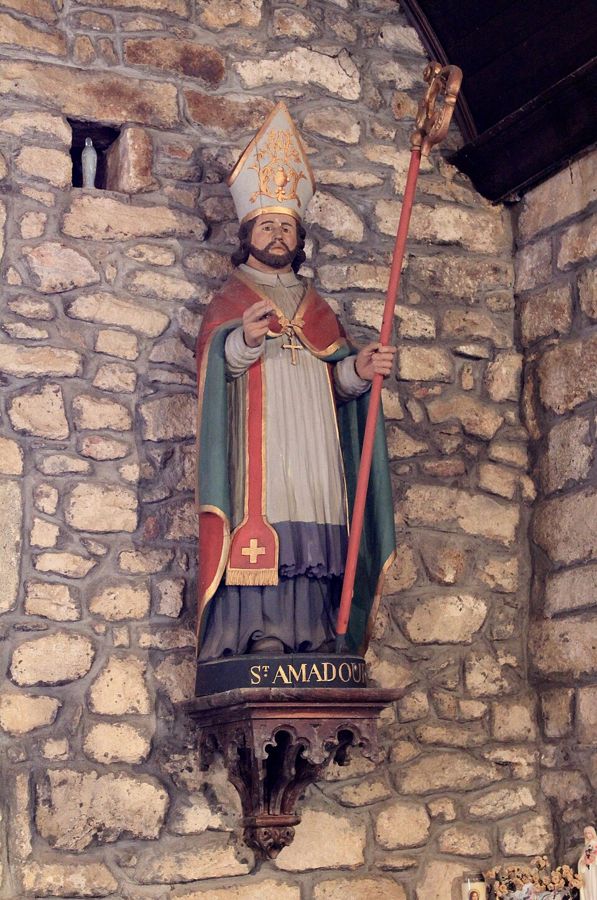
B

A shepherd who stayed with his people through hard times.

Read the essentials →
May 1 · Bishop

St. Brioch

St. Brioch

A shepherd who stayed with his people through hard times.

Traditional feast

May 1
1914 / pre-1969 calendar, per Baring-Gould (1897)

Current feast

Not verified yet

Represents

Bishop

Their story

Adapted in modern English from the Catholic Encyclopedia (1913) · original text below

Brioch (Brieuc) was a Celtic saint of Brittany, educated in Ireland and then under St Germanus. The Catholic Encyclopedia says much of what is told about his early years must be taken with caution.

He returned to France early in 431 and later settled in Armorica, where he founded a monastery. He then went to Upper Brittany and built an oratory at the place since called St Brieuc-des-Vaux, becoming its first bishop. His Acts (the written account of a martyr's trial and death) tell of many miracles, among them the cure of Count Riguel, who gave him his own palace and estates.

He probably died in 502 or early in the sixth century, in his monastery, and was buried in his cathedral. Churches in England, Ireland and Scotland are dedicated to him.

Early life

The book says little or nothing about early life. This is how the account begins.

Thin entry · the 1897 book gives only 186 words. We have not filled the gap with invented detail.

Germain of Paris, or of some other saint of the same name, is unknown, He preached in Brittany, where his knowledge of the Keltic tongue made him useful as an apostle. At Tr^guier he converted a chief named Conan, who gave him lands at Landebaeron whereon to found a monastery. He afterwards went Eastward, and was well received by the chief Rignal, who lived near the mouth of the river Gonet, and who gave him a site, whereon he built a monastery, called S. Brieuc-des-Vaux, because it is at the junction of several valleys.

What they represent

How they teach us to live

Drawn from themes in the original account

Share your faith, in words and by example. Preaching and conversion are central here.

Build up the community you belong to. This life was lived with and for a community.

Make time for silence. Solitude and withdrawal to pray shape this life.

Learn from the kind of life it was. A shepherd who stayed with his people through hard times.

From the Catholic Encyclopedia

1913 · 420 words

A Celtic saint of Brittany who received his education in Ireland and then studied under St. Germanus said to be the famous St. Germanus of Auxerre. Much of what we read concerning his early years must be received with caution; indeed, Ussher asserts that he was of Irish birth, but it is tolerably certain that he returned to France early in 431, bringing with him St Iltud. Even before his ordination to the priesthood, St. Brieuc worked several miracles duly chronicled in his "Acts" (edited by F. Godefrid Herschenn), and after a short period spent with his parents, he entered on his missionary career. In 480, he settled in Armorica [Brittany in north-west France], and founded a monastery at Landebaeron. Thence he proceeded to Upper Brittany where he established an oratory at a place ever since known as St. Brieuc-des-Vaux, between St. Malo and Land Triguier, of which he was named first bishop. Numerous miracles are cited in the "Acts", especially his cure of Count Riguel, who gave the saint his own Palace of Champ-du-Rouvre as also the whole manorial estates. Authorities differ as to date of St. Brieuc's death, but it was probably in 502, or in the early years of the sixth century. He died in his own monastery at St. Brieuc-des-Vaux and was interred in his cathedral church, dedicated to St. Stephen. Baring-Gould says that St. Brieuc is represented as "treading on a dragon", or else "with a column of fire" as seen at his ordination. His relics [the bodily remains of a saint, or objects they used, kept with honor] were translated to the Church of SS. Sergius and Bacchus of Angers in 865, and again, in a more solemn manner, on 31 July, 1166. However, in 1210, a portion of the relics was restored to St. Brieuc Cathedral, where the saint's ring is also preserved. The festival of St. Brieuc is celebrated on 1st May, but, since 1804, the feast is transferred to the second Sunday after Easter. Churches in England, Ireland, and Scotland are dedicated to this early Celtic saint.

Acta SS. (1 May), I; BUTLER, Lives of the Saints (1 May); LOBINEAU, Vies des Saints de Bretagne, TRESVAUD ed. (1836); BARING-GOULD, Lives of the Saints (1 May), V; BAILLET, Vies des Saints; LE BARD, Histoire de Bretagne; CRESSY, Church History of Brittany; LE GRAND, De Vitis Sanctorum Britanniœ Armoricæ; O'HANLON, Lives of the Irish Saints (1 May), V; LELAND, Itinerary, III; GODESCARD, Les Vies des Pères et des Martyrs (1 May); Tractarian Lives of the English Saints, IX; LANIGAN, Ecclesiastical History of Ireland, I; PALLISER, Brittany and its Byways (1869).
Read more

The full original · 186 words

Read Baring-Gould’s full account

Baring-Gould’s sources: Venerated as patron at S. Brieux, in Brittany. Feast of the translation of his relics, Oct. i8tb. His life in the proper lections for his festival in the Church of S. Brieux is of little historical value.] The life of S. Brioch, as it has come to us, is singularly deficient in interest. Like so many similar compositions drawn up long subsequent to the event, it contains scarcely a feature of interest, and few of the statements can be relied on as historically correct All we are justified in concluding from the “life” is that he was a Briton, bom probably in Cardigan. He is said to have become a disciple of S. Germain, but whether of S. Germain of Auxerre, or S. May i.] S. Kellach.

Germain of Paris, or of some other saint of the same name, is unknown, He preached in Brittany, where his knowledge of the Keltic tongue made him useful as an apostle. At Tr^guier he converted a chief named Conan, who gave him lands at Landebaeron whereon to found a monastery. He afterwards went Eastward, and was well received by the chief Rignal, who lived near the mouth of the river Gonet, and who gave him a site, whereon he built a monastery, called S. Brieuc-des-Vaux, because it is at the junction of several valleys. For himself he established a hermitage near a spring, now called Notre-Dame-de-laFontaine. The church of his monastery was afterwards converted into a cathedral. A portion of his relics [the bodily remains of a saint, or objects they used, kept with honor] are preserved at S. Brieux, a small portion also in the church of Benoit-sur-Loire. The festival of S. Brioch is celebrated in the diocese of S. Brieux on the second Sunday after Easter.

His name has undergone various transformations, as Briocus, Briomaclus, Vriomoclus. He is represented treading on a dragon, or with a column of fire, which, according to tradition, designated him for ordination.

Feast days

Feast: May 1

Nine days · Free

Pray the novena
with us.

One short email a day for nine days. The day's prayer, a line from St. Brioch's story, and a nudge to keep going.

Also on May 1
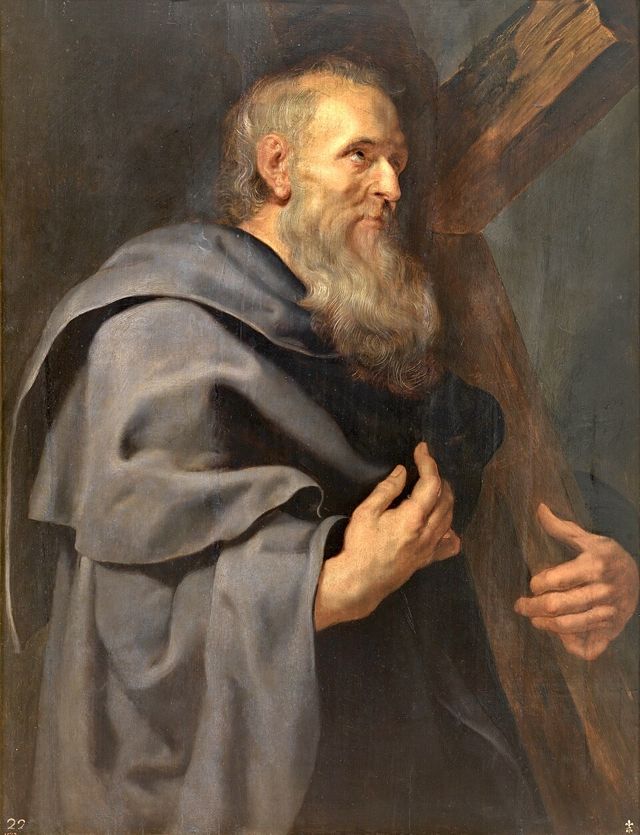
St. Philip

St. Philip

May 1 · Apostle, Martyr
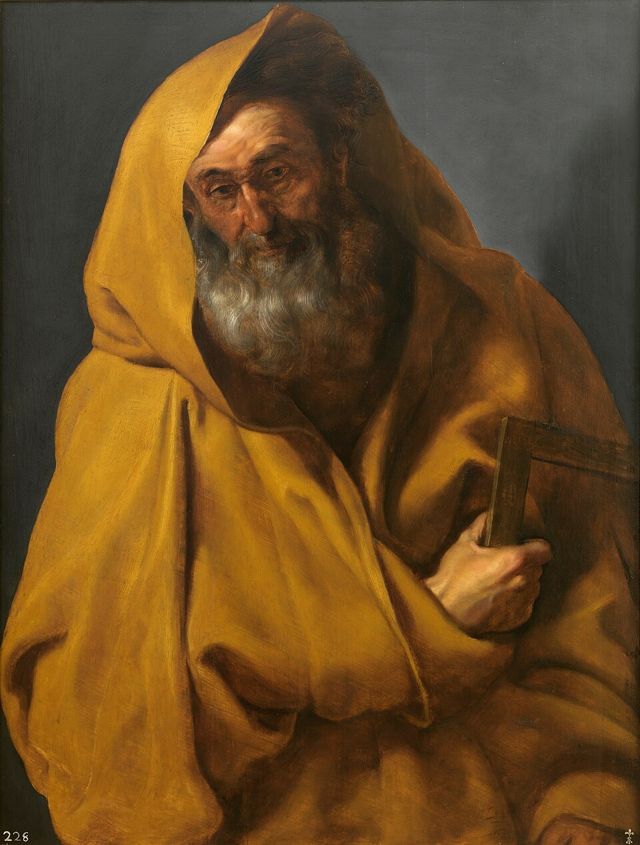
St. James the Less

St. James the Less

May 1 · Apostle
St. Amator of Auxerre

St. Amator of Auxerre

May 1 · Bishop
← All 1726 saints in the library
Sources & notes

Feast-day sources

Story sources

Sources

Credits

From Sabine Baring-Gould, The Lives of the Saints, new edition in 16 vols. (London: John C. Nimmo, 1897–98); text from the Internet Archive scan (OCR, lightly cleaned; errors possible). Public domain.

From “Catholic Encyclopedia (1913)/St. Brieuc,” The Catholic Encyclopedia (New York: Robert Appleton Company, 1907–1914), via Wikisource. Public domain. Matched by name and feast date; text unedited except for our bracketed notes in grey.

From Sabine Baring-Gould, The Lives of the Saints, new edition in 16 vols. (London: John C. Nimmo, 1897–98); text from the Internet Archive scan (OCR, lightly cleaned; errors possible). Public domain in the United States. Reproduced unedited, except for short bracketed notes in grey that we added to explain names and terms (“S.” is the old abbreviation for Saint). Some history and judgments reflect 19th-century scholarship.