Baring-Gould’s sources: English Martyrologies. His life is given by Bede, in his Ecclesiastical History, lib. 3, caps. 21, 22, 23.
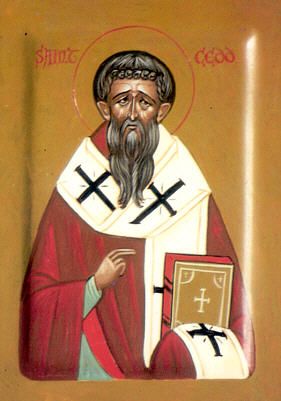
Peada, son of Penda, King of Mercia [the Anglo-Saxon kingdom of the English Midlands], being appointed by his father King of the Midland English, by which name Bede [English monk and historian (d. 735)] distinguished the inhabitants of Leicestershire, and part of Lincolnshire and Derbyshire, from the rest of the Mercians; the young king visited Oswy, King of Northumbria [the Anglo-Saxon kingdom of northern England and south-east Scotland], at Atwell, or Walton, was baptized along with several of his nobles, by Bishop Finan, and was provided by Oswy with two priests to instruct his people in Christianity. One of these was S. Cedd, who had been trained in the monastery of Lindisfarne. "When these two," says Bede, "travelling to all parts of that country, had gathered a numerous church to the Lord, it happened that Cedd returned home, and came to the church of Lindisfarne to confer with Bishop Finan; who, finding how successful he had been in the work of the Gospel, made him Bishop of the Church of the East Saxons, calling to him two other bishops, to assist at the ordination. Cedd, having received the episcopal dignity, returned to his province, and pursuing the work he had begun, with more ample authority, built churches in several places, ordaining priests and deacons to assist him in the work of faith, and the ministry of baptizing, especially in the city which, in the language of the Saxons, is called Ithancester, [31] as also in that named Tilabury (Tilbury); the first of which places is on the bank of the Pante, the other on the bank of the Thames; where, gathering a flock of servants of Christ, he taught them to observe the discipline of regular life, as far as those rude people were then capable.
"Whilst the doctrine of everlasting life was thus, for a considerable time, making progress, to the joy of the King and of all the people, it happened that the King, at the instigation of the enemy of all good men, was murdered by his own kindred. The same man of God, whilst he was bishop among the East Saxons, was wont also to visit, at intervals, his own country, Northumberland, to make exhortations. Ethelwald, the son of King Oswald, who reigned over the Deiri, finding him a holy, wise, and good man, desired him to accept some land to build a monastery, to which the King himself might frequently resort, to offer his prayers and hear the word, and be buried in it when he died; for he believed that he should receive much benefit by the prayers of those who were to serve God in that place. The King had before with him a brother of the same bishop, called Celin, a man no less devoted to God; who, being a priest, was wont to administer to him the word and the Sacraments, by whose means he chiefly came to know and love the bishop.
"That prelate, therefore, complying with the King's desires, chose himself a place to build a monastery among craggy and distant mountains, which looked more like lurking places for robbers, and retreats for wild beasts, than habitations for men. The man of God, desiring first to cleanse the place for the monastery from former crimes, by prayer and fasting, that it might become acceptable to our Lord, and so to lay the foundations, requested the King to give him leave to reside there all the approaching Lent [the forty days of fasting before Easter], to pray. All which time, except Sundays, he fasted till the evening, according to custom, and then took no other sustenance than a little bread, one egg, and a little milk mixed with water. This, he said, was the custom of those of whom he had learnt the rule of regular discipline; first, to consecrate to our Lord, by prayer and fasting, the places which they had newly received for building a monastery or a church. When there were ten days of Lent still remaining, there came a messenger to call him to the King; and he, that the religious work might not be intermitted, on account of the King's affairs, entreated his priest, Cynebil, who was also his own brother, to complete that which had been so piously begun. Cynebil readily complied, and when the time of fasting and prayer was over, he there built the monastery, which is now called Lestingan, [32] and established therein the religious customs of Lindisfarne."
At this time, owing to the influence of S. Wilfrid [bishop of York (d. 709)], who had been established at Ripon by Alchfrid, son of King Oswy, a great split was forming in the Church, which made itself felt even in the Royal family. All the missionaries of the north had been brought up in Iona, or Lindisfarne, and followed the Keltic ritual; Wilfrid, ordained by a French bishop, introduced Roman ways. Oswy had been baptized and educated by Keltic monks, and followed the usages of the Mother Church of Iona; but his wife, Eanfleda, had learned in exile Roman ways, and she brought with her to the court of Oswy a Canterbury priest—Romanus by name, and Roman in heart—who guided her religious exercises. Two Easter feasts were thus celebrated every year in the same house; and as the Saxon kings had transferred to the chief festivals of the Christian year, and especially to the Queen of Feasts, the meeting of assemblies, and the occasion which those assemblies gave them of displaying all their pomp, it is easy to understand how painful it must have been for Oswy to sit, with his earls and thanes, at the great feast of Easter, at the end of a wearisome Lent, and to see the Queen, with her maids of honour and her servants, persisting in fasting and penance, it being with her still only Palm Sunday. [33] To settle this difference, and prevent a rupture, the King convoked a parliament at Whitby, in 664. In this parliament Colman, Bishop of Lindisfarne, Cedd, Bishop of the East Saxons, who had at this time re-established the episcopal see of London [a bishop’s “see” is his diocese, named from his seat (Latin sedes)], and S. Hilda, the great abbess of Whitby, upheld the Keltic rite. On the other side were S. Wilfrid, the young Prince Alchfrid, and James, the deacon of York. In this parliament, it was decided that the Roman usages should be adopted, and Cedd renounced the customs of Lindisfarne, in which he had been educated, and returned to his diocese of London to spread the Roman usages there.
"Cedd," says Bede, "for many years had charge of his bishopric and of the monastery of Lastingham, over which he had placed superiors. It happened that he came there at the time that a plague was raging, and he fell sick and died. He was first buried in the open air, but in process of time, a church of stone was built in the monastery, in honour of the Mother of God, and his body was interred in the same, on the right hand of the altar."
The Bishop left the monastery to be governed after him by his brother Chad, who was afterwards made bishop. For the four brothers, Cedd, and Cynebil, Celin, and Ceadda (Chad)—which is a rare thing to be met with—were all celebrated priests of our Lord, and two of them also came to be bishops.