Baring-Gould’s sources: Canonized by Alexander IV. in 1255. Authority Her life, written shortly after her death by order of Alexander IV., and other notices in Wadding's Annals of the Minorites, and in the Acta Sanctorum.] The illustrious Clara, who shines in the constellations of the saints beside S. Francis of Assisi as does S. Scholastica beside S. Benedict, S. Paula beside S. Jerome, and S. Jeanne Chantal beside S. Francis de Sales, was born in 1194 at Assisi, of noble parents, Favorino Sceffi and Hortulana de Fiumi. To this day the crumbling walls of their castle of Sasso- Rosso on the southern slope of Monte Subasio may be seen by the curious traveller bent on exploring the quaint old town and its scarcely less interesting environs. The family of Fiumi still survives in Assisi, and the arms of the Sceffi and the Fiumi may be seen decorating the ancient doorways of houses in Assisi, once noble mansions, now the residence of poor contadini.
Clara had two sisters, Agnes and Beatrice, to whom she was tenderly attached, and who eventually followed her to the convent.
The wonderful influence of the great Francis, his voice, his example, his enthusiasm, thrilled the heart of the young girl, and filled her with that vehemence of love, that passion of devotion, which nothing could quench in after years. She sought an interview with the patriarch [the title of the bishops of the great ancient sees: Rome, Constantinople, Alexandria, Antioch, Jerusalem] of the Mendicants in his little convent of the Portiuncula, poured out into his ear her desires, and received from him a cheering assurance that he would accept the sacrifice of her life.
She was eighteen: modest, retiring, hating the world and the dissipation of society; delighting in the privacy of her little room and the company of her sisters. On Palm Sunday, a.d. 1212, she was in the Cathedral Church of Assisi with her parents. After the palms had been blessed, the congregation filed past the altar, where the bishop distributed the palms. The girl Clara shrank from pressing forward with the rest to the sanctuary, and remained in her place. The bishop’s eye rested on her; she was without a palm, standing back in bashfulness. Suddenly he stepped down into the nave, the acolytes bearing their tapers before him, wondering at his movements, and uncertain whither they were directed. Bearing a palm branch he advanced to Clara, and placed the bough in her hands. To her it was as a consecration. In the evening she hasted to the Portiuncula. She was in her rich dress, beseeming her rank, adorned with necklace and brooches. She entered the convent chapel. Francis and his greyhabited brethren, barefoot, holding lighted tapers, stood in the choir in ranks. She fell on her knees and implored them to receive her. In a paroxysm of devotion she tore off her jewels, divested herself of her silk brocade and velvets, and bowed her head to the shears to have her long dark hair cut off. A coarse grey habit was hastily flung over her, and trembling with joy and surprise, she found herself enrolled in the ranks of the champions of Poverty. It was impossible for S. Francis to lodge his ardent novice within the walls of the Portiuncula, destined solely for men. He therefore conducted her to the Benedictine [monks following the Rule of St. Benedict] nunnery of S. Paolo, where she might remain till the designs of God towards her were made more clear.
When the parents and relations of Clara heard what she had done, they were angry, vexed, some were amused. It was a girlish freak, a momentary ebullition of religious excitement; they sought her in her refuge, and endeavoured to persuade her to return. She steadfastly refused. Her resolution irritated, exasperated them. They tried to tear her away. She clasped the altar cloth, it was half dragged off in the struggle. Finding her obstinate, they withdrew, supposing that a few days of fasting and lying on a hard couch would alter her determination. They were greatly mistaken, it served to confirm Clara in her love of a cloistered life. From S. Paolo she removed, by the advice of S. Francis, to the Benedictine nunnery of S. Angelo de Panfo, outside the town.
The thoughts of her favourite sister and companion Agnes filled her mind. She craved for her society, she trembled for the salvation of little Agnes, left without her protecting care in the world. She therefore prostrated herself before the aJtar, and besought the Lord to give her Agnes as a companion in the cloister as she had been a companion in her father’s house. A fortnight after the reception of Clara, Agnes secretly left home, ran to the convent, and threw herself into her sister’s arms, begging to be allowed to remain for ever by her.
The parents of the two girls were exceedingly incensed at the flight of their youngest daughter, who was quite a child, and who was passionately loved by them. They went to the convent to reclaim her. They carried her off, but Agnes by her struggles, and by opposing her dead weight to their efforts, tired them out; Clara rushed to the rescue, caught up the child, when the parents had relaxed their hold on her for a moment, and ran with her back to the convent. Soon after this the church of S. Damiano was given to the two sisters by S. Francis, who had repaired it for use, and therewith the foundation of an order of religious women in connexion with the society of the Minorites was begun; Many girls and women, moved by the exhortations of the Franciscans, placed themselves under the sheltering walls of S. Damiano. Beatrice soon followed her sisters, and Hortulana, the mother, on the death of her husband, sought a S. Clara.
refuge from the world in the cloister with her daughters. Clara was appointed abbess by S. Francis, and she ruled the community with love and care. She was fully inspired with the same enthusiastic devotion to poverty that animated the great patriarch. She would not allow her daughters to possess anything as their own, she would not allow the Society to have any possession, — the begging friars must feed them with the crusts and crumbs they extorted from the charitable every day.
From Innocent III. she obtained sanction for this privilege of poverty, of living solely on the alms of the beneficent; and the order has ever since borne the title of the “ Poor Clares.” Gregory IX. thought the rule unreasonable, and offered to relax it, but Clara protested that it was not irksome, and entreated that it might be maintained in its full rigour.
Gregory IX., perhaps moved by malicious gossip, sent peremptory orders that the friars were not to go in and out of the convent of the Poor Clares, under the excuse that they were ministering to them the Word of God. He would not have them set their foot within, unless with his express and formal sanction. “ Very well,” said Clara; “if the holy friars may not feed us with the bread of life, they shall not minister to us the bread that perishes and she refused the crusts and broken meat they had collected in their rounds. What was to be done ? The whole convent would starve; in a few days the Poor Clares would be dead. An express was sent to the Pope. - Gregory could defy an emperor, and that such an emperor as Barbarossa, but not a woman. He held his ground dauntlessly against Frederick II., but he yielded at once to the opposition of S. Clara.
Clara is said to have practised mortifications to such an extent that the Pope and S. Francis combined to insist on her moderating her passion for self-torture. The life of the sisters was one long dreary penance; even their sacred services were unrelieved by music; they were to be read at Easter, as in the dolorous season of the Passion. Those who could not read were not suffered to learn to read. To acquire death to the world by habits of devotion was to be their sole occupation and delight.
In r243 Innocent IV. became Pope, and hopes were entertained that some reconciliation might be effected between the Holy See and the German Empire, which might mitigate the miseries of Italy. But such hopes were speedily frustrated, and the war continued as before. In the Council of Lyons, r 245, the Pope deposed and excommunicated the Emperor. “ The sentence of God must precede our sentence: we declare Frederick excommunicated of God, and deposed from all the dignity of the empire, and from the kingdom of Naples. We add our sentence to that of God; we excommunicate Frederick, and depose him from all the dignity of the Empire, and from the kingdom of Naples.” The Emperor’s subjects in both realms were declared absolved from all their oaths and allegiance, and the princes of Germany were ordered to proceed at once to the election of a new Emperor. The kingdom of Naples was reserved to be disposed of by the Pope and the cardinals. The council sat panic-stricken; the imperial ambassadors uttered loud groans and beat their breasts in sorrow; as well they might — the sentence meant general revolt throughout Germany and Italy, bloodshed, and fire, and ruin. Frederick received the report of his dethronement at Turin. “The Pope has deprived me of my crown ! Whence this presumption, this audacity ? Bring hither my treasure chests.” He opened them. “ Not one of my crowns but is here.” He took one out, placed it 6'. Clara.
on his head, and with a terrible voice, his heart bursting with wrath, exclaimed, “ I hold my crown of God; the Pope, the council, the devil himself shall not wrench it from The dogs of war were unslipped. Italy became a prey to the adverse factions of Guelph and Ghibelline. War swept the peninsula from north to south; sometimes the Papal forces were successful, more often those of the Emperor.
In 1249 the German troops defeated those of the Pope under Cardinal Capoccio in a bloody battle. The standard of the keys had to fly before that of the eagle. The ravages committed in Central Italy were fearful. The men ot Foligno and the German soldiery destroyed Nocera, sparing only its lofty castle. The clergy fled, leaving their books and sacred vessels to the pillagers, who quartered themselves and their horses in the cathedral. A convent near Fermo was ransacked, plundered, its mills burnt, its bells, doors, bedding, live stock, even down to the beehives, carried off. Umbria became the prey of the freebooters who followed the imperial captains. Assisi was assailed by the Saracens [medieval Christian name for Arab and Muslim peoples] acting as mercenaries in the army of the Emperor. The nunnnery of San Damiano was surrounded. S. Clara lay on a bed of sickness; she was roused by the cries of the sisterhood. She caused herself to be borne to the point of danger, preceded by the Host. She flung herself before her Lord. “ My God ! suffer not these feeble ones to fall a prey to barbarians without pity ! I cannot protect them. I place them in thy hands.’' She thought she heard an answer, “ I will preserve them.” “ Lord !” she entreated further, “have mercy on this city, which has sustained us with its alms.” Again the answer was borne in upon her soul, “ It shall not suffer. Be of good courage 1” A sudden panic fell on the Saracens. They had already climbed the walls; they jumped down outside, withdrew their ladders, and deserted Assisi, leaving it unhurt. Not long afterwards Vitale of Aversa, captain of the imperial troops, cut down the trees around Assisi, and swore that he would not stir till he had taken the holy city. But S. Clara placed ashes on the heads of her nuns, and sent them all to their knees. On the next night the besiegers were scattered, and their leader’s death soon followed.
After forty-two years of the religious life, S. Clara fell sick, and prepared to die. Innocent IV. was on his way from Lyons to Perugia with his college of cardinals. He heard of the illness of the holy abbess, and hasted to Assisi to give her his apostolic benediction before her departure. As she died, she was heard murmuring that she saw Our Lord surrounded with virgins crowned with flowers, and that one, whose flowing wreath was arched above “ like a windowed censer,” bowed over her and kissed her.
She died on the nth August, 1257, but her festival is observed on the 12th, the day of her burial. Her body was buried in the church of S. George. In r8so her sepulchre was opened, and her sacred relics [the bodily remains of a saint, or objects they used, kept with honor] translated to a shrine. Some of the ribs of the left side were given to the Pope.
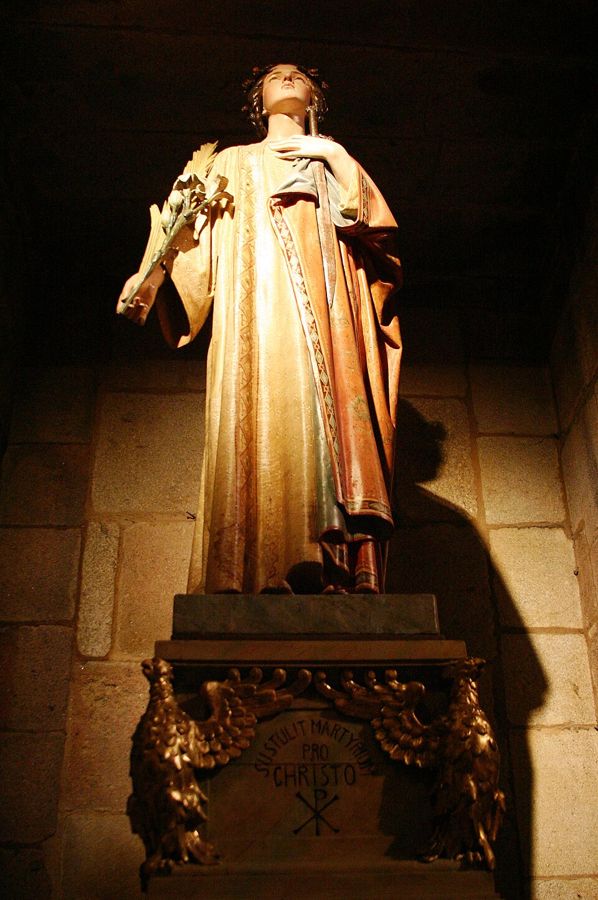
/ S. Clara is usually represented kneeling in ecstasy before the Host, sometimes standing with a lily in one hand and a book, her testament left to her nuns, in the other. ft- ft SS. Hippolytus and Concordia.