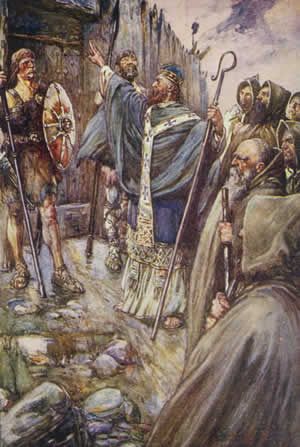
Baring-Gould’s sources: Roman Martyrology, Usuardus, Notker, Sarura, and York Kalendars, Donegal and Tallagbt Martyrologies, Cashel Kalendar and Aberdeen Breviary. The translation of S. Columba on the 17th June. Authorities: —Mention by Bede, lib. v., c. 10, a life by Adamnan, abbot of Iona. Bom only a quarter of a century later, he had seen in his childhood the actual companions of Columba, and those who had received his last breath. A still earlier narrative, written by Comyn the Fair, abbot of Iona, and reproduced almost word for word by Adamnan, forms the basis of his work, which he has completed by a multitude of anecdotes and testi monies collected with scrupulous care, and which altogether, though unfortunately without chronological order, forms one of the most living, attractive, and authentic relics of Christian history. This biography by Adamnan was written between 690 and 703; Comyn the Fair was abbot from 657 to 669. There is also a history of the saint in Irish by Magnus O’Donnell, put together in 1532, incorporating some important Irish traditions and historical details. The following life is condensed from that by M. de Moutalembert in his "Monks of the West.'’] S. Columba was a scion of one of the great royal families of Ireland. His father was descended from one of the eight sons of the great King Niall of the Nine Hostages, who was supreme monarch of all Ireland from 379 to 405, at the period when S. Patrick was brought to the island as a slave. Consequently he sprang from a race which had reigned in Ireland for six centuries; and in virtue of the ordinary law of succession, might himself have been called to the throne. His mother belonged to the reigning family in Leinster, one of the four subordinate kingdoms of the island. He was bora at Gartan, in one of the wildest districts of Donegal, where the stone upon which his mother lay at the moment of his birth is still shown. Before his birth, his mother had a dream, which posterity has accepted as a graceful and poetical symbol of her son's career. An angel appeared to her, bringing her a veil covered with flowers of wonderful beauty and variety June 9-] 6' Columba.
…of colour. Immediately she saw the veil carried away by the wind, and rolling out as it fled over plains, woods, and mountains; then the angel said to her, “ Thou are about to become the mother of a son, who shall blossom for heaven, who shall be reckoned among the prophets of God, and who shall lead numberless souls to the heavenly country.”
He was educated by a priest who had baptized him. From the house of this priest, Columba passed into the great monastic schools, which were not only the nursery for the clergy of the Irish Church, but where also young laymen of all conditions were educated. Columba, like many others, there learned to make his first steps in that monastic life to which he had been drawn by the call of God. He devoted himself not only to study and prayer, but also to the manual toil then inseparable, in Ireland and elsewhere, from a religious profession. Like all his young companions, he had to grind over-night the com for the next da/s food; but when his turn came, it was so well and quickly done, that his companions suspected him of having been assisted by an angel. The royal birth of Columba procured him several distinctions in the schools which were not always to the satisfaction of his comrades. One of the latter, named Kieran, who was also destined to fill a great place in Irish legend, became indignant at the ascendancy of Columba; but while the two students disputed, the abbot entered, and placing before Kieran an auger, a plane, and an axe, said, “Look at these tools, and recollect that these are all thou hast sacrificed for God, since thy father was a carpenter; but Columba has given up the sceptre of Ireland, which might have been his by right of birth.”
We learn from authentic documents that Columba completed his monastic life under the holy abbots, both bearing the name of Finnian. The first Finnian of Clonard, who was also a bishop, ordained him deacon, but seems to have had him under his authority for a shorter time than the second Finnian.
It is easy to perceive, by the importance of the monastic establishments which Columba had brought into being even before he had attained the age of manhood, that his influence must have been as precocious as it was considerable. Apart from the virtues of which his after life afforded so many examples, it may be supposed that his royal birth gave him an irresistible ascendancy in a country where, since the introduction of Christianity, all the early saints, like the principal abbots, belonged to reigning families, and where the influence of blood and the worship of genealogy continue, even to this day, to a degree unknown in other lands. Springing, as has been said, from the same race as the monarch of all Ireland, and consequently himself eligible for the same high office, he was also related by ties of blood to almost all the provincial kings.
Before he had reached the age of twenty-five he had presided over the creation of a crowd of monasteries. As many as thirty-seven in Ireland alone recognised him as their founder. The most ancient and important of these foundations were situated, as was formerly that of S. Bridget at Kildare, in vast oak forests, from which they took their name. The first Durrow f Dair-mach ), where a cross and bell bearing the name of Columba are still to be seen, was erected in the central regions. The other Derry (Doirc-cha/gauh) is situated in the northern part of the island, in Columba's native province, in the hollow of a bay of that sea which separates Ireland from Scotland.
The young Columba was specially attached to Derry, S. Columba [Irish abbot of Iona (d. 597), apostle of Scotland]. where he habitually lived. He superintended with care not only the discipline and studies of his community, but external matters, even so far as to watch over the preservation of the neighbouring forest He would never permit an oak to be cut down. Those which fell by natural decay, or were struck down by the wind, were alone made use of for the fire which was lighted on the arrival of strangers, or distributed to the neighbouring poor. The poor had a first right in Ireland as everywhere else, to the goods of the monks; and the monastery of Derry fed a hundred applicants every day with methodical regularity. At a more advanced age our saint gave vent to his tenderness for his monastic creations in songs, an echo of which has come down to us. The text of these songs, such as has been preserved, is probably later than Columba; but it is written in the oldest Irish dialect, and it expresses, naturally enough, the sentiments of the founder and his disciples: — “ Were all the tribute of Scotia mine.
From its midland to its borders; 1 would give all for one little cell In my beautiful Derry. For its peace and for its purity, For the white angels that go In crowds from one end to the other, I love my beautiful Derry.
For its quietness and its purity, For heaven's angels that come and go Under every leaf of the oaks, I love my beautiful Derry.
My Derry, my fair oak grove, My dear little cell and dwelling; Oh God, in the heavens above I Let him who profanes it be cursed.
Beloved are.Durrow and Derry, Beloved is Raphoe the pure, Beloved the fertile Drumhome, Beloved are Swords and Kells I But sweeter and fairer to roe, The salt sea where the sea-gulls cry, When I come to Derry from far, It is sweeter and dearer to me— Sweeter to me."
The monk Columba was then a poet He opens the series of two hundred Irish poets, whose memories and names, in default of their works, have remained dear to Ireland. He wrote his verses not only in Latin, but also, aud more frequendy, in Irish. Only three of his Latin poems survive; but two centuries ago eleven of his Irish poems were still in existence, which have not all perished, and the most authentic of which is dedicated to the glory of S. Bridget, the virgin slave, patroness of Ireland, and foundress of female religious life in the Isle of Saints. She was still living when Columba was born. Like most Irish saints and even monks whom history has kept in mind, he had a passionate love for travelling, and to that passion he added another, which brought him more than one misadventure. Books, which were less rare in Ireland than everywhere else, were, nevertheless, much sought after, and guarded with jealous care in the monastic libraries, which were their sole depositories. Columba had a passion for fine manuscripts, and one of his biographers attributes to him the laborious feat of having transcribed with his own hand three hundred copies of the Gospel and of the Psalter. He went everywhere in search of volumes, which he could borrow or. copy, often experiencing refusals, which he resented bitterly. While visiting his ancient master, Finnian, our saint found means to make a clandestine and hurried copy of the abbot's psalter, by shutting himself up at night in the church where the psalter was deposited. The abbot Finnian discovered what was going on by means of a June 9-1 S. Columba.
curious wanderer, who looked in through the keyhole. Indignant at what he thought a theft, Finnian claimed the copy when it was finished, on the ground that a copy made without permission, ought to belong to the master of the original. Columba refused to give up his work, and the question was referred to the king in his palace at Tara.
King Diarmid, or Dermott, supreme monarch of Ireland, was, like Columba, descended from the great King Niall, but by another son than he whose great-grandson Columba was.
His judgment was given in a rustic phrase, which has passed into a proverb in Ireland. To every cow her ca //, and, consequently, to every book its copy. Columba protested loudly. “It is an unjust sentence,” he said, “ and I will revenge myself.” After this incident, a young prince, son of the provincial king of Connaught, who was pursued for having committed an involuntary murder, took refuge with Columba, but was seized and put to death by the king. The irritation of the poet-monk knew no bounds. The ecclesiastical immunity which he enjoyed in his quality of superior and founder of several monasteries, ought to have, in his opinion, created a sort of sanctuary around his person, and this immunity had been scandalously violated by the execution of the youth whom he protected. He threatened the king with prompt vengeance. “I will denounce,” he said, “to my brethren and to my kindred thy wicked judgment, and the violation in my person of the immunity of the Church; they will listen to my complaint, and punish thee sword in hand. Bad king, thou shalt no more see my face in thy province until God, the just judge, has subdued thy pride. As thou hast humbled me to-day before thy lords and thy friends, God will humble thee on the battle day before thine enemies.” Diarmid attempted to retain him by force in the neighbourhood; but, evading the vigilance of his guards, he escaped by night from the court of Tara, and directed his steps to his native province of Tyrconnell. His first stage was Monasterboyce, where he heard from the monks that the king had planted guards on all the ordinary roads to intercept him. He then continued his course by a solitary pathway over the desert hills which lay between him and the North of Ireland; and as he went upon his lonely way, his soul found utterance in a pious song. He fled, chanting the Song of Trust, which has been preserved to us, and which may be reckoned among the most authentic relics [the bodily remains of a saint, or objects they used, kept with honor] of the ancient Irish tongue.
Columba arrived safely in his province, and immediately set to work to excite against King Diarmid the numerous and powerful clans of his relatives and friends, who belonged to a branch of the house of Niall, distinct from, and hostile to that of the reigning monarch. His efforts were crowned with success. The Hy-Nialls of the North armed eagerly against the Hy-Nialls of the South, of whom Diarmid was the special chief They naturally obtained the aid of the king of Connaught, father of the young prince. According to the other narratives, the struggle was one between the Nialls of the North, and the Piets established in the centre of Ireland. But in any case, it was the north and west of Ireland which took arms against the supreme king. Diarmid marched to meet them, and they met in battle at Cool-Drenery, or CoolrDreimhne^ upon the borders of Ultonia and Coomacia. He was completely beaten, and obliged to take refuge at Tara. The victory was due, according to the annalist Tighernach, to the prayers and songs of Columba, who had fasted and prayed with all his might to obtain from heaven the punishment of the royal insolence, and who, besides, was Jnae 9.] S. ColutTlbCL. gj present at the battle, and took upon himself before ail 1 men the responsibility of the bloodshed. As for the manuscript, which had been the object of this strange conflict of copyright, elevated into a civil war, it was afterwards venerated as a kind of national, military, and religious palladium. Under the name of Cathae, or Tighter, the Latin Psalter transcribed by Columba, enshrined in a sort of portable altar, became the national relic of the O’Donnell clan. For more than a thousand years it was carried with them to battle as a pledge of victory, on the condition of being supported upon the breast of a clerk free from all mortal sin. It is thought to have escaped as by miracle from the ravages of which Ireland has been the victim, and is held to exist still, to the great joy of all learned Irish patriots. Columba, though victor, had soon to undergo the double re-action of personal remorse, and the condemnation of many pious souls. The latter punishment was the first to be felt He was accused by a synod, convoked in the centre of the royal domain, at Leilte, of having occasioned the shedding of Christian blood, and sentence of excommunication was, in his absence, pronounced against him. Perhaps this accusation was not entirely confined to the war which had been raised on account of the copied psalter. His excitable and vindictive character, and, above all, his passionate attachment to his relatives, and the violent part which he took in their domestic disputes, and in their continually recurring rivalries, had engaged him in other struggles, the date of which is perhaps later than that of his first departure from Ireland, but the responsibility of which is formally imputed to him by various authorities, and which also ended in bloody battles.
Columba was not a man to draw back before his VOL. VI. 7 U»ne$. accusers and judges. He presented himself before the synod, which had struck without hearing him. He found a defender there in the famous Abbot Brendan, the founder of the monastery of Beir. Thanks to the intervention of Brendan, or to some other motive not mentioned, the sentence of excommunication was withdrawn; but Coiuraba was charged to win to Christ by his preaching as many pagan souls as the number of Christians who had fallen in the battle of Cool-Drewny. It was then that his soul seems first to have been troubled, and that remorse planted in it the germs at once of a startling conversion, and of his future apostolic mission. Sheltered as he was from all vengeance, or secular penalties, he must have felt himself struck so much the more by the ecclesiastical judgment pronounced against him. Various legends reveal him to us at this crisis of his life, wandering long from solitude to solitude, and from monastery to monastery, seeking out holy monks, masters of penitence and Christian virtue, and asking them anxiously what he should do to obtain the pardon of God for the murder of so many victims. One of these, Froech, who had long been his friend, reproached him with affectionate severity for having been the instigator of that murderous fight “It was not I who caused it,” said Columba with animation; “ it was the unjust judgment of King Diarmid; it was his violation of ecclesiastical immunity which did it all.” “A monk,” answered the solitary, “ would have done better to bear the injury with patience than to avenge it with arms in his hand." “Be it so,” said Columba; “but it is hard for a man unjustly provoked to restrain his heart, and to sacrifice justice.” He was more humble with Abban, another famous monk of the time, founder of many religious houses, one of which was called the Cell of Tears. When Columba went to Jana gJ 5. Colutnba.
Abban, he said, u 1 come to beseech thee to pray for the souls of all those who have perished in the late war, which I raised for the honour of the Church.” The aged solitary, without reproaching Columba, resisted his entreaties for some time, by reason of his great modesty, but ended by consenting; and after having prayed, gave him the assurance that these souls enjoyed eternal repose. Columba, thus reassured as to the fate of the victims of his rage, had still to be enlightened in respect to his own duty. He found the light which he sought from a holy monk called Molais, famed for his studies of Holy Scriptures, who had already been his confessor [in old usage, a saint who was not martyred, or who suffered for the faith without being killed], and whose ruined monastery is still visible in one of the isles of the Atlantic. This severe hermit confirmed the decision of the synod; but to the obligation of converting to the Christian faith an equal number of pagans as there were of Christians killed in the civil war, he added a new condition, which bore cruelly upon a soul so passionately attached to country and kindred. The confessor condemned his penitent to perpetual exile from Ireland. Columba bowed to this sentence with sad resignation. “What you have commanded,” he said, “ shall be done.” He announced his future fate in the first place to his relations, the warlike Nialls of Tyrconnell. “ An angel has taught me that I must leave Ireland and remain in exile as long as I live, because of all those whom you slew in the last battle, which you fought on my account, and also in others which you know of.” It is not recorded that any among his kindred attempted to hold him back; but when he acquainted his disciples with his intended emigration, twelve among them decided to follow him. The most ardent of all was a young monk called Mochonna, son of the provincial king of Ulster. In vain Columba represented to him that he ought not to abandon his parents and native soiL “ It is thou, ” answered the young tnjm> “ who art my father, the Church is my mother, and my country is where I can gather the largest harvest for Christ” Then, in order to render all resistance impossible, he made a solemn vow aloud to leave his country and follow Columba. “ I swear to follow thee wherever thou goest, until thou hast led me to Christ, to whom thou hast consecrated me." It was thus, says his historian, that he forced himself rather than offered himself as a companion to the great exile in the course of his apostolical career among the Piets, and he had no more active or devoted auxiliary.
Columba accepted, though not without sadness, as has been seen, the sentence of his friend. He dedicated the rest of his life to the expiation of his faults by a voluntary exile, and by preaching the faith to the heathen. Up to this time we have had difficulty in disentangling the principal events of the first forty years of his life from a maze of confused and contradictory narratives. Henceforward we shall find a surer guide in Adam nan, who only touches very slightly upon the first half of his hero's life. A voluntary exile, at the age of forty-two, from his native island, Columba embarked with twelve of his companions in one of those great barks of osier, covered with hide, which the Celtic nations employed for their navigation. He landed upon a desert island situated on the north of the opening of that series of gulfs and lakes which, extending from the south-west to the north-east, cuts the Caledonian peninsula in two, and which at that period separated the still heathen Piets from the district occupied by the Irish Scots, who were partially Christianized. This isle, which he has made immortal, took from him the name of I.-Colm-Kill (the island of Columb of the Churches), but is better known under that of Iona. A legend, suggested Columba,.
by one of our saint’s most marked characteristics, asserts that he first landed upon another islet called Oronsay, but having climbed a hill near the shore immediately on landing, he found that he could still see Ireland, his beloved country. To see so far off that dear soil which he had left for ever was too hard a trial. He came down from the hill, and immediately took to his boat to seek, farther of£ a shore from which he could not see his native land. When he had reached Iona he climbed the highest point in the island, and gazing into the distance, found no longer any trace of Ireland upon the horizon. He decided, accordingly, to remain upon this unknown rock. One of those heaps of stones called cairns in the Celtic dialect, still marks the spot where Columba made this unfruitful examination, and has long borne the name of the Cairn of Farewell.
Nothing could be more sullen and sad than the aspect of this celebrated isle, where not a single tree has been able to resist either the blighting wind, or the destroying hand of man. Only three miles in length by two in breadth, flat and low, bordered by grey rocks which scarcely rise above the level of the sea, and overshadowed by the high and sombre peaks of the great island of Mull, it has not even the wild beauty which is conferred upon the neighbouring isles and shores by their basaltic cliffs, which are often of prodigious height, or which belongs to the hills, often green and rounded at the summits, whose perpendicular sides are beaten incessantly by the Atlantic waves, which bury themselves in resounding caverns, hollowed by the everlasting labours of that tumultuous sea. Upon the narrow surface of the island white stretches of sand alternate with scanty pastures, a few poor crops, and the turf-moors where the inhabitants find their fuel. Poor as the culture is, it seems everywhere resisted and disputed rjune 9.
by the gneiss rocks, which continually crop out, and in some places form an almost inextricable labyrinth. The only attraction possessed by this sombre dwelling-place is the view of the sea, and of the mountains of Mull and the other islands, to the number of twenty or thirty, which may be distinguished from the top of the northern hill of Iona. The bay where Columba landed is still called the Bay of the osier bark, Port \ a Churraieh; and a long mound is pointed out to strangers as representing the exact size of his boat, which was sixty feet long. The emigrant did not remain in this bay, which is situated in the middle of the isle; he went higher up, and, to find a little shelter from the fierce sea winds, chose for his habitation the eastern shore, opposite the large island of Mull, which is separated from Iona only by a narrow channel of a mile in breadth, and whose highest mountains, situated more to the east, approach the mountain top of Morven, which is continually veiled with clouds. It was there that the emigrants built their huts of branches, for the island was not then, as now, destitute of wood. When Columba had made up his mind to construct for himself and his people a settled establishment, the buildings of the new-born monastery were of the greatest simplicity. As in all Celtic constructions, walls of withes or branches, supported upon long wooden props, formed the principal element in their architecture. Climbing plants, especially ivy, interlacing itself in the interstices of the branches, at once ornamented and consolidated the modest shelter of the missionaries. Thus the monastic capital of Scotland, and the centre of Christian civilisation in the north of Great Britain, came into being thirteen centuries ago. Some ruins of a much later date than the days of Columba, though still very ancient, mingled among a few cottages scattered on the shore, still point out the site.
6*. Columba. Far from having any prevision of the glory of Iona, his soul was still swayed by a sentiment which never abandoned him — regret for his lost country. All his life he retained for Ireland the passionate tenderness of an exile, a love which displayed itself in the songs which have been preserved to us, and which date perhaps from the first moment of his exile. It is possible that their authenticity is not altogether beyond dispute; and that, like the poetic lamentations given forth by Fortunatus in the name of S. Radegund, they were composed by his disciples and contemporaries. But they have been too long repeated as his, and depict too well what must have passed in his heart to permit us to neglect them. “ Death in faultless Ireland is better than life without end in Albyn.” After this cry of despair follow strains more plaintive and submissive. In one of his elegies he laments that he can no longer sail on the lakes and bays of his native island, nor hear the song of the swans with his friend ComgalL He laments above all to have been driven from Erin by his own fault, and because of the blood shed in his battles. He envies his friend Comgall who can go back to his dear monastery at Durrow, and hear the wind sigh among the oaks, and the song of the blackbird and cuckoo. As for Columba all is dear to him in Ireland except the princes who reign there. This last particular shows the persistence of his political rancour. No trace of this feeling, however, remains in a still more characteristic poem, which must have been confided to some traveller as a message from the exile of Iona to his country. In this he celebrates, as always, the delight of voyaging round the coast of Ireland, and the beauty of its cliffs and beach. But, above all, he mourns over his exile.
“What joy to fly upon the white-crested sea, and to watch the waves break upon the Irish shore I What joy to row the little bark, and land among the whitening foam upon the Irish shore ! Ah 1 how my boat would fly if its prow were turned to my Irish oak-grove ! But the noble sea now carries me only to Albyn, the land of ravens. My foot is in my little boat, but my sad heart ever bleeds. There is a grey eye which ever turns to Erin; but never in this life shall it see Erin, nor her sons, nor her daughters. From the high prow I look over the sea, and great tears are in my grey eye when I turn to Erin — to Erin, where the songs of the birds are so sweet, and where the clerks sing like the birds; where the young are so gentle, and the old so wise; where the great men are so noble to look at, and the women so fair to wed. Young traveller, carry my sorrows with thee, carry them to Comgall of eternal life. Noble youth, take my prayer with thee, and my blessing; one part for Ireland — seven times may she be blessed; and the other for Albyn. Carry my blessing across the sea— carry it to the west My heart is broken in my breast; if death comes to me suddenly, it will be because of the great love I bear to the Gael”
But it was not only in these elegies, repeated and perhaps retouched by Irish bards and monks, but at each instant of his life, in season and out of season, that this love and passionate longing for his native country burst forth in words and in musings; the narratives of his most trusty biographers are full of it The most severe penance which he could imagine for the guiltiest sinners who came to confess to him, was to impose upon them the same fate which he had voluntarily inflicted upon himself — never to set foot again upon Irish soil. But when, instead of forbidding to sinners all access to that beloved isle, he had to smother his envy of those who had the right and happiness to go there at their pleasure, he dared scarcely trust himself to name its name; and when speaking to his June 90 S. Columba.
guests, or to the monks who were to return to Ireland, he could only say to them, “ You will return to the country that you love.” This melancholy patriotism never faded out of his heart, and was evidenced much later in his life by an incident which shows an obstinate regret for his lost Ireland, along with a tender and careful solicitude for all the creatures of God. One morning he called one of the monks and said to him, “ Go and seat thyself by the sea, upon the western bank of the island; there thou wilt see arrive from the north of Ireland and fall at thy feet a poor travelling stork, long beaten by the winds and exhausted by fatigue. Take her up with pity, feed her and watch her for three days. After three days' rest, when she is refreshed and strengthened, she will no longer wish to prolong her exile among us; she will fly to sweet Ireland, her dear country where she was born. I bid thee care for her thus, because she comes from the land where I, too, was born." Everything happened as he had said and ordered. The evening of the day on which the monk had received the poor traveller, as he returned to the monastery, Columba, asking him no questions, said to him, “God bless thee, my dear child, thou hast cared for the exile; in three days thou shalt see her return to her country " And, in fact, at the time mentioned, the stork rose from the ground in her host's presence; and, after having sought her way for a moment in the air, directed her flight across the sea, straight upon Ireland. However bitter the sadness might be with which exile filled the heart of Columba, it did not for a moment turn him from his work of expiation. As soon as he had installed himself with his companions in that desert isle, from whence the Christian faith and monastic life were about to radiate over the north of Great Britain, a gradual and almost complete transformation became apparent in (June 9.
him. Without giving up the loveable peculiarities of his character and race, he gradually became a model for penitents, and at the same time for confessors and preachers.
This man, whom we have seen so passionate, so irritable, so warlike and vindictive, became little by little the most gentle, the humblest, the most tender of friends and fathers. It was he, the great head of the Caledonian Church, who kneeling before the strangers who came to Iona, or before the monks returning from their rock, took off their shoes, washed their feet, and after having washed them respectfully kissed them. But charity was still stronger than humility in that transfigured souL No necessity, spiritual or temporal, found him indifferent. He devoted himself to the solace of all infirmities, all misery, and pain, weeping often over those who did not weep for themselves. These tears became the most eloquent part of his preaching, the means which he employed most willingly to subdue inveterate sinners, to arrest the criminal on the brink of the abyss, to appease and soften and change those wild and savage but simple and straightforward souls whom God had given him to subdue. In the midst of the new community Columba inhabited, instead of a cell, a sort of hut built of planks and placed upon the most elevated spot within the monastic enclosure. Up to the age of seventy-six he slept there upon the hard floor, with no pillow but a stone. This hut was at once his study and his oratory. It was there that he gave himself up to those prolonged prayers which excited the admiration and almost the alarm of his disciples. It was there that he returned after sharing the outdoor labour of his mQnks, like the least among them, to consecrate the rest of his time to the study of Holy Scripture and the transcription of the sacred text. The work of transcription remained until his last day the occupation of his old age as it had been the passion of his youth; it had such an attraction for him, and seemed to him so essential to a knowledge of the truth that, as we have already said, three hundred copies of the Holy Gospels, copied by his own hand, have been attributed to him. It was in the same hut that he received with unwearied patience the numerous and sometimes importunate visitors who soon flowed to him, and of whom sometimes he complained gently — as of that indiscreet stranger, who desirous of embracing him, awkwardly overturned his ink upon the border of his robe. These importunate guests did not come out of simple curiosity; they were most commonly penitent or fervent Christians, who, informed by the fishermen and inhabitants of the neighbouring isles of the establishment of the Irish monk, who was already famous in his own country, and attracted by the growing renown of his virtues, came from Ireland, from the North and South of Britain, and even from the midst of the still heathen Saxons, to save their souls and gain heaven under the direction of a man of God.
Every day, and every minute of the day, the abbot and his companions, in the retirement of their cells, or at their outdoor labours, heard great cries addressed to them from the other side of the narrow strait which separates Iona from the neighbouring island of Mull. These shouts were the understood signal by which those who sought admission to Iona gave notice of their presence, that the boat of the monastery might be sent to carry them over. Among the crowds who crossed in that boat some sought only material help, alms, or medicines; but the greater part sought permission to do penance, and to pass a longer or shorter time in the new monastery, where Columba put their vocation to so many trials.
Lives 0/ the Saints. The narrow inclosure of Iona was soon too small for the increasing crowd, and from this little monastic colony issued in succession a swarm of similar colonies, which went forth to plant new communities, daughters of Iona, in the neighbouring isle, and on the main land of Cale* donia, all of which were under the authority of Columba. Ancient traditions attribute to him the foundation of three hundred monasteries or churches, as many in Caledonia as in Hibernia, a hundred of which were in the islands or upon the sea shore of the two countries. Modern learning has discovered and registered the existence of ninety churches, whose origin goes back to Columba, and to all, or almost all, of which, according to the custom of the time, monastic communities must have been attached. The portion of Great Britain which received the name of Caledonia did not include the whole of modem Scotland; it embraced only the districts to the north of the isthmus which separates the Clyde from the Forth, or Glasgow from Edinburgh. All this region to the north and to the east was in the hands of those terrible Piets whom the Romans had been unable to conquer, and who were the terror of the Britons. But to the west and southwest on the side where Columba landed, he found a colony of his own country and race — that is to say, the Scots of Ireland, who were destined to become the sole masters of Caledonia, and to bestow upon it the name of Scotland. These Scots who had left Ireland, after the conversion of the island by S. Patrick [apostle of Ireland (5th century)], were probably Christians like all the Irish, at least in name; but no certain trace of ecclesiastical organisation or of monastic institutions is visible among them before Columba’s arrival at Iona. Columba and his disciples neglected no means of fortifying and spreading religion among their countrymen, who were emigrants like themselves. We see him in the narratives June 9O S. Columba.
of Adamnan administering baptism and the other rites of religion to the people of Scotic race, through whose lands he passed, planting there the first foundations of monastic communities.
Columba was still in the flower of his age when he established himself at Iona. He was not more at the most than forty-two. All testimonies agree in celebrating his manly beauty, his remarkable height, his sweet and sonorous voice, the cordiality of his manner, the gracious dignity of his deportment and person.
But it was towards another race, very different from his Scotic countrymen and much less accessible, that Columba felt himself drawn as much by the penance imposed upon him as by the necessities of the Church and of Christendom. While the Irish Scots occupied the islands, and part of the western coast of Caledonia, all the north and east — that is to say, by far the greater part of the country — was inhabited by the Piets, who were still heathens. The thirty-four years of life which Columba had still before him were chiefly spent in missions undertaken for the purpose of carrying the frith to the hilly straths, and into the deep glens and numerous islands of Northern Caledonia. There dwelt a race, warlike, grasping, and bold, as inaccessible to softness as to fear, only half-clothed notwithstanding the severity of the climate, and obstinately attached to their customs, belief, and chiefs. Columba crossed again and again that central mountain range in which rise those waters which flow, some north and west to fall into the Atlantic Ocean, and some to the south to swell the North Sea. This was the recognised boundary between the Scots and Piets.
He was the first to traverse in his little skiff Loch Ness, and the river which issues from it He penetrated thus, after a long and painful journey, to the principal fortress of the Picdsh king, the site of which is still shewn upon a rock north of the town of Inverness. This powerful and redoubtable monarch, whose name was Bruidh or Brude, son of Malcolm, gave at first a very inhospitable reception to the Irish missionary. It is not recorded whether ever Bruidh himself became a Christian, but during all the rest of his life he remained the friend and protector of Columba. He confirmed to him the possession of Iona, the sovereignty of which he seems to have disputed with his rival the king of the Dalriadian Scots, and our exile thus saw his establishment placed under the double protection of the two powers which shared Caledonia between them. But the favour of the king did not bring with it that of the heathen priests, who are indicated by the Christian historians under the name of Druids or Magi, and who made an energetic and persevering resistance to the new apostle. These priests do not seem either to have laught or practised the worship of idols, but rather that of natural forces, and especially of the sun and other celestial bodies. They followed or met the Irish preacher in his apostolic journeys less to refute his arguments than to hold back and intimidate those whom his preaching gained to Christ One day while labouring in his evangelical work in the principal island of the Hebrides, the one which lies nearest to the mainland, he cried out all at once, “ My sons, today you will see an ancient Pictish chief, who has kept faithfully all his life the precepts of the natural law, arrive in this island; he comes to be baptized and to die.” Immediately after, a boat was seen to approach the shore with a feeble old man seated in the prow, who was recognised as the chief of one of the neighbouring tribes. Two of his companions took him up in their arms and brought him before the missionary, to whose words, as repeated by the interpreter, he listened attentively. When the disS. Columba.
course was ended the old man asked to be baptized; and immediately after breathed his last breath, and was buried on the very spot where he had just been brought to shore. At a later date, in one of his last missions, when, himself an old man, he travelled along the banks of Loch Ness, always in the district to the north of the mountain range of the dorsum Britannia, Columba said to the disciples who accompanied him, “Let us make haste and meet the angels who have come down from heaven, and who wait for us beside a Piet who has done well according to the natural law during his whole life and to extreme old age; we must baptize him before he dies.” Then hastening his steps and outstripping his disciples, as much as was possible at his great age, he reached a retired valley, now called Glen Urquhart, where he found the old man who awaited him. Here there was no longer any need of an interpreter, which makes it probable that Columba in his old age had learned the Pictish dialect The old Piet heard him preach, was baptized, and with joyful serenity gave up to God the soul which was awaited by those angels whom Columba saw.
Upon the opposite shore, in that striking promontory which forms the eastern extremity of Scotland, a district now known as Beecham, various churches trace their origin to Columba, and to one of his Irish disciples called Drostan. The mor-matr, or chief of the country, had at first refused them his permission to settle here, but his son fell dangerously ill, and he hastened after the missionaries, offering them the land necessary for their foundation, and begging them to pray for the dying boy. They prayed, and the child was saved. After having blessed the new church, Columba installed his companions in their new home, and himself turned to continue his journey. When Drostan saw himself thus condemned to live at a distance Uao*9.
from his master, he could not restrain his tears; for these old saints, in their wild and laborious career, loved each other with a passionate tenderness. Then Columba said, “ Let us call this place the Monastery of Tears f and the great abbey which lasted a thousand years upon that spot always retained the name. “He who sows in tears shall reap in joy.”
One day toward the end of his life, being alone with Diarmid, his minister (as the monk attached to his personal service was called), he cried out all at once, “ The bell 1 let the bell be rung instantly T The bell of the modest monastery was nothing better than one of the little square bells made of beaten iron, which are still shewn in Irish museums, exactly similar to those which are worn by the cattle in Spain and the Jura. It was enough for the necessities of the little insular community. At its sound the monks hastened to throw themselves on their knees around their father. “ Now,” said he, “let us pray — let us pray with intense fervour for our people, and for King Ai'dan; for at this very moment the battle has begun between them and the barbarians.” When their prayers had lasted some time, he said, “Behold the barbarians flee ! Aldan is victorious I” The barbarians against whom Columba rang his bells, and called for the prayers of his monks, were the AngloSaxons of Northumbria [the Anglo-Saxon kingdom of northern England and south-east Scotland], who were still pagans, and whose descendants were destined to owe the inestimable blessings of Christianity to the monks of Iona, and the spiritual posterity of Columba. As for King Aldan, he had replaced his cousin-german, King Connall, who had guaranteed to Columba the possession of Iona, as chief of the Dalriadan colony, in Argyll. His accession to the throne took place in 574, eleven years after the arrival of Columba; and nothing proves more fully the influence S. Columba, acquired by the Irish missionary during this short interval, than Aldan’s resolution to have his coronation blessed by the abbot of Iona. Columba, who was then in a neighbouring island, went back to Iona, where he was met by the new king. The abbot laid his hands upon the head of Aldan, blessed him, and ordained him king. According to Scotch national tradition, the new King Aldan was consecrated by Columba upon a great stone, called the Stone of Fate. This stone was afterwards transferred to Dunstaffhage Castle, the ruin of which may be seen upon the coast of Argyll, not far from Iona; then to the abbey of Scone, near Perth; and was finally carried away by Edward I., the stern conqueror of Scotland, to Westminster, where it still serves as a pedestal for the throne of the kings of England on the day of their coronation. The solemn inauguration of the kingdom of Aldan marks the historical beginning of the Scotch monarchy, which before that period was more or less fabulous.
But to secure the independence of the new Scottish royalty, it was necessary to break the link of subjugation, or vassalage, which bound the Dalriadian colony to the Irish kings. All this time it had remained tributary to the monarchs of the island which it had left nearly a century before to establish itself in Caledonia. To obtain by peaceable means the abolition of this tribute, Columba must have seemed the mediator indicated by nature. He accepted the mission, and returned to Ireland, which he had thought never to see again, in company with the king whom he had just crowned, to endeavour to come to an agreement with the Irish monarch, and the other princes and chiefs assembled at Drumkeith. The Irish king renounced all sovereignty over the king of the Dalriadians of Albania^ as Scotland was then called. VOL. vi. 8 [Jane 9.
Independence and freedom from all tribute were granted to the Albanian Scots, who, on their side, promised perpetual alliance and hospitality to their Irish countrymen.
Columba had another cause to plead at the parliament of Drumkeith, which was almost as dear to his heart as the independence of the Scotic kingdom and colony of which he was the spiritual head The question in this case was nothing less than that of the existence of a corporation as powerful as, and more ancient and national than, the clergy itself; it concerned the bards, who were at once poets and genealogists, historians and musicians, and whose high position and popular ascendency form one of the most characteristic features of Irish history. The entire nation, always enamoured of its traditions, surrounded with ardent and respectful sympathy the men who could clothe in a poetic dress all the lore and superstitions of the past, as well as the passions and interests of the present They were overwhelmed with favours and privileges by the kings and petty princes, on whom their songs and their harp could alone bestow a place in history, or even a good name among their contemporaries. But naturally this great power had produced many abuses, and at the moment of which we speak, the popularity of the bards had suffered an eclipse. A violent opposition had been raised against them. Their great number, their insolence, their insatiable greed, had all been made subjects of reproach. The enmities raised against them had come to such a point, that King Aodh felt himself in sufficient force to propose to the assembly of Drumkeith the radical abolition of this, dangerous order, and the banishment, and even outlawry,, if not, as some say, the massacre of all the bards.
It was Columba who saved them. He who was born a Jo«9j •S'. Columba. poet, and remained a poet to the last day of his life, interceded for them, and gained their cause. His success was not without difficulty, for King Aodh was eager in their pursuit; but Columba, as stubborn as bold, made head against all. He represented that care must be taken not to pull up the good corn with the tares; that the general exile of the poets would be the death of a venerable antiquity, and of that poetry which was so dear to the country, and so useful to those who knew how to employ it The king and the assembly yielded at length, under the condition that the number of bards should be henceforward limited, and that their profession should be put under certain rules determined by Columba himself. It was his eloquence alone which turned aside the blov by which they were threatened; and knowing themselves to be saved by him, they showed their gratitude b • exalting his glory in their songs, and by leaving to their successors the charge of continuing his praise. Immediately after this favourable decision of the assembly, Dalian composed a song in honour of Columba, and came to sing it before him. At the flattering sounds of this song of gratitude, the abbot of Iona could not defend himself from a human sentiment of self-satisfaction. But he was immediately reproved by one of his monks. Columba profited by the warning. He imposed silence upon Dalian, reminding him that it was only the dead who should be praised, and absolutely forbade him to repeat his song. Dalian obeyed reluctantly, and awaited the death of the saint to make known his poem, which became celebrated in Irish literature under the name of Ambhra, or the Praise of S. ColumbkilL There is no doubt that, after the assembly of Drumkeith, Columba made many journeys to Ireland. The direction of the various monasteries which he had founded there (June 9.
I l6 before his voluntary exile, and ot which he had kept the government in his own hands, must have led him often back. Sometimes toward the decline of his life, while traversing a hilly or marshy country, he travelled in a car, as S. Patrick had done; but the care with which his biographers note this fact, proves that formerly the greater part of his journeys had been made on foot During all the rest of his life, which he was to pass in his island of Iona, or in the ne ghbouring districts of Scotland, which had been evangelised by his unwearied zeal, nothing strikes and attracts the historian so much as the general ardour of Columba’s charity. The history of his whole life proves that he was born with a violent, and even vindictive temper, but he had succeeded in subduing and transforming himself to such a point, that he was ready to sacrifice all things to the love of his neighbour. It is not merely an apostle, or a monastic founder whom we have before us — beyond and besides this, it is a friend, a brother, a benefactor of men, a brave and untiring defender of the labourer, the feeble, and the poor; it is a man occupied not only with the salvation, but also with the happiness, the pursuits, and the interests of all his fellowcreatures, and in whom the instinct of pity showed itself in a bold and continual interposition between the oppressor and the oppressed.
In his just wrath against the spoilers of the poor, and the persecutors of the Church, he drew back before no danger, not even before the assassin’s dagger. Among the reivers who infested Scottish Caledonia, making armed incursions into their neighbours’ lands, and carrying on that system of pillage which, up to the eighteenth century, continued to characterise the existence of the Scottish clans, he had distinguished the sons of Donnell, who belonged to a branch of the family which ruled the Jane 9.] 6*. Columba.
Dalriadian colony. Columba did not hesitate to excommunicate them. Exasperated by this sentence, one of these powerful ill-doers, named or sur-named, Lamm-Dess (Right-hand), took advantage of a visit which the great abbot paid to a distant island, and undertook to murder him in his sleep. But Finn-Lugh, one of the saints’ companions, having had some suspicion, or instinctive presentiment of danger, and desiring to save his father’s life by the sacrifice of his own, borrowed Columba’s cowl, and wrapped himself in it The assassin struck him whom he found clothed in the well-known costume of the abbot, and then fled. But the sacred vestment proved impenetrable armour to the generous disciple, who was not even wounded.
Some time before, another criminal of the same family, called Ian, had chosen for his victim one of the hosts of Columba, one of those poor men whom the abbot had enriched by his blessing in exchange for the hospitality which even in their poverty they had not refused. The poor man lived on the wild and barren peninsula of Ardnamurchan, a sombre mass which rises up out of the waves of the Atlantic, and forms the most western point of the Scottish mainland. The benediction of the missionary had brought him good fortune. But Columba was not satisfied with merely enriching his humble friend, he gave him also a place in his affections, and had even bestowed upon him his own name; so that all his neighbours called him Columbain, the friend of S. Columba. Three times in succession, Ian, the princely spoiler, had pillaged and ravished the house of the enriched peasant, the friend of the abbot of Iona; the third time, as he went back with his servants, laden with booty, to the boat which awaited him on the beach, he met the great abbot, whom he had supposed far distant Columba reproved him for his exactions and crimes, and entreated him to give up his prey; but the reiver continued his course, and answered only by an immoveable silence, until he had gained the beach and entered his boat As soon as he was in his vessel, he began to answer the abbot's prayers by mockeries and insults. Then the noble old man plunged into the sea, up to his knees, as if to cling to the boat which contained the spoils of his friend; and when it went off, he remained for some time with his two hands raised towards heaven, praying with ardour. When his prayer was ended, he came out of the water, and returned to his companions, who were seated on a neighbouring mound, to dry himself After a pause he said to them, “This miserable man, this evil-doer, who despises Christ in His servants, shall never more land upon the shore from which you have seen him depart — he shall never touch land again. To-day a little cloud begins to rise in the north, and from that cloud comes a tempest that will swallow him up, him and his; not one single soul shall escape to tell the tale !' The day was fine, the sea calm, and the sky perfectly serene. Notwithstanding, the cloud which Columba had announced soon appeared; and the spectators, turning their eyes to the sea, saw the tempest gather, increase, and pursue the spoilers. The storm reached them between the islands of Mull and Colonsay, from whose shores their boat was seen to sink and perish with all its crew and all its spoils.
We have all read in Caesar's Commentaries how, when he landed on the shores of Britain, the standard-bearer of the tenth legion threw himself into the sea, up to his knees in water, to encourage his comrades. Thanks to the perverse complaisance of history for all feats of force, this incident is immortal. How much grander and more worthy of recollection is the sight offered to us at the S. Columba.
other extremity of the great Britannic Isle, by this old monk, who also rushed into the sea up to his knees — but to pursue a savage oppressor, in the interest of an obscure victim.
By the side of the terrible act of vengeance which has just been narrated, the student loves to find in this bold enemy of the wicked and the oppressor a gentle and familiar sympathy for all the affections, as well as all the trials of domestic life. Rich and poor, kings and peasants, awoke in his breast the same kindly emotion, expressed with the same fulness. When King Aldan brought his children to him, and spoke of his anxiety about their future lives, he did not content himself with seeing the eldest “Have you none younger ?” said the abbot; “ bring them all — let me hold them in my arms, and on my heart !” and when the younger children were brought, one fair-haired boy, Hector, (Eochaidh Buidhe), came forward running, and threw himself upon the saint's knees. Columba held him long pressed to his heart, then kissed his forehead, blessed him, and prophesied for him a long life, a prosperous reign, and a great posterity. Let us listen while his biographer tells how he came to the aid of a woman in extremity, and how he made peace in a divided household. One day at Iona he suddenly stopped short while reading, and said with a smile to his monks, “ I must go now and pray for a poor little woman who is in the pains of childbirth, and suffers like a true daughter of Eve. She is down yonder, in Ireland, and reckons upon ray prayers, for she is my kinswoman, and of my mother's family.” Upon this he hastened to the church, and when his prayer was ended, returned to his brethren saying, “She is delivered. The Lord Jesus Who deigned to be born of a woman has come to her aid; this time she will not die.”
Another day, while he was visiting an island on the Irish coast, a pilot came to him to complain of his wife, who had taken an aversion for him. The abbot called her and reminded her of the duties imposed upon her by the law of the Lord. “ I am ready to do everything/* said the woman; “ I will obey you in the hardest things you can command. I do not draw back from any of the cares of the house. I will go even, if it is desired, on pilgrimage to Jerusalem, or I will shut myself up in a nunnery; in short, I will do everything except live with him.” The abbot answered that there could be no question of a pilgrimage, or of a convent, so long as her husbind lived* “But,” he added, “let us try to pray to God, all three, fasting — you, your husband, and myself.” “ Oh,” said the woman, “ I know that you can obtain even what is impossible from God.” However, his proposal was carried out — the three fasted, and Columba passed the whole night in prayer without ever closing his eyes. Next morning he said to the woman with the gentle irony which he so often employed, “Tell me to what convent are you bound after your yesterday's projects?” “To none,” said the woman; “my heart has been changed to-night I know not how I have passed from hate to love.” And from that day until the hour of her death, she lived in a tender and faithful union with her husband. But Columba fortunately was connected with other households more united, where he could admire the happiness of his friends without feeling compelled to make peace. From his sanctuary at Iona, his habitual solicitude and watchful sympathy followed them to their last hour. One day he was alone with one of the Saxons whom he had converted and attached to his community, and who was the baker of the monks; while this stranger prepared his bread, he heard the abbot say, looking up to heaven — S. Columba.
“ Oh ! happy, happy woman I She goes into heaven with a guard of angels.” Exactly a year after, the abbot and the Saxon baker were again together.
“ I see the woman,” said Columba, of whom I spoke to thee last year, coming down from heaven to meet the soul of her husband, who has just died. She contends with powerful enemies for that dear soul, by the help of the holy angels. She gains the day, she triumphs, because her good man has been a just man — and the two are united again in the home of everlasting consolation.” “Let no one follow me to-day,” Columba said one morning with unusual severity to the assembled community. “ I would be alone in the little plain to the west of the isle.” He was obeyed; but a brother more curious and less obedient than the rest, followed him far off, and saw him, erect and motionless, with his hands and his eyes raised to heaven, standing on a sandy hillock where he was soon surrounded by a crowd of angels, who came to bear him company and to talk with him. The hillock has to this day retained the name of the Angels’ Hill. And the citizens of the celestial country, as they were called at Iona, came often to console and strengthen their future companion during the long winter nights which he passed in prayer in some retired corner, voluntarily exposed to all the torments of sleeplessness and cold. For as he approached the end of his career, this great servant of God consumed his strength in vigils, fasts, and dangerous macerations. His life, which had been so full of generous struggles, hard trials, and toil in the service of God and his neighbour, seemed to him neither full enough nor pure enough. In proportion as the end drew near, he redoubled his austerities and mortifications. Every night, according to one of his biographers, he plunged into cold water, and remained there for the time necessary to recite 122 Lives 0/ the Saints. ijune* the whole psalter. One day, when, bent by age, he sought, perhaps in a neighbouring island, a retirement still more profound than usual, in which to pray; he saw a poor woman gathering wild herbs and even nettles, who told him that her poverty was such as to forbid her other food. Upon which the old abbot reproached himself bitterly that he had not yet come to that point. “ See,” he said, ‘‘this poor woman who finds her miserable life worth the trouble of being thus prolonged; and we who profess to deserve heaven by our austerities, we live in luxury.” When he went back to his monastery, he gave orders that he should be served with no other food than the wild and bitter herbs with which the beggar supported her existence; and he severely reproved his minister, Diarmid, who had come from Ireland with him, when he, out of compassion for hi6 master's old age and weakness, threw a little butter into the cauldron in which this miserable fare was cooked. The celestial light which was soon to receive him began already to surround like a garment or a shroud. His monks told each other that the solitary cell in the isle of Humba, near Iona, which he had built for himself, was lighted up every night by a great light, which could be seen through the chinks of the door and key-hole, while the abbot chanted unknown canticles till day-break. When he returned to Iona to die, continuing faithful to his custom of spending a great part of the night in prayer, he bore about with him everywhere the miraculous light which surrounded him like the symbol and earnest of his holiness. The whole community was involuntarily agitated by the enjoyment of that foretaste of paradise. One winter's night, a young man who was destined to succeed Columba as fourth abbot of Iona, remained in the church while the ceded by a golden light which fell from the heights of the £ Columba.
vaulted roof, and lighted all the corners of the building, even including the little lateral oratory where the young monk hid himself in alarm. All who passed during the night before the church, while their old abbot prayed, were startled by this light, which dazzled them like lightning. These signs which were the forerunners of his deliverance, shewed themselves for several years towards the end of his life, which he believed and hoped was nearer its termination than it proved to be. But this remnant of existence, from which he sighed to be liberated, was held fast by the filial love of his disciples, and the ardent prayers of so many new Christian communities founded or ministered to by his zealous care. Two of his monks, one Irish and one Saxon, of the number of those whom he admitted to his cell to help him in his labour or to execute his instructions, saw him one day change countenance, and perceived in his face a sudden expression of the most contrary emotions: first a beatific joy, which made him raise to heaven a look full of the sweetest and tenderest gratitude; but a minute after this ray of supernatural joy gave place to an expression of heavy and profound sadness. The two spectators pressed him with questions which he refused to answer. At length they threw themselves at his knees and begged him, with tears, not to afflict them by hiding what had been revealed to him. “ Dear children," he <aid to them, “ I do not wish to afflict you.... know, then, that it is thirty years to-day since I began my pilgrimage in Caledonia. I have long prayed God to let my exile end with this thirtieth year, and to recall me to the heavenly country. When you saw me so joyous, it was because I could already see the angels who came to seek my soul. But all at once they stopped short down there upon that rock at the farthest limjt of the sea which surrounds our islands, as if they would approach to take me and could not. And in truth, they could not, because the Lord had paid less regard to my ardent prayer than to that of the many Churches which have prayed for me, and which have obtained against my will, that I should still dwell in this body for four years. This is the reason ol my sadness.”
At the end of the four years thus fixed he arranged everything for his departure. It was the end of May, and it was his desire to take leave of the monks who worked in the fields in the only fertile part of Iona, the western side. His great age prevented him from walking, and he was drawn in a car by oxen. When he reached the labourers he said to them, “I greatly desired to die a month ago, on Easter-day, and it was granted to me; but I preferred to wait a little longer, in order that the festival might not be changed into a day of sadness for you.” And when all wept, he did all he could to console them. Then turning towards the east, from the top of his rustic chariot he blessed the island and all its inhabitants — a blessing which, according to local traditions, was like that of S. Patrick in Ireland, and drove, from that day, all vipers and venomous creatures out of the island. On Saturday in the following week he went, leaning on his faithful attendant Diarmid, to bless the granary of the monastery. Seeing there two great heaps of corn, the fruit of the last harvest, he said, “ I see with joy that my dear monastic family, if I must leave them this year, will not at least suffer from famine.” “Dear father,” said Diarmid, “ why do you thus sadden us by talking of your death?” “Ah, well,” said the abbot, “here is a little secret which I will tell thee if thou wilt swear on thy knees to tell no one before I am gone. To-day is Saturday, the day which the Holy Scriptures call the Sabbath or rest And it will be truly my day of rest, for it shall be the last of 3. Columba.
my laborious iile. This very night I shall enter into the path of my father. Thou weepest, dear Diarmid, but console thyself; it is my Lord Jesus Christ who deigns tc invite me to rejoin Him; it is He who has revealed to me that my summons will come to-night”
Then he left the storehouse to return to the monastery, lut when he had gone half way stopped to rest at a spot which is still marked by one of the ancient crosses of Iona. At this moment an ancient and faithful servant, the old white horse which had been employed to carry milk from the dairy daily to the monastery, came towards him. He came and put his head upon his master's shoulder, as if to take leave of him. The eyes of the old horse had an expression so pathetic that they seemed to be bathed in tears. Diarmid would have sent the animal away, but the good old man forbade him. “The horse loves me," he said, “ leave him with me; let him weep for my departure. The Creator has revealed to this poor animal what he has hidden from thee, a reasonable man.” Upon which, still caressing the faithful brute, he gave him a last blessing. When this was done he used the remnants of his strength to climb to the top of a hillock from which he could see all the isle and the monastery, and there lifted up his hands to pronounce a prophetic benediction on the sanctuary he had created. “ This little spot so small and low, shall be greatly honoured, not only by the Scottish kings and people, but also by foreign chiefs and barbarous nations; and it shall be venerated even by the saints of other Churches.” After this he went down to the monastery, c ntered his cell, and began to work for the last time. He was then occupied in transcribing the Psalter. When he had come to the 33rd Psalm and the verse Inquirmtes autem dominum non deficient omni bono, he stopped short “I must stop here,” he said, “Baithen will write the rest” (June 9.
Baithen was the steward of Iona, and was to become its abbot After this the aged saint was present at the vigil service before Sunday in the church. When he returned to his cell he seated himself upon the naked stones which served the septuagenarian for bed and pillow, and which were shown for nearly a century near his tomb. Then he entrusted to his only companion a last message for the community. “ Dear children, this is what I command with my last words — let peace and charity, that is mutual and sincere, reign always among you ! If you act thus, following the example of the saints, God who strengthens the just will help you, and I, who shall be near Him, will intercede on your behalf, and you shall obtain of Him not only all the necessities of the present life in sufficient quantity, but still more the rewards of eternal life, reserved for those who keep his law.”
These were his last words. As soon as the midnight bell had rung for the matins of the Sunday festival, he rose and hastened before the other monks to the church, where he knelt down before the altar. Diarmid followed him, but as the church was not yet lighted he could only find him by groping and crying in a plaintive voice, “ Where art thou, my father?” He found Columba lying before the altar, and, placing himself at his side, raised the old abbot's venerable head upon his knees. The whole community soon arrived with lights, and wept as one man at the sight of their dying father. Columba opened his eyes once more, and turned them to his children on either side with a look full of serene and radiant joy. Then with the aid of Diarmid he raised, as best he might, his right hand to bless them all; his hand dropped, the last sigh came from his lips; and his face remained calm and sweet like that of a man who in his sleep had seen a vision of heaven.