C

A shepherd who stayed with his people through hard times.

Read the essentials →
October 14 · Bishop

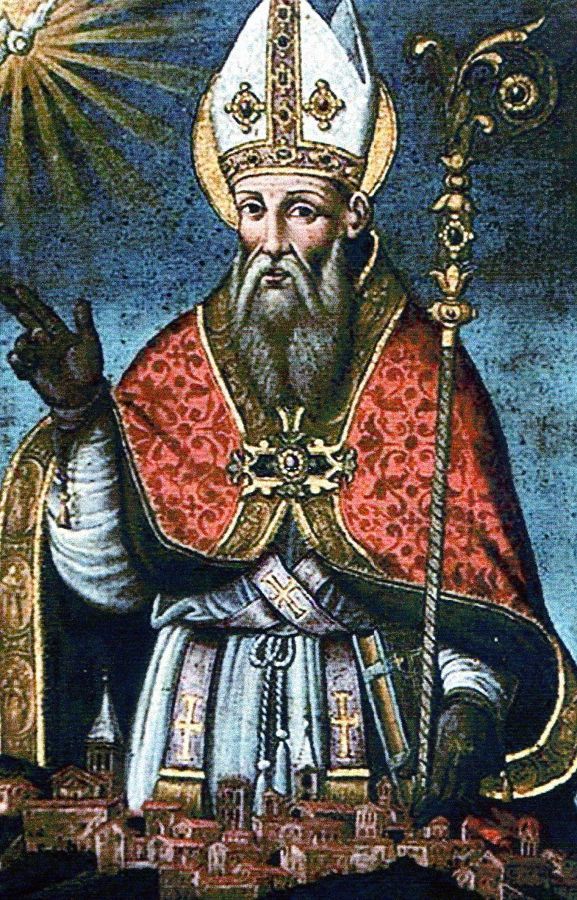
St. Cosmas

St. Cosmas

A shepherd who stayed with his people through hard times.

Traditional feast

October 14
1914 / pre-1969 calendar, per Baring-Gould (1897)

Current feast

Not verified yet

Represents

Bishop

Their story

Adapted in modern English from Baring-Gould (1897–98) · original text below

(The surviving account on this page begins partway through the story.)

Cosmas, a friend of St. John Damascene, became a monk of St. Sabbas and was made bishop of Majuma, the port of Gaza, against his will in 734.

He is remembered as the most learned of the Greek Church's hymn-writers. He often wrote on the same feasts as Damascene, as if in friendly rivalry. His dense meaning and harsh, compressed phrasing make him the hardest of them to understand; Dr. Neale compared him to Adam of S. Victor. He probably died about 780, though the date is uncertain.

He was consecrated by John, Patriarch of Jerusalem, who had also ordained Damascene. The Greek Church's office for his feast praises him as "the spiritual harp, the divine lyre," whose melodies proclaim the Passion and the falling-asleep of the Virgin. He wrote canons, long hymns in several parts, for the Nativity, the Epiphany and the Transfiguration.

Early life

The book says little or nothing about early life. This is how the account begins.

Cosmas, like his friend, became a monk of S. Sabbas, and against his will was consecrated Bishop of Majuma, the port of Gaza, in 734, by John, Patriarch of Jerusalem, the same who ordained Damascene priest. In the office for the saint in the Greek Church for this day is the following testimony to his powers as a hymnographer: — “Put on a glad countenance, O Church, and call thy children together, that thou mayest with them rejoice for thy sublime preacher. For Cosmas, divine and glorious, the spiritual harp, the divine lyre, calls all to the mystic table, laying before us mellifluous and divinely resounding melodies....

What they represent

How they teach us to live

Drawn from themes in the original account

Learn from the kind of life it was. A shepherd who stayed with his people through hard times.

Keep their day. Remember them on October 14 with a short prayer, and ask for their help.

Read more

The full original · 309 words

Read Baring-Gould’s full account

Baring-Gould’s sources: Greek Menaea and Menology.] S. Cosmas of Jerusalem holds the second place among Greek ecclesiastical poets. Left an orphan at an early age, he was adopted by the father of S. John Damascene; and the two foster-brothers were bound together by a friendship kXt I which lasted through life. They excited each other to hymnology, and assisted, corrected, and polished each other’s compositions.

Cosmas, like his friend, became a monk of S. Sabbas, and against his will was consecrated Bishop of Majuma, the port of Gaza, in 734, by John, Patriarch of Jerusalem, the same who ordained Damascene priest. In the office for the saint in the Greek Church for this day is the following testimony to his powers as a hymnographer: — “Put on a glad countenance, O Church, and call thy children together, that thou mayest with them rejoice for thy sublime preacher. For Cosmas, divine and glorious, the spiritual harp, the divine lyre, calls all to the mystic table, laying before us mellifluous and divinely resounding melodies.... O Blessed one ! like a trumpet thou proclaimest the passion and miracles of Christ, and singest the sleep of the Immaculate Mother; thou hast rejoiced all, O Cosmas, by the sweet and soft music of thy words.”

“Where perfect sweetness dwells, is Cosmas gone; But his sweet lays to cheer the Church live on,” says the stichos prefixed to his life. His compositions are tolerably numerous, and he seems to have taken a pleasure in competing with S. John Damascene, as on the Nativity, the Epiphany, and the Transfiguration, where the canons of both are given. He is the most learned of the Greek Church-poets; and his fondness for types, boldness in their application, and love of aggregating them, made him the Oriental Adam of S. Victor. It is partly owing to a compressed fulness of meaning, very uncommon in the Greek ecclesiastical poets, partly to the unusual harshness and contraction of his phrases, that he is the hardest of ecclesiastical bards to comprehend. 1 He probably died in a.d. 780, but the date cannot be fixed with certainty.

1 Dr. Neale, “ Hymns of the Eastern Church." £ND OF VOL. XI Printed by Ballantynb, Hanson & Ca Edinburgh dr* London
Feast days

Feast: October 14

Nine days · Free

Pray the novena
with us.

One short email a day for nine days. The day's prayer, a line from St. Cosmas's story, and a nudge to keep going.

Also on October 14
St. Fortunatus of Todi

St. Fortunatus of Todi

October 14 · Bishop
← All 1726 saints in the library
Sources & notes

Feast-day sources

Story sources

Sources

Credits

From Sabine Baring-Gould, The Lives of the Saints, new edition in 16 vols. (London: John C. Nimmo, 1897–98); text from the Internet Archive scan (OCR, lightly cleaned; errors possible). Public domain.

From Sabine Baring-Gould, The Lives of the Saints, new edition in 16 vols. (London: John C. Nimmo, 1897–98); text from the Internet Archive scan (OCR, lightly cleaned; errors possible). Public domain in the United States. Reproduced unedited, except for short bracketed notes in grey that we added to explain names and terms (“S.” is the old abbreviation for Saint). Some history and judgments reflect 19th-century scholarship.