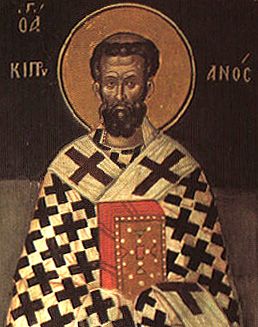
The Ancient Roman Martyrology published by Bucherius. The Sacramentaries of Leo I., Gelasius II., and Gregory I. The Roman and most Latin Martyrologies. York, Sarum, and Hereford. But though commemorated this day, the observance of the festival is transferred in the Modern Roman Martyrology to Sept. 16. In the Anglican Reformed Kalendar it is transferred to Sept. 26; in both because Sept. 14 is the Exaltation of the Cross. Authorities: — His own Letters, a biography by his deacon, Pontus [a region on the Black Sea coast of Turkey]; the Proconsular Acts, published by Ru inart, Eusebius [Eusebius of Caesarea (d. c. 339), the first historian of the Church], S. Jerome [translator of the Bible into Latin (d. 420)] in his Eccl. Writers.1] Thascius Cyprian was of Punic race, born probably at Carthage. The greater part of his life he spent as a heathen, teaching rhetoric in Carthage, remarkable for his eloquence and learning, his integrity, and his morality. He was already advanced in life when he made acquaintance with Csecilian, a venerable Christian priest, and from him learned the great verities of the Faith. A new light broke in on his soul, and filled him with uneasiness. “I lay,” says he, in his book addressed to Donatus, “in darkness; I floated on the stormy sea, a stranger to the light and uncertain where to plant my feet. I then thought that what I was told of the new life was hard and impracticable— that a man should be born again, and, casting off his former self, while his bodily nature remained the same, become in soul and disposition another man. How, said I, can such a change be possible ? Entangled in the many errors of my earlier life, from which I could see no deliverance, I abandoned myself to my besetting sins, and, despairing of amendment, nurtured the evil within me as if it belonged to my nature. But when, after the stains of my former life had been washed away in the laver of regenera1 There is an oration by S. Gregory Nazianzen on S. Cyprian; but it makes a sad jumble of the Cyprian of Carthage, and another Cyprian, a necromancer of fable, for whose legend see Sept. 26.
tion, light from on high was shed abroad on a heart now freed from guilt, made clear and pure; when I breathed the breath of heaven, and was changed into a new man by second birth, then did that which before appeared so doubtful become most evident. That lay open which before was shut, that was light which before was darkness, that became easy which before was impracticable, so that I could understand how it was that, being born in the flesh, I had lived subject to sin, leading a worldly life; whereas the life I now began to live was the commencement of a life proceeding from God, and quickened by the Holy Spirit/' The priest who had been the means of bringing Cyprian to the knowledge of the truth died, and in dying commended to the care of his disciple his wife and children. Cyprian, at the font, took on him, in addition to his former names of Thascius and Cyprian, the name of his guide, Csecilius.
Interpreting literally the words of our Lord, “ If thou wilt be perfect, go, sell that thou hast, and give to the poor,” he sold the two landed estates that he possessed in order to fulfil this requisition, and distributed the proceeds among the poor.1 The devout zeal which so brightly shone forth in him even whilst a neophyte gained for him, in a great measure, the love and esteem of the community. He became almost at once a noted man in the African Church. He devoted himself to the study of Tertullian. When he called for the volumes, he was wont to say, “ Reach hither my master 1” He wrote a treatise to Donatus on the Contempt of the World, and another on the Vanity of Idols. Soon after his baptism he was, in a.d. 277, contrary to the letter of the law, raised by the votes of the Christian 1 His garden was probably soon restored to him by the affection of his flock, as we may gather from some words of Pontius. S. Cyprian.
community to the dignity of the priesthood, and as early as the next year placed at the head of the Church as bishop. The people surrounded his house in order to compel him to accept the episcopal dignity, and to guard all the avenues lest he should attempt to escape.
But this very circumstance, that he had been raised to this high station by the enthusiastic love of the Church, contributed from the first to the formation of a party against him, at the head of which were five priests. Of these, some, perhaps, had themselves claims to the episcopal office, and consequently regarded with jealous eyes the neophyte who had been promoted over the heads of those who had grown grey in the service of the Church. They might also he influenced by other motives now unknown. Cyprian was well aware of the difficulties of the position he was about to assume. When he shrank from accepting the chief pastoral office, its whole weight and responsibility stood clearly before him — however attractive, on the other hand, it must have appeared to a man of his peculiar bent and talent for government to be placed at the head of the Church. We here discover the first ground and germ of the ensuing controversies. The five priests, with their followers, proceeded to contest the episcopal authority of Cyprian. They seem to have been priests at the head of separate churches in Carthage or its neighbourhood; and they ventured, in defiance of the bishop, whom they hated, to take several independent proceedings in the management of their daughter and subordinate churches; or, at any rate, such measures as Cyprian, from the principles which he maintained of the rights of a bishop, might well consider as infringements of the bishop’s rights. One of them, the restless firebrand Novatus, without authority from the bishop, whom he would not recognise, ordained as deacon of his own church one of his followers, Felicissimus. This was a gross act of schism, an encroachment on the episcopal powers, which could not be passed over. He had arrogated to himself a power to confer orders never given to him. Yet Cyprian proceeded with the utmost patience and forbearance. To his conduct in this matter Pontius probably refers, when he exclaims, “ With what lightness, with what patience, with what kindness, did he deal ! How generously did he forgive, counting those who opposed him afterwards amongst his dearest and closest friends, to the wonder of all !”
The outbreak of the Decian persecution, instead of quenching the smouldering fire of discord, fanned it into a blaze. One of the first to suffer was the Roman Pontiff, Fabian. Several of the bishops withdrew from theii churches till the first tempest of persecution should be over. This course might seem an act of weakness, if the> had been impelled to it by a fear of death; but they were probably actuated by loftier motives.
The hatred of the Emperor directed itself especially against the bishops, and as the presence of these prelates served only to exasperate the heathen, they, perhaps, looked on it as a duty to contribute, by their temporary absence, to the peace of their flocks. Cyprian was one of these \ his conduct did not escape censure. His later conduct shows that he was not deficient in courage • and the frankness and serenity with which he explains his conduct, in a letter to the Roman Church, are sufficient to exonerate him from all blame.
“At the first beginning of the troubles/' he writes, “when, with furious outcries, the people had repeatedly demanded my death, I withdrew for a time, not so much out of regard for my own safety as for the public peace of the brethren, that the tumult might not be increased by my presence, which was so offensive to the heathen. ” Sept.,4J -S’. Cyprian.
This conduct was in accordance with the principles on which, in similar cases, he recommended others to act. “ On this account,” says he, “ our Lord commanded us, in times of persecution, to give way and fly; He prescribed this rule, and followed it Himself. For as the martyr’s crown comes from the grace of God, and cannot be gained if the appointed hour has not arrived, he who withdraws foi a season, while he still remains true to Christ, denies not the faith, but abides his time.”
There was, unquestionably, a difference between the case of Christians generally and of one who had the pastoral care of souls. But Cyprian neglected none of these obligations. He could truly say that, although absent in the body, yet in spirit he was constantly present with his flock, and by counsel and act endeavoured to guide them according to the precepts of his Lord.1 From his retirement he maintained a constant correspondence with his people by means of certain ecclesiastics. The letters which he thus sent show how truly he could say this of himself; how vigilantly he laboured to maintain the discipline and order of his church, and in every way to provide both for the wants of the poor, who were hindered by persecution from pursuing their ordinary employments, and for the relief of such as were confessing Christ in prison. The same principles of Christian prudence which moved him to avoid a momentary danger were also maintained in his exhortations to his flock, in which, while he exhorted them to Christian courage and constancy, he warned them against all fanatical extravagance. “ I beg of you,” he writes to his clergy,2 “to be slack neither in prudence nor care for the preservation of quiet; and if, through love, our brethren are anxious to visit those worthy confessors whom divine grace has already honoured by a Ep. xiv.
glorious beginning, let it at all events be done circumspectly, and not in crowds, lest the suspicion of the heathen should be excited, and so all access to them should be prohibited, and, in our eagerness for too much, we should lose the whole. Be careful, then, for the greater safety, to manage this matter with due moderation. In administering the Holy Eucharist to the prisoners in their dungeon, let the priests, as well as the deacons who assist, do so in rotation; for, by such a change of persons and of visitors, we shall best avoid exciting the suspicions of our oppressors. Indeed, we must in all things, as becomes the servants of God, meekly and humbly accommodate ourselves to the times, and labour to preserve peace and the welfare of the people.” He advised his church to regard the persecution as a call to prayer. “ Let each of us,” he says,1 “ pray to God, not for himself only, but for all the brethren, according to the form which our Lord has given us, where we are taught to pray, not as individuals for ourselves alone, but, as a common brotherhood, for all. When the Lord shall see us humble and peaceable, united among ourselves, and made better by our present sufferings, He will deliver us from the persecutions of our enemies.”
The withdrawal of Cyprian to a place of safety on the breaking out of persecution, wise and in accordance with the Lord's command, as it was, served as a handle for the faction jealous of his authority in Carthage. It was a step which admitted of being differently interpreted, and his enemies were not slow to place it in the worst light, and to accuse him of deserting his pastoral duties under the influence of a degrading cowardice.
The party opposed to Cyprian had many opportunities, arising out of the persecution, of increasing in numbers and influence. During the persecution, many who, either 1 Ep. vii.
from fear or violence, had been driven to violate the duties of confessors of the faith, had been excluded from the communion of the Church. Most of these, however, were afterwards seized with compunctions of remorse, and longed to be restored to the fellowship of the brethren, and to the privilege of sacramental communion with the Lord. The question now arose, Ought their wishes to be forthwith complied with? — or, Should their petition be absolutely rejected ?
Before the Decian persecution had begun to rage, Cyprian, looking at the question in the abstract, had been inclined to the stern view that such as had denied Christ should for ever remain outside of the pale of the visible Church.1 But when he was brought face to face with the question as a practical one, and saw the agony of contrition — the broken and contrite hearts bewailing their transient weakness — he could not but feel that the blood of Jesus Christ must reach and heal these, and that to them the privileges of the Church should be only so far refused as was necessary for the maintenance of a high moral and chivalrous tone of feeling towards the profession of a Christian. If the cords of discipline were too far relaxed, all fear of the consequences of apostasy would be removed; if too far tightened, the lapsed would fall into despair. It was necessary to maintain a wise prudence in dealing with this sort of cases.
The paternal heart of S. Cyprian revolted at the thought of the perpetual exclusion of the fallen, but he dared not act independently of other bishops. In this state of indecision, he gave it as his opinion that the lapsed were not to be shunned, but to be exhorted to repentance; and that the final decision on each separate case must be reserved 1 “To him who has smned against God, no forgiveness can be granted in the Church," De testimomis, iii. 28.
to the time when, with the restoration of tranquillity, the bishops and clergy would be able to investigate the cases. There was a great variety in the offences of the fallen brethren. Some, merely to avoid the sacrifice of their worldly possessions, had without a struggle even hastened to the altars of the gods; while others had fallen through ignorance or under force of torture. The disorders of the time made it impossible to examine carefully into the several offences and the difference of moral character in individuals. Moreover, those that had fallen must, in the mean time, by giving practical proof of their penitence, render themselves worthy of readmission to the communion of the Church.
But here was an opportunity for the faction opposed to Cyprian. They espoused the cause of the lapsed, and instead of exhorting them to peace and submission, in obedience to the wishes of the bishop, they encouraged them in their importunate demands, and availed themselves of the occasion for fomenting the division in the Carthaginian Church.
The question of the lapsed was further complicated by the action of the martyrs. It was customary at first for the faithful to beseech the prayers of those who were hastening to their crown, when they stood in the presence of their Lord. The lapsed also crowded round them, on their way to martyrdom, and besought their intercession, not only with the Lord in Heaven, but also with the earthly bishop, to obtain for them speedy reconciliation with the Church, and restoration to communion. Such intercession rarely failed to be listened to with respect, and to gain a ready consent. Many fallen Christians, at the prayer of the martyrs, were restored to their full Christian privileges. But the custom grew into an abuse. The martyrs began to urge their demands, not as a privilege, but as a right 3 not to ask for S. Cyprian.
absolution for penitents, but to exercise it; not to request their readmission to the communion of the Church, but to pronounce it authoritatively.
The poet Commodian thought it necessary to remind the martyrs that even their sufferings could not expiate sin. The bishops were often placed in no slight embarrassment by the peremptory declarations of the martyrs, “ Let such an one, together with his, be received back again to the communion of the Church” — an expression admitting of interpretations and applications without limit. Thousands of these “ letters of peace” were daily given by the confessors, without any examination as to whether the recipients deserved them, as Cyprian informs us.1 Many of the clergy, who, as' Cyprian exhorted them, ought to have set the martyrs and confessors right on this matter, encouraged them in their delusion, using them as tools in their machinations against the bishop. Those who applied these indefinite declarations to themselves, now boasted that the confessors or martyrs had granted them absolution, and would hear of no delay in their reception to communion, would submit to no trial of their conduct, would listen to no exhortations to penitence. Tertullian, at the close of the 2nd century, had seen the mischief to morals wrought by this practice, and he intimated that many were made to feel secure in their sins by these “letters of peace,” so inconsiderately showered on them by the confessors.2 S. Cyprian, by his opposition to this growing abuse, rendered himself obnoxious to both confessors and the lapsed. When a certain confessor [in old usage, a saint who was not martyred, or who suffered for the faith without being killed], Lucian, “ in the name of Paul, a martyr ” — in obedience to whose last injunctions he professed to be acting — bestowed restorations to communion on the fallen brethren, Cyprian refused to acknowledge his certificates of church-membership. He wrote, “ Although our Lord has commanded that all nations should be baptized, and receive remission of their sins in the name of the Father, the Son, and the Holy Ghost, yet this man, in ignorance of the divine law, proclaims peace and forgiveness of sins in the name of Paul; he forgets that the Gospel makes the martyrs, and not the martyrs the Gospel”1 To the same purpose did he express himself in a discourse uttered by him on his return to Carthage:2 “ Let no man deceive himself, the Lord alone can show mercy. He alone can pardon the sins which are committed against Himself, who bore our sins; who suffered for us; and whom God delivered up for our offences. The servant may not forgive the sins that have been committed against his Master, lest the offender contract additional guilt by being unmindful of what is written — ‘ Cursed is he that putteth his trust in man’ (Jer. xvii. 5). We must pray to the Lord, who has said that He will deny those that deny Him, who alone has received all judgment from the Father. Do the martyrs wish anything ? What they wish must be written in the law of the Lord \ we must know, first of all, that they have obtained from God what they wish, and then only can we do what they require; for it by no means follows, as a matter of course, that the Divine Majesty will grant what a man has promised. Either then the martyrs are nothing, if the Gospel can be made void 3 or if the Gospel cannot be made void, then they have no authority to act against the Gospel, who by its means become martyrs. That man whose faith and hope and power and glory are in Christ only, can neither say nor do anything against Christ.” But Cyprian, with that wonderful patience and moderation which characterized all his conduct, took no exaggerated line in this matter. He was the last to deny to the martyrs their just meed of honour, and was ready to grant their 1 Ep. xxii. 2 Sermo de Laps is.
S. Cyprian. petitions when they did not conduce to disorganization of moral discipline. When the summer heat of an African climate produced many cases of sickness, he granted absolution to those of the lapsed who in sickness and the fear of death desired communion, and who supported their demand by certificates given them by confessors to the Faith.1 In his report to the Roman Church, he assigns, as his reason for so doing, his wish, by a compliance in this particular, to assuage, in some measure, the violence of his opponents, and to relieve himself from the obloquy of refusing to the martyrs due honour and respect. And, also, it was his desire to follow the practice of the Roman Church, with which he had no wish to be at variance.2 So, by Christian prudence in his conduct, by contriving to unite mildness with energy; by his paternal, friendly representations, whereby he won over the better disposed among the confessors; by the firmness wherewith he withstood the obstinate opposition of the insubordinate priests, by the love and esteem in which he was held by the majority of the Church, Cyprian seemed to have succeeded in restoring tranquillity to Carthage; and he was rejoicing in the hope that, as the fury of the Decian persecution began to abate, he might be able to return to his church and celebrate amidst his flock the Easter festival of a.d. 251. Rut ere his hopes could be realized, discord broke out again more fiercely, and his opponents assumed an attitude more impracticable than heretofore. The occasion for this outbreak was found in an order given by Cyprian for the distribution of the alms of the Church.
Before his return to Carthage he sent two bishops and two priests as his deputies, with full power to hold a visitation. To such of the poor as from age or sickness could 1 Ep. xii., xiii., xiv.
2 Ep. xiv. “ Standum putavi et cum vestra sententia, ne actus nostcr, qui adunatus esse et consentire circa omnia debet, in aliquo discreparet.” do nothing for their own support, they were to assign so much out of the Church-chest as might be necessary for the supply of their bodily wants. To those who, having a trade, were unable to gain from it enough for their subsistence, or who wanted money to purchase the tools and stock necessary, or who, having been ruined in their business by the persecution. now wished to commence it again, they were to make grants as might appear advisable in the several cases. Finally, they were to draw up a list of all the poor who were to be supported out of the Church funds, distinguishing their ages and their behaviour during the persecution, in order that the bishop might promote the worthy, especially those of a meek and humble spirit, to such offices in the Church as they might be qualified to fill. The party opposed to S. Cyprian took occasion at the visitation to excite a general and determined spirit of opposition. At the head of this opposition stood Felicissimus, the Deacon of Novatus. The deacons were the dispensers of the Church funds. He announced to the poor of the church in which Novatus ministered as priest, that he would contrive without fail to provide them money for their wants, and stirred them up to resist the inquisition made into their conduct and necessities by the visitors commissioned by the bishop. If they dared to appear before the commissioners, they were to be cut off from all benefits, temporal and spiritual, which could accrue to them by maintaining their connexion with the church of Novatus. This church became also the general resort of all the lapsed who wished to re-enter the communion of the Church without irksome delay and inconvenient investigation into their conduct. There, without any previous preparation, they were at once admitted to the Holy Communion, and all the wise precautions and rules against hasty reception of the fallen laid down by Cyprian were openly and defiantly flouted.
.S'. Cyprian. It was these troubles which induced S. Cyprian to defer his return to Carthage until after the Easter of a.d. 251. He chose this particular moment because he could reckon on the other bishops of North Africa being at that time assembled there for the annual synod. He had been absent from February a.d. 250, to April or May, a.d. 251. The council was composed of a great number of African bishops, and some priests and deacons. It excommunicated Felicissimus and the five priests, after having given them a patient hearing. At the same time, it formulated a series of decrees on the treatment of the lapsed, which were collected into a book, and formed the first Penitentiary that appeared in the Church. Unfortunately it is lost, but S. Cyprian has informed us of its principal dispositions in his 32nd letter. In the first place, the different circumstances of the offences of the fallen brethren were to be carefully investigated, and in cases of sickness and the approach of death, they were all to be communicated, even those who had sacrificed not being excluded from the mercy and forgiveness of the Church. Should such persons recover, they were not to be deprived of the privilege they had obtained by the grace of God, but were to remain in the fellowship of the Church. Afterwards, when the persecution was renewed with increased violence, a further indulgence, prompted by Christian charity, was conceded. The communion of Christ’s Body and Blood was granted to all who had given evidence by their conduct of true, heartfelt repentance. They, on the other hand, who had not given the least evidence of sincerity in their repentance, and never expressed a desire till they lay on their deathbeds to receive the blessed Sacrament, were not then to receive it, since it was evidently not sorrow for sin, but the fear of death which prompted the feeling.
The synod, after having made these wise and merciful provisions, passed sentence of condemnation on the party of Felicissimus; and thus, by the support of the bishops of North Africa, S. Cyprian succeeded in putting an end to the schism. Novatus, finding his position uncomfortable at Carthage, went to Rome,1 where, with the facility of an unprincipled and restless stirrer up of strife, he threw himself into a faction directly opposed to that which he had formerly headed, and setting up Novatian as bishop, urged on into open schism those who thought that the Church had accorded pardon to the lapsed on too easy terms.
The story of that schism has been already told, in the life of S. Cornelius, and nothing further need be said on the subject here.
The attention of Decius [Roman emperor 249–251, who ordered everyone to sacrifice to the gods] had been withdrawn from persecuting Christians by events of greater political importance— the insurrection in Macedonia, and the Gothic war. And it was in the latter war, towards the close of the year, that he lost his life. The calm in consequence of this event which the Christians enjoyed, continued during only a part of the year 252, under the reign of Gallus and Volusianus. A destructive pestilence spread over the face of the empire, producing everywhere panic, whilst drought and famine, afflicting several provinces, added to the miseries produced by the ravages of the plague, and excited an outburst of popular fury against the Christians.
An imperial edict was put forth enjoining all the subjects of the empire to sacrifice to the gods, in order to obtain deliverance from so grievous a national calamity. Public attention was again arrested by the numbers who withdrew from these solemnities because they were Christians Hence arose new persecutions, in the hope of increasing the number of sacrifices, and of sustaining the old religion, which was everywhere declining.
1 He is said by Pacian to have fled, fearing lest the council should investigate the barges brought against him of deserting his father and his wife. Ijt * At the same time a fresh schism threatened to vex the Carthaginian Church, or perhaps we may say that the old schism assumed a new front.
In a.d. 240 Privatus, an African bishop, had been deposed by a council of ninety bishops at Carthage, on what ground does not transpire. Privatus presented himself before the council that met at Carthage on the matter of the lapsed, in May, 251, and asked to have his case reheard. This was refused, and Privatus revenged himself by setting up Fortunatus as another rival Bishop of Carthage. Fortunatus was one of the five priests who had from the first shown such determined opposition to Cyprian. In this assumption of the episcopal title he was only supported by a very small and extreme party of adherents; but Felicissimus sailed at once for Rome, and reported that twenty-five bishops had assisted in the consecration of Fortunatus. The Pope and the clergy of Rome, however, refused to have any communication with him; but at the same time Cornelius wrote to Cyprian, rather complaining that the latter had sent no official information of the election of Fortunatus. There seems no reason why Cyprian should have done so; but if he had been inclined, he was, perhaps, prevented by attempts which were now making at Carthage to renew the persecution. In the answer which he wrote to Cornelius, he speaks of the populace again demanding that he should be thrown to the lions; but with respect to the election of Fortunatus, he gently rebukes Cornelius for having paid any attention to idle rumours.
Cornelius lived to receive only one more letter from Cyprian, and then obtained the crown of martyrdom. His successor was Lucius, who was forced to leave Rome almost as soon as he was elected; but he returned before the end of the year, and received a letter of congratulation from Cyprian.
The Bishop of Carthage did not, on this occasion, leave his city, but contrived to remain there and preserve his life, though almost every day brought news of some of his clergy being arrested or martyred. His attention to the spiritual and temporal wants of his flock was unceasing. Wherever Christians were suffering, there was his hand ready to comfort and console. An incursion of barbarians had carried off a great number of prisoners in Numidia, and Cyprian laboured to raise for their ransom a subscription which amounted to about 3ooo£1 Gallus was assassinated in a.d. 253, and with his death and the accession to the purple of Valerian [Roman emperor 253–260, who persecuted bishops and clergy] peace was restored to the Christians throughout the empire. S. Cyprian had now a splendid opportunity of Christian revenge upon the city that had thirsted for his blood. The plague that had been devastating other portions of the empire broke out at Carthage with singular virulence.
It spread from house to house, especially those of the lower orders, with awful regularity. The streets were strewn with the bodies of the dead and the dying, who vainly appealed to the laws of nature and humanity for that assistance to which those who passed them by might soon stand in need. General distrust spread through society. Men avoided or exposed their nearest relatives; as if, by excluding the dying, they could exclude death. No one, says the Deacon Pontius, writing of the population of Carthage in general, did as he would be done by. Cyprian addressed the Christians in the most earnest and effective language. He exhorted them to show the sincerity of their faith in the doctrine of their Master, not by confining their acts of kindliness to their own brotherhood, but by extending them indiscriminately to their enemies. The city was divided into districts; offices were assigned to all the Christians; S. Cyprian.
the rich lavished their wealth, the poor their personal exertion; and men, perhaps just emerged from the mine or the prison, with the scars or mutilations of their recent tortures upon their bodies, were seen exposing their lives, if possible, to a more honourable martyrdom; as before the voluntary victims of Christian faith, so now of Christian charity. The Emperor Valerian, in the first year of his reign, treated the Christians with unusual clemency; but the increase in their numbers and influence filled him, after awhile, with alarm, and in a.d. 257, after the Church had enjoyed four years of tranquillity, he suffered himself to be persuaded into a change of measures towards them. But at first he sought to avoid the effusion of blood; he gave orders merely that the bishops and clergy should be exiled, and the assembly of congregations be prohibited. S. Cyprian was at once (August 30) summoned before the tribunal of the proconsul, Aspasius Paternus, and was thus addressed: — “ The most sacred Emperors, Valerian and Gallienus, have done me the honour to command me by their letter, that I oblige all who follow not the Roman worship immediately to conform to it. What is your name and quality ?” Cyprian said: “ I am a Christian and a bishop. I know no other gods besides the one true God, who made heaven and earth, and the sea, and all that is therein. This God we Christians serve; his mercies we implore both day and night for ourselves, for all men, and for the safety of these very Emperors." When the proconsul further asked him if he persevered in that resolution, he replied that, u A purpose so well founded, and a will which hath once devoted itself to God, can never be altered." The proconsul said: “ Go then into banishment to the city Curubis." The martyr answered: “I will go." The proconsul said: “The Emperors have done me the honour to write to me to find out not only bishops but also priests, I would therefore know what priests live in this city.*' Cyprian answered: “ The Roman laws wisely forbid us to become informers; and I cannot discover them. But they may be found at home.” The proconsul said: “ I will find them.” He added: “ I have orders also to forbid the holding of your assemblies in any place, or entering into the cemeteries. Whoever observes not this wholesome ordinance, shall be put to death.” To which Cyprian made answered: “ Then obey your orders.”
The proconsul having commanded that he should be banished to Curubis, the saint arrived there on the 13th or r4th of September. Curubis was a small town fifty miles from Carthage, situated on a peninsula upon the coast of the Libyan sea, not far from Pentapolis.
He remained some time in this pleasant retreat rather than place of exile, in a villa shaded by verdant groves, and with a clear and healthful stream of water rippling past his door. It was provided with every comfort, and even luxury, in which the austere nature of Cyprian would permit itself to indulge.
A question now arose which somewhat interrupted that unanimity between S. Cyprian and the Roman pontiff, which had been so conspicuous in the Novatian controversy. In a council held at Carthage, about a.d. 215, and another held at Iconium about a.d. 23 t, it had been decided against the validity of baptism administered by heretics. From some cause or other which is not explained, S. Stephen, Bishop of Rome, had rather an angry controversy with some of the Asiatic bishops upon this point. S. Firmilian, Bishop of Csesarea in Cappadocia [a region of central Turkey], and Helenus, Bishop of Tarsus, sent some bishops to Rome to consult Stephen on the subject, and bring about unity of practice. But Stephen maintained the validity of heretical baptism, and would not S. Cyprian.
even admit the bishops to an interview, nor offer them common hospitality. He also threatened to cut off communion with the Churches of Asia. This called forth an indignant reproof from S. Firmilian. This disagreement probably happened in the year 254, and Stephen was soon brought in contact with opponents nearer home. Eighteen bishops in Numidia consulted S. Cyprian on the propriety of rebaptizing persons who had been baptized by heretics or schismatics. A council of thirty-one bishops was then sitting at Carthage, and Cyprian wrote in their name, asserting the necessity of baptism being administered in such cases. A Mauritanian bishop, named Quintus, gave him an opportunity of writing a second letter, in which he justified the practice, not only from ancient custom, but from the nature of the sacrament itself; and there are expressions in his letter which seem to allude to the Bishop of Rome maintaining a contrary opinion.
Not long after, perhaps at the beginning of the year 256, another council was held at Carthage, which was attended by seventy bishops from Africa and Numidia. Among other matters, the validity of baptisms administered by heretics was again considered; and again the council decided that they were not valid.
S. Cyprian then wrote to S. Stephen, communicating to him the decision of the African Church. His letter was mild and conciliatory. He did not pretend to be ignorant that Stephen’s mind was made up, and that he would be unwilling to relinquish impressions which he had once imbibed: but he observed that this need not cause a dissolution of concord and amity. He disclaimed any wish to dictate to Stephen the conduct which the Pope should adopt, but, at the same time, he asserted that it was the right of each bishop to make rules for his own Church, for which he was immediately responsible to God. That S. Cyprian was sincere in these professions of moderation may be judged from what he says in a letter written shortly after to Jubaianus, an African bishop, in which he defends at some length his own opinions, but gives to every bishop the right of acting for himself.
It is to be regretted that Stephen did not meet these advances in a spirit of charity. He spoke strongly on the other side, for he felt strongly. In his Church it had never been the custom to rebaptize persons who came over from heresy. The Church of Rome, on this point, differed from the African and the Eastern Churches; which is, perhaps, to be accounted for, because heresy had been much less frequent at Rome than elsewhere. Even at the end of the 4th century, we find it stated that no heresy had taken its rise in Rome;l and therefore the cases which led to the present controversy were less likely to have occurred there than in the East. Nothing, however, could justify Stephen for defending his opinion with such intemperate warmth. He repulsed the messengers of the African council, and others who came upon the same subject from some Churches in Asia Minor. He even threatened to exclude them from communion with the Church of Rome. The letter, which he wrote at that time, and which has not come down to us, appears to have been very intemperate. He called those who maintained an opposite opinion — that is, all the bishops of Asia and Africa — perverters of the truth and traitors to ecclesiastical unity.
S. Cyprian made no reply personally to Stephen, but he speaks strongly of his letter in some epistles which he wrote at this time to persons who consulted him on this question. The threat of excommunication drew from him the severe remark, that the person who uttered it was a friend of heretics and an enemy to Christians.2 1 Ruffinus in Symbol. 3. 1 Ep. Ixxiv.
S. Cyprian. Cyprian, however, never lost sight of his love of unity. He sent one of his deacons into Cappadocia, who was to deliver copies of his letters to S. Firmilian; and, although two councils had already assembled at Carthage, and the question had been unanimously decided, he convened another, and still larger, council in the autumn of 256, which was attended by eighty-seven bishops from Africa, Numidia, and Mauritania, besides other clergy, and a large body of laity. The proceedings were opened by Cyprian calling upon each of the bishops to deliver his opinion singly, while as a body they judged no one who differed from them, nor thought of excluding them from communion. “ For,” said he, “ none of us makes himself a bishop of bishops, or tries tyrannically to frighten his colleagues into the necessity of obeying, since every bishop, in virtue of his own liberty and power, is master of his own will, and is as incapable of being judged by another, as he is of judging him himself; but let us wait for the universal judgment of our Lord Jesus Christ, who alone has the power of putting us over the government of His Church, and of judging us for our actions.” The council was unanimous in confirming the former decisions. We do not know whether any further communication was held with Stephen upon this subject; but before the end of the year, the deacon, who had been sent into Cappadocia, returned with a letter from S. Firmilian, in which he professed his entire agreement with S. Cyprian and the African Church, and commented in no measured terms on the letter of Stephen. Considerations of personal danger were likely now to put an end to religious controversy. Cyprian, as has been already related, was sent into exile, and in the month of August, a.d. 257, Stephen fell a victim to' the persecution which broke out.
The banishment of Cyprian was followed by the trial of numbers of his flock. Not only bishops and priests, but multitudes of the common people, even young women and children, were brought before the tribunal of the proconsul for their religion. The Emperor had not yet given orders for capital punishment to be inflicted; but these innocent persons were beaten, imprisoned, and sent to the mines in distant parts of Africa. Many of Cyprian's colleagues, bishops and clergy, were forced to work at this arduous and unwholesome labour; but Cyprian, probably on account of his rank and abilities, which were generally recognised, was treated with less indignity. His deacon Pontius attended him, his friends were not prohibited from visiting him; and he was able to send, not only letters, but money, to the Christians who were working in the mines. His banishment at Curubis lasted for more than a twelvemonth, during which time he had opportunities of preaching to large congregations attracted to his place of retreat. In a.d. 258 appeared a more bloody edict than the former, by Valerian. It ordered that bishops, priests, and deacons should be punished immediately with death; but that senators and men of rank, and knights, should be degraded and lose their property, and if they persisted in being Christians, they were to suffer capitally; women were to lose their property and be sent into banishment. A letter of S. Cyprian's is extant, which he wrote upon receiving news of this imperial decree. He was now in daily expectation of his end. Galerius Maximus had succeeded Paternus as proconsul, and S. Cyprian was removed from Curubis to a place near Carthage, which was once his own property. It was whilst there that he heard that he was to be conveyed to Utica, there to receive the sentence of the proconsul, who happened to be temporarily residing at that place. It was his wish, however, like a faithful shepherd, to give his last testimony, by word and by sufferS. Cyprian.
ing, in the presence of his flock; he therefore yielded to the entreaties of his friends, and withdrew awhile, untii the proconsul should relarn. From the place of his concealment he addressed his last letter to his flock.1 “ I allowed myself/’ he says, “ to be persuaded to retire for a time, because it is fitting that a bishop should confess the Lord in the place where he is set over the Church of the Lord, so that the whole Church may be honoured by the confession of their bishop. For whatsoever the confessing bishop utters in the moment of confession, by the guidance of the Divine Spirit, is the utterance of all. Let me, then, in this secret retirement, await the return of the proconsul to Carthage, that I may learn from him the decree of the Emperor with regard to both the laity and the bishops among the Christians, and may speak in that hour as the Lord may give me utterance. But do you, my dearest brethren, agreeably to the precepts which I have taught you, study to preserve quiet. Let no one lead the brethren on to tumultuous proceedings, or give himself up voluntarily to the heathen. The only time for any one to speak is when he has been apprehended; in that hour, the Lord, who dwelleth in us, speaks by our lips.'' At length the proconsul returned to Carthage, and then Cyprian showed himself walking amidst the flowers of his garden, and was at once arrested. The officers sent to take him put him in a chariot betwixt them, and carried him to a country seat where the proconsul, who was very ill, was staying. Galerius Maximus was not able to see him that day, on account of his health, and the bishop was conducted to the house of the chief officer who had apprehended him, in the street of Saturn at Carthage. When the news of the arrest of Cyprian spread, the city poured its inhabitants into the streets; even the pagans 1 Up. lxxxiii.
VOL. X. gathered and swelled the crowd that came to do honour to the heroic bishop who had so undauntedly braved the pestilence to minister to their sick and dying, whose virtues, patience, whose noble bearing and beautiful expression of countenance, to which Pontius bears witness, had impressed them with reverence and love.
All night long the dense crowd blocked the street of Saturn and the adjoining streets of Venus and Salus \ their murmurs, and the occasional burst of hymn, were heard in the room where Cyprian and his friends supped. The officers treated him with the utmost courtesy, and denied admittance to no one whom he wished to see, nor put more restraint on his freedom than was consistent with their duty to prevent escape.
Next morning the bishop was conducted by a strong guard to the court of the proconsul. Galerius, whose illness was increasing, was not as yet arrived. Leave was therefore given to S. Cyprian to go out of the crowd into a private apartment, and a seat was offered him, accidentally covered with a linen cloth, as it were a symbol of his episcopal dignity, says the deacon Pontius. One of the guards, who had been a Christian, seeing he was hot and tired by the walk and crowd, courteously offered him a change of dry linen for his body; but Cyprian gently declined the courtesy: “ There is no need for me temporarily to relieve an inconvenience from which this day I shall be wholly freed.”
By this time the proconsul had taken his seat, and Cyprian was brought before him. Galerius was worn with pain, and spoke with difficulty. The court was a sea of heads. The examination was very brief: — u Art thou Thascius Cyprian, the bishop of so many impious men ? The most sacred Emperor commands thee to sacrifice.” Cyprian answered, “I will not sacrifice.” S. Cyprian.
“ Consider well,” rejoined the proconsul. “Execute your orders/’ answered Cyprian; “the case admits of no consideration/' Galerius consulted with his council, and then, speaking with difficulty,1 delivered his sentence. “ Thascius Cyprian, thou hast lived long in thy impiety, and assembled about thee many men involved in the same wicked conspiracy. Thou hast shown thyself an enemy alike to the gods and the laws of the empire; the pious and sacred Emperors have in vain endeavoured to recall thee to the worship of thy ancestors. Since, then, thou hast been the chief author and leader of these guilty practices, thou shalt be an example to those whom thou hast deluded to thy unlawful assemblies. Thou must expiate thy crime with thy blood.” Cyprian said, “ God be thanked !”
The whole court, crowded with Christians, resounded with the roar, “ Let us die with him !” When the martyr went out of the court a great number of soldiers attended him, marching on either side, to keep off the people. They led him into the open country to a plain, studded with trees, up which men smarmed in their eagerness to see the last of their bishop. It was September the 14th, a clear day, the autumn sun burning in a cloudless sky over head, the deep dark blue of the Mediterranean lining the northern horizon.
S. Cyprian, on reaching the appointed spot, took off his mantle, fell on his knees, and prayed. Then he divested himself of his dalmatic, and remained kneeling in a long white linen garment, awaiting the stroke of the executioner. He bound the napkin round his own eyes, and extended his hands to a priest and deacon to tie. The Christians spread before him napkins to receive his body when he 1 “ Vix aegre,” no doubt on account of his bad health; it may, however, mean •• reluctantly.” But Galerius died of his sickness a few days after. fell, that they might be sprinkled with the blood of so great a martyr. The sword flashed, his white head fell, and the body bowed forward, and was prostrate on the cloths. The faithful took up the corpse, and in the night buried it with great solemnity on the Mappalian way.
Two churches were afterwards erected to his memory, one on the place of his burial, called the Mappalia, the other on the place of his martyrdom, called Mensa Cypriana, the table of Cyprian, because there, as in sacrifice, he had offered his life to God.
In the Liberian Kalendar, and in the early Roman one,, the festival of S. Cyprian was celebrated on the 14th September, the day of his death; but from the fifth century it has been generally observed along with that of S. Cornelius on the 16th September.
Some ambassadors of Charlemagne [king of the Franks, crowned emperor in 800], passing through Carthage, opened the tomb of the Saint and carried off his relics [the bodily remains of a saint, or objects they used, kept with honor] to France, and they were deposited at Arles, in a.d. 806. Charles the Bald removed them to Compiegne, and placed them beside those of S. Cornelius.