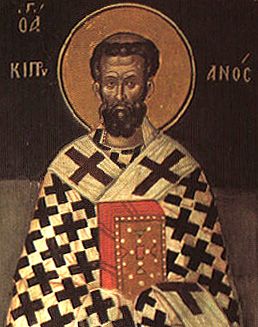
Baring-Gould’s sources: Ado, Usuardus, Roman, Gallican, and German Martyrologies. The Acts of S. Maternus are wholly apocryphal.] According to the Lessons for the Office of S. Maternus at Trhves, he was the disciple of S. Peter, commissioned by the prince of the apostles to carry the Gospel into Gaul, along with S. Eucharius and S. Valerius. On their way Maternus died. Eucharius and Valerius thereupon returned to Rome, and S. Peter gave them his staff to lay on the body of Maternus. When they came to 111, three miles from Schelestadt, in Alsace, where they had left the body, they reopened the grave, and placed on the corpse the staff of S. Peter; thereupon Maternus arose, and continued his journey, none the worse for it, to Treves. The grave is shown to the present day, and is the resort of numerous pilgrims, who visit it on the third Saturday after Easter. There are numerous indulgences granted by Popes to those visiting the spot. According to an equally veracious account, Maternus was the son of the widow of Nain. The Bollandist fathers discredit the story of the resurrection of Maternus through the imposition of the staff of S. Peter, because very similar fables are told of other saints, pretended disciples of S. Peter. S. Memmius of Catalonia is said to have been sent by S. Peter into Gaul with S. Dionysius, S. Sixtus, S. Sabinian, S, Eucharius, and S. Sinicius. After the party had proceeded on their way some distance, Domitian, subdeacon of Memmius, died. Memmius buried him, and then returned to Rome; but S. Peter gave him his mantle, and bade him lay it on the body of Domitian. He did so; the subdeacon arose, and went on into Gaul with the bishop.
S. Mater nits. S. Fronto, Bishop of Perigueux, is likewise said to have been sent into Gaul [roughly modern France and Belgium] by the prince of the apostles. After three days’ journey, his friend George died \ thereupon he returned to Rome, got the staff of S. Peter, and laid it on George, who straightway rose out of his grave. S. Martial, Bishop of Limoges, also was commissioned by S. Peter to preach in Gaul. On his way his deacon, Austriclinian, died; Martial went back to Rome in tears; S. Peter gave him his staff; he laid it on the deacon, and he arose alive and well.1 Sigebeit of Gemblours tells us that in a.d. 953 the staff of S. Peter which revived S. Maternus was solemnly translated to Cologne.
“ With what zeal, with what fervour, with what rejoicings, it was brought to Cologne every one knows,” says Folcmar in his Life of S. Bruno. Archbishop Warin (a.d. 980) sawed the staff in two, and gave half to the church of Treves [Trier in Germany], where the portion was received also with inexpressible zeal, fervour, and joy.
Thence it was carried in time of troubles to Metz, and what finally became of that portion nobody knows. The ferule of the stick, three inches long, is venerated at Prag, in the church of S. Veit, given in 1354; a much longer piece receives religious veneration at Weingarten in Swabia.
There is little reason to doubt that S. Maternus was Bishop of Cologne and Treves in the fourth century, and that it is only the ambition of the churches of Cologne and Treves to claim an apostolic foundation which has elevated Maternus into a disciple of S. Peter, commissioned to build the church there. Maternus was Bishop of Cologne in 313; he is named by Optatus of Mile vis in his book on the Donatist schism. The Donatists appealed to Constantine to let some of the Gallican bishops consult on their case. Constantine, in an epistle which Eusebius [Eusebius of Caesarea (d. c. 339), the first historian of the Church] has preserved, bade Reticius of Autun, Maternus of Cologne, and Marinus of Arles proceed to Rome, and take counsel with Pope Miltiades relative to the case of Csecilian of Carthage.1 The assembly took place in 3 1 3; nineteen bishops attended; it met in the Lateran [St. John Lateran, the pope’s cathedral in Rome] palace, in the apartment of the Empress Faustina, on October 2nd, and lasted three days. Judgment was given in favour of Caecilian; but the Donatists would not rest satisfied, and complained that the case against him had not been sufficiently gone into at Rome. Constantine therefore ordered the assembly of a council at Arles to investigate the matter thoroughly, and for ever, as he fondly hoped, set a miserable strife at rest.
The council met in a.d. 314. Marinus, as bishop, presided. There were present also Agricius of Trhves, Theodore of Aquileja, Csecilian of Carthage, Reticius of Autun, Maternus of Cologne, Restitutus of London, Adelf of Caerleon, and many others.
It is probable that Maternus moved afterwards to Treves, or perhaps ruled both sees for a time together, for he is regarded as bishop of both places, and finds a place in the lists of the bishops of Treves as the third, and of Cologne as the first.
The relics [the bodily remains of a saint, or objects they used, kept with honor] of S. Maternus are shown in the church of S. Paulinus at Treves; others in the abbey church of S. Matthias; others at Luxembourg, Cologne, Tongern, Liege, and Maestricht; others again at Prag; and a rib in the Escurial.
1 Optat. Milev, De Schis. Donat, lib. i., Euseb., Hibt. Eccl. lib. x., c. 5. The Exaltation of the Cross. TIIE EXALTATION OF