Baring-Gould’s sources: Roman, Irish, Scotch, and ancient Anglican Martyrologies. His festival was celebrated in England with rulers of the choir, and nine lessons. Pope Callixtus II. ordered him to be venerated throughout the Christian world. There are no very ancient accounts of S. David, The oldest is a life existing in MS. at Utrecht, which was not known to Usher or Colgan. Usher cites Ricimer, Giraldus, and John of Tynemouth, a Durham priest, who collected the Acts of the English, Scottish, Welsh, and Irish Saints, and who lived in 1360. Ricimer was Bishop of S. David's about 1085, and died about 1096. His life of S. David seems to have been the foundation of all subsequent biographies of that saint. Several MSS. of this life are extant; and a portion of it containing matter not found in the life of the same saint by Giraldus Cambrensis, was printed by Wharton in the Anglia Sacra. Giraldus Cambrensis wrote his life of S. David about 1177. S. Kentigern (d. 590) mentions S. David, and there are numerous allusions to him in the lives of contemporary Welsh and Irish saints.
S. David, or Dewi, as the Welsh call him, was born about 446, at Mynyw, which was named S. David's after him. His father was Sandde, son of Ceredig, who was the son of Cunedda, the great conqueror of N. Wales. His mother's name was Nôn; she was the daughter of Gynyr of Caergawch. Giraldus says he was baptized at Porth Clais by Alveas, Bishop of Munster, "who by divine providence had arrived at that time from Ireland." The same author says he was brought up at "Henmenen," which is probably the Roman station Menapia.
S. David was educated under Iltyt at Caerworgon. He was afterward ordained priest, and studied the Scriptures for ten years with Paulinus at Ty-gwyn-ar Dâf, or Whitland, in Caermarthenshire. He then retired for prayer and study to the Vale of Ewias, where he raised a chapel, and a cell on the site now occupied by Llanthony Abbey. The river Honddu furnished him with drink, the mountain pastures with meadow-leek for food. His legendary history states that he was advised by an angel to move from under the shadow of the Black Mountains to the vale of Rhos, and to found a monastery at Mynyw, his birth place.
March 1.
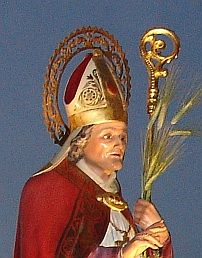
He built a monastery on the boggy land which forms nearly the lowest point of that basin-shaped glen: on, or near its site stands the present Cathedral of S. David. He practised the same rigorous austerities as before. Water was his only drink, and he rigorously abstained from animal food. He devoted himself wholly to prayer, study, and to the training of his disciples. He, like many other abbots at that time, was promoted to the episcopate. A wild legend makes him to have started on a pilgrimage to Jerusalem, and to have received consecration at the hands of the patriarch [the title of the bishops of the great ancient sees: Rome, Constantinople, Alexandria, Antioch, Jerusalem] John III. This tale was invented by some British monk to show that the Welsh bishops traced their succession to the oldest, if not the most powerful, of the patriarchates. Except when compelled by unavoidable necessity he kept aloof from all temporal concerns. He was reluctant even to attend the Synod of Brefi. This was convened by Dubricius about 519 at Llandewi Brefi, in Cardiganshire, to suppress the Pelagian [followers of Pelagius, who taught people could be good without God’s grace] heresy, which was once more raising its head. The synod was composed of bishops, abbots, and religious of different orders, together with princes and laymen. Giraldus says, "When many discourses had been delivered in public, and were ineffectual to reclaim the Pelagians from their error, at length Paulinus, a bishop with whom David had studied in his youth, very earnestly entreated that the holy, discreet, and eloquent man might be sent for. Messengers were therefore despatched to desire his attendance: but their importunity was unavailing with the holy man, he being so fully and intently given up to contemplation, that urgent necessity alone could induce him to pay any regard to temporal or secular concerns. At last two holy men, Daniel and Dubricius, persuaded him to come. After his arrival, such was the grace and eloquence with which he spoke, that he silenced the opponents, and they were utterly vanquished. But Father David, by common consent of all, whether clergy or laity, (Dubricius having resigned in his favour), was elected primate [the leading bishop of a country] of the Cambrian Church." Dubricius retired to the Isle of Bardsey.
A beautiful yet wild legend tells us:—"While S. David's speech continued, a snow white dove descending from heaven sat upon his shoulders; and moreover the earth on which he stood raised itself under him till it became a hill, from whence his voice was heard like a trumpet, and was understood by all, both near and far off: on the top of which hill a church was afterwards built, and remains to this day."
S. David at first strenuously declined the primacy; at last he accepted it on the condition that he was to be allowed to transfer the archiepiscopal chair from the busy city of Caerleon upon the Usk—the former capital of Britannia Secunda—to the quiet retreat of Mynyw. Arthur, the famous king, and Pendragon, who is said to have been a nephew of our saint, assented to this. Doubtless the advances westward which the heathen English were making, filled S. David with dread lest the seat of the primacy should one day fall into their hands. So he thought it prudent to remove it to the iron-bound shores of Pembroke, where the English could not so easily land.
After his elevation, S. David, in spite of his retiring disposition, proved a vigorous and hard-working prelate. He occasionally resided at Caerleon, and in 529 he convened a synod, which exterminated the Pelagian heresy, and was in consequence named "The Synod of Victory." It ratified the canons and decrees of Brefi, as well as a code of rules which he had drawn up for the regulation of the British Church, a copy of which remained in the Cathedral of S. David's until it was lost in an incursion of pirates. Giraldus says, "In his times, in Cambria, the Church of God flourished exceedingly, and ripened with much fruit every day. Monasteries were built everywhere; many congregations of the faithful of various orders were collected to celebrate with fervent devotion the Sacrifice of Christ. But to all of them Father David, as if placed on a lofty eminence, was a mirror and pattern of life. He informed them by words, and he instructed them by example; as a preacher he was most powerful through his eloquence, but more so in his works. He was a doctrine to his hearers, a guide to the religious, a light to the poor, a support to the orphans, a protection to widows, a father to the fatherless, a rule to monks, and a path to seculars, being made all things to all men that he might bring all to God."
He founded several churches and monasteries. It is also generally agreed that Wales was first divided into dioceses in his time.
Geoffrey of Monmouth states that he died in his monastery at Mynyw i.e. , S. David's, where he was honourably buried by order of Maelgwn Gwynedd. This event is recorded by him as if it happened soon after the death of Arthur, who died 542. According to the computations of Archbishop Usher, S. David died 544, aged 82. The Bollandists [Jesuit scholars who since the 1600s have critically studied the lives of the saints] agree with Usher on the date of his death, but they put his birth back as far as 446, so that according to their calculation he lived to the age of 98.
Numerous legends have gathered round the history of S. David. Thus an angel is said to have foretold his birth thirty years before to his father in a dream. "On the morrow, said the angelic voice, thou wilt slay a stag by a river side, and wild find three gifts there, to wit, the stag, a fish, and a honeycomb. Thou shalt give part of these to the son who shall be born thirty years hence. The honeycomb proclaims his honied wisdom, the fish, his life on bread and water, the stag his dominion over the old serpent." The mention of the stag doubtless arose from the old fancy that that animal kills serpents by trampling on them: thus did David trample the Pelagian heresy under foot. When S. Patrick [apostle of Ireland (5th century)] settled in the vale of Rhos, a voice bade him depart, for it was reserved for the abode of a child who should be born thirty years after.
At his baptism, S. David splashed some water on to the blind eyes of the bishop who was baptizing him, and restored their power of sight. His schoolfellows at "Henmenen" saw a dove teaching him, and singing hymns with him. After studying with Paulinus, he journeyed to Glastonbury. He was intending to dedicate afresh the church which had been re-built, when the Lord appeared to him in a dream, and told him that He had already dedicated it: as a sign that He had spoken unto him He pierced the saint's hand with His fingers. So our saint contented himself with building a Lady Chapel at the east end. He is said to have founded twelve monasteries on this journey. He returned to Wales, and then established a monastery at Mynyw, which was soon filled with monks and disciples. They worked hard with their own hands in the fields; they harnessed themselves to the plough instead of using oxen for that purpose; they tended bees that they might have some honey to give to the sick and the poor. The bees became so attached to one monk, Modemnoc, that they followed him on board ship when he was about to set sail for Ireland. He returned to the monastery and made several attempts to embark unobserved by his winged friends; but all his efforts failed. So at last he asked S. David's leave to take them with him; the saint blessed the bees, and bade them depart in peace, and be fruitful and multiply in their new home. Thus Ireland, where bees had been hitherto unable to live, was enriched by their honey.
He opened many fountains in dry places, healed many brackish streams, raised many dead to life, and had many visions of God and of Angels. In one of these visions he was warned that he should depart, March 1st. Thenceforth he was more zealous in the discharge of his duty: on the Sunday before his death he preached a sermon to the assembled people, and after consecrating and receiving the Lord's Body, he was seized with a sudden pain: then turning to the people he said, "Brethren, persevere in the things which ye have heard of me: on the third day hence I go the way of my fathers." On that day, while the clergy were singing the Matin Office, he had a vision of his Lord; then, exulting in spirit, he exclaimed, "Raise me after Thee." With these words he breathed his last.
He was canonized by Pope Callixtus II., A.D. 1120 ; who is also said to have granted an indulgence to all those who made a pilgrimage to his shrine. Three kings of England—William the Conqueror, Henry II., and Edward I.—are said to have undertaken the journey, which when twice repeated was deemed equal to one pilgrimage to Rome; whence arose this saying:—
"Roma semel quantum, dat bis Menevia tantum."
A noble English matron, Elswida, in the reign of Edgar, transferred his relics [the bodily remains of a saint, or objects they used, kept with honor], probably in 964, from S. David's to Glastonbury.
S. David's plain but empty shrine stands now in the choir of S. David's Cathedral to the north of Edward Tudor's altar tomb.