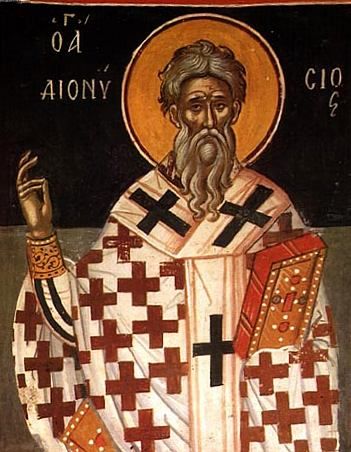
Called "the Great" by Eusebius [Eusebius of Caesarea (d. c. 339), the first historian of the Church], St. Basil, and others, was undoubtedly, after St. Cyprian, the most eminent bishop of the third century. Like St. Cyprian he was less a great theologian than a great administrator. Like St. Cyprian his writings usually took the form of letters. Both saints were converts from paganism; both were engaged in the controversies as to the restoration of those who had lapsed in the Decian persecution, about Novatian, and with regard to the iteration of heretical baptism; both corresponded with the popes of their day. Yet it is curious that neither mentions the name of the other. A single letter of Dionysius has been preserved in Greek canon law. For the rest we are dependent on the many citations by Eusebius, and, for one phase, to the works of his great successor St. Athanasius.
Dionysius was an old man when he died, so that his birth will fall about 190, or earlier. He is said to have been of distinguished parentage. He became a Christian when still young. At a later period, when he was warned by a priest of the danger he ran in studying the books of heretics, a vision-so he informs us-assured him that he was capable of proving all things, and that this faculty had in fact been the cause of his conversion. He studied under Origen. The latter was banished by Demetrius about 231, and Heraclas took his place at the head of the catechetical school. On the death of Demetrius very soon afterwards, Heraclas became bishop, and Dionysius took the headship of the famous school. It is thought that he retained this office even when he himself had succeeded Heraclas as bishop. In the last year of Philip, 249, although the emperor himself was reported to be a Christian, a riot at Alexandria, roused by a popular prophet and poet, had all the effect of a severe persecution. It is described by Dionysius in a letter to Fabius of Antioch. The mob first seized an old man named Metras, beat him with clubs when he would not deny his faith, pierced his eyes and face with reeds, dragged him out of the city, and stoned him. Then a woman named Quinta, who would not sacrifice, was drawn along the rough pavement by the feet, dashed against millstones, scourged, and finally stoned in the same suburb. The houses of the faithful were plundered. Not one, so far as the bishop knew, apostatized. The aged virgin, Apollonia, after her teeth had been knocked out, sprang of her own accord into the fire prepared for her rather than utter blasphemies. Serapion had all his limbs broken, and was dashed down from the upper story of his own house. It was impossible for any Christian to go into the streets, even at night, for the mob was shouting that all who would not blaspheme should be burnt. The riot was stopped by the civil war, but the new Emperor Decius [Roman emperor 249–251, who ordered everyone to sacrifice to the gods] instituted a legal persecution in January, 250. St. Cyprian describes how at Carthage the Christians rushed to sacrifice, or at least to obtain false certificates of having done so. Similarly Dionysius tells us that at Alexandria many conformed through fear, others on account of official position, or persuaded by friends; some pale and trembling at their act, others boldly asserting that they had never been Christians. Some endured imprisonment for a time; others abjured only at the sight of tortures; others held out until the tortures conquered their resolution. But there were noble instances of constancy. Julian and Kronion were scourged through the city on camels, and then burnt to death. A soldier, Besas, who protected them from the insults of the people, was beheaded. Macar, a Libyan, was burnt alive. Epimachus and Alexander, after long imprisonment and many tortures, were also burnt, with four women. The virgin Ammomarion also was long tortured. The aged Mercuria and Dionysia, a mother of many children, suffered by the sword. Heron, Ater, and Isidore, Egyptians, after many tortures were given to the flames. A boy of fifteen, Dioscorus, who stood firm under torture, was dismissed by the judge for very shame. Nemesion was tortured and scourged, and then burnt between two robbers. A number of soldiers, and with them an old man named Ingenuus, made indignant signs to one who was on his trial and about to apostatize. When called to order they cried out that they were Christians with such boldness that the governor and his assessors were taken aback; they suffered a glorious martyrdom. Numbers were martyred in the cities and villages. A steward named Ischyrion was pierced through the stomach by his master with a large stake because he refused to sacrifice. Many fled, wandered in the deserts and the mountains, and were cut off by hunger, thirst, cold, sickness, robbers, or wild beasts. A bishop named Chæremon escaped with his súmbios (wife?) to the Arabian mountain, and was no more heard of. Many were carried off as slaves by the Saracens [medieval Christian name for Arab and Muslim peoples] and some of these were later ransomed for large sums.
Some of the lapsed had been readmitted to Christian fellowship by the martyrs. Dionysius urged upon Fabius, Bishop of Antioch, who was inclined to join Novatian, that it was right to respect this judgment delivered by blessed martyrs "now seated with Christ, and sharers in His Kingdom and assessors in His judgment". He adds the story of an old man, Serapion, who after a long and blameless life had sacrificed, and could obtain absolution from no one. On his death-bed he sent his grandson to fetch a priest. The priest was ill, but he gave a particle of the Eucharist to the child, telling him to moisten it and place it in the old man's mouth. Serapion received it with joy, and immediately expired. Sabinus, the prefect, sent a frumentarius (detective) to search for Dionysius directly the decree was published; he looked everywhere but in Dionysius's own house, where the saint had quietly remained. On the fourth day he was inspired to depart, and he left at night, with his domestics and certain brethren. But it seems that he was soon made prisoner, for soldiers escorted the whole party to Taposiris in the Mareotis. A certain Timotheus, who had not been taken with the others, informed a passing countryman, who carried the news to a wedding-feast he was attending. All instantly rose up and rushed to release the bishop. The soldiers took to flight, leaving their prisoners on their uncushioned litters. Dionysius, believing his rescuers to be robbers, held out his clothes to them, retaining only his tunic. They urged him to rise and fly. He begged them to leave him, declaring that they might as well cut off his head at once, as the soldiers would shortly do so. He let himself down on the ground on his back; but they seized him by the hands and feet and dragged him away, carrying him out of the little town, and setting him on an ass without a saddle. With two companions, Gaius and Peter, he ramained in a desert place in Libya until the persecution ceased in 251. The whole Christian world was then thrown into confusion by the news that Novatian claimed the Bishopric of Rome in opposition to Pope Cornelius. Dionysius at once took the side of the latter, and it was largely by his influence that the whole East, after much disturbance, was brought in a few months into unity and harmony. Novatian wrote to him for support. His curt reply has been preserved entire: Novatian can easily prove the truth of his protestation that he was consecrated against his will by voluntarily retiring; he ought to have suffered martyrdom rather than divide the Church of God; indeed it would have been a particularly glorious martyrdom on behalf of the whole Church (such is the importance attached by Dionysius to a schism at Rome); if he can even now persuade his party to make peace, the past will be forgotten; if not, let him save his own soul. St. Dionysius also wrote many letters on this question to Rome and to the East; some of these were treatises on penance. He took a somewhat milder view than Cyprian, for he gave greater weight to the "indulgences" granted by the martyrs, and refused forgiveness in the hour of death to none.
Read the rest of the article
After the persecution the pestilence. Dionysius describes it more graphically than does St. Cyprian, and he reminds us of Thucydides and Defoe. The heathen thrust away their sick, fled from their own relatives, threw bodies half dead into the streets; yet they suffered more than the Christians, whose heroic acts of mercy are recounted by their bishop. Many priests, deacons, and persons of merit died from succouring others, and this death, writes Dionysius, was in no way inferior to martyrdom. The baptismal controversy spread from Africa throughout the East. Dionysius was far from teaching, like Cyprian, that baptism by a heretic rather befouls than cleanses; but he was impressed by the opinion of many bishops and some councils that repetition of such a baptism was necessary, and it appears that he besought Pope Stephen not to break off communion with the Churches of Asia on this account. He also wrote on the subject to Dionysius of Rome, who was not yet pope, and to a Roman named Philemon, both of whom had written to him. We know seven letters from him on the subject, two being addressed to Pope Sixtus II. In one of these he asks advice in the case of a man who had received baptism a long time before from heretics, and now declared that it had been improperly performed. Dionysius had refused to renew the sacrament after the man had so many years received the Holy Eucharist; he asks the pope's opinion. In this case it is clear that the difficulty was in the nature of the ceremonies used, not in the mere fact of their having been performed by heretics. We gather than Dionysius himeself followed the Roman custom, either by the tradition of his Church, or else out of obedience to the decree of Stephen. In 253 Origen died; he had not been at Alexandria for many years. But Dionysius had not forgotten his old master, and wrote a letter in his praise to Theotecnus of Cæsarea.
An Egyptian bishop, Nepos, taught the Chiliastic error that there would be a reign of Christ upon earth for a thousand years, a period of corporal delights; he founded this doctrine upon the Apocalypse in a book entitled "Refutation of the Allegorizers". It was only after the death of Nepos that Dionysius found himself obliged to write two books "On the Promises" to counteract this error. He treats Nepos with great respect, but rejects his doctrine, as indeed the Church has since done, though it was taught by Papias, Justin, Irenæus, Victorinus of Pettau, and others. The diocese proper to Alexandria was still very large (though Heraclas is said to have instituted new bishoprics), and the Arsinoite nome formed a part of it. Here the error was very prevalent, and St. Dionysius went in person to the villages, called together the priests and teachers, and for three days instructed them, refuting the arguments they drew from the book of Nepos. He was much edified by the docile spirit and love of truth which he found. At length Korakion, who had introduced the book and the doctrine, declared himself convinced. The chief interest of the incident is not in the picture it gives of ancient Church life and of the wisdom and gentleness of the bishop, but in the remarkable disquisition, which Dionysius appends, on the authenticity of the Apocalypse. It is a very striking piece of "higher criticism", and for clearness and moderation, keenness and insight, is hardly to be surpassed. Some of the brethren, he tells us, in their zeal against Chiliastic error, repudiated the Apocalypse altogether, and took it chapter by chapter to ridicule it, attributing the authorship of it to Cerinthus (as we know the Roman Gaius did some years earlier). Dionysius treats it with reverence, and declares it to be full of hidden mysteries, and doubtless really by a man called John. (In a passage now lost, he showed that the book must be understood allegorically.) But he found it hard to believe that the writer could be the son of Zebedee, the author of the Gospel and of the Catholic Epistle, on account of the great contrast of character, style and "what is called working out". He shows that the one writer calls himself John, whereas the other only refers to himself by some periphrasis. He adds the famous remark, that "it is said that there are two tombs in Ephesus, both of which are called that of John". He demonstrates the close likeness between the Gospel and the Epistle, and points out the wholly different vocabulary of the Apocalypse; the latter is full of solecisms and barbarisms, while the former are in good Greek. This acute criticism was unfortunate, in that it was largely the cause of the frequent rejection of the Apocalypse in the Greek-speaking Churches, even as late as the Middle Ages. Dionysius's arguments appeared unanswerable to the liberal critics of the nineteenth century. Lately the swing of the pendulum has brought many, guided by Bousset, Harnack, and others, to be impressed rather by the undeniable points of contact between the Gospel and the Apocalypse, than by the differences of style (which can be explained by a different scribe and interpreter, since the author of both books was certainly a Jew), so that even Loisy admits that the opinion of the numerous and learned conservative scholars "no longer appears impossible". But it should be noted that the modern critics have added nothing to the judicious remarks of the third-century patriarch [the title of the bishops of the great ancient sees: Rome, Constantinople, Alexandria, Antioch, Jerusalem].
The Emperor Valerian [Roman emperor 253–260, who persecuted bishops and clergy], whose accession was in 253, did not persecute until 257. In that year St. Cyprian was banished to Curubis, and St. Dionysius to Kephro in the Mareotis, after being tried together with one priest and two deacons before Æmilianus, the prefect of Egypt. He himself relates the firm answers he made to the prefect, writing to defend himself against a certain Germanus, who had accused him of a disgraceful flight. Cyprian suffered in 258, but Dionysius was spared, and returned to Alexandria directly when toleration was decreed by Gallienus in 260. But not to peace, for in 261-2 the city was in a state of tumult little less dangerous than a persecution. The great thoroughfare which traversed the town was impassable. The bishop had to communicate with his flock by letter, as though they were in different countries. It was easier, he writes, to pass from East to West, than from Alexandria to Alexandria. Famine and pestilence raged anew. The inhabitants of what was still the second city of the world had decreased so that the males between fourteen and eighty were now scarcely so numerous as those between forty and seventy had been not many years before. A controversy arose in the latter years of Dionysius of which the half-Arian [followers of Arius, who taught that the Son is a created being, not fully God] Eusebius has been careful to make no mention. All we know is from St. Athanasius. Some bishops of the Pentapolis of Upper Libya fell into Sabellianism and denied the distinctness of the Three Persons of the Blessed Trinity. Dionysius wrote some four letters to condemn their error, and sent copies to Pope Sixtus II (257-8). But he himself fell, so far as words go, into the opposite error, for he said the Son is a poíema (something made) and distinct in substance, xénos kat' oùsian, from the Father, even as is the husbandman from the vine, or a shipbuilder from a ship. These words were seized upon by the Arians of the fourth century as plain Arianism. But Athanasius defended Dionysius by telaling the sequel of the history. Certain brethren of Alexandria, being offended at the words of their bishop, betook themselves to Rome to Pope St. Dionysius (259- 268), who wrote a letter, in which he declared that to teach that the Son was made or was a creature was an impiety equal, though contrary, to that of Sabellius. He also wrote to his namesake of Alexandria informing him of the accusation brought against him. The latter immediately composed books entitled "Refutation" and "Apology"; in these he explicitly declared that there never was a time when God was not Father, that Christ always was, being Word and Wisdom and Power, and coeternal, even as brightness is not posterior to the light from which it proceeds. He teaches the "Trinity in Unity and the Unity in Trinity"; he clearly implies the equality and eternal procession of the Holy Ghost. In these last points he is more explicit than St. Athanasius himself is elsewhere, while in the use of the word consubstantial, 'omooúsios, he anticipates Nicæa, for he bitterly complains of the calumny that he had rejected the expression. But however he himself and his advocate Athanasius may attempt to explain away his earlier expressions, it is clear that he had been incorrect in thought as well as in words, and that he did not at first grasp the true doctrine with the necessary distinctness. The letter of the pope was evidently explicit and must have been the cause of the Alexandrian's clearer vision. The pope, as Athanasius points out, gave a formal condemnation of Arianism long before that heresy emerged. When we consider the vagueness and incorrectness in the fourth century of even the supporters of orthodoxy in the East, the decision of the Apostolic See will seem a marvellous testimony to the doctrine of the Fathers as to the unfailing faith of Rome.
We find Dionysius issuing yearly, like the later bishops of Alexandria, festal letters announcing the date of Easter and dealing with various matters. When the heresy of Paul of Samosata, Bishop of Antioch, began to trouble the East, Dionysius wrote to the Church of Antioch on the subject, as he was obliged to decline the invitation to attend a synod there, on the score of his age and infirmities. He died soon afterwards. St. Dionysius is in the Roman Martyrology on 17 Nov., but he is also intended, with the companions of his flight in the Decian persecution, by the mistaken notice on 3 Oct.: Dionysius, Faustus, Gaius, Peter, and Paul, Martyrs(!). The same error is found in Greek menologies.
The principal remains of Dionysius are the citations in Eusebius, H. E., VI-VII, a few fragments of the books On Natrure in Idem, Præp. Evang., xiv, and ;the quotations in Athanasius, De Sententiâ Dionysii, etc. A collection of these and other fragments is in Gallandi, Bibl. Vett. Patrum, III XIV, reprinted in P.G., X. The fullest ed. is by Simon de Magistris, S. Dion. Al. Opp. omnia (Rome, 1796); also Routh, Reliquiæ Sacræ III-IV. Syriac and Armenian fragments in Pitra, Analecta Sacra, IV. A complete list of all the fragments is in Harnack, Gesch. der altchr. Litt., I, 409-27, but his account of the passages from the Catena on Luke (probably from a letter to Origen, On Martyrdom) needs completing from Sickenberger, Die Lucaskatene des Niketas von Heracleia (Leipzig, 1902). For the life of Dionysius see Tillemont, IV; Acta SS., 3 Oct.; Dittrich, Dionysius der Grosse, eine Monographie (Freiburg im Br., 1867); Morize, Denys d'Alexandrie (Paris, 1881). Dom Morin tried unsuccessfully to identify the Canons of Hippolytus with D IONYSIUS" 'Epistóle diokonikè dià 'Ippolútou (Euseb., H. E., VI, 45-6) in Revue Bénédictine (1900), XVII, 241. Also Mercati, Note di letteratura bibl. et crist. ant.: Due supposte lettere di Dionigi Aless. (Rome, 1901). For chronology see Hanack, Chronol., I, 202, II, 57. A very good account, with full bibliography, is in Bardenhewer, Gesch. der altkirchl. Litt., II. On the Chiliastic question see Gry, Le Millénarisme (Paris, 1904), 101.