Theodoret, after relating the virtues of S. Maro the hermit, (Feb. 14th) goes on to tell of a holy virgin, named Domnina, who lived in a small shed, and attended prayers in the Chu
Read the essentials →Theodoret, after relating the virtues of S. Maro the hermit, (Feb. 14th) goes on to tell of a holy virgin, named Domnina, who lived in a small shed, and attended prayers in the Chu
Read the essentials →Theodoret, after relating the virtues of S. Maro the hermit, (Feb. 14th) goes on to tell of a holy virgin, named Domnina, who lived in a small shed, and attended prayers in the Chu
March 1
March 1
Virgin
Hermit
Thin entry · the 1897 book gives only 92 words. We have not filled the gap with invented detail.
Theodoret, after relating the virtues of S. Maro the hermit, (Feb. 14th) goes on to tell of a holy virgin, named Domnina, who lived in a small shed, and attended prayers in the Church at cock-crow. She was emaciated with continuous fasting; she neither looked at any one, nor suffered her own face to be seen. Whenever she took the hand of Theodoret, the bishop, to kiss it, he drew it away moistened with her tears.
Pray a little every day. Prayer runs all through this account.
Practise small acts of self-denial. The account dwells on fasting and penance; a skipped snack or a phone-free hour is a start.
Make time for silence. Solitude and withdrawal to pray shape this life.
Theodoret, after relating the virtues of S. Maro the hermit, (Feb. 14th) goes on to tell of a holy virgin, named Domnina, who lived in a small shed, and attended prayers in the Church at cock-crow. She was emaciated with continuous fasting; she neither looked at any one, nor suffered her own face to be seen. Whenever she took the hand of Theodoret, the bishop, to kiss it, he drew it away moistened with her tears. She spent her time, when not engaged in prayer, in ministering to the necessities of travellers.
Feast: March 1
One short email a day for nine days. The day's prayer, a line from St. Domnina's story, and a nudge to keep going.
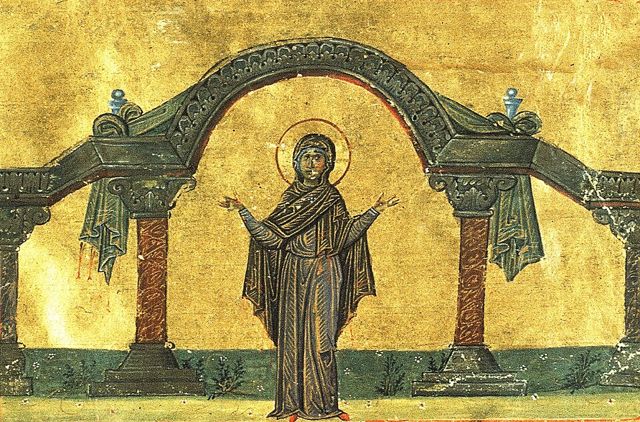
Image: Domnina of Syria (Menologion of Basil II).jpeg · Authors of Menologion of Basil II (circa 985 AC, Constantinople), Byzantine manuscript illuminators[1]: Pantoleon with G · Public domain, via Wikimedia Commons
From Sabine Baring-Gould, The Lives of the Saints, new edition in 16 vols. (London: John C. Nimmo, 1897), digitized text from Project Gutenberg. Public domain.
Image: Authors of Menologion of Basil II (circa 985 AC, Constantinople), Byzantine manuscript illuminators[1]: Pantoleon with G, Wikimedia Commons (Public domain)
From Sabine Baring-Gould, The Lives of the Saints, new edition in 16 vols. (London: John C. Nimmo, 1897), digitized text from Project Gutenberg. Public domain in the United States. Reproduced unedited, except for short bracketed notes in grey that we added to explain names and terms (“S.” is the old abbreviation for Saint). Some history and judgments reflect 19th-century scholarship.