Baring-Gould’s sources: Canonized by Alexander III. in 1161, and the festival appointed for Jan. 5. In 1163 the body was translated, on Oct 13; on which day his principal festival is now kept A national council at Oxford in 1222 commanded his festival to be kept throughout England as a holiday. Authorities: — (1) A life by Aelred of Rievaulx, d. 1166. (2) A second life written before 1074, pub. by H. R. Ward, in “ Rer. Britann. Med. Aevi Script.” iii. (3) “ La Estoire de Seint iEdward le Rey,” an old French epic poem, written by a monk of Westminster in 1245. (4) The Anglo-Saxon Chronicle. (5) Florence of Worcester, d. 1118. (6) William of Malmesbury, d. 1143. (7) Ordericus Vitalis, d. 1144. (8) An Icelandic JAtvarthar Saga, pub. Copenhagen, 1852. (9) ‘‘Encomium Emmse,” by a contemp. writer; &c.] On the death of Ethelred II. in 1016, many of the English, wearied with the incessant conflict with the Danes, resolved to elect Cnut, or Canute as he is commonly called, king of the English. But those who remained faithful to the old house of the Saxon princes held an election in London, and chose Edmund, son of Ethelred, in his room, and he was crowned in the cathedral of S. Paul’s by Archbishop Lyving. Canute held Wessex, which now included the whole of England south of the Thames, but on an uncertain tenure, as the gallant Edmund entered Wessex, and defeated the Danes at Pen Selwood. Canute besieged London, but Edmund again defeated him, at Brentford.
Edmund died, after a glorious reign of seven months, on S. Andrew’s day, leaving behind him two sons, Edmund and Edward. Of his brothers three at least were living, Edwy, son of Ethelred the Unready, by his first wife, and Alfred and Edward, the sons of Emma of Normandy. On the death of Edmund Ironside, Canute established himself without resistance over the whole realm. Alfred and Edward, sons of Ethelred and Emma, escaped with their mother to Normandy, and the two sons of Edmund, Edward and Edmund, were sent by Canute to King Olaf of Sweden, who sent them into Hungary to S. Stephen, that they might be beyond the reach of Canute, who desired their deaths, and had requested Olaf to destroy them. Edmund died young, but Edward lived, and eventually married Agnes, niece of Gisela, wife of S. Stephen.
In 1017 Canute sent over to Normandy for Queen Emma, widow of Ethelred, and married her. She must have been somewhat advanced in life, for it was fifteen years since her marriage with Ethelred, and Canute was a young man, only twenty-two. Queen Emma is said to have made Canute promise that he would leave the crown to one of her children by him, should she have any through her second marriage. Edmund and Edward, her sons by Ethelred, remained in Normandy under the care of Duke Richard. In 1026 Richard of Normandy died, and his successor, Richard III., died very soon after. Then, in 1028, Robert, the 0cL X30 6*. Edward the Confessor. 329 younger son of Richard II., succeeded his brother. He was the father of William the Conqueror. The Norman writers inform us that he meditated doing something to advance the claims of his cousins to the throne of England, and that he sent a fleet against Canute, but that it was driven back by contrary winds, and some of the ships were wrecked. Emma, now queen of the English for the second time, had become the mother of two children by Canute, Hardacanute and Gunhilda. Canute died in 1035, at the age of forty, and was succeeded by his son Harold, by Elgiva, daughter of Earl Alfhelm. Harold took the kingdom north of the Thames, whilst the south was relinquished to Hardacanute. The latter, however, was in Denmark, of which he was king, and during his absence his dominions in the south of England were governed by his mother Emma and Earl Godwin. Godwin was a very remarkable man: risen apparently from obscurity, he forced his way by his abilities to a position of the highest trust and power. Very early in the reign of Canute he was made an earl, and shortly after Earl of all Wessex [the Anglo-Saxon kingdom of southern England], and viceroy when Canute was out of England. When Canute died, Godwin remained Earl of the West Saxons under Hardacanute, Harold, and Edward. In the year 1036 Alfred, the eldest of the surviving children of Ethelred, was murdered, and the name of Godwin was implicated in the foul deed. The story is told variously. Though Hardacanute had been made king over part of England, he stayed in Denmark, and great discontent was felt in Wessex at his not visiting bis dominions. It was most likely this which induced Alfred, son of Ethelred and Emma, to leave Normandy and venture into England. He hoped to profit by this discontent, and secure for himself the crown of Wessex. It does not appear that either Emma or Earl Godwin, or any one else, invited him, but it is quite certain that he came over, bringing with him a good many Norman followers. It is uncertain whether he met his mother or not. According to some accounts she was exasperated at his intrusion; and, in alarm lest he should wrest the crown from her favourite son, Hardacanute, she herself had a hand in the bloody deed. Earl Godwin met Alfred at Guildford, but did not arrest him, nor interfere with his progress, and it is not improbable that he secretly sympathized with his attempt. But Alfred was shortly after taken by the servants of Harold, his companions were killed, tortured, or mutilated, and he himself was conveyed to Ely, where his eyes were put out, and he soon afterwards died. Godwin has been charged with this crime by later historians, but the evidence is against his having had any share in it Godwin was not the minister of Harold, but of Hardacanute, and he had opposed the election of Harold,. Godwin probably saw that before long the popular impatience of Hardacanute would lead to the union of Wessex with the north of England under the sceptre of Harold, and he may have feared that in this event his prospects would not improve. Far safer for him to have a Saxon prince his master in Wessex. His interest lay in protecting and favouring Alfred, not in putting him out of the way.
Next year, 1037, the people of Wessex got tired of waiting for Hardacanute, and Harold was chosen king over all England. Queen Emma was driven out of the land, and took refuge with Baldwin of Flanders at Bruges. Harold died in 1040, and was succeeded by Hardacanute. He crossed at once to England with sixty Danish vessels, and the first thing he did was to levy a heavy tax on the whole land to pay his Danes [Viking raiders from Scandinavia]. He then caused the body of his half-brother Harold to be dug up, and thrown into a fen. An accusation was then trumped up against Bishop Lyving of Worcester and Earl Godwin of having caused the murder of Alfred. Hardacanute deprived the bishop; but Earl S. Edward the Confessor.
Godwin took oath of his innocence, and bought his exculpation at the price of a magnificent ship, manned by eighty picked men, well armed.
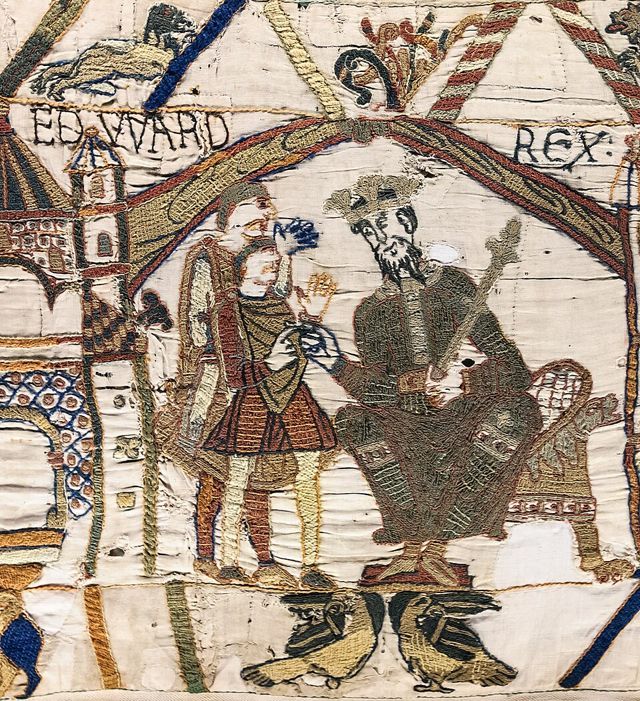
Shortly after Hardacanute deprived Archbishop Elfiric, to whom he had given the bishopric of Worcester, and rein-, stated Lyving; so that there seems no doubt that the king did not believe in Ly ving*s guilt Queen Emma returned to England in 1040, and then her son Edward came over from Normandy and lived at the Court of Hardacanute. In the year 1042 Hardacanute died, and Edward was almost unanimously elected king of the English in his room, through the united influence and persuasion of Bishop Lyving and Earl Godwin. Edward was anointed and crowned king on Easter Day, 1042, at the age of forty. He was a mild, pious, but feeble prince: his heart, weaned from the world, sought comfort in religion, and the cares of government were a painful distraction to a mind musing on heavenly things. From his infancy he had been addicted to prayer. He assisted daily at the holy Sacrifice, visited churches and monasteries with assiduity, and loved the converse of churchmen. He was modest in his comportment and sparing in his words.
Earl Godwin became the king’s chief adviser, and nearly two years after his coronation, in January, 1045, Edward married Godwin’s daughter, Edith.
Ingulf of Croyland says: “ He married Editha, the daughter of Earl Godwin, a lady of exquisite beauty, of exceeding erudition, of exemplary conduct, of humble piety, and throughout the whole of her life an unsullied virgin; mild and retiring in character, she was not imbued with any of the rude and barbarous manners of her father and brothers; true and honourable in mind, she excited the enmity of no one; so that she deserved the eulogium of the well-known verse, ‘ As the thorn the rose, so Godwin begat Editha.’ Many a time have I, when a boy on a visit to my father at the king’s court, beheld her, and often has she met me on my return from school, and questioned me about literature and my composition, and then, diverting the conversation, as she much liked to do, from grammatical accuracy to the trifling subtleties of logic, of which she was a perfect mistress, when she had reduced me to silence by a cunning train of argument, she has directed her attendant to present me with three or four pieces of money, and then sent me to the royal buttery, feasted me, and sent me off.” Unfortunately Ingulf is not to be trusted. His work is, if not a late forgery, at all events so amplified by a later hand with fraudulent purpose, as to be undeserving of confidence. His account of himself is full of anachronisms, consequently we can put no trust in his statement that Edith was an unsullied maiden to the day of her death. William of Malmesbury, writing in 1142, just a century later than the reign of Edward, says: “ She was a woman whose bosom was the school of every liberal art, though little skilled in earthly matters; on seeing her, if you were amazed at her erudition, you must absolutely languish for the purity of her mind, and the beauty of her person. Both in her husband’s lifetime and afterwards, she was not entirely free from suspicions of dishonour; but when dying, in the time of King William, she voluntarily satisfied the bystanders of her unimpaired chastity by an oath. When she became his wife, the king acted towards her most delicately, and knew her not I have not been able to discover whether he acted thus from dislike to her family, or out of pure regard to chastity; 1 yet it is most notoriously affirmed that he never violated her purity.” As soon as Edward was crowned, accompanied by the 1 Roger of Wendover says: “ Whether he acted thus from hatred of her father, or from love of chastity, is uncertain; but the presumption is strong that the pious king was unwilling to beget successors of a traitor stock.” S. Edward the Confessor.
three great earls, Godwin, Leofric, and Siward, he rode to Gloucester, where his mother Emma was living. She had not shown any love to him or his brother Alfred, but had transferred her maternal affections to her children by Danish Canute. Edward resented this, and his first act after his coronation was to swoop down on her, “ and the king caused all the lands which his mother possessed to be seized into his own hands,” says the Saxon chronicle, “ and he took from her all that she possessed in gold, and in silver, and in things unspeakable, because she had before held it too closely from him. And soon after, Stigand was deposed from his bishopric, and all that he possessed was seized into the king’s hands, because he was nearest to his mother’s counsel, and she went just as he advised her, as people thought.” Florence of Worcester adds that he kindly allowed her the necessaries of life, and “ ordered her to remain quiet.”
Not long after, Edward banished Gunhilda, niece of King Canute, with her two sons, probably because they had opposed his election.
But if Edward was implacable against those who had not been liberal towards him when he needed money, or who had opposed his coming to the crown, he was ready enough to favour those who had befriended him. In Normandy he had contracted many friendships, and when he became King of England these Normans swarmed about him, asking for preferment. Edward good-naturedly gave them what they wanted. He put a Norman monk into the bishopric of London, and he gave that of Dorchester to another Norman, named Ulf, a bad man, who, as the chronicles say, “ did nothing bishop-like.”
This nominee of the king went to Rome for confirmation, but Pope Leo “ almost broke his staff,” as the Saxon chronicle says, because Ulf was so ignorant that he could scarcely read the missal or breviary. But Ulf bribed those around the Pope and secured the bishopric. In 1050, Eadsig, Archbishop of Canterbury, died, and the monks of Christ Church elected to the vacant throne one Elfric, an Englishman. Earl Godwin urged the king to confirm the election, but he would not hearken to his advice, or regard the rights of the electors, but appointed to the archiepiscopal see his Norman favourite, Robert, to whom he had given the bishopric of London. There had not been a foreigner archbishop of Canterbury, perhaps not bishop of any see at all, since Theodore of Tarsus. And now, as if there were nobody in England good enough for any high place, these Normans were given bishoprics and other high offices, and were generally set to suck up the fat of the land. Even those who did not stay in England to hold estates and offices, came over to see the king, and to get presents from him. Archbishop Robert especially was always foremost in mischief; he tried to set the king against Earl Godwin and those of the English who were about his person. The king's sister Godiva had married Drogo, Count of Mantes, and her son Ralph had an earldom, and other Normans large estates in the island, and they erected strong castles on them after the Norman fashion, oppressed the people and reduced them to vassalage. This was very galling to the English, who could not endure the feudal despotism which had been growing up in France, and which was alien to their free institutions. Presently there came a crash.
Godiva had lost her husband, the Count of Mantes, and she married Eustace, Count of Boulogne, who shortly after his marriage came over, like other people, to see his brother-in-law, and get from him estates or money. Then he set off on his way home, laden with presents. On reaching Dover he and his retainers went to the house of one of the principal citizens, and wanted to force their way in and lodge there uninvited, Gooq S. Edward the Confessor.
as conquerors might treat a subjugated people. The master of the house refused to admit the haughty strangers, and a skirmish took place between the Normans and the people of Dover, who rushed to revenge theij fellow-citizen, whom the Normans had killed for refusing them hospitality. If we may trust Roger of Wendover, “ The earl and his comrades in great wrath slew a number of men and women, and trod their children under their horses' feet.” In the fight, about twenty people on each side were killed, 1 but at length Eustace and his men were driven out of the town. They returned to the king, who was at Gloucester, and told him their story. Edward was so incensed, that he ordered Earl Godwin to march with troops at once to Dover, and severely chastise the town for having insulted his Norman brother-in-law. Godwin peremptorily refused to stain his hands in blood for such a matter. He told the king that no man in his earldom should be put arbitrarily to death without a fair trial by jury, as instituted by King Alfred. French vassals might submit to be chastised like curs at the caprice of their lords, but this free Englishmen would not endure. If the men of Dover had committed a crime, let their magistrates be brought to trial before the Witenagemot, and tried fairly. This language ill pleased the king's French favourites; they represented to him that in their land a sovereign prince, or noble, might chastise his vassals at will, and was supreme judge of their conduct. And they incensed him more and more against Godwin, whose freedom of speech in defence of right had somewhat galled his spirit. Godwin, finding that the king was set against him, assembled with Earls Sweyn and Harold at Beverstone in Gloucestershire, on the top of the Cotswolds near Tetbury. Meanwhile the king sent to Siward, the Danish Earl ot 1 Roger of Wendover says that eighty Normans were killed, but this is an exaggeration.
the Northumbrians, and to Leofric, Earl of the Mercians, and to his nephew, the French Earl Ralph, and got together an army. But the great bulk of the people flocked to Earl Godwin, as the protector of their rights and liberties. Then, as the king had done no justice, Earl Godwin demanded that Edward should banish his Norman friends from their earldoms, where they oppressed their subjects, and that the earldoms should be given up to them. The king refused, as his army was eager to attack Earl Godwin and his AngloSaxons. But the great earl did not dare to bring matters to a bloody conclusion, and it was agreed that the matter should be referred to the Witenagemot. When the wise men assembled, Godwin and his sons were summoned before them. They declined to attend unless the king would pledge his word that they should be allowed to come and go safely, and would deliver hostages in pledge of his sincerity. This the king refused to do, so Godwin and his sons would not appear before the Witenagemot The assembly therefore pronounced them contumacious and outlawed them. So Earl Godwin and his wife Gytha, and their sons Sweyn, Tostig, and Gurth, took refuge with Baldwin, Count of Flanders, at Bruges.
It is probable that the pride and power of Godwin had created jealousy and alarm. He was right in his demands, and he took up arms in the defence of the right, but underneath all lay, or was thought to lie, ambition to advance his own family. This may explain the conduct of the wise men in outlawing him and his sons. Godwin’s sons Sweyn and Tostig and Gurth accompanied him to Bruges, but Harold and Leofwin, his two other sons, went to Ireland, where they were well received by Dermot, King of Leinster. As soon as Godwin and his sons were disgraced and outlawed, King Edward turned on his wife Edith, the daughter of Godwin, and treated her much as he had treated his S. Edward the Confessor.
mother. The Anglo-Saxon Chronicle says: “ Then put away the king the lady who had been consecrated his queen, and caused to be taken from her all which she possessed, in land, and in gold, and in silver, and in all things, and delivered her to his sister at Wherwall.” 1 At the same time he expelled Sparhavoc, Bishop of London, and thrust upon the diocese his Norman chaplain, William. The abbey of Abingdon he gave to a Norman bishop, Rudolf. The earldom of Somerset, Devon, Dorset, and Cornwall was given by the king to a kinsman — probably another Norman — named Odda.
As soon as Godwin was gone, Edward felt relieved of the dictation which interfered with his surrounding himself with Normans. He was visited then by William, Duke of Normandy, his cousin, and it was then that Edward made to him the unfortunate promise which cost England her best blood, and led to her conquest. William always based his claim to the throne on a promise made him by King Edward at this time. The crown of England was elective, so that Edward could not leave it to whom he would, but he was so imbued with French despotic notions which he had imbibed in his youth in Normandy, that he may have thought he could do so. And at this time he was full of bitterness against Godwin and his sons, so that he probably made the promise to William in the hopes of excluding Godwin's family from the throne, and in his bigoted preference for Norman despotism over the freedom of English institutions.
William and his companions received many gifts from King Edward, with which they returned to Normandy. In 1052 died the queen's mother, Emma, at Winchester, and was buried beside her second husband, Canute. She 1 Florence of Worcester and Roger of Wendover say. “He sent her away ignominiously, with one servant."
seems to have been a hard, selfish, and unscrupulous woman. Scandalous stories were circulated about her intercourse with Bishop Alwyn of Winchester, and she was put to the ordeal by fire, but walked unharmed over red-hot ploughshares. Such is the story told by historians like Brompton (a.d. 1198) and Knyghton (a.d. 1395), but the story is imported from the legend of S. Kunegund (a.d. 1040), the wife of Henry II. of Germany. No historian to whom much credit is due records it.
Things did not prosper in England under Norman rule. Griffith, King of North Wales, burst into Herefordshire and harried the country as far as Leominster. Frequent skirmishes took place and much blood was shed, the Welsh generally proving victorious; the whole frontier was in a condition of alarm and distress.
Meanwhile, Earl Godwin and his sons thought of coming home again. They got the Marquis Baldwin, and Henry, King of the French, to plead for them, but in vain; the Norman favourites of the king had his ear, and would not suffer him to hearken. Accordingly Godwin and his three sons who were with him in Flanders, sailed for England, and simultaneously Harold and Leofwin came over from Ireland with nine ships. King Edward sent a fleet to Sandwich to watch for Godwin, under the Earls Ralph and Odda, but a storm drove back the ships of Godwin. When he sailed again, King Edward found that his English sailors and soldiers would not fight under their Norman chiefs against the English earl, and Godwin landed on the 14th September, a.d. 1052, in London. The king made every effort to collect an army. “ But,” says Florence of Worcester, “ as there were few men of any courage, either on the king’s or on Godwin’s side, who were not Englishmen, nearly all shrunk from fighting against their kinsfolk and countrymen; S. Edward the Confessor.
so that the wiser sort on both sides interfered to restore peace between the king and the earl, and both armies received orders to lay down their arms. The next morning the king held a council, and fully restored to their former honours Godwin, and his wife, and all his sons.... The king also took back with due honours Queen Edith, the earl’s daughter, and restored her to her former dignity. The alliance being renewed and peace established, they promised just law to all the people, and banished all the Normans who had introduced unjust laws and given unrighteous judgments, and in many things had influenced the king to the disadvantage of his English subjects.”
When the two French bishops, Robert of Canterbury and Ulf of Dorchester, heard the decision of the Witenagemot, they mounted their horses and galloped out of the east gate of London, cutting down with their long Norman broadswords all who opposed them, till they got to the coast, when they sailed away in a crazy ship, and never came back. Bishop William of London went away also, but he was recalled, for he was a good and holy man, and the English people bare no ill-will against him. Next morning the Witenagemot met again, and Earl Godwin rose and made a speech, and said that he and his sons were guiltless of the charges raised against them; and he was reinstated in his earldom, and all his sons were taken back into favour with the king.
Next year, 1053, at Easter, died Earl Godwin, whilst feasting with the king. An idle story was invented concerning his death, which has been reported by the Norman chroniclers, who held him in peculiar detestation. According to this tale, whilst Godwin was feasting with the king, the cupbearer’s foot slipped, and he would have fallen had he not stayed himself up with the other foot. Then said Godwin, “So brother helpeth brother.” “I had a brother once,” said Edward; “ he would have helped me hadst thou not slain him.”
Then said Godwin, “ Many a time have I been charged by thee with this murder of thy brother Alfred. Now I call God to witness that I am innocent. If not, may this piece of bread choke me.” And he took a morsel of bread from the table and put it in his mouth. It stuck in his throat and he died. 1 This malicious story rests on no foundation. The English wept for Earl Godwin as for their friend and father, the defender of their liberties, a true Englishman at heart; but they rejoiced that he had left a worthy son to walk in his ways. For when Godwin died, Harold, his son, was made Earl of the West Saxons, and from this time Harold became the greatest man in the kingdom. He and King Edward were very good friends, and Harold in fact governed the kingdom, leaving the king ample leisure for his theological musings and devotions. Edward was very fond of hunting.
“There was one enjoyment in which he chiefly delighted,” says William of Malmesbury, “ which was, hunting with fleet hounds, whose opening in the woods he used with pleasure to encourage; and again, with the pouncing of birds whose nature it is to prey on their kindred species. In these exercises, after hearing divine service in the morning, he employed himself whole days. In other respects he was a man by choice devoted to God, and lived the life of an angel in the administration of his kingdom. To the poor and to the stranger, more especially foreigners, and men of religious orders, he was kind in invitation, munificent in presents, and 1 The story is contradicted by the account of Florence of Worcester, who says that the earl was taken ill at the banquet, and carried to the king's room, where he lingered on for five days, and then died. He evidently was struck with apoplexy. S. Edward the Confessor.
constantly inciting the monks of his own country to imitate their holiness. He was of a becoming stature, his beard and hair milk-white, his countenance florid, fair throughout his whole person, and his form of admirable proportion.” Elsewhere William of Malmesbury says of him: “ He was a man from the simplicity of his manners little calculated to govern, but devoted to God, and in consequence directed by Him. For while he continued to reign there arose no popular commotions which were not immediately quelled; no foreign war, all was calm and peaceable both at home and abroad, which is the more to be wondered at, because he conducted himself so mildly that he would not even utter a word of reproach to the meanest person. For when he had gone out once hunting, and a countryman had upset the standings by which the deer are driven into the toils, struck with noble indignation he exclaimed, * By God and His Mother ! I will serve you just such a turn, if ever I have the chance.* Here was a noble mind, which forgot that he was a king, under such circumstances, and could not think himself allowed to injure a man even of the lowest condition.” William of Malmesbury rightly attributes the tranquillity and prosperity of his reign to his having been under the control of master minds: Siward, Earl of Northumbria [the Anglo-Saxon kingdom of northern England and south-east Scotland]; Leofric, Earl of Hereford; and Harold, son of Godwin, Earl of the West Saxons. “ However indolent and unassuming he himself might be esteemed, he had nobles capable of elevating him to the highest pitch.”
It will be hardly necessary to relate the political events of the remaining years of King Edward's life, as whatsoever was done in repelling and crushing the Welsh, and in fighting the Scots, was done by his great Earls Harold and Siward. He had no part in the wars and victories, and no credit attaches to him for the breaking of the Welsh power, or for the defeat of Macbeth.
[Oct. i* In 1055, as King Edward had no children, he sent an embassy into Germany to the Emperor Henry III., and one object of the embassy was to get the emperor to send into Hungary for Edward the Etheling, son of Edmund Ironside, who was now the only representative of the old royal race. King Edward was then aged fifty-two. In 1057 Edward the Etheling came to England with his children, but did not meet his uncle the king, for he died on his arrival in England, and was buried in S. Paul's, leaving a son, Edgar, a child.
King Edward remitted the tax called the Danegeld, which had been imposed on the nation in 1000, and which was money for bribing the Danes not to molest the English. When Canute was king he continued the tax, and paid with it his Danish fleet It continued to be collected under Hardacanute, and also under King Edward, though the excuse for the tax was gone. But Edward saw this and remitted it, to the great joy of the English. According to the legend the king was taken into his treasury to see the pile of gold at his disposal, collected under the name of Danegeld, and he exclaimed that he saw a devil dancing on top of the heap. He therefore ordered it to be dispersed among the poor, and refused to have the tax again imposed on the English.
During his exile in Normandy, S. Edward made a vow to perform a pilgrimage to the tomb of the Apostles at Rome, should God give him the throne of his father. When made king he thought about fulfilling his vow, but when he propounded before the Witenagemot his intention of making his pilgrimage, the council protested that it was impracticable, and at last made the king understand that it was folly for him to think of leaving the kingdom to shift for itself whilst he was absent. Edward consented to refer the matter to Leo IX., who then sat in the chair of S. Peter. Aelred, S. Edward the Confessor.
Archbishop of York, Heriman, Bishop of Winchester, and two abbots were despatched to Rome on this errand. The Pope dispensed with the vow on condition that Edward should give to the poor the money which his journey would have co$t him, and also should build and endow a magnificent abbey dedicated to S. Peter. King Edward having received this brief, pitched on Westminster as the site of his foundation. The year 1065 was a troubled one. The Northumbrians were not content under the rule of Tostig, their earl, son of Godwin, and brother of Harold. He was a rough, stem governor, and he compassed his ends by unjustifiable means. In 1064 a Northumbrian thane named Cospatric had come to the Court of King Edward. Tostig bore him some grudge, and he sent private intimation of his wish to see him made away with to his sister, the learned and pious Edith, the queen. Edith at once had him murdered at Court, whilst the Christmas festivities were being carried on. Tostig also murdered two thanes, Gamel, Orm's son, and Ulf, Dolfin’s son, in his own chamber at York.
“ Soon after the feast of S. Michael/* says Florence of Worcester, “ the Northumbrian thanes Gamelbjom, Dunstan Athelneth’s son, Glonicom Hjardulfs son, entered York with two hundred soldiers, to avenge the execrable murder of the noble Northumbrian thane, Cospatric, who was treacherously killed by order of Queen Editha at the king's Court on the fourth night of Christmas, for the sake of her brother Tostig,” as also for the murder of Gamel and Ulf. Another cause of discontent was the “ enormous taxes which Tostig unjustly levied throughout the whole of Northumbria.** The rising became general throughout the north; the men of Lincolnshire, Nottinghamshire, and Derbyshire joined them, and marched to Northampton. There Harold went to meet them, and held a great meeting. King Edward [Oct. i> sent, charging the Northumbrians to leave off their rebellion. They in return demanded that Earl Harold should lay their complaints personally before him, and should demand the banishment of Tostig from the king’s presence and from the kingdom, otherwise they said they would fight. Harold went to the king with their message, on which Tostig charged his brother most unjustly with having set on the Northumbrians to make these accusations against him. Nothing could be more unlikely, as Harold had no kind of motive for doing so; and Harold indignantly repudiated the charge. But though Harold had no motive to stir up the Northumbrians to rebellion, he had an obvious motive not to push them to extremities. A civil war between the north and south of England would be most disastrous to the whole nation, and rather than have that, he would consent to their just demands, and sacrifice his brother. Whilst he was with the king, the Northumbrians gave earnest of their intentions by plundering Northamptonshire, burning houses and com, and carrying off hundreds of captives. Harold met them again at Oxford, which the Northumbrian army had now reached. He tried to persuade them to take Tostig back, but they would not hearken. So Morkere, son of Earl Alfgar, was made their earl, and Tostig was outlawed and banished. King Edward was very angry at having to part with his favourite, and at not being allowed to chastise his enemies. But Earl Harold knew that it must be so, and the king had nothing left but to pray that God might punish them, and whether through his prayers or not, certainly the Northumbrians suffered evil enough during the ensuing years. In 1066, at Christmas, King Edward held his Court at Westminster, and on Holy Innocents’ Day caused the abbey he had erected to be dedicated with great pomp to the Prince of the Apostles. But both before and during the solemn festival of the dedication he was ill. As his illness aits&:K?I 3 III a S. Edward the Confessor.
increased he took to his bed, when, after lying two days speechless, and apparently lifeless, he revived on the third day, and fetching a deep sigh, exclaimed, “ Almighty God, if it be not an illusion, but a true vision which I have beheld, grant me strength to tell it to those who are by; but if on the other hand it be false, I pray Thee withhold from me the power of telling it.” After this prayer he said: u I saw just now standing by me two monks whom I had seen in Normandy in my youth, and knew to have lived most religiously, and died most Christianly. These men assured me that they were sent to me with a message from God, and proceeded as follows: * Forasmuch as the princes, dukes, bishops, and abbots of England are not the servants of God but of the devil, therefore God will within a year and a day deliver this kingdom into the hand of the enemy; and this land shall be wholly overrun with demons/ On my saying that I would declare this to the people that they might repent, 4 It will be to no purpose/ they replied, ‘for they will not repent, nor will God have mercy upon them/ 4 But when may we hope for a remission of such dire calamities?’ I asked. ‘When/ they replied, 4 a green tree shall be cut down and the head carried far away from the roots, and after this they of their own accord unite and blossom and bear fruit, then may a remission of these evils be hoped for/” Roger of Wendover appends this remark: “The English afterwards proved the truth of this prophecy; for England truly became the dwelling of foreigners and felt the yoke of strangers, none of her dukes, or prelates, or abbots being English, nor was there any hope of ending this misery.” Roger of Wendover wrote in 1235; he took his stoiy from William of Malmesbury, who wrote in 1142. The story was, no doubt, invented after the Norman Conquest, when popular delusion had exalted Edward into the representative Saint and Patron of the English people. [Oct- z> There was not the slightest probability of his regarding a Norman invasion as the overrunning of the country by demons. He always favoured these insolent foreigners at the expense of his own subjects.
King Edward died on the eve of the Epiphany, Thursday, January 5, 1066, and was buried next day in the minster he had built, and where his body still reposes. He was the first English king to touch scrofulous swellings and sores for the purpose of healing them. Many came to him to be touched, and every one who asserted that he was healed was rewarded with a gold medal. It was marvellous how many succeeded in persuading the king that they were healed, and thus securing the piece of gold. The body of S. Edward reposes in a noble tomb in Westminster Abbey. 1 has been consulted.