Witnessing to Christ by the way of life, not by death.
Read the essentials →Witnessing to Christ by the way of life, not by death.
November 6
November 6
Confessor
…satisfied husband. The screams of the chief prevented an explanation. The husband and wife looked out, and four\d the chief seated on the horse, glued by his hand to the wall, and the steed cropping the grass, and gradually retreating from under him, like Don Quixote’s adventure at the inn.
Make time for silence. Solitude and withdrawal to pray shape this life.
Build up the community you belong to. This life was lived with and for a community.
Learn from the kind of life it was. Witnessing to Christ by the way of life, not by death.
…satisfied husband. The screams of the chief prevented an explanation. The husband and wife looked out, and four\d the chief seated on the horse, glued by his hand to the wall, and the steed cropping the grass, and gradually retreating from under him, like Don Quixote’s adventure at the inn. The prayers of the holy couple released the chief, and he largely endowed Efflam with lands in gratitude, and promised not to disturb Honora with his attentions for the future. Efflam built his wife a cell at a little distance from his own. After some years, hearing of the virtues of the inhabitants of Llannenock, she went there, and was received by S. Nennocha with great warmth. She died in that community, and is regarded as a saint, and is invoked in fevers. S. Efflam and his community ate nothing on Mondays, Wednesdays, and Fridays. On the other days an angel brought them excellent viands from Paradise, and spread their table for them on the grass.
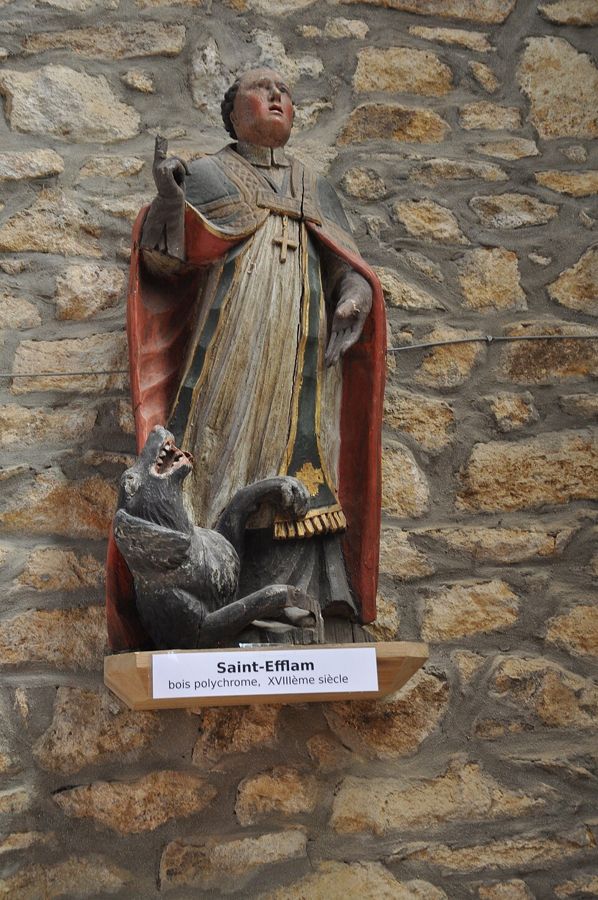
After some time a priest named Gestin appeared at the cell door and claimed the hovel. He had built and inhabited it, but had deserted it when he went on a pilgrimage to Rome. Efflam offered to remove, but when Gestin saw how virtuous he was, he declined to reoccupy his old cabin. An angel appeared and ordered Efflam to remain in possession, and Gestin to retire to the adjoining forest. The parish is called after him Plou-Gestin, contracted into Plestin. After having served God well in his hermitage, Efflam died, on November 6th, at the close of the sixth century. He is represented in royal habits, treading on a dragon. The tomb of S. Efflam, constructed in the fourteenth or fifteenth century, was opened in 1819, but no traces of the body were found. All that was discovered was a stone with an incised hatchet on it, a little copper cross, and some bits of sea- wrack.
Feast: November 6
One short email a day for nine days. The day's prayer, a line from St. Efflam's story, and a nudge to keep going.
Image: Saint Efflam, Carnoet.jpg · Philippe Alès · CC BY-SA 4.0, via Wikimedia Commons
From Sabine Baring-Gould, The Lives of the Saints, new edition in 16 vols. (London: John C. Nimmo, 1897–98); text from the Internet Archive scan (OCR, lightly cleaned; errors possible). Public domain.
Image: Philippe Alès, Wikimedia Commons (CC BY-SA 4.0)
From Sabine Baring-Gould, The Lives of the Saints, new edition in 16 vols. (London: John C. Nimmo, 1897–98); text from the Internet Archive scan (OCR, lightly cleaned; errors possible). Public domain in the United States. Reproduced unedited, except for short bracketed notes in grey that we added to explain names and terms (“S.” is the old abbreviation for Saint). Some history and judgments reflect 19th-century scholarship.