Read Baring-Gould’s full account
Baring-Gould’s sources: Roman, Gallican, Belgian, and Benedictine Martyrologies. At Bergues- Saint- Winnoc three festivals are held in his honour — Nov. 6, the day of his death; Feb. 20, the day of the Exaltation of his relics; and Sept. 18, the feast of their Translation. Ferrarius indicates both Nov. 6 and Sept. 18, and also another festival on 23rd March, probably owing to the translation of some relics. Authority: — A Life written by an anonymous author in the 8th cent, retouched and augmented in the loth or beginning of the I Ith by another anonymous writer, in Ghesqui&re, Acta SS. Belgii, t vi.; and Mabillon, Acta SS. O.S.B. t. iii.] S. Winnoc was of royal birth.1 The genealogy preceding his Life cannot, however, be trusted, as it makes him the son of Juthael, Prince of Brittany, and brother of S. Judichael. More probably he was nephew of Judichael. Hoel III. or Juthael died in 612, and S. Winnoc died in 717, before he was eighty years old. There was, however, another S. 1 Geraint (Prince of Devon) had a son Cathov, whose son Urbien had a son Withol, father of Deroch, whose son Riwal invaded Brittany in the reign of Clothair, and established there a principality. Riwal had a daughter named Deroch, who bore Riata, the mother of Jonas, who begat Judwal. Judwal begat Juthael, who was die father of S. Judichael the king, and S. Judoc, S. Winnoc, and others in the reign of Dagobert. “ Genealogia S. Winnoc i,” ap. Mabillon. ■S'. Winnoc.
Winnoc who, as Gregory of Tours [bishop and historian of the Franks (d. 594)] informs us,1 lived in the days of Guntram, king of Orleans and Buigundy, and died ir prison, about 590. This Winnoc was of British origin, and may have been the son of Hoel III., whilst S. Winnoc whc died in 717 was son or nephew of Judichael, who succeeded Hoel. Another Winnoc again is mentioned in the life of S. Columbanus [Irish monk (d. 615) who founded monasteries in France and Italy].
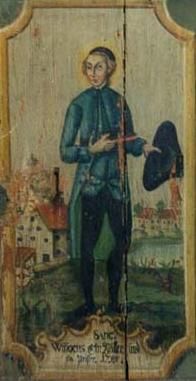
S. Winnoc, whilst yet young, escaped from Brittany with three companions, Madoc, Ingenoc, and Gadanoc, and went into Cornwall and the Saxon south of England. He then crossed the sea to the land of the Morini, and placed himself under S. Bertin at Sithieu. He made such progress, that S. Bertin sent him at the head of a swarm to hive in another place, and he fixed on Bergues-Saint-Winnoc, in French Flanders. This soon became a flourishing monastery. A man of fortune named Heremar having given an estate at Wormhout to S. Bertin, that abbot bade S. Winnoc take possession with three monks, and establish there a hospital. This grew into a monastery, and Winnoc was elected abbot. The story is told that he often fell into trances, and that on one occasion he was surprised by an ecstasy whilst engaged in the mill grinding com in a hand-quem. He remained entranced with extended hands and eyes turned to heaven, and the quem went on grinding com without him. He died and was buried at Wormhout, but his body was carried in 900 to S. Omer, and thence in 964 to Bergues, where the relics [the bodily remains of a saint, or objects they used, kept with honor] are still religiously preserved. On Trinity Sunday the shrine is carried in procession round the town and dipped in the river Colma, in commemoration of the miraculous recovery of a drowning boy through the merits of S. Winnoc.