E

Faithfulness to Christ when it cost everything.

Read the essentials →
September 22 · Bishop, Martyr

St. Emmeram

St. Emmeram

Faithfulness to Christ when it cost everything.

Traditional feast

September 22
1914 / pre-1969 calendar, per Baring-Gould (1897)

Current feast

September 22
Secondary source · Wikipedia

Represents

Bishop
Martyr

Their story

Adapted in modern English from the Catholic Encyclopedia (1913) · original text below · little is known

Emmeram was born at Poitiers to a noble family and became a priest; he may have been bishop there for a short time. Hearing that the Bavarians were still pagans, he travelled up the Loire, across the Black Forest and down the Danube to Ratisbon, and preached in Bavaria for three years.

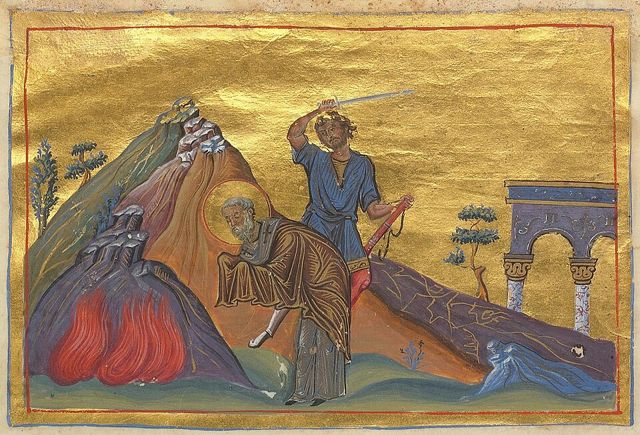
On his way to Rome he was attacked and cruelly tortured by the Duke's men at Kleinhelfendorf, and he died soon after at Ascheim. The Catholic Encyclopedia says the reason is unknown. It calls improbable the tale in Aribo's life that he took on himself the blame for the duke's daughter's sin. He died on 22 September, before 696, and his relics rest at Ratisbon.

Early life

The book says little or nothing about early life. This is how the account begins.

Thin entry · the 1897 book gives only 51 words. We have not filled the gap with invented detail.

…him out of the cottage where he was lodging, bound him to a ladder, and cut off his hands, feet, ears, dug out his eyes, and tore out his tongue. Thus he died, and for the murder Lautebert was driven into exile. The body of S. Emmeram was translated to Ratisbon.

What they represent

How they teach us to live

Drawn from themes in the original account

Stay faithful when it costs you. This account is about holding firm under pressure.

Learn from the kind of life it was. Faithfulness to Christ when it cost everything.

From the Catholic Encyclopedia

1913 · 544 words

Emmeram, Saint, Bishop of Poitiers and missionary to Bavaria, b. at Poitiers in the first half of the seventh century; martyred at Ascheim (Bavaria) towards the end of the same century. Of a noble family of Aquitaine, he received a good education and was ordained priest. According to some authors Emmeram occupied the See of Poitiers, but this cannot be verified, for his name does not appear among the Bishops of Poitiers. He probably held the see for a short time, from the death of Dido (date unknown) to the episcopate of Ansoaldus (674). Having heard that the inhabitants of Bavaria were still idolaters, he determined to carry the light of the Faith to them. Ascending the Loire, crossing the Black Forest, and going down the Danube, he reached Ratisbon [Regensburg in Bavaria] in a region then governed by the Duke Theodo. For three years he labored in Bavaria, preaching and converting the people, acquiring also a renown for holiness. He then turned his steps towards Rome, to visit the tombs of Sts. Peter and Paul, but after a five days' journey, at a place now called Kleinhelfendorf, south of Munich, he was set upon by envoys of the Duke of Bavaria who tortured him cruelly. He died shortly afterwards at Ascheim, about fifteen miles distant. The cause of this attack and the circumstances attending his death are not known. According to the legend related by Aribo, Bishop of Freising, the first to write a life of St. Emmeram, Ota, daughter of the Duke of Bavaria, who had been seduced by Sigipaldus, an important personage of her father's court, fearing her father's wrath, confessed her fault to the bishop. Moved with compassion, he advised her to name himself, whom every one respected, as her seducer, and it was in consequence of this accusation that Theodo ordered him to be followed and put to death. The improbability of the tale, the details of the saint's martyrdom, which are certainly untrue, and the fantastic account of the prodigies attending his death show that the writer, infected by the pious mania of his time, simply added to the facts imaginary details supposed to redound to the glory of the martyr.

All that is known as to the date of the saint's death is that it took place on September 22, some time before St. Rupert's arrival in Bavaria (696). At Kleinhelfendorf, where he was tortured, there stands today a chapel of St. Emmeram, and at Ascheim, where he died, is also a martyr's chapel built in his honor. His remains were removed to Ratisbon and interred in the church of St. George, from which they were transferred about the middle of the eighth century by Bishop Gawibaldus to a church dedicated to the saint. This church having been destroyed by fire in 1642, the saint's body was found under the altar in 1645 and was encased in a magnificent reliquary. The relics [the bodily remains of a saint, or objects they used, kept with honor], which were canonically recognized by Bishop Ignaz de Senestrez in 1833, are exposed for the veneration of the faithful every year on September 22. It is impossible to prove that Emmeram occupied the See of Ratisbon, for the official episcopal list begins with the above-mentioned Gawibaldus, who was consecrated by St. Boniface in 739 and died in 764.
Read more

The full original · 51 words

Read Baring-Gould’s full account

Baring-Gould’s sources: Roman and German Martyrologies. Wandelbert and Hrabanus. Authority; — A Life by Aribo, Bishop of Freising (764-784); another Life, an amplification of the former, by Meginfrid, provost of Magdeburg.] Emmeram, patron of Ralisbon, was a.native of Poictiers, and perhaps a bishop. Fired with zeal for the conversion of the Avars, he left his home and entered Bavaria, where he was warmly received by the Duke Theotto, who represented to him the impossibility of penetrating into Hungary, at least from that side, as constant war was going on upon the borders between the Avars and the Bavarians. Emmeram accordingly consented to stay at Ratisbon, and he laboured to instil true religion into the natives. After three years he asked leave to go to Rome, there to finish his studies. Before he left, the daughter of the duke, named Oda, revealed to him a miserable secret. Moved by unlawful passion, she was about to become a mother, by a young man named Sigibald, and she dreaded that discovery would lead to the execution of her paramour. If we may trust Aribo, the bishop bade her tell her father a lie, that he, Emmeram, was her betrayer. He would be safe in Italy. Then he took his way to Rome. But Lautebert, brother of Oda, discovered her condition, and when she told him that Emmeram was the partner in her guilt, he was filled with fury, pursued the bishop, and caught him up at Kelffendorf, before he had crossed the frontier, dragged S. Salaberga.

…him out of the cottage where he was lodging, bound him to a ladder, and cut off his hands, feet, ears, dug out his eyes, and tore out his tongue.

Thus he died, and for the murder Lautebert was driven into exile. The body of S. Emmeram was translated to Ratisbon [Regensburg in Bavaria].

Feast days

Feast: September 22

Nine days · Free

Pray the novena
with us.

One short email a day for nine days. The day's prayer, a line from St. Emmeram's story, and a nudge to keep going.

Also on September 22
St. Phocas the Gardener

St. Phocas the Gardener

September 22 · Martyr
D

Sts. Digna and Em E Rita

September 22 · Virgins, Martyrs
L

St. Lo of Coutances

September 22 · Bishop
← All 1726 saints in the library
Sources & notes

Feast-day sources

Story sources

Sources

Credits

From Sabine Baring-Gould, The Lives of the Saints, new edition in 16 vols. (London: John C. Nimmo, 1897–98); text from the Internet Archive scan (OCR, lightly cleaned; errors possible). Public domain.

From “Catholic Encyclopedia (1913)/St. Emmeram,” The Catholic Encyclopedia (New York: Robert Appleton Company, 1907–1914), via Wikisource. Public domain. Matched by name and feast date; text unedited except for our bracketed notes in grey.

From Sabine Baring-Gould, The Lives of the Saints, new edition in 16 vols. (London: John C. Nimmo, 1897–98); text from the Internet Archive scan (OCR, lightly cleaned; errors possible). Public domain in the United States. Reproduced unedited, except for short bracketed notes in grey that we added to explain names and terms (“S.” is the old abbreviation for Saint). Some history and judgments reflect 19th-century scholarship.