St. Phocas the Gardener

Phocas lived near the gate of Sinope in Pontus by working a garden, which supported him and let him give generously to the poor.

Read the essentials →
September 22 · Martyr

St. Phocas the Gardener

St. Phocas the Gardener

Phocas lived near the gate of Sinope in Pontus by working a garden, which supported him and let him give generously to the poor.

Traditional feast

September 22
1914 / pre-1969 calendar, per Baring-Gould (1897)

Current feast

September 22 (also listed: March 5, July 3)
Secondary source · Wikipedia

Represents

Martyr

Their story

Adapted in modern English from Alban Butler's Lives of the Saints · Baring-Gould original below · little is known

Phocas lived near the gate of Sinope in Pontus by working a garden, which supported him and let him give generously to the poor. Butler's sources are panegyrics by St. Asterius and St. Chrysostom.

His relics were divided among many churches. Asterius, bishop of Amasea about 400, praised him on his feast, and the emperor Phocas later built a great church in his honour at Constantinople. Butler and Baring-Gould agree on 303.

Early life

The book says little or nothing about early life. This is how the account begins.

In a persecution, probably that of Diocletian, he was impeached as a Christian; and executioners were sent to despatch him. These men before entering Sinope stopped to rest at his house. He courteously entertained them, and then when they had supped told them that he knew the man they were sent to kill, and that he would deliver him into their hands on the morrow.

What they represent

How they teach us to live

Drawn from themes in the original account

Welcome guests and strangers. Hospitality shows up in this account.

Stay faithful when it costs you. This account is about holding firm under pressure.

Make time for silence. Solitude and withdrawal to pray shape this life.
Read more

The full original · 251 words

Read Baring-Gould’s full account

Baring-Gould’s sources: Not in the Roman Martyrology. The Bollandists on this day. Alban Butler on July 3. Authority A panegyric by S. Asterius, Bishop of Amasca in a.d. 400.] |AINT PHOCAS, a gardener, dwelt near the gate of Sinope, a city of Pontus; he was a humble, WM god-fearing man, given to hospitality, and chariJ table out of his poor means.

In a persecution, probably that of Diocletian [Roman emperor 284–305, who began the ‘Great Persecution’ of Christians in 303], he was impeached as a Christian; and executioners were sent to despatch him.

These men before entering Sinope stopped to rest at his house. He courteously entertained them, and then when they had supped told them that he knew the man they were sent to kill, and that he would deliver him into their hands on the morrow. After they had retired to bed, he dug a grave, prepared everything for his burial, and spent the night in disposing his soul for his last hour. When it was day he went to his guests, and told them Phocas was found, and in their power as soon as they were ready to apprehend him. Glad at this news, they inquired where he was. “He is here present/'* said the martyr; “ I myself am the man/' Struck at his undaunted resolution, and at the composure of his mind, they stood a considerable time as if they had been motionless, nor could they at first think of imbruing their hands in the blood of a person in whom they discovered such heroic virtue, and by whom they had been so courteously entertained. He indirectly encouraged them by saying, that as for himself, he looked upon such a death as the greatest of favours, and his highest advantage. At length recovering themselves from their surprise, they struck off his head. The Christian? of that city, after peace was restored to the Church, buhta church over his relics [the bodily remains of a saint, or objects they used, kept with honor].

Feast days

Feast: September 22

Nine days · Free

Pray the novena
with us.

One short email a day for nine days. The day's prayer, a line from St. Phocas the Gardener's story, and a nudge to keep going.

Also on September 22
D

Sts. Digna and Em E Rita

September 22 · Virgins, Martyrs
L

St. Lo of Coutances

September 22 · Bishop
E

St. Emmeram

September 22 · Bishop, Martyr
← All 1726 saints in the library
Sources & notes

Feast-day sources

Story sources

Sources

Credits

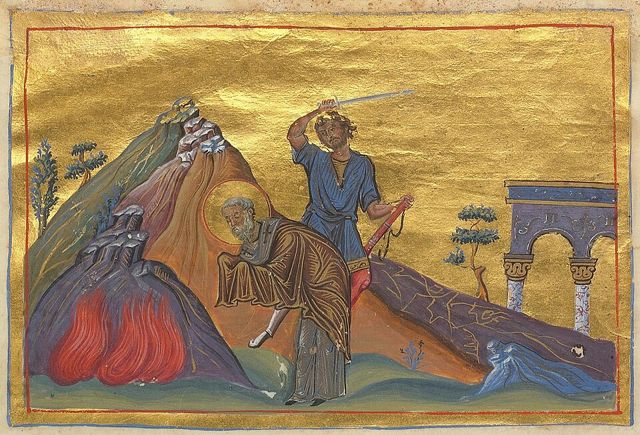
Image: Phocas the Gardener of Sinope (Menologion of Basil II).jpg · Authors of Menologion of Basil II (circa 985 AC, Constantinople), Byzantine manuscript illuminators[1]: Pantoleon with G · Public domain, via Wikimedia Commons

From Sabine Baring-Gould, The Lives of the Saints, new edition in 16 vols. (London: John C. Nimmo, 1897–98); text from the Internet Archive scan (OCR, lightly cleaned; errors possible). Public domain.

Image: Authors of Menologion of Basil II (circa 985 AC, Constantinople), Byzantine manuscript illuminators[1]: Pantoleon with G, Wikimedia Commons (Public domain)

From Sabine Baring-Gould, The Lives of the Saints, new edition in 16 vols. (London: John C. Nimmo, 1897–98); text from the Internet Archive scan (OCR, lightly cleaned; errors possible). Public domain in the United States. Reproduced unedited, except for short bracketed notes in grey that we added to explain names and terms (“S.” is the old abbreviation for Saint). Some history and judgments reflect 19th-century scholarship.