J
Sts. Julius and Aaron
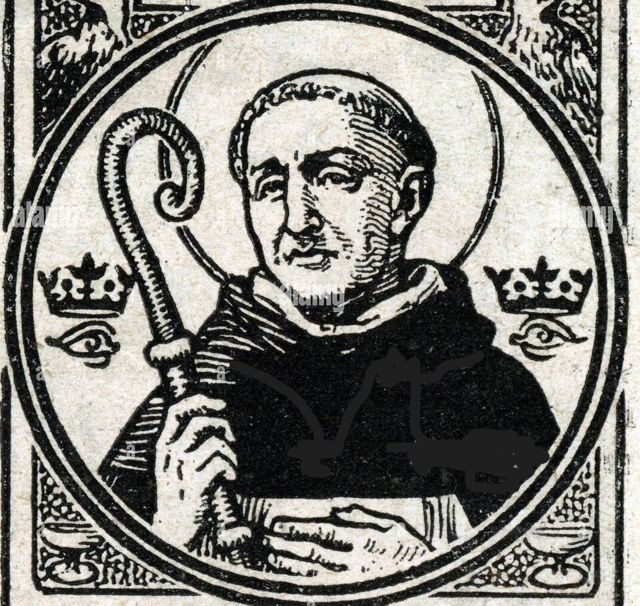
St. Theodoric
C
A life spent serving ordinary people.
July 1
Not verified yet
Priest
But feeling a desire for the religious life, Eparchius retired into the monastery of S^daciac, in P&igord, where he was sent, in spite of his noble birth, to prune vines and plough the soil He is said to have been so gentle to wild birds and beasts, that they allowed him to touch them. Then he blessed the little mother and her awkward young, and departed.
Make time for silence. Solitude and withdrawal to pray shape this life.
Learn from the kind of life it was. A life spent serving ordinary people.
U®ljr«. Felix Oreolus. He was sent to school at Pdrigueux at the age of seven, but was taken from it by his grandfather Felicissimus, count of Pdrigueux, who made him his secretary, and he remained with him for fifteen years. But feeling a desire for the religious life, Eparchius retired into the monastery of S^daciac, in P&igord, where he was sent, in spite of his noble birth, to prune vines and plough the soil He is said to have been so gentle to wild birds and beasts, that they allowed him to touch them. One day he saw a wild goat with its kids, and going to her, she suffered him to milk her, for the relief of his thirst, as he was on a journey. He is said also to have gone to a bird's nest, when the hen-bird was sitting over her little ones, and to have raised her that he might have a sight of her fledglings, without her showing any resistance. Then he blessed the little mother and her awkward young, and departed.
The bishop of Angoulfime, named Apthonius, invited him to settle near his city, and offered him a suitable situation for his retreat. By consent of his abbot, and the bishop of Pdrigueux, he removed thither, and found a pleasant spot in a loop of the river Charente, wooded and rocky, with a stream trickling down the cliff beside a cave. There he settled with some monks, who placed themselves under his rule, and thus laid the foundation of the abbey of S. Cybard, not far from the gates of AngoulSme. The grotto remains to this day. At the bottom of it has been carved in stone a statue of the saint above an altar. The statue was mutilated at the Revolution, when the abbey of S. Cybard was desecrated. The abbey is now turned into a factory. The grotto was reconciled on July ist, 1851, by Monsgr. Cousseau, bishop of Angoul£me, who offered therein on that day the same holy sacrifice which S. Cybard had offered one thousand two hundred years before. S. Leonore.
The saint showed great sympathy with prisoners, and obtained the commutation of the barbarous sentences pronounced against them in a rude age. One robber, whose life he could not obtain of the governor, he cut down from the gallows on which he was hanging, and he restored the man to life and consciousness after suspended animation caused by the pressure of the cord. A curious story is told by his biographer which illustrates the power a simple age supposed to reside in these hermits. S. Eparchius had written to a lady of rank. Looking one stormy day from her window, which corns manded the sea, she saw a ship battling with the waves, in great peril. She at once caught up the letter of Eparchius, rushed out upon the cliffs and fluttered it in the winds, calling on the waves and gale to reverence the handwriting of the saint. The vessel did not founder, thanks, she supposed, and her biographer also, to the virtue of this epistle.
Feast: July 1
One short email a day for nine days. The day's prayer, a line from St. Eparchius's story, and a nudge to keep going.
From Sabine Baring-Gould, The Lives of the Saints, new edition in 16 vols. (London: John C. Nimmo, 1897–98); text from the Internet Archive scan (OCR, lightly cleaned; errors possible). Public domain.
From Sabine Baring-Gould, The Lives of the Saints, new edition in 16 vols. (London: John C. Nimmo, 1897–98); text from the Internet Archive scan (OCR, lightly cleaned; errors possible). Public domain in the United States. Reproduced unedited, except for short bracketed notes in grey that we added to explain names and terms (“S.” is the old abbreviation for Saint). Some history and judgments reflect 19th-century scholarship.