St. Theodoric

Leaving everything to pray, yet still drawing people who needed wisdom.

Read the essentials →
July 1 · Priest, Hermit

St. Theodoric

St. Theodoric

Leaving everything to pray, yet still drawing people who needed wisdom.

Traditional feast

July 1
1914 / pre-1969 calendar, per Baring-Gould (1897)

Current feast

July 1
Secondary source · Wikipedia

Represents

Priest
Hermit

Their story

Adapted in modern English from Baring-Gould (1897–98) · original text below · little is known

(The surviving account on this page begins partway through the story.)

Theodoric was raised by St. Remigius and married by his parents' choice, but told his bride he meant to be a monk, and she left him. Susanna, a holy woman of Rheims, advised him to build a monastery on Mont d'Or; he chose the site where he saw a white eagle circling.

His father Marquard became a monk under him, and his bride also entered a convent. King Thierry is said to have been cured of an eye disease by him. His relics are at St. Thierry near Rheims.

Early life

Selected sentences from the original account, unaltered.

Thin entry · the 1897 book gives only 222 words. We have not filled the gap with invented detail.

King Thierry, son of Clovis, is said to have been cured of ophthalmia by the saint touching his eyes with oil.

What they represent

How they teach us to live

Drawn from themes in the original account

Build up the community you belong to. This life was lived with and for a community.

Make time for silence. Solitude and withdrawal to pray shape this life.

Learn from the kind of life it was. Leaving everything to pray, yet still drawing people who needed wisdom.
Read more

The full original · 222 words

Read Baring-Gould’s full account

Baring-Gould’s sources: Galilean and Modern Roman Martyrologies. Usuardus, Maurolycus, &c. Authorities: — A life by Flodoard, in his history of the church of Rheims, written about A. D. 966; and an earlier life published by Mabillon and the Bollandists, from which Flodoard probably drew most of his information.] Theodoric, or Theudric, son of Marquard of Anancourt, or Alamannd, as the place was then called, near Rheims, 1 “Serranos vero puHcem in os ejus profuit;" perhaps it was his thumb, “poUkem," and not a flea, “ pulicem.”

[July i. was brought up by S. Remigius [bishop of Reims who baptized Clovis, king of the Franks], and as soon as he was of age, was married by the advice of his parents to a girl of suitable rank. But Theodoric at once informed his bride that his purpose was to live as a monk, and she, in disgust, left him.

Theodoric then applied to Susanna, a venerable woman at Rheims, who was regarded as a proficient in the religious life, and asked her to give him advice. She recommended him to seek out a spot on the forest-grown Mont d’Or, near Rheims, where he might build a monastery. He went into the forest with Susanna, and saw a white eagle circling round the top of one of the hills, and took that as an indication of the site of his monastery. 1 He had the satisfaction of seeing his father Marquard embrace the religious life under him, and not less to hear that his bride, who really had been passionately attached to him, unable to bear the thoughts of an union with anyone else, after having given her young heart to Theodoric, had retired from the world into the cloister. King Thierry, son of Clovis, is said to have been cured of ophthalmia by the saint touching his eyes with oil. His relics [the bodily remains of a saint, or objects they used, kept with honor] are preserved at S. Thierry, near Rheims.

Feast days

Feast: July 1

Nine days · Free

Pray the novena
with us.

One short email a day for nine days. The day's prayer, a line from St. Theodoric's story, and a nudge to keep going.

Also on July 1
J

Sts. Julius and Aaron

July 1 · Martyrs
C

St. Carileff

July 1 · Priest, Hermit
G

St. Gall of Clermont

July 1 · Bishop
← All 1726 saints in the library
Sources & notes

Feast-day sources

Story sources

Sources

Credits

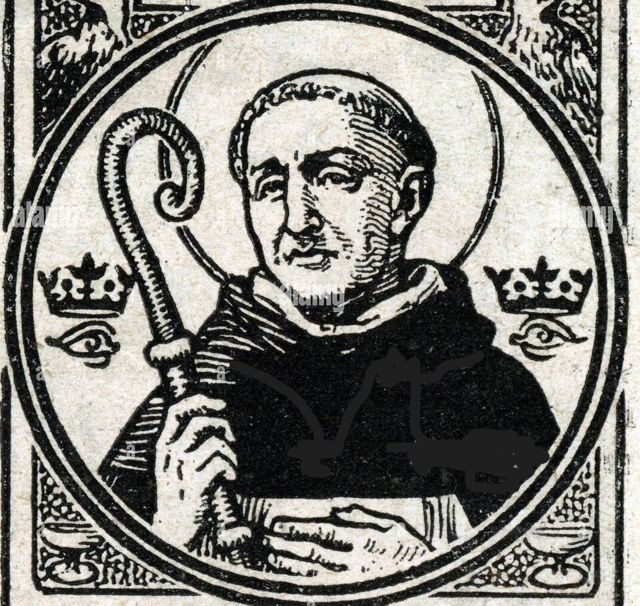
Image: Image of Saint Thierry of Mount D'Or.jpg · Iamkhalilcosta · CC0, via Wikimedia Commons

From Sabine Baring-Gould, The Lives of the Saints, new edition in 16 vols. (London: John C. Nimmo, 1897–98); text from the Internet Archive scan (OCR, lightly cleaned; errors possible). Public domain.

Image: Iamkhalilcosta, Wikimedia Commons (CC0)

From Sabine Baring-Gould, The Lives of the Saints, new edition in 16 vols. (London: John C. Nimmo, 1897–98); text from the Internet Archive scan (OCR, lightly cleaned; errors possible). Public domain in the United States. Reproduced unedited, except for short bracketed notes in grey that we added to explain names and terms (“S.” is the old abbreviation for Saint). Some history and judgments reflect 19th-century scholarship.