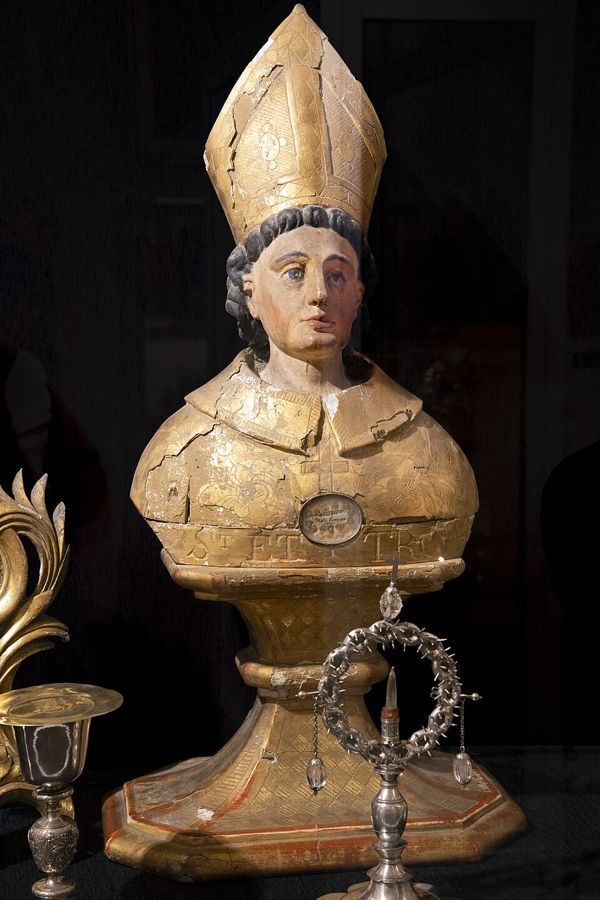
Their story
Adapted in modern English from the Catholic Encyclopedia (1913) · original text below
Erkonwold (Erconwald) came from the princely family of the East Anglian Offa. He used much of his inheritance to found two monasteries: one for monks at Chertsey, which he ruled himself, and one for nuns at Barking in Essex, under his sister St Ethelburga.
In 675, at the wish of King Sebbi and Archbishop Theodore, he became Bishop of London. Bede (the English monk-historian, d. 735) records that the sick were cured by touching the litter on which he had been carried. He enlarged his church and obtained privileges for it, and King Ini called him 'my bishop'.
He is said to have retired to his sister's convent at Barking, where he died on 30 April. He was buried in St Paul's, where Londoners held his shrine in great devotion; tradition says it survived the cathedral fire of 1087 untouched.
From the Catholic Encyclopedia
1913 · 371 words
Erconwald, Saint, Bishop of London, d. about 690. He belonged to the princely family of the East Anglian Offa, and devoted a considerable portion of his patrimony to founding two monasteries, one for monks at Chertsey, and the other for nuns at Barking in Essex. Over the latter he placed his sister, St. Ethelburga, as abbess. He himself discharged the duties of superior at Chertsey. Erconwald continued his monastic life till the death of Bishop Wini in 675, when he was called to the See of London, at the instance of King Sebbi and Theodore, Archbishop of Canterbury. As monk and bishop he was renowned for holiness of life, and miracles were wrought in attestation of his sanctity. The sick were cured by contact with the litter on which he had been carried; this we have on the testimony of Venerable Bede [English monk and historian (d. 735)]. He was present in 686 at the reconciliation between Archbishop Theodore and Wilfrith. King Ini in the preface to his laws calls Erconwald "my bishop". During his episcopate he enlarged his church, augmented its revenues, and obtained for it special privileges from the king.
According to an ancient epitaph, Erconwald ruled the Diocese of London for eleven years. He is said to have eventually retired to the convent of his sister at Barking, where he died April 30. He was buried in St. Paul's, and his tomb became renowned for miracles. The citizens of London had a special devotion to him, and they regarded with pride the magnificence of his shrine. During the burning of the cathedral in 1087 it is related that the shrine and its silken coverings remained intact. A solemn translation [the solemn moving of a saint’s relics to a new shrine] of St. Erconwald's body took place November 14, 1148, when it was raised above the high altar. The shrine was robbed of its jewels and ornaments in the sixteenth century; and the bones of the saint are said to have been then buried at the east end of the choir. His feast is observed by English Catholics on November 14. Prior to the Reformation, the anniversaries of St. Erconwald's death and translation of his relics [the bodily remains of a saint, or objects they used, kept with honor] were observed at St. Paul's as feasts of the first class, according to an ordinance of Bishop Braybroke in 1386.