E

Leaving everything to pray, yet still drawing people who needed wisdom.

Read the essentials →
March 23 · Hermit

St. Ethelwold

St. Ethelwold

Leaving everything to pray, yet still drawing people who needed wisdom.

Traditional feast

March 23
1914 / pre-1969 calendar, per Baring-Gould (1897)

Current feast

Not verified yet

Represents

Hermit

Their story

Adapted in modern English from Baring-Gould (1897) · original text below

Ethelwold was a monk at Ripon and, Bede (the English monk-historian, d. 735) says, honoured the priesthood by his life. After St. Cuthbert's death he succeeded him as a hermit in Cuthbert's cell on the island of Farne. Cuthbert's oratory was so roughly built that the sea wind whistled through the planks despite patches of clay and straw, so Ethelwold got a calf's skin and nailed it to the wall where he prayed, to keep the wind out of his ear.

Bede tells a miracle he heard from Guthfried, later abbot of Lindisfarne. Guthfried and two brothers had visited Ethelwold and were sailing home when a violent storm struck; neither sail nor oars helped and they despaired of their lives. Looking back, they saw Ethelwold at the mouth of his cave watching them. He knelt and prayed, and at once the sea calmed and a fair breeze carried them to shore. As soon as they pulled the boat up, the storm returned and raged all day, showing, Guthfried said, that the lull was granted at the hermit's prayer.

Ethelwold spent twelve years on Farne and died there. He was buried at Lindisfarne in the church of St. Peter near Cuthbert and Eadbert. His bones were moved during the Danish raids of 875, taken to Durham in 995, and enshrined more honourably in 1160.

Early life

Selected sentences from the original account, unaltered.

Bede says, "I will relate one miracle of Ethelwold, which was told me by one of the brothers who was concerned, and for whose sake it was wrought, Guthfried, the venerable servant and priest of Christ, who afterwards presided in quality of abbot over the church of Lindisfarne, in which he was educated.

What they represent

How they teach us to live

Drawn from themes in the original account

Pray a little every day. Prayer runs all through this account.

Learn from the kind of life it was. Leaving everything to pray, yet still drawing people who needed wisdom.

Read more

The full original · 519 words

Read Baring-Gould’s full account

Baring-Gould’s sources: Menardus on Jan. 6th. Edward Mayhew in his Trophæa Cong. Anglic. O.S.B. on March 23rd. So Heronymus Porter in his Flores Vitarum Sanct. Angliæ, Scotiæ, and Hiberniæ. The revised Anglican Martyrology of 1640, on same day. Authority:—Bede in his life of S. Cuthbert.

S. Ethetwold, or Ethelwold, was for some time a monk at Ripon, "where having received the priestly office," says Bede [English monk and historian (d. 735)], "he sanctified it by a life worthy of that degree. After the death of that man of God, Cuthbert, this venerable priest succeeded him in the exercise of a solitary life, in the cell which the saint had inhabited in the islet of Farne, before he was made bishop." He found the oratory of Cuthbert so rudely put together, that the sea-wind shrieked in through the joints of the planks, and though patched up with clay and stubble, the chapel was so full of draughts that Ethelwold asked for and obtained a calf's skin, and this he nailed against the wall where he was wont to pray, to keep the wind from blowing into his ear. Bede says, "I will relate one miracle of Ethelwold, which was told me by one of the brothers who was concerned, and for whose sake it was wrought, Guthfried, the venerable servant and priest of Christ, who afterwards presided in quality of abbot over the church of Lindisfarne, in which he was educated. I came, said he, to the islet of Farne, with two other brothers, desiring to speak with the most reverent father Ethelwold; and when we had been comforted by his discourses, and having asked his blessing, were returning home, when on a sudden, as we were in the sea, the fair weather that was wafting us over changed, and so great and furious a storm fell on us, that neither sail nor oars availed, and we despaired of life.

"Having a good while struggled in vain with the wind and waves, we looked back at last to see if by any means we might return to the island, but found that we were equally beset with the tempest on all sides; but we could perceive Ethelwold at the mouth of his cavern, contemplating our danger. For, hearing the howl of the wind, and the roar of the sea, he came forth to see how we fared. And when he saw our desperate condition, he bent his knees to the Father of our Lord Jesus Christ, to pray for our life and safety. As he finished his prayer, the swelling sea immediately abated its violence, and the rage of the winds ceased, and a fair gale springing up bore us over the smooth waters to the shore. But no sooner had we arrived, and drawn our boat out of the water, than the same storm began to rage again, and ceased not all that day; to the end that it might plainly appear, that this small intermission had been granted from heaven at the prayer of the man of God, that we might escape."

S. Ethelwold spent twelve years at Farne, and died there; but he was buried in Lindisfarne, in the Church of S. Peter, near the bodies of SS. Cuthbert and Eadbert. His bones were afterwards taken up in the time of the Danish ravages, 875, and were translated to Durham in 995, and more honourably enshrined in 1160.
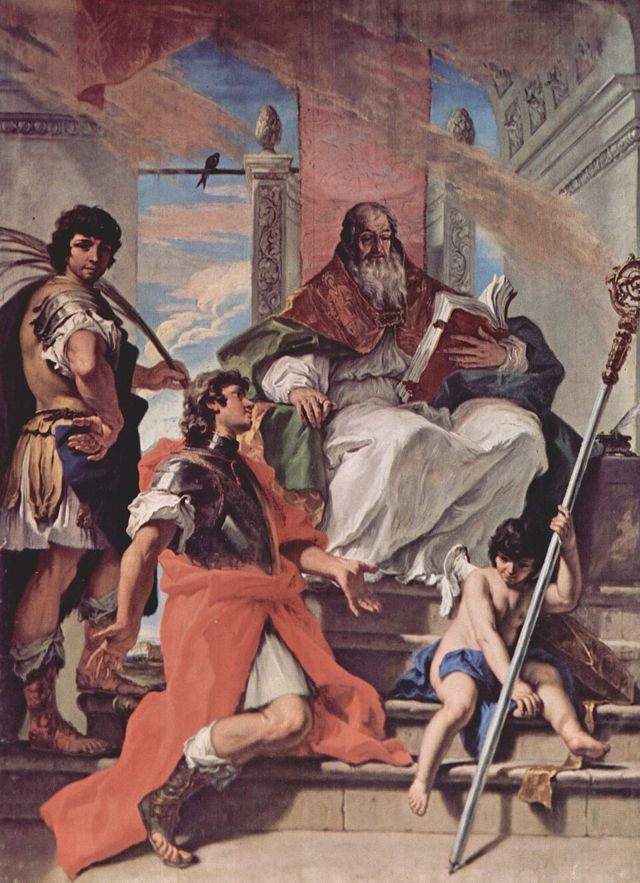
Feast days

Feast: March 23

Nine days · Free

Pray the novena
with us.

One short email a day for nine days. The day's prayer, a line from St. Ethelwold's story, and a nudge to keep going.

Also on March 23
St. Proculus of Verona

St. Proculus of Verona

March 23 · Bishop
F

Sts. Fingar and Piala

March 23 · Martyr, Virgin
V

St. Victorian and Others

March 23 · Martyrs
← All 1726 saints in the library
Sources & notes

Feast-day sources

Story sources

Sources

Credits

From Sabine Baring-Gould, The Lives of the Saints, new edition in 16 vols. (London: John C. Nimmo, 1897), digitized text from Project Gutenberg. Public domain.

From Sabine Baring-Gould, The Lives of the Saints, new edition in 16 vols. (London: John C. Nimmo, 1897), digitized text from Project Gutenberg. Public domain in the United States. Reproduced unedited, except for short bracketed notes in grey that we added to explain names and terms (“S.” is the old abbreviation for Saint). Some history and judgments reflect 19th-century scholarship.