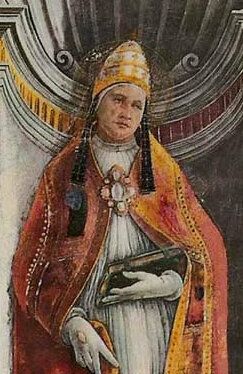
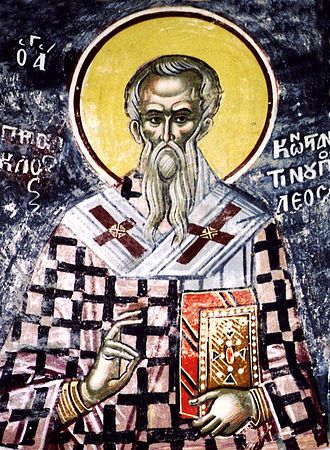
Their story
Adapted in modern English from the Catholic Encyclopedia (1913) · original text below · little is known
Evaristus appears in second-century lists as the fourth successor of St Peter, after St Clement, reigning about eight years around the turn of the first and second centuries. Eusebius (bishop of Caesarea, d. c. 339, the first historian of the Church) says only that he succeeded Clement.
The Liber Pontificalis (the early medieval 'Book of the Popes', not always reliable for the earliest ones) calls him the son of a Hellenic Jew from Bethlehem and credits him with assigning churches to Roman priests and dividing the city into deaconries, but the Catholic Encyclopedia says these were later institutions. More reliable is that he was buried near St Peter in the Vatican. His martyrdom is traditional but not historically proven.
Early life
The book says little or nothing about early life. This is how the account begins.
Thin entry · the 1897 book gives only 51 words. We have not filled the gap with invented detail.
…stylum veritatis.” He is called a martyr in the Roman Martyrology, but there is no evidence that he suffered death for the faith; there is every probability that he is so entitled, because on this day another of the same name is commemorated as a martyr in the ancient Roman Martyrology.
From the Catholic Encyclopedia
1913 · 235 words
Evaristus, Saint, Pope, date of birth unknown; d. about 107. In the Liberian Catalogue his name is given as Aristus. In papal catalogues of the second century used by Irenaeus and Hippolytus, he appears as the fourth successor of St. Peter, immediately after St. Clement. The same lists allow him eight years of reign, covering the end of the first and the beginning of the second century (from about 98 or 99 to about 106 or 107). The earliest historical sources offer no authentic data about him. In his "Ecclesiastical History" Eusebius [Eusebius of Caesarea (d. c. 339), the first historian of the Church] says merely that he succeeded Clement in the episcopate of the Roman Church, which fact was already known from St. Irenaeus. This order of succession is undoubtedly correct. The "Liber Pontificalis" says that Evaristus came of a Hellenic family, and was the son of a Bethlehem Jew. It also attributes to him the allotment of definite churches as tituli to the Roman presbyters, and the division of the city into seven diaconias or deaconries; in this statement, however, the "Liber Pontificalis" arbitrarily refers to the time of Evaristus a later institution of the Roman Church. More trustworthy is the assertion of the "Liber Pontificalis" that he was laid to rest in Vaticano, near the tomb of St. Peter. The martyrdom of Evaristus, though traditional, is not historically proven. His feast occurs October 26 The two decretals ascribed to him by Pseudo-Isidore are forged.