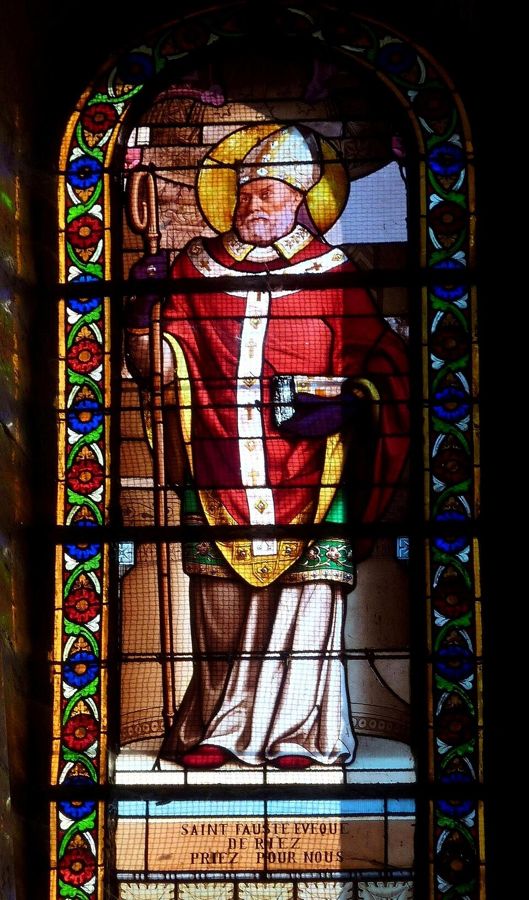
A shepherd who stayed with his people through hard times.
Read the essentials →A shepherd who stayed with his people through hard times.
September 28
September 28
Bishop
In his youth Faustus was devoted to the study of elocution, and of Christian philosophy.
Share your faith, in words and by example. Preaching and conversion are central here.
Feed your mind with Scripture and good books. Learning and the Scriptures matter in this life.
Learn from the kind of life it was. A shepherd who stayed with his people through hard times.
In his youth Faustus was devoted to the study of elocution, and of Christian philosophy. In 420, or thereabouts, Faustus entered the monastery of Lerins, and was elected abbot in the room of S. Maximus, in 433 or 434. There he lived an austere life, devoted to prayer and study, imitating, as Sidonius tells us, the lives of the Fathers of the Egyptian deserts, in the barren isle off the shores of the Province. Gennadius tells us that about this time he wrote a letter to a deacon named Gratus, who was infected with Nestorian [Nestorius (d. c. 451), whose teaching split Christ into two persons; condemned at Ephesus in 431] errors. S. Honoratus, Bishop of Arles, who had been Abbot of Lerins whilst Faustus was monk in it, respected him greatly, as is mentioned in the life of S. Hilary by a contemporary writer. The brother of S. Sidonius was under his charge at Lerins; and, as S. Augustine tells us, Faustus harboured Julian the Pelagian [followers of Pelagius, who taught people could be good without God’s grace] on his isle when expelled from Italy for his heresy. It is this fact which, perhaps, made Baronius [Cardinal Baronius (d. 1607), church historian who edited the Roman Martyrology] hesitate to insert the saint in the Roman Martyrology. There can be no question that Faustus, in common with S. Hilary and other Gallic saints, viewed with alarm the iron dogma of predestinarianism to which S. Augustine was attempting to commit the Church. Faustus saw that this revolting doctrine, if acted upon, cuts at the roots of Christian morality and good works, and therefore opposed it vehemently. Julian sought v?. Faustus.
a refuge in Gaul [roughly modern France and Belgium], and Faustus offered him one in Lerins till a council could be held at Arles to decide on the questions of Grace and Free-will.
Faustus was elected to the bishopric of Riez in or about a.d. 452. In a homily by him on his predecessor, S. Maximus, he speaks of himself with the utmost humility. Lerins, said he, has furnished the Church with two successive bishops. It is proud of the first; it blushes for the second. Both S. Sidonius and Ruric of Limoges praise highly the eloquence and unction of S. Faustus when preaching R* the people the Word of God.
Benedictus Paulinus consulted S. Faustus on questions 0 repentance. The answer of the Bishop of Riez is extant “ I am asked, in the second place, says he, whether th< knowledge of the Trinity in Unity suffices for salvation In divine things, I answer, the reason of belief is not alone demanded, but also the reason of pleasing God. Naked faith without merits is empty and vain.7' In 473 the doctrines of predestination were propounded in their most flagrant and offensive baldness by a certain Lucidus, a priest. He held that some men were predestined by God to sin, and so they sinned inevitably; others were predestined to do good, and they lived holy lives by inevitable necessity; there was no merit; grace blew men where it listed; this into damnation, that into justification. S. Faustus met Lucidus, and endeavoured to reason him out of his heresy, but in vain. Then he wrote him a letter, in concert with the Bishops of Arles and Lyons, which is a glorious summary of Catholic doctrine on grace and freewill.1 This letter was written on the occasion of an assembly of thirty bishops at Arles in 475. The archbishop and metropolitan [the archbishop who heads a group of dioceses] Leontius wished to condemn the l Some copies are signed by Faustus alone, others by Faustus and ten other bishops error of the predestinarians in this synod. But before the council took any decisive action, Faustus wrote to Lucidus, telling him that the bishops were about to suspend him from his office unless he renounced his errors. And as an abridgment of the points which he was to admit, Faustus laid down the following propositions: — “ 1. Those who deny, like Pelagius, original sin, and the necessity for grace, are anathema.
“ 2. Anathema to those who maintain that the baptized Christian falling into mortal sin does so through the inherence of original sin (/.<?., fatally, and not through the action of his free will).
“ 3. Anathema to those who hold that man is fatally doomed to spiritual death by virtue of the predeterminate counsel of God.
“ 4. And to those who teach that such as are lost did not receive from God means of salvation. “ 5. And to those who declare that a vessel of dishonour may not rise to become a vessel of honour. “ 6. Anathema to those who affirm that Christ sought the salvation of some, not of all men.”
If Lucidus would come and meet Faustus, the letter goes on to state, the Bishop of Riez and others of the assembled prelates would give him the reasons for their conclusions. And Faustus added: — “ As for us, we think that he who loses his salvation by his fault, might have been saved by the assistance of grace, if he had co-operated with it; and, on the other hand, that he who, by co-operating with grace, attains to salvation, might, by negligence or his own fault, have been lost. We exclude all self-esteem, for we regard as a gift, not as a debt, what we have received from the hand of the Lord/’ Lucidus, seeing that his position was endangered, sub' scribed the letter.
Lioba. Leontius of Arles and the synod assembled at Arles empowered Faustus of Riez to draw up a work on grace and predestination. In fulfilment of this mission, he composed his two grand books “ De gratia Dei et humanse mentis libero arbitrio,” which he dedicated to Leontius. But unfortunately Faustus attacked S. Augustine by name, and pointed to him as the source of this mischievous heresy. There can be little question that Augustine did start these fatal doctrines; but the Church has pardoned him this evil, and overlooked his blameworthiness in the matter, for the sake of his inestimable merits and labours in behalf of true doctrine on other points. His predestinarianism was the rust of his old Manichaeism working its way out of his soul. The fact that Faustus had thus openly attacked Augustine has occasioned suspicion to cling to his memory, and has lost him a place in the modern Roman Martyrology, though his doctrine is the same as that of Molinus, which may be said to represent the accepted teaching on grace and predestination in the Western Church.
Feast: September 28
One short email a day for nine days. The day's prayer, a line from St. Faustus of Riez's story, and a nudge to keep going.
Image: Riez Notre-Dame de l'Assomption Vitrail Saint Fauste.jpg · Reinhardhauke; shifted & cropped by Rabanus Flavus · CC BY-SA 3.0, via Wikimedia Commons
From Sabine Baring-Gould, The Lives of the Saints, new edition in 16 vols. (London: John C. Nimmo, 1897–98); text from the Internet Archive scan (OCR, lightly cleaned; errors possible). Public domain.
Image: Reinhardhauke; shifted & cropped by Rabanus Flavus, Wikimedia Commons (CC BY-SA 3.0)
From Sabine Baring-Gould, The Lives of the Saints, new edition in 16 vols. (London: John C. Nimmo, 1897–98); text from the Internet Archive scan (OCR, lightly cleaned; errors possible). Public domain in the United States. Reproduced unedited, except for short bracketed notes in grey that we added to explain names and terms (“S.” is the old abbreviation for Saint). Some history and judgments reflect 19th-century scholarship.