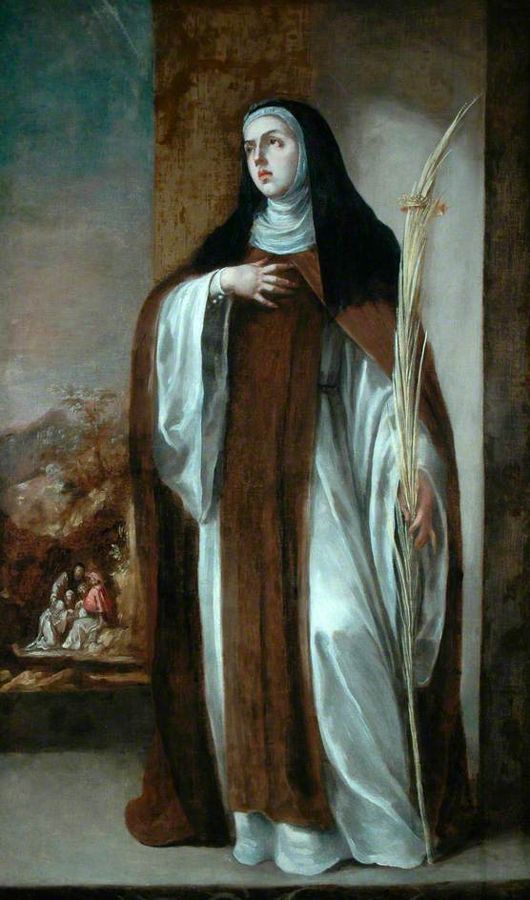
Building a community where women could live the Gospel together.
September 28
Not verified yet
Abbess
I am the only daughter of my two parents; and I would, though I be unworthy, that I might regard you as my brother, for there is no man in whom I can place my trust more than in you.
Pray a little every day. Prayer runs all through this account.
Feed your mind with Scripture and good books. Learning and the Scriptures matter in this life.
Learn from the kind of life it was. Building a community where women could live the Gospel together.
“ I pray your clemency to remember the former friendship which you had for my father, called Tinne in the Western regions. He died eight years ago, and so, I pray you, do not refuse me your prayers to God for his soul. I also commend to your memory my mother, Ebba, related to you by the ties of blood — she is still painfully living, oppressed for long with great infirmity. I am the only daughter of my two parents; and I would, though I be unworthy, that I might regard you as my brother, for there is no man in whom I can place my trust more than in you. I have ventured to send this little missive, not that it is worthy of your kind consideration, but that you may retain some recollection of little me, nor let it slip clean away through distraction of scenes and duties: for indeed the ties of true love should be knotted to all eternity. My dear brother, I beg this of you especially, that you will by your prayers screen me against the poisoned darts of the lurking foe.
“ There is one thing more that I ask, and that is, that you will correct the rustic simplicity of this letter, and not refuse to send me some words as tokens of your affability. I pant eagerly for them. I have appended to my letter some verses which I have composed according to poetic rule, not through pertness, but because I want your help, and I desire to wake into use the rudiments of a graceful fancy. I learned this art from Eadburga, who was indefatigable in turning the Divine law into rhyme. Farewell! Livelong and happily and pray for me.
" Almighty Father, alone who all things created, Who in thy kingdom, brightly, eternally shinest, Where also equally reigneth the glory of Jesus, Keep thee, protect thee uninjured, my brother." This exquisite little letter mirrors for us in its simple sentences the guiltless, pure soul of the “ Dear One/' S. Boniface [English missionary to Germany, martyred 754] bore his little cousin in mind. After some years he began to found monasteries in Germany, and then he wrote to Tetta, Abbess of Wimboum, to send him Lioba to assist him in his labours. This was in or about 74S. Can we not picture to ourselves the flutter of delight into which this sweet innocent soul was cast when the summons came for her to go forth and join the great Archbishop and Apostle in his mighty work ? The Abbess Tetta was most reluctant to part with her, but smothered her wishes, under a sense of duty. S. Boniface had sent his disciple Sturmi to Monte Cassino, some years before to learn there the true discipline of monastic life, and Sturmi was now appointed head and abbot of the monks Boniface called together in Germany, and Lioba was by him made abbess of the nuns he had collected at Bischoffsheim near Mainz, between the Main and the Rhine.
Her biographer gives a beautiful picture of the abbess. “ She was a woman of great virtue, and so rigorous in the prosecution of her duty, that she thought no more of her fatherland and kindred, but devoted herself wholly to fulfil what she had undertaken, to show herself blameless in the sight of God, and be an example to those set under her, in word and conversation. She was careful never to require others to do that which she did not do herself. There was no pride, no arrogance, in her manners. She showed herself affable and benevolent to all without acceptation of persons.
“ She was like an angel in face, and had a pleasant speech, a bright understanding, and sound sense. In faith she was most catholic, in hope most patient, in charity most largehearted. And though she had always a smiling countenance, yet she never gave way to boisterous laughter. She, being most humane about diet, ate and drank with the rest. The cup out of which she was wont to drink on account of its little size was called by the sisters * Darling's mug.'”1 She was a diligent student of Holy Scripture, and took care to commit large portions of it to memory. She was careful not to allow sleep to be injudiciously curtailed, knowing well, as her biographer says, that unless she slept soundly and sufficiently, her mind was not clear enough to understand and profit by what she read. “ Take away sleep and you take away sense,” was one of her pithy sayings. Nevertheless, she insisted on the young girls in rotation sitting by her bed whilst she slept, whether at night, or noon, and reading aloud from the sacred Scriptures. If the reader stumbled in her pronunciation, Lioba would open her eyes, correct her, and go to sleep again.
When S. Boniface went on his fatal mission to Frisia [the North Sea coast of the Netherlands and Germany], he earnestly commended the abbess to his successor, Lulli. Hildegard,2 queen of Charlemagne [king of the Franks, crowned emperor in 800], was warmly attached to S. Lioba, and came to see her shortly before her death. Caliculus ejus unde bibere solebat, pro quantitate sui, Dilectae parvus a sororibus vocabatur.”
S. IVenceslas. Lioba met her at Schonersheim; she was then an old woman, and ill. Hildegard, moved by her appearance, threw her arms round her neck and kissed her lips, her eyes, and her brow. She felt it was the last time she should see her, and she clung to her sobbing, “ May Christ our Creator and Redeemer make us to meet again without confusion of face in the day of judgment.*' A few days after Lioba felt that death was approaching. She received the B. Sacrament from the hands of Torabert, an English priest, and died gently. Her body was translated to Fulda, and laid beside that of her friend and kinsman, S. Boniface. Her tomb was examined in 1613, but little of the body remained.
Feast: September 28
One short email a day for nine days. The day's prayer, a line from St. L I O B A's story, and a nudge to keep going.
From Sabine Baring-Gould, The Lives of the Saints, new edition in 16 vols. (London: John C. Nimmo, 1897–98); text from the Internet Archive scan (OCR, lightly cleaned; errors possible). Public domain.
From Sabine Baring-Gould, The Lives of the Saints, new edition in 16 vols. (London: John C. Nimmo, 1897–98); text from the Internet Archive scan (OCR, lightly cleaned; errors possible). Public domain in the United States. Reproduced unedited, except for short bracketed notes in grey that we added to explain names and terms (“S.” is the old abbreviation for Saint). Some history and judgments reflect 19th-century scholarship.