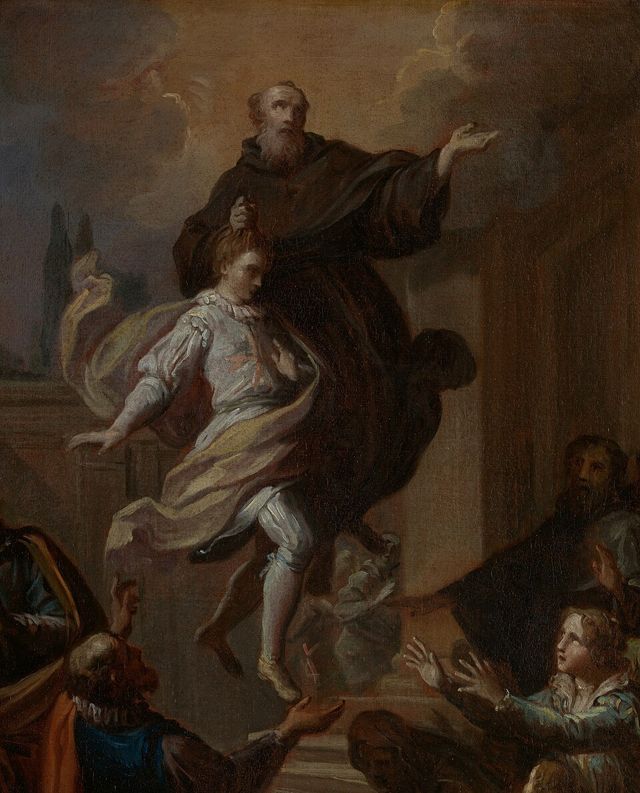
Baring-Gould’s sources: Roman and Gallican Martyrologies. In copies of the martyrdom of Jerome on Sept. 19. Ado, Usuardus, &c. on the 18th. Authorities Mention by Sidonins Apollinaris, lib. vi. ep. 1, by S. Venantius Fortunatus, lib. viii. casus. 4; S. Gregory of Tours; and the Acts, trustworthy, though with the speeches amplified by later hands.] VINT FERREOLUS, a young man in Vienne, was brought before Crispinus the governor, and ordered to adore the gods by whom the Emperors swore, or he would be divested of his military rank.
Ferreolus replied, “ I am a Christian, and I will not sacrifice. I have obeyed the Emperors conscientiously, but in this matter I cannot obey.”
He was therefore beaten, and thrown into a filthy cellar, probably the Barathrum. The inner prison in the Roman world was called the Robur or Lignum, from the beams of wood to which prisoners were chained, or from the character of its floor. It had often no window or outlet, except the door, which, when closed, absolutely shut out light and air. VOL. X.
It was into this apartment that SS. Paul and Silas were cast at Philippi, before it was known that they were Romans. The jailor, we are told, put them in the inner prison, and fastened them in the stocks, which was one of the pieces of furniture of the Robur or Lignum.
In the Acts of the Scilitane martyrs we read of the Proconsul giving sentence, “ Let them be thrown into prison; let them be put into the Lignum till to-morrow/' The utter darkness, the heat, and the stench of this miserable place, in which the inmates were confined day and night, are often dwelt upon by the martyrs and their biographers. “ After a few days/' says S. Perpetua, “ we were taken to the prison, and I was frightened, for I never had known such darkness. O bitter day ! the heat was excessive by reason of the crowd there.” In the Acts of S. Pionius and others of Smyrna, we read that the jailors, “ shut them up in the inner part of the prison, so that, bereaved of all comfort and light, they were forced to sustain extreme torment, from the darkness and stench of the prison.” And, in like manner, martyrs of Africa about the time of S. Cyprian’s death say, “ they were not frightened at the foul darkness of that place.. but the torments of it no statement can equal.” Yet there was a place of confinement even worse than this. In the floor of the inner prison was a sort of trap-door, or hole, opening into the Barathrum, or pit. Sometimes prisoners were confined here; sometimes despatched by being cast headlong into it through the opening. It was into this pit at Rome that S. Chrysanthus was cast; and there, and elsewhere, it was nothing short of the prison cesspool. It may be noticed that the Prophet Jeremiah seems to have had personal acquaintance with the outer prison, the Lignum and the Barathrum. We read in one place of his being shut up in the vestibule of the prison; at another time he is in the inner prison; and lastly, his enemies let S. Metfiodins.
him down by ropes into the pit, in which “ there was no water, but mud/' Into the Barathrum the young soldier Ferreolus was let down, to spend the night in the filth, unable to sleep, stifled by the loathsome odours of the place, and aching from the wounds he had received from the scourge. But after he had been left there the whole of the following day. he determined to make his escape, and having succeeded in removing the shackles from his feet, he stole away, probably by means of a sewer, for it conducted him into the Rhone, which he crossed by swimming. Having reached the other side, he made the best of his way to the village now called le Gene. But his appearance aroused suspicion, he was arrested, lead back to Vienne, and put to death.