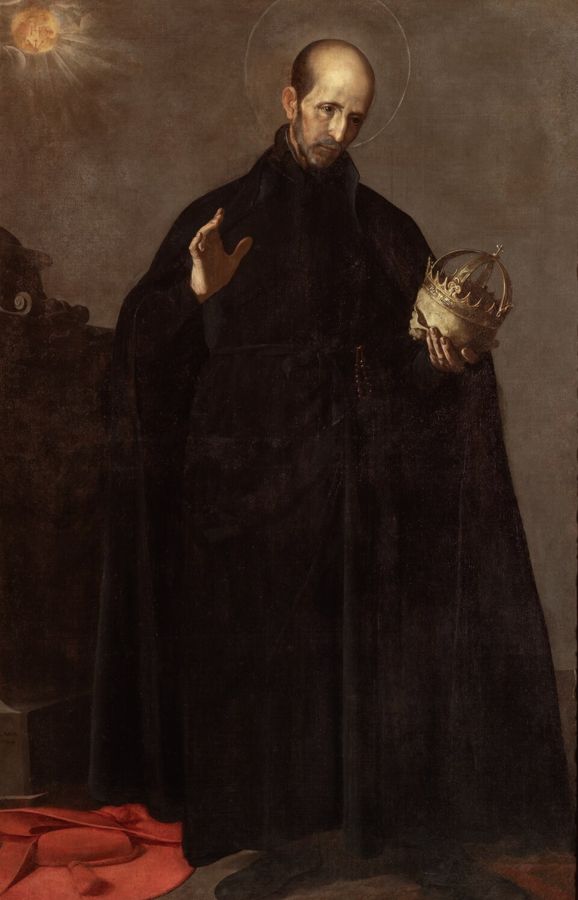
Baring-Gould’s sources: Roman Martyrology. Beatified by Urban VIII. in 1624, and canonized in 1716 by Clement IX., and his festival fixed for Oct. 10 by Innocent XI. in 1683. Authority: — His life, written by Ribadeneira, who was his confessor during nine years. Another life by Vasquez, also at one time the saint’s confessor, used by Verjus in his 41 Vie de S. Franyois Borgia.”] Alexander VI., the pope of infamous memory, was married before he became pope. He was a Borgia, and his wife was Julia Famese. Among other children he had John Borgia, duke of Gandia. John Borgia married Joanna of Aragon, daughter of Alphonso, natural son of Ferdinand V. of Aragon. John Borgia, third duke of Gandia, was the father of S. Francis, the subject of this notice. The saint was bom in 1510, at Gandia, the seat of the family, in Valencia. He was brought up in all the gravity and state of a Spanish noble’s house.
In 1520 the young Francis ran a risk of losing his life. A seditious monk, having by his sermons excited the citizens of Valencia to take up arms and punish certain criminals in a tumultuary manner, the people, pleased with this exercise of power, and with the discovery of their own importance, not only refused to lay down their arms, but formed themselves into troops and companies, that they might be regularly trained to martial exercises. To obtain security against the oppression of the grandees was the motive of this association, and proved a powerful bond of union; for as the aristocratic privileges and independence were more complete in Valencia than in any other of the Spanish kingdoms, the nobles, being scarcely accountable for their conduct to any superior, treated the people, not merely as vassals, but as slaves. They were alarmed, however, at the progress of this unexpected insurrection, but as they could not repress it without having recourse to arms, it became necessary to appeal to the emperor, and ask his permission to attack the insurgents. At the same time the people made choice of deputies to represent their grievances, and to implore the protection of their sovereign. Happily for the latter, they arrived at court when Charles V. was exasperated to a high degree against the nobility. Piqued at their resistance to his will in a matter on which he had set his heart, and moved by the justice of the complaints of the delegates of the people, he decided in favour of the latter, and rashly authorized them to continue in arms. The deputies returned in triumph, and were received by their fellowcitizens as the deliverers of their country. The insolence of the multitude increased with their success: they j-ose against the nobles, drove them from the city, and entrusted the government of it to magistrates of their own election. This was speedily followed by the sacking of the castles and palaces of the grandees throughout Valencia, and in their rage against those who had oppressed them, they perpetrated great cruelties. The armed mob surrounded the mansion of the Duke of Gandia, and tore it down; with the greatest difficulty, and in disguise, the duke escaped with his mother and daughters. The young Francis was mounted on a horse, and galloped without drawing rein to Diani, where his father carried him by boat, for greater security, to a strong tower built on a rock; afterwards, the country being still disturbed, the duke sent him to Saragossa, to his uncle, the Archbishop S. Francis Borgia.
Don John of Aragon. The archbishop gave him a house and retinue suitable to his rank, and provided him with masters in grammar, music, and fencing.
From Saragossa, Francis was sent to Baeza in Granada, to his great grandmother, Donna Maria de Luna, wife of Don Henriquez, uncle and master of the household to Ferdinand, Regent of Castile, and Grand Commander of Leon. Thence he was sent to Tordesillas, to be taken into the service of the Infanta Catharine, sister of Charles V., who was shortly to be married to John III., King of Portugal. The marriage took place in 1525, but Francis did not accompany her to Portugal, as his father had greater views for his son in Spain. He therefore recalled him, and sent him back to the Archbishop of Saragossa, to have his education completed. Francis was then aged fifteen, and after he had finished rhetoric he studied philosophy for two years.
In 1528 he was removed to the court of Charles V., where he made himself a general favourite by his courtesy of manner and cordiality of disposition. At the age of nineteen he was married to Eleanor de Castro, a Portuguese lady of high rank and considerable personal attractions. On the occasion of his marriage, the emperor created him Marquis of Lombay. By her Francis became the father of eight children; the eldest, Charles Borgia, inherited his father's title. In 1536 Francis Borgia followed Charles V. in his ill-advised and vainglorious expedition into Provence.
S. Francis saw the emperor, his master, harassed by Montmorency, his troops weakened by disease, and dispirited by disaster, the more intolerable because wholly unexpected. The emperor, after spending two inglorious months in Provence, without having performed anything suitable to his vast preparations, after having lost half his troops by disease or famine, was forced to retire. The retreat became a rout [Oct. TO.
He was pursued by the French troops, assisted by crowds of peasants eager to be avenged on those who had brought desolation on their country, and Charles could only bring a shattered remnant of his magnificent army back within the frontiers of Milan. Unable to bear exposure to the scorn of the Italians after such a sad reverse of fortune, he embarked with Francis and other of his immediate attendants for Spain.
The saint accompanied Charles V. on another equally disastrous expedition, that against Algiers, and saw the destruction of another great army under circumstances scarcely less ignominious. These two expeditions, with their fatal terminations, may have led, and probably did powerfully lead, to the final change in the life of Francis Borgia. In 1539 a somewhat dramatic event occurred, which marked the conversion of the saint. He had been much in the company of the Empress Isabella, and had contracted for her a warm devotion. Charles V. was at Toledo, striving to wring a grant of money out of the reluctant Cortes ol Castile, when Isabella died. The Marquis and Marchioness of Lombay were commissioned by the emperor to attend her corpse to Elvira, where she was to be buried. When the funeral convoy arrived at Elvira, and the marquis delivered the coq)se into the hands of the magistrates, it was required that he should take oath that the body he delivered over was that of Isabella of Portugal. The leaden coffin lid was removed, that he might look on the face of the dead, and so take the required oath. But decomposition had made such fearful ravages, that every trace of the wonderful beauty of the late queen was gone, and all that remained of her was a festering mass of corruption. Francis took the required oath, not because he could recognise the body, but because of the care he had taken with it, which made it certain that nobody could have changed it on the road.
^Googld Oct x©.] S. Francis Borgia. The impression made on his soul by this spectacle he was never able to shake off. It finally determined him to quit the world so soon as God should remove the hindrances which now prevented him from taking such a step. On the return of Francis to Toledo the emperor made him viceroy of Catalonia, and created him knight and commander of the order of S. Iago. Francis entered on the discharge of his new duties with singular zeal. He made a clean sweep of the brigands who infested the province, made travelling dangerous, and obstructed commerce. The judges were venal. He kept a sharp watch upon them, and insisted on their discharging their duties with expedition and impartiality. He set up schools and hospitals, and was a model of piety to the whole province. He had formerly been accustomed to communicate monthly, he now communicated weekly.
Whilst Francis Borgia was governor of Catalonia, F. Aretino Aroaz, a member of the Jesuit Order, only recently founded, came to preach in Barcelona. By this means Francis became acquainted with the new institute, and was much struck with its character, and with what he heard of the life of its founder. He even wrote to S. Ignatius and received from him letters in reply.
Whilst Francis was viceroy of Catalonia, his father died, and he inherited the family estates and titles. Shortly after, he obtained leave to resign his charge, and he then repaired to court, and was appointed master of the household of the Infanta Maria of Portugal, then on the point of being married to Philip, the son of the emperor. The death of the princess before the projected marriage took place, set the saint at liberty to follow his own inclination, and he retired to Gandia, in 1543, and built in it a Jesuit college and a Dominican convent.
His wife shortly after fell ill; Francis began to pray for her recovery, but his internal consciousness assuring him that he could not carry out his plan of renouncing the world, if she were to recover, he discontinued his supplications for her restoration, and she died March 27th, 1546. A few days later, F. Pierre Lefevre arrived at Gandia, to lay the first stone of a college of Jesuits which the duke designed to erect in princely style. Francis went through the spiritual exercises of S. Ignatius with him with such benefit that he wrote to the Pope to request him to pronounce his apostolic approval of them. Another fruit of the course was that Francis Borgia definitely resolved to join the Society of Jesus. He wrote to S. Ignatius on this subject, but the great founder in his reply advised the duke to defer the execution of his design till his children were placed in such a position in life as no longer to need his parental care. This advice was so reasonable that Francis was obliged to submit. Ignatius gave him four years for attending to his children, but Francis was only required to wait during three, as his family was settled by marriage or otherwise within that time.
In the year of the jubilee of 1550, Francis Borgia started for Rome, accompanied by his second son, John, and thirty servants. He was received with great honour; several ambassadors and cardinals came to meet him as he entered the Eternal City, with their gorgeous carriages and liveries. The Pope offered him rooms in his palace, but Francis Borgia declined them that he might visit the Jesuit College, and cast himself at the feet of S. Ignatius. It was supposed that Francis Borgia would be created cardinal, on this occasion, as he had two brothers cardinals; but he left Rome almost immediately, and returned to Spain. He did not, however, go back to Gandia, but retired to Ognate in Guipuscoa, whence he wrote to the emperor, requesting leave to resign his duchy in favour of his eldest son; he Oct. io.] S. Francis Borgia.
received the consent of Charles V., and the act of resignation was made by him at Ognate before a notary. He then had his hair cut, put off his ducal robes, and put on the J esuit’s habit. This took place in 1 55 1. After a devout preparation he was ordained priest, in the same year, and said his first mass privately in the castle of Loyola. On the morrow, to satisfy the devotion of the people, he said another solemnly in the town of Vergara. The crowd was so great that there was not room to contain it in the church, and an altar had to be erected in a field; such numbers came to communicate at his hand that he was not able to put off his vestments till three o’clock in the afternoon. The inhabitants of Ognate gave him a hermitage in the neighbourhood, and there he constructed wooden cells foi himself and his companions.
Multitudes came to see the Duke of Gandia transformed into a hermit, and his solitude was broken in upon by the unfailing streams of visitors. S. Ignatius hearing of this, ordered him to preach in Portugal. He therefore departed on this mission, which was attended with considerable results.
From Portugal he returned to Spain, and his exertions at Valladolid and elsewhere gained many disciples to the new Order. S. Ignatius accordingly made him Vicar General for Spain.
S. Ignatius died in 1556, and F. Laynez was elected second General of the society, and nine years after, on the death of Laynez, S. Francis was chosen his successor, and removed to Rome as the head-quarters of the society. In 1570, the year before the battle of Lepanto, he was sent by Pope Pius V., with his nephew Cardinal Alexandrini, on an embassy into France, Spain, and Portugal, to engage the Christian princes to send succours for the defence of Christendom against the Mahomedans. S. Francis was at that time very infirm, the journey and anxieties were too much for him, and he fell so ill at Ferrara, after having accomplished the legation, that his cousin, the Duke of Ferrara, sent him back to Rome in a litter. He died on October ist, 1572, at the age of sixty-two. Oct XX.
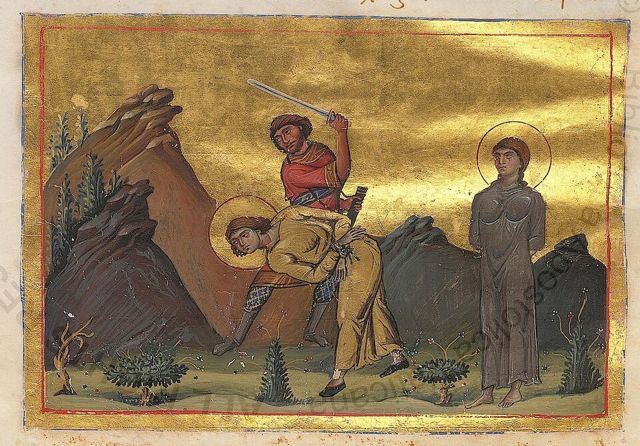
SS. Zenais and Pkilonilla, October ix. SS. Zenais and Pkilonilla, at Tarsia in Cilicia; 1st cent. SS. Nicasius, Quirinus, and Scubiculus, MM. at Ecos; a.d. a86. SS. Tarachus, Probus, and Andronicus, MM. at Anaxarbus tn S. Nkctarius, Patr. 0/ Constantinople; a.d. 391. S. Germ anus, B. 0/ Besangon; circ. a.d. 407. S. Sisinnius, Patr. 0/ Constantinople; a.d. 427. S. Firminus, B. 0/ Uses in France; a.d. 453. S. Ethelburga, V. Abss. 0/ Barking in Essex; jth cent S. Paldo, Ab. 0/ S. Vincent at Benevento; a.d. 720. S. Julia, V. Abss. of Pavilly in Normandy; 8 th cent. S. Winard, C. at Langres; 8 th cent.
S. Gummar, C. at Lyre in Brabant; 8 th cent. S. Bruno, Abp.of Cologne; a.d. 965.