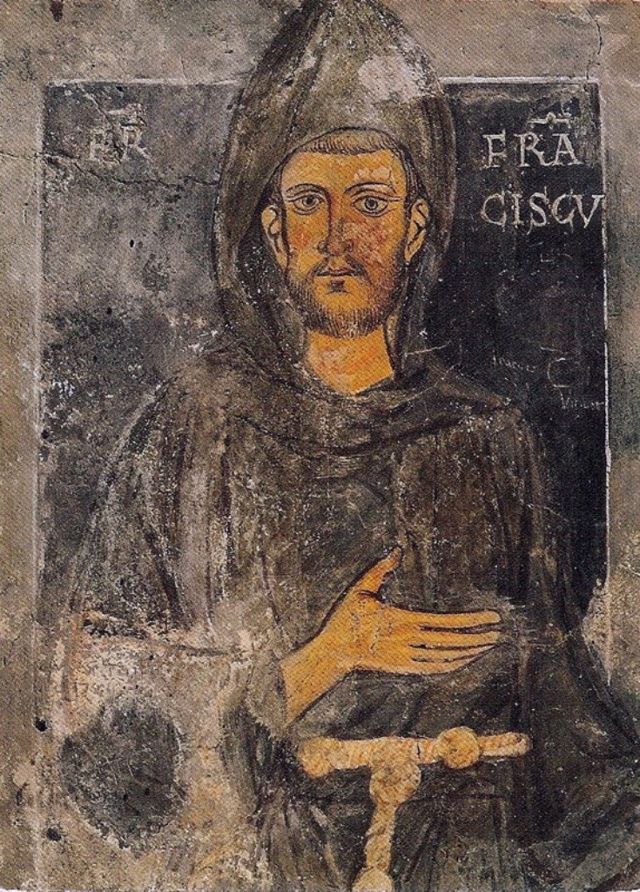
Baring-Gould’s sources: Roman and Franciscan Martyrologies. Canonized by Gregory IX., in 1228. Authorities: — (1) A Life by Thomas de Celano, his disciple. (2) Another Life by S. Bonaventura (d. 1274). (3) A Life, perhaps by Thomas Ceprani, fl 1245. (4) An Appendix to the Life by Thomas de Celano, by three associates of the Saint, Brothers Leo, Rufinus, and Angelus; published by the Bollandists. (5) “ Speculum vitae S. Francisci,” a singular work, composed subsequently, perhaps in the 14th cent. There are several editions, one of Metz of 1509, another of Antwerp of 1620, a third of Cologne of 1623, all somewhat differing from one another. The “Speculum” is of no historical value towards the Googl S. Francis of Assisi.
…biography of the Saint. (6) Another singular book illustrative of the extraordinary cultus of S. Francis is the “Vinea S. Francisci,” published at Antwerp in 1518. (7) The “ Fioretti di San Francesco ” is a collection of anecdotes of the Saint, collected in the 14th cent.] 1 The quaint little town of Assisi, in the Duchy of Spoleto, perched upon rocks, was the birth-place of the seraphic Father of the Franciscan order. He was bom in 1182, of good, though hardly noble, parents. His father, Peter Bemadone, was a merchant; his mother’s name was Pica. The Franciscans, in their eagerness to establish a close uniformity between their founder and the Saviour of the World, fabled that he was bom in a stable. The stable is now a chapel dedicated to San Francesco il Piccolo. 2 This fable, however, arose after the 14th century, for then Bartholomew of Pisa wrote his “ Conformities of S. Francis with Christ,” a most extraordinary book, in which the Messianic prophecies are interpreted as applying to S. Francis. In it he drew an exact parallel between the Saint and the Saviour, but he says nothing about the nativity in the stable, which he certainly would have adduced had the myth been then in existence.
Another wonderful legend of his infancy is, that when he was being baptized in the church a mysterious and venerable stranger appeared, who took the child in his arms and acted as his godfather at the font, and then vanished in the direction of the Cathedral of S. Rufinus. According to another version of the story, the mysterious old man was an angel, who took the child up in his arms, signed its right shoulder with the cross, and uttered a canticle which is a poor copy of the " Nunc Dimittis.” This is another of the fables circulated for the purpose of making the analogies 1 In the composition of this life much use, often verbatim, has been made of Mrs. Oliphant’s “ Francis of Assisi ” (Macmillan and Co.X and to it the reader is referred for full details of a life abounding in beautiful incidents. between the life of S. Francis and of Christ more exact. It is, of course, in the wonderful book of Bartholomew of Pisa. To return to plain facts. At his baptism the child was called by his mother, John; at the time his father was absent in France; on his return the name was changed familiarly into Francis. The legend writers have invented a host of reasons, all too ridiculous to deserve notice. 1 The real reason is not hard to seek. At an early age his father, who, having travelled in France on business of merchandise, knew the value of a knowledge of other languages besides the mother tongue, and who destined his son to succeed him in his business, took pains to have the child instructed in French. The young folks of Assisi, unable to appreciate the reasons of Peter Bemadone, ridiculed the boy for speaking French, and called him, in jest “ Franciscus,” or “ Frenchman.” Later biographers say that his acquisition of the French tongue was miraculous, but had it been so, it would not have been imperfect, and Thomas of Celano and S. Bonaventura inform us that though he could talk French, he did not talk it correctly.
Francis, in his youth, was keen in the pursuit of money, but no miser. He spent freely but not extravagantly, dressed handsomely, and ate and drank of the best 2 He was fond of fun and cheerful society, but he never seems to have stained his youth with sins of unchastity, nor to have been immodest in his conversation.
About the year 1201 the city of Perugia was at war with that of Assisi, and in one of the frays between the rival citizens, Francis was captured and detained a twelvemonth he had acquired miraculously— so Jacques de Voragine. The same wise author says another reason was, because he found experimentally that the name “ Francis n had wonderful efficacy in scaring away devils. 3 He was fond of poultry. After his conversion he had himself led through the streets of Assisi with a rope round his neck, and his companions who conducted him cried, “ See the man who fattened on chickens ! ” in prison in Perugia. On his return to Assisi, his love of the sober routine of a merchant’s life gave way to a taste for arms. He had a friend who proposed to go to Apulia, to sustain the pretensions of Walter de Brienne to the kingdom of Sicily. Whilst the project was shaping in his mind, he went out one day dressed in a new suit of the handsome clothes for which he had a carnal inclination. On the way he met “ a certain soldier of honour and courage, but poor and vilely clad.” The charity which was habitual to him, and the feeling of brotherhood towards an old man-at-arms which his new-born military ardour naturally inspired, moved him to a sudden enthusiasm. He took off his fine clothes and gave them to the poor old warrior. “ Thus he at once fulfilled two offices of pity,” says Bonaventura, “ by covering the shame of a noble knight and relieving a poor man’s penury.”
This kindly act was rewarded on the next night by a remarkable dream. He thought he beheld a goodly palace, and that he entered it and found an armoury filled with every variety of weapon, each signed with the cross, and flags and symbols of military triumph were hung along the walls. “ All these,” said a voice, “ are for thee and for thy soldiers.” Little did he then imagine what this dream portended, and that the weapons of his warfare were not to be carnal.
Francis provided himself with horse and suit of mail, and set out on his way to Apulia. He got as far as Spoleto, but there fell ill, probably with a relapse of the intermittent fever which pursued him more or less all his life, and which haunts like a ghost the fairest parts of Italy. While he thus lay, one night, in the feverish succession of heat and cold, half asleep, half stupefied, he suddenly heard a voice which questioned him: u Francis, whom does it profit most to follow, the master or the servant?” “The master,” answered the sick man, promptly. “Why then,” asked the voice, “ do you leave the master for the servant, the prince for his subject ?” The young Francis said, like Saul, “ Lord, what wilt thou have me to do ?” “ Return to thy country,” answered the voice, “ and then it will be told thee what thou must do.”
Such was the story which Francis, in after years, told his followers. Whether it was a dream, or whether some good counsellor had visited his sick couch, he was not in a condition to say. Next morning the tertian ague left him, after its wont, suddenly. Perhaps feeling that with this complaint on him he would make but a poor soldier, perhaps impressed by the mysterious conversation which had taken place in the night, he remounted his horse, not to go on to Aphlia, but to return to Assisi. He returned to his former course of life, but not with the same zest as formerly. He was just at an age when the deepest feelings of man’s nature begin to make themselves heard. The round of drinking and frolic, music and laughter, did not satisfy the vague cravings of a soul capable of lofty things. One evening he was revelling with his companions. When supper was over, the merry party dashed out of the hot, lighted room into the open air. The dark indigo-blue vault of heaven was overhead, besprent with myriads of stars, the air was soft and balmy, and all was hushed. Francis stood still, his sensitive, poetic nature was touched by the contrast.
“ What ails you, Francis ? ” asked one of the revellers. “ He is star-gazing for a wife,” joked another. “ Ah ! ” said Francis solemnly, “ for a wife past all that your imaginations can conceive!”
His soul with inarticulate cravings strained for some great love to fill it and satisfy it, but what that love was he knew not.
oct. 4.] S. Francis of Assisi. 73 Whether this was the last of his revels we are not told, perhaps it was; it marked the first distinct perception that his old life of careless merriment was at an end for him. From this time he was gradually drawn on towards the goal. He was drawn by his kindliness of heart He had been profuse in his charities, sympathizing with misery, always ready to do a kind act to him who needed it, but now these impulses settled into a systematic habit of charity. One class of sufferers he had always avoided, from his instinctive love of beauty, this was that of lepers. But he determined to overcome this repugnance. One day as he was riding across the valley he met a poor leper. The moment for an act of self-conquest was come. He descended from his horse, kissed the hand of the poor wretch, and filled it with money.
Whilst he was in a state of profound uncertainty, the transition from one state to another, he went to Rome, probably upon mercantile business, which he did not neglect throughout this crisis of his inner life. He was drifting on a sea of doubt, not knowing whither to steer. He had broken from his old moorings, but he had found no port. He was sick at heart, dissatisfied with himself, with life, with the world, but his vocation was not clear to him. His mind even seems to have been slightly thrown off its balance. He was ready to obey any impulse, however strange, in the vague expectation that he would hit at last on the road that would lead him to peace and happiness. As he was wandering through the basilica of S. Peter’s at Rome, in this unsettled condition, he was struck with the poverty of the offerings made at the shrines. He at once thmst his hand into his purse, pulled out all the money in it, and threw it in at the grating before the tomb of the Apostles. The money fell with such a noise that it attracted the attention of all who were near. Francis, ashamed of his act, as if one of ostentation, though no such motive had prompted him, hastened out of the church. Then he saw the steps crowded with beggars. Another fit of enthusiasm came over his disturbed heart, he plucked off his clothes, changed them with a beggar for his rags, and seated himself for the rest of the day on the steps of the cathedral, begging with the squalid and hungry crew.
There could be no more striking indication of the chaos of all his ideas, than this ready yielding to a succession of unreasonable impulses.
He returned to Assisi, having finished his business; but it was not to the joyous, careless life of former days. The current of his life gradually, imperceptibly, swept into the new channel of piety — not of active charity only, but of deep meditation on God and the mystery of Redemption. The sublime life of Christ in all its simplicity and self-abnegation, and the death on the Cross which concluded that long sacrifice, seized upon his soul, as sometimes the influence of a living leader will fire a young imagination with enthusiasm and self-devotion. “And I, if I be lifted up, will draw all men after me.” Those words of Our Lord were fulfilled in Francis. His heart, which had gone forth begging for a love to which to ding, found its object in the Incarnate Son of God. No anxiety about his own salvation seems to have distressed Francis. He forgot himself in the ecstasy of his love for his Saviour. He had found what he desired, and it was more than he had dreamed of. The Gospel narrative pondered over by Francis was so real, that he longed to follow every step of the Life of Lives. Having found a quiet cave in a wood or thicket, away from the roads, he was wont to retire thither, accompanied by a friend, whom he left outside. There he would spend hours of devotion and contemplation; and when he issued forth, his companion was struck by the alteration in his countenance, it had be so pale and haggard. Francis was walking in darkness, waiting to be pointed out his way; his old life was impossible to him now, its landmarks removed, its pleasures emptied out, its apples turned to dust. It was his hour in the wilderness; and so far as his friends and relations could see, an eclipse had fallen upon the bright promise of his youth.
But the character of Francis was not one that would allow him to rest thus — he must find something to do. His future was determined by his next step, and that by an act which certainly shows how completely disturbed his mental state was at the time. There was a little church dedicated to S. Damian at Assisi, which had fallen into disrepair. This deserted church attracted Francis, and he was often wont to seek it for private prayer. The ruinous condition of the sacred building forced itself on his notice, and then suddenly flamed up in him the resolve to restore the dilapidated sanctuary. But this very natural resolution arose, according to his biographers S. Bonaventura and the Three Companions, from a very wonderful event, of which, however, Thomas de Celano, writing only three years after the death of the Saint, knew nothing, so rapidly do legends grow. According to the story, Francis was kneeling in the crumbling old church, before an image of the Crucified, when the image said to him, “ Francis, seest thou not that my house is in ruins ? Go, and restore it for me.” 41 With good will, Lord,” answered the eager suppliant, thinking that the church referred to was the little chapel of S. Damian, and not the Catholic Church, which in the West was tottering, and would have fallen, had not S. Francis and S. Dominic been raised up, as two pillars, to support it on their shoulders. Francis sprang from his knees, seized with the impulse to repair the church of S. Damian, — an impulse as sudden as that which made him empty his purse into the tomb of the Apostles, and change his clothes with a beggar; and with the same unreasoning precipitation he hastened home, carried off several bales of cloth from his father's warehouse, to which he had no right, conveyed them to Foligno, and there sold them, together with the horse which had brought them thither. Then he ran with the money to the church of S. Damian, and offered it to the priest who ministered there This worthy man, surprised at the large sum offered, and th excitement of the young man, before receiving it asked ques tions about how he had come by it, and elicited the facts. When he ascertained that Francis had no right to the money, he refused to receive it, and Francis, disappointed and angry, tossed the bag containing it into the comer of a built-up window, there to lie among the dust and rubbish which were as valueless as it had proved to be.
Francis, knowing he had done wrong, was afraid to face his father, and begged the priest to take him in. This he consented to do; but his honesty made him resolute in his refusal to receive the money. Francis remained some days in the presbytery, out of spirits and bewildered. Before long, Bemadone discovered the place of his son’s retreat. He was greatly exasperated at what Francis had done, and having collected his neighbours, he made a raid upon San Damiano, to recover his son and his money. Francis took refuge in a dark cellar, where he lay concealed for several days. He stayed there long enough to reach the depths of despondency, and at last to recover sufficient moral courage to face the difficulty. He therefore issued from his voluntary dungeon, pale and worn by his seclusion, and the poor fare with which he had been supplied, and left San Damiano a very different figure from the “felix mercator”who had carried his money and heart to God’s house, in the exuberance of enthusiasm, a short time before.
When he appeared in the streets, and was recognized, a S. Francis of Assist. popular tumult arose. The townsfolk, among whom he had been a great favourite, crowded round him with threats and insults. He was pelted with stones, and pursued with shouts of derision. The noise of the commotion reached the ears of Pietro Bemadone in his dark shop, and he issued forth, flaming with indignation and resentment. His gallant son, whom he had proudly said was more like a prince than a merchant, who had been the favourite of Assisi and the hope of his house, had now become a squalid, wretched fanatic. He rushed into the street, mad with shame and rage, and falling upon Francis with all the fury of outraged love and pride, drove him home with blows and curses to the house where he had been bom. He was shut up in a dark prison, bound as a criminal, and compelled to endure the bitter reproaches of his incensed father. A few days after, Bemadone went out on business, and then the mother crept to her boy; she unloosed his chains and unbarred the door, and bid him depart. It was in love that she sent him forth, but yet it was banishment from his home. Francis went back to San Damiano without a word of complaint, having thus had the bonds of nature snapt from him one by one. Thenceforth there was no choice left for him; no looking back, had he desired it. The little presbytery, the poor priest, the old church falling into ruins — such were the only friend and refuge left to him in the world. When Pietro returned and found his son gone, he was not softened, but pursued him with unwavering virulence. He appealed to the magistrates to recover for him his son and his money. Francis, by this time, had recovered his courage. There is something in excessive violence which weakens persistence, and even, if that be possible, neutralizes the most just ground of complaint. The young man had repented, and had been punished severely; and now his spirit was roused. He replied to the summons of the magistrates, that he was now a servant of God, and independent of their jurisdiction. Pietro then carried his appeal to the bishop. “ I will go readily to the bishop,” said Francis; and accordingly, in the episcopal palace he met, probably for the last time, his unyielding father. Public opinion had now begun to turn against the harsh Pietro, who demanded not only the restoration of his money, but also a public renunciation of all claim to any share of the family property from his once favourite boy. The bishop exhorted Francis to restore the money. “ Give it back to him,” said he; “ for whatever is acquired by unjust means, God refuses to accept. Therefore, my son, have faith in God, and act like a man.”
These words soothed and encouraged the young penitent. His father’s relentless persecution had stirred his indignation and contempt. This same father, who pursued him so pitilessly about a miserable sum, the result of one day’s sale, had formerly grudged him no extravagance. “ Not only the money,” said Francis, “but everything that can be called his, even the clothes he gave me, I will restore.” And throwing off his gay garments, he piled them in a heap in the midst, placing the money on the top of all. Then he turned, half naked, yet delivered by his passion from all sensitiveness or shame. “ Bear witness all present,” he cried, “I have restored to Pietro Bemadone all that was his. Up to this time I have called him my father, I call him so no more. God alone is now my father.” The bishop threw his mantle over the naked shoulders of the youth, and tenderly embraced him. And a scene so strange and touching moved every heart. The father, still indignant and full of bitterness, collected the money and the clothes, and went forth carrying the remains of the son who was henceforth dead to him.
A labourer’s rough frock was obtained, and Francis, clothed in it, departed. It was winter, and the snow was on the ft ft ground, but Francis departed to the woods, and wandered among the snow-laden trees, singing in French the praises of God. He found refuge in a monastery, where for some time he laboured in the kitchen. He stayed there till his one garment was worn out, and then he rambled off to Gubbio, to an old friend, to beg another. After this follows an indefinite period of wandering, during which he gave himself up to the nursing of lepers, and entire subjection of his own will and carnal inclination.
When he had thoroughly achieved the conquest of himself, he returned to San Damiano, to commence the work which lay near his heart. He brought stones from the quarries, hewed them, shaped them, and built them into the walls of San Damiano; he was indefatigable over his task. He dragged heavy stones up the hill on his shoulders, worked the mortar, laid the courses, and plastered, all with his own hands. The townsfolk looked on in wonder. By degrees their ridicule died away, and he was treated with reverence and awe. By degrees the citizens lent assistance, and so he succeeded in restoring the church. It was whilst engaged on this pious task that the kindly priest of San Damiano provided certain delicacies for the young man, knowing how daintily he had been brought up. Francis was shocked at this indulgence of his palate. In his fervour he almost rebuked the kindness of his fatherly friend: — “You, a priest,” he said, “and thus lend yourself to human weakness ! ”
And in his excitement he seized a dish and ran into Assisi, begging from door to door scraps which would have been bestowed on paupers. The Assisan housewives who, with an amazement beyond words, gave their alms to that strange petitioner, knew all his story; they knew his daintiness of old, and they knew also the reason why he had conquered it. When he had collected scraps enough for his meal, the once fastidious Francis returned to the presbytery with the broken crusts upon his plate, to eat them with what appetite he could. At first, disgust took possession of him, and he turned from the unpalatable meal, but afterwards, going back to it with renewed courage, he consumed it all, and rising with joyful heart, told the priest that thenceforth it would be unnecessary to make provision for him; he had found out the means of supplying his own bodily wants, without interfering with his work for God.
Thus, as it were by accident, the first principle of the Rule of S. Francis was established. But no idea of any Rule was then in his mind. When the church of S. Damiano was finished, Francis restored two others, a church of S. Peter, and that of S. Maria degli Angeli, at the Portiuncula, which became from that time his home.
This work occupied him two years. Up to this time he had lived a curious, semi-ecclesiastical life. But he was still untonsured; it does not seem to have occurred to him to make himself a monk of any of the existing rules. He lived alone, free to follow his own devices. But the day which was to fix his destiny approached. He had been converted in 1206; and it was in 1208, when he was hearing mass one day in the little church he so loved, that something in the Gospel struck him as it had never done before. When the mass was over he begged the priest to expound it to him. The words which suddenly smote on his conscience as a new and special message were these: “ Provide neither gold, nor silver, nor brass in your purses, nor scrip for your journey, neither two coats, neither shoes, nor yet staves. And as ye go, preach, saying, ‘The kingdom of heaven is at hand/ ”
“ Here is what I have wanted,” said Francis, “ here is what I have long sought;” and leaving the church, he divested himself of his shoes, cast away his staff, loosed MARRIAGE OP 8. 7RANCI3 TO POVERTY.
From t Fresco by Giotto in the Lower Church st Assisi. S. Francis of Assisi. the leathern girdle from his waist, and supplied its place by a piece of cord, the first thing that was ready at hand. Thus again, half by accident, another distinction of the unformed Order came into existence. But what was more, this message to his soul conveyed to it an object, gave it a purpose, for which it had groped during the years of probation. His mouth was opened to preach the Gospel to the poor. He went forth out of the little church of the Portiuncula on that S. Barnabas Day, 1208, as a preacher, and thus, unaware, began a mission which was to move whole kingdoms, and dominate the lives of multitudes of men. Nobody could be less aware of this than the humble Francis. He began his preaching everywhere with the salutation, “ The peace of God be with you,” and was heard by all. “ His words were like fire,” says Celano, “piercing the heart.” His first disciple, according to Celano and the Three Companions, was a certain nameless boy of Assisi, but as no further mention of him or particulars concerning him occur in any of the lives of S. Francis, it is probable that he fell away from the young Order. The next to join Francis was a citizen named Bernardo di Quintavalle, a man of wealth and learning. He distributed all his goods among the poor, and placed himself unreservedly at the disposal of the saint The next to offer himself as a disciple was Pietro de Catanio, a canon of the Cathedral of Assisi; both these men of position and fortune were received together, and eight days after, another citizen of Assisi, called Egidio, presented himself as a candidate. As soon as Egidio had received the brown habit of the new Order, Francis took him as his companion on an apostolic journey into the Marches of Ancona. They went along the sunny roads together singing praise to God, and “as it happened that S. Francis had not yet begun publicly to preach to the people, he went along admonishing and reproving men and women by the way, saying simply, VOL. xi. 6 with tenderness, 4 Love and serve God, and do penance, as is meet, for your sins;’ and Brother Egidio said, 4 Do what my spiritual father says to you, because what he says is the best.’ ”
S. Francis seems then to have had some forecasting ot what his society would become, for he said to his companion, 44 Son, our Order will be like the fisher, who puts his net into the waters and takes a great multitude of fishes, keeping the larger ones, and leaving the small er ” At this Egidio marvelled, for the whole Order then consisted of himself, Bernardo, Pietro, and their friends.
But others now began to flow into the community, and as soon as his disciples had reached the number of seven, S. Francis sent them out to preach by twos, as our Lord had sent His disciples. He made them an affectionate address before they separated; 44 Go,” said he, according to Bonaventura, 44 proclaim peace to men; preach repentance for the remission of sins. Be patient in tribulation, watchful in prayer, strong in labour, moderate in speech, grave in conversation, thankful for benefits.” And to each, separately, as he took leave of him, he said, 44 Cast thy care upon the Lord, and He will sustain thee.”
The preachers met with all the ordinary varieties of reception. Some hailed them as messengers from heaven, others mobbed them as maniacs, but wherever they went they roused the public mind, sometimes to interest, sometimes to opposition, always, at least to wonder. And already this bold pictorial lesson of men wedded to poverty, presented before a world which was corrupted by the greed of gain, had begun to tell. Up to this time the little company had lived together by the simple exercise of their own will, without any rule or formal bond uniting them. Francis was their natural leader, it was he who had drawn them by his example out of the world, and to whom they looked as their S. Francis of Assisi guide; but they were, as yet, under no legitimate subjection to him, nor were they bound to the life of hardship which they had voluntarily adopted.
When the little house which they inhabited at the Portiuncula was so full that there was scarcely room for them all to lie down in it, it became necessary to give to the family a constitution. Francis felt this, and was troubled. He went forth at night to pray and meditate over the matter. On one such occasion, Celano informs us, he had retired to his accustomed devotion, his heart heavy with thought and anxiety, and in his depression, able to say nothing but “ God be merciful to me a sinner,” when a certain prevision of what his order would become came on him and filled his soul with unspeakable ecstasy. When he returned to his brethren, he bade them rejoice with him. “Be comforted, my dearest ones,” he cried; “ rejoice in the Lord, and be not downcast because we are few, for it has been shown to me by God that you shall increase to become a great multitude, and shall go on increasing to the end of the world. I see a multitude of men coming towards me from every quarter, French, Spaniards, Germans, and English, each in his different tongue encouraging the others.” So the rule was drawn up, consisting, like the other monastic rules, of the three great vows of poverty, chastity, and obedience, differing only in so far that the poverty ordained by Francis was absolute. In other rules, though the individual was allowed to possess nothing, the community had often rich possessions, but among the Fratres Minores there was not to be so much as a provision secured for the merest daily necessities. Day by day they were to live by God's providence, eating what they were given in charity, taking no thought how they were to be fed or wherewithal clothed.
Another grand distinction of the rule drawn up by S. Francis was the occupation it prescribed to its members. They were not to shut themselves up or to care first for their own salvation. They were to preach — this was their special work; they were to be the heralds of God to the world, to proclaim the coming of His kingdom. Cloistered seclusion was not to the taste of S. Francis. So far as we can make out, he had thought little of himself — even of his own soul to be saved — all his life. The trouble on his mind had been what to do, how sufficiently to work for God, and to help men. His fellow-creatures were dear to him: he gave them his cloak from his shoulders many a day, and the morsel from his own lips; and would have given them the heart from his bosom had that been possible. He was not of the world, but yet he would not be taken out of the world.
As soon as the rule was completed, Francis presented it to the Bishop of Assisi, who stumbled at the prohibition of all possessions. “ Your life,” said the bishop, “ without any goods in the world seems to me most hard and terrible.” “ My lord,” answered Francis, “ if we had possessions we should need arms to protect them.” There was force in this response. The bishop knew the violence and rapacity of the Umbrian lords, and he withdrew his objections. Francis, with his companions, now went to Rome to obtain the confirmation of the rule from the Pope. According to the account of Bonaventura, Francis approached Innocent III. whilst walking on the terrace of the Lateran [St. John Lateran, the pope’s cathedral in Rome], lost in thought. The Pope, annoyed at the invasion of his privacy, waved the poor stranger away impatiently. But that night he saw in a dream the great church of S. John Lateran tottering to its fall, when two men hasted to set their shoulders to support it. In one of these Innocent recognized the brown-dressed stranger of the day before, the other he afterwards saw in S. Dominic. S. Francis of Assisi.
Next day he sent for S. Francis and had his rule examined; objections were again raised against the prohibition of all property, but Francis overruled them. Innocent approved the rule, and gave to the members of the new order the tonsure [shaving part of the head as a sign of entering the clergy or monastic life], so that, though not priests, they might be considered clerks.
The joy of the little band was extreme. When they had received the Pope's blessing, and that sign of consecration, they set out, shoeless, staffless, without a penny, or a purse to put one into, without a crust of bread for their journey, upon their way home. But though they were on their way back to Assisi, they were not about to resume their lodging in the shed at the Portiuncula; for what reason we are not told; perhaps the permission to do so had been temporarily withdrawn from them. They went slowly upon their way, and lingered, Celano tells us, for a fortnight near the town of Orta, preaching daily in the city, and begging their food. They then proceeded “ by cities and castles; ” now entering a walled and guarded mediaeval town, where, in the piazza, where the markets are held, the brethren in their brown habits stood round their leader as he poured forth addresses, burning from his heart, upon the astonished crowd; now toiling up the steep paths to some great feudal castle where the men-at-arms would wonder and gibe at them as they preached of righteousness, temperance, and judgment to come. The words of Francis found a ready response, however, in these untamed hearts, and we hear of one whole castle full, lord and lady, officers and retainers, casting themselves at the feet of Francis, and begging to be allowed to follow him in the path of perfect renunciation. It was this which startled Francis into the foundation of his Third Order, an order intended for laymen and laywomen, living in the world, and requiring no sacrifice beyond that of the heart. S. Francis was too wise in his perfect naturalness and sincerity, to believe it possible that the common uses of the world could be abandoned, and the ordinary duties thrown away, by a sudden impulse such as this affecting a crowd. He calmed down his excited audience by the promise of a rule to be established for them, and an order into which they could enter without shaking off the responsibilities and ties of their position in the world. When S. Francis and his companions reached the neighbourhood of Assisi, they stopped at a deserted hut on the wayside, at a place called Rivo-Torto, and there they remained for some time. Here their food seems to have consisted for the most part of biscuits only, bread having failed in their daily quests. It was apparently while living in this place that the brethren asked from their leader a form of prayer. They had no ecclesiastical books out of which to say the canonical hours; and they were, moreover, untrained laymen, not accustomed to the elaborate offices of the clergy. The prayers S. Francis prescribed to them were the “ Our Father,” and the prayer, “ VVe adore Thee, O Christ, in all Thy churches which are in all the world, and we bless Thee, because Thou hast by Thy Holy Cross redeemed the world.” When they saw cross or church, however far off, they knelt down and humbly repeated these two prayers — their entire vocabulary of worship. After a stay of some time at Rivo-Torto, the little church and plot of ground surrounding it at the Portiuncula was given to S. Francis by the Benedictines [monks following the Rule of St. Benedict] of Subiaco, to whom it belonged, and the little confraternity moved to it, as their place of permanent rest. The Portiuncula thus became the cradle and home of the Franciscan Order, henceforth as famous as Monte Subiaco itself.
In this house the brethren do not seem to have had any formal division of their time — so many hours for study, so many for work, so many for manual labour — as was S. Francis of Assisi.
the case in the older Orders. They were to hear mass once a day if possible; they went and came freely, begging yet bestowing; giving to any whom they might encounter, who were as poor as themselves, of that bread of charity, which, to Francis, was as the bread of angels. Money they were bound not to touch under any conditions, not even for the relief of the poor.
By this time, not much more than three years from the moment when the pale penitent was hooted through Assisi amid the derisive shouts of the people, and driven with blows and curses into confinement in his own father’s house, we find that it had already become his custom on Sunday to preach in the Cathedral, and that, from his little convent at the Portiuncula, Francis had risen into influence in the whole country. Already the mind of the people, so slow to admit, but so ready to accommodate itself to anything novel, had used itself to the sight of the brethren in their snuff-coloured habits, and, leaping from one extreme to the other, instead of madmen, began to consider them saints. " Because they possessed nothing earthly,” says Bonaventura, “ loved nothing earthly, and feared to lose nothing earthly, they were secure in all places; troubled by no fears, distracted by no cares, they lived without trouble of mind, waiting without solicitude for the coming day, or the night’s lodging.”
We find many little anecdotes of the life of S. Francis at this period in the “ Fioretti.” In every sketch the popular chronicler gives of the interior of the convent, there is some glimpse of S. Francis stealing out into the wood to pray. This wood, in the narrative, occupies the position which a secluded convent garden holds in monastic stories. Probably the Portiuncula had not even such a refuge. There is a little door which leads to the wood in the convent wall, and through it we see constantly the figure of Francis pass, to disappear within the sacred, mysterious woodland depths.
In the community at this time there was a certain Brother Richerio, one of the humbler members of the community, who had a great longing for the affection of Francis, and at the same time entertained one of those timid fancies which so often accompany love, that for some secret reason Francis thought badly of him and did not return his regard. The poor brother went sadly about his usual occupations, turning over and over, in troubled musings, the doubt which embittered his life. One day, as he passed the cell where his leader was praying, Francis suddenly called him. “ Let not this temptation disturb you, my son,” he said, with his natural cordial tenderness; “for you are dear to me, and even amongst those whom I hold most dear. You know that you are worthy of my friendship, therefore come to me in confidence whensoever you will, and from friendship learn faith.”
On another occasion the same insight into the feelings of others, occasioned by his warm sympathy, made S. Francis aware that one of the brethren, who had injured his health by excessive fasting, was “ so pinched with hunger, that on a certain night he was unable to sleep. He got up immediately, took some bread, and, going to the cell of the starving brother, began to eat, inviting him to share his frugal supper. The sufferer, thus delivered from the shame of yielding to his own innocent and natural craving, ate, and was rescued from that supremacy of bodily sensations which, though few ascetics have confessed it, as often accompanies extreme abstinence as indulgence. This truth S. Francis seems to have perceived for others, if not for himself. He called the brethren together in the morning, and told them what had passed, recommending, it would seem, his own example to their imitation, that they might S. Francis 0/ Assisi.
succour each other when austerity went beyond due limits; but also exhorting them to u follow discretion, which is the charioteer of all virtues.”
We may add one more incident, and that of a different kind, to the particulars of the life of our saint in this its second phase. He had renounced all things, not only the lusts of the flesh, if they had ever existed in him, but also the tenderer charm of the affections, which were so much more likely to hold fast such a spirit. He had given up without hesitation, as would appear, all the indefinite sweetness of youthful hopes. But, nevertheless, he was still young, still a man, with human instincts and wishes, the tenderest nature, and an imagination full of all the warmth and grace of his age and his country. It does not appear that he ever put into words the musings which caught him unawares. But one night he rose suddenly from the earthen floor, which was his bed, and rushed out into the night in an access of passion and despair. A certain brother who was praying in his cell, peering, wondering, through his little window, saw him heap up seven little figures of snow in the clear moonlight. “ Here is thy wife,” he said to himself; “ these four are thy sons and daughters, the other two are thy servant and handmaid; and for all these thou art bound to provide. Make haste, then, and provide clothing for them, lest they perish with cold. But if the care of so many trouble thee, be thou careful to serve the Lord alone.” What piteous human yearning is manifested in this little scene ! The gentle heart, all sympathy and love, for one moment had gone forth in imagination to see himself by the fireside with a loving wife and little ones about his knee; for one moment the agony of seeing the tenderest, holiest love that God has planted on earth, cast aside by him for the greater love of God, made itself felt. Was there some face of an Assisian maiden loved of old that rose then to haunt him ? Or was it but an ideal vision, like those of the unborn faces of children, that thus presented itself before him ? We cannot tell* Francis says no word of the trial that goes on in his heart. He dissipates the dream by the chill touch of the snow, and then the curtain of prayer and silence falls over him, and the convent walls close black around.
It is a remarkable peculiarity of the history of S. Francis, that whereas every Saint in the calendar, from S. Antony downwards, is sometimes troubled with visions of voluptuous delight, only Francis, in his pure dreams, is tempted by the modest joys of wife and children, the most legitimate and tenderest love.
In the meantime the first twelve had begun to grow into a great army; and as soon as the new members were sufficiently well known to make apparent any special talents there might be in them, they were sent forth, two and two, into new places, those who could preach being licensed by S. Francis, according to the power given him by Pope Innocent. They followed the evangelical precept with strict literalness. If there was a priest who would receive them, they went to that priest; if not, they asked for the most worthy in the place, and dwelt with him till they had drawn a little band of new brethren round them, and a habitation had to be found for yet another community.
The first Chapter of the Order took place, apparently, in 1212, only six years from the conversion of S. Francis. This general assembly was a most necessary refreshment to the brethren, who had wandered over the face of the country, from shore to shore, during all winter and spring. And henceforth, every Pentecost saw the Order reassemble, at first in little groups, Assisians, Perugians, neighbours from all the towns of Umbria, but growing daily, till thousands came to camp around the Portiuncula.
•S'. Francis of Assist. The year 1212 saw a new development of the Order, in the establishment of a sisterhood in connection with the Society. The story of S. Clara has been already given (Aug. 12), and need not be repeated here. Clara was the first fruits of the Mendicant Order amongst women, the founder of the Poor Clares, the second Order of S. Francis. The application of the new Rule, which was based not only upon individual but corporate poverty, was harder as applied to women than it was to men. The brides of Christ were cloistered, and unable to go out and beg their daily bread, as were their brethren; for religious fervour, even at its highest pitch, had not yet conceived the pos'sibility of a young and beautiful girl like Clara going forth publicly to serve the world, and receive from it her humble subsistence. To Clara and her sisters was given the passive part; theirs it was to support the brethren by their prayers, to stand by and watch and offer the sacrifice of all things, spending their time in supplications for a world which did not pray for itself, as the brethren spent their lives and strength in preaching and active succour.
This was the beginning of one of those tender and touching friendships which are to the student of history like green spots in the desert; and which give to the man and the woman thus voluntarily separated from all the joys of life a certain human consolation in the midst of their hardships. The two saints can have seen each other but seldom, for it was one of the express stipulations of the Franciscan Rule that the friars should refrain from all society with women, and have only the most sparing and reserved intercourse even with their sisters in religion. And Francis was no priest, directing the spiritual life of his daughter in the faith. But he sent to her to ask enlightenment from her prayers, when any difficulty was in his way. He went to see her when he was in trouble. That he was sure of her sympathy in all things, of her prayers and spiritual aid, whatsoever he might be doing, wheresoever he might be, no doubt was sweet to Francis in all his labours and trials. As he walked many a weary day past the church of S. Damian, every stone of which was familiar to him, and many laid with his own hands, must not his heart have warmed at the thought of the sister within, safe from all conflict with the world, upon whose fellow-feeling he could rely as absolutely as man can rely only on woman ? The world has jeered from its earliest age at the possibility of such friendships, and yet they have always existed — one of the most exquisite and delicate of earthly ties. Gazing back into that far distance over the graves, not only of those two friends, but of a hundred succeeding generations, a tear of sympathy comes into the student's eye. He is glad to believe that, all those years, Francis could see in his comings and goings the cloister of S. Clara; and that this sacred gleam of human fellowship — love purified of all self-seeking, tender, visionary, celestial affection — sweetened their solitary lives. The year 1212 had been a most eventful one in his life. He had been able to recognize and identify his Order as rapidly rising in importance, sanctioned by the Pope, though as yet only verbally, and attracting the sympathy and attention of the Church. His bishop, the Cardinal of San Paolo, and other great ecclesiastics, had been moved by the truth and fervour of the man to recognize in him one of those bom reformers who arise now and then in the world. His first great difficulties were over; and the community, even were he taken away from it, was strong enough and sufficiently well organized to stand by itself. In these circumstances it was not of rest that he thought. He resolved on undertaking a mission in the East, in the track of the Crusaders. He set out, but the attempt failed, and he returned for the Pentecostal Chapter without having accomplished anything. Next year he set out for Spain, to preach to, and, as he hoped, 5 \ Francis of Assisi.
convert, the Moors [the Muslims of North Africa and Spain]. But this expedition was likewise without result. About the time of his return from Spain, Francis met and made the acquaintance of Cardinal Ugolino, Bishop of Ostia, who afterwards became the first protector of the Order. He was the Pope’s legate [an official representative sent by the pope] in Florence. Ugolino seems to have persuaded S. Francis to abandon, at least for the present, his fruitless expedition, and to confine his attention to the consolidation of the Order at home. A Council was to be held in Rome in the following year, and no better opportunity could be found for the final settlement of the important business of obtaining a written confirmation of the rule.
In 1215 the fourth great Lateran Council assembled, and in it the rule of the Franciscans was publicly sanctioned by Innocent III. and the assembled bishops. It was not even now confirmed by a bull, as was afterwards done by Innocent’s successor, but a public recognition was accorded it, which sufficed for the complete establishment of the Order in Italy.
It is supposed to be there that S. Dominic and S. Francis met Dominic, whilst praying in a church in Rome, saw, in vision, our Lord rise from the right hand of the Father in wrath, wearied at last with the contradiction of sinners, with a terrible aspect, and three lances in his hand, each one of which was destined for the extermination of a special class of offenders. But while the dreamer gazed at this awful spectacle, the Virgin Mother arose and pleaded for the world, declaring that she had two faithful servants whom she would send forth into the world to bring sinners to the feet of the Saviour. One of these was Dominic himself; the other was a poor man, meanly clad, whom he had never seen before. This vision deeply impressed the devout Spaniard. Next morning, while he mused on the dream which had been sent to him, his eye fell all at once upon a stranger m a brown tunic, of aspect humble and modest, coming to the same church to pray. Dominic at once ran to him, fell on his neck, and kissed him, saying: “ Thou art my companion; thy work and mine is the same. If we stand by each other, nothing can prevail against us.” The silent years between 1214 and 12 19 contain no public incidents in the life of S. Francis, but the narrative abounds in beautiful stories of his private life, of his tenderness, kindness, humanity, and of the beautiful courtesy of his character. He was a man overflowing with sympathy for man and beast, for all God’s creatures, wherever and howsoever he encountered them. Not only was every man his brother, but every animal, the sheep in the fields, the birds in the branches, the brother-ass on which he rode, the sisterbees which took refuge in his kind protection. He was the friend of everything that suffered or rejoiced; no emotion went beyond his sympathy; his heart rose to see the gladness of nature, and melted over the distresses of the smallest and meanest creature on the face of the earth. Some of the anecdotes related of him in his relation to the dumb animals are as follows.
“ The blessed Francis, returning from beyond the sea, was travelling through the Marches of Venice, and heard a vast multitude of birds singing among the bushes. And when he saw them he said to his companions, ‘ Our sisters, the birds, are praising their Maker. Let us then go into their midst and sing to the Lord the Canonical Hours.* And when they had gone into their midst, the birds moved not from the place; but as, on account of their chirping and twittering, the brethren were not able to hear each other, the holy man turned to the birds and said, ‘ Sisters, cease your song until we have rendered our bounden praise to God.’ And they at once were silent, and when the praises were finished resumed their song.”
8. FRANCIS OF A88I8I PREACHING TO THE BIRD3. From a Painting by Giotto. ■S'. Francis of Assisi. On another occasion, when he was preaching in the town of Alvia, the swallows, with their perpetual screaming, incommoded the audience. Francis had gone up to a piece of high ground, that he might be seen of all, and had asked for silence from the assembled people. But the birds were flitting all about in airy circles, making their nests, chirping, and calling to each other overhead in the blue heaven of the Italian sky. When it became apparent that these sweet disturbers of the peace prevented their human companions from hearing the word of God, the preacher turned and courteously saluted the little nest-builders. “ My sisters,” he said, “ it is now time that I should speak. Since you have had your say, listen now in your turn to the word of God, and be silent till the sermon is finished.” It is needless to say that he was perfectly obeyed. Other instances of the sense of safety which the very presence of so holy and kind a soul diffused around him abound in the early biographies. One day, at the village of Gubbio, a live leveret was brought to him, probably as part of his day’s provision. When he saw the little creature, his gentle heart was moved to pity. " Little brother leveret, come to me,” he said; “ why didst thou suffer thyself to be taken?” The trembling animal immediately escaped out of the hands of the brother who held it, and fled to Francis, taking refuge in the folds of his gown. From this shelter he disentangled it, set it free on the ground, and gave it leave to depart. The same story is told of a wild rabbit, which took refuge with him in an island on the lake of Perugia. “ It still returned into the father’s bosom, as it it had some hidden sense of the pitifulness of his heart,” says Bonaventura.
“Once he was seated in a little boat on the Lake of Rieti, near a certain part, when a fisherman, catching a large tench, brought it to Francis. And he, taking it kindly and cheerfully, began to call it brother, and putting it into the water again, he began devoutly to bless the name of God; and all the while that he continued in prayer the fish played about in the water round the boat, and departed not from the spot till the saint of God gave him leave/’ Lambs were the special objects of his regard. On one occasion, while walking silently along the road in one of his many journeys, he noticed a single lamb feeding amidst a herd of goats. It was like our Lord amidst the Pharisees, he thought; and he could not bear to leave the emblem of his Master in the midst of the rude bearded flock. But Francis had nothing to offer as the price of it, except his brown habit. A merchant coming up, and hearing his difficulty, bought the lamb and presented it to Francis. It was near the city of Osimo, where he was going to preach, and he resumed his journey with joy and thanks, leading with him the white lamb that was like his Lord. The bishop wondered at this unusual addition to the party; but Francis made his little companion the subject of his discourse, and so set forth the divine story as to move all hearts. When, however, Francis and his brethren had got as far as San Severino on their further way, the lamb became something of a burthen to the travellers, and was finally left at a convent with a community of sisters, who received the charge of it with joy. Some time after, the sisters sent to the saint a gown made of its wool, which he received with unfeigned delight. At home, at the Portiuncula, a lamb was one of his daily companions. “ The holy man taught it that it should always praise God, and give no offence to the brethren,” says the simple narrative.
He was overtaken by darkness one night with a com panion on the borders of the Po. The road was dangerous, and the river swollen. The brother who accompanied Francis was seized with alarm as the darkness closed around S. Francis of Assisi.
them. “ Father, pray that we may be delivered from this peril,” he cried. " God is powerful,” answered Francis; “ if it please Him to dispel the darkness and bestow on us the blessing of light, He will do so.” He had scarcely spoken the words when a flash of summer lightning kindled the skies, exhibited to them the rolling stream, the road, and the distant hostel to which they were bound. Then the wayfarers lifted up their voices and sang the praises of God. One night Francis lay in his cell, weak and worn with fever, when there came upon him a longing to hear some music. He had loved it from his earliest days, and it was a necessity to his poetic nature. He said nothing, however, of the longing in his breast “ The decorum of religion,” says Bonaventura, “ forbade his asking for it at the hand of man;” and it is difficult to imagine that Brothers Bernard or Elias, even had he asked it of them, could have charmed his ear with harp or lute. But as he lay awake one night in his weakness, suddenly his desire was granted to him. “ He heard the sound of a harp, of wonderful harmony, and most sweet melody.” The sound went and came, as if the player were moving to and fro under the convent windows.
In the year 1219 took place a famous Chapter of the whole Order, when probably every member of the society was present at Assisi. It was the first time that an actual numerical estimate of the strength of the Order was made, and then, according to numerous testimonies, it amounted to five thousand. A certain need of general legislation seems to have shown itself, and necessitated such a great assembly. The brethren came pouring in at Pentecost from all sides, without purse or penny to put therein among the entire crowd, the end of their journey being a little church and convent, poor as themselves, where, instead of a supply of provisions enough for so great a multitude, there was not VOL. xl 7 store enough of fragments laid up to sustain the founder and his little nucleus of friars beyond a single day. The Portiuncula is situated on one of the lowest slopes of the Apennine hills, and below stretches the plain, blazing under the Italian sun, which was the only guest-chamber Francis could provide for his visitors. Here they erected a quantity of little tents made of straw thatch, or matting and rushes; such shelters from the sun as may still be seen about the Italian fields rudely propped up on posts, as no doubt were the huts of the brethren. From this peculiarity the Chapter derives its name, Storcarum — the assembly of the straw huts. They were arranged, we are told, in distinct lines, according to the provinces from which the brethren came. The scene is set before us in the “Fioretti” with all the reality which would naturally belong to the narrative of an eye-witness. And if we can trust the anonymous chronicler, Cardinal Ugolino was present, and also S. Dominic, watching with curious, critical eyes, how the other Order was managed. Francis had made no provision for the crowd which surrounded him; he had dared to throw his entire brotherhood upon the bounty of Providence, and met them cheerfully, without a crust to give them, with a faith which, even to his fellow saint, seems to have for the moment appeared more rash than sublime. With many illustrious visitors looking on, S. Francis addressed his brethren camped around him, swarming among the narrow passages that divided the coverts of straw: “ My children,” he said, “ we have promised great things to God, and greater things still have we been promised by God; let us observe those things that we have promised Him, and He for His part will surely perform what He has undertaken.”
As he spoke, there were seen trains of horses and waggons coming towards the Portiuncula. A sudden impulse of generosity and charity had moved the citizens of Perugia, S. Francis 0/ Assisi.
Spoleto, Foligno, and Assisi to send supplies of provisions to the assembled friars. Bread, wine, beans, and game poured into the camp, as though the Lord had made windows in heaven, and had showered abundance where before was dearth. S. Dominic seeing this, felt that he had been wrong in doubting the faith of Francis and the bounty of Providence, and, falling on his knees before the saint, exclaimed, “Truly, God has a special care for this poor family, and I knew it not.”
In this great conclave the organization of the Order was, for the first time, formally established. “ Ministers were elected and sent out with the brethren into all the provinces of the world in which the Catholic faith is observed,” say the Three Companions.
Francis had theoretically established the office of Minister when he framed his rule, and had chosen the title in accordance with the humility which it was his desire should always guide his followers. He would not permit them to assume the title of abbot or prior, but desired that the Superior of each community should be simply the Guardian, and the Provincial the Minister or servant of all. But though these offices had been theoretically established, this is the first occasion of the institution of members of the community to them. The community had grown too extensive to be kept any longer under one single head. Each Provincial was to rule the guardians of the several convents in his province, and the Provincials were responsible to the General or head of the whole Order at Assisi.
As soon as the Chapter was over, S. Francis set out on his long-cherished mission to the East. The crusading army under the saintly king Louis was then in Egypt, occupied at the time in the siege of Damietta. S. Francis sailed for Egypt, entered the Christian host, and passed daringly through the open country swept by Arabs, with the deliberate purpose of being taken prisoner and confronted with the Sultan, Melek-el-Khamed. He was captured and brought to the Sultan, when he at once opened his mouth and preached to him Christ crucified. The Arab sat and listened, with admiration of the courage and enthusiasm of the Christian fakeer, but no results followed, and when, after a stay of a few days in the Moslem army, Francis sadly became aware that his preaching was ineffectual, he with• drew to the Christian army, the Sultan giving him free leave to depart, and S. Francis, “ seeing that he could not gain much fruit in these parts, resolved to return home.” He accordingly abandoned the unfruitful mission, and returned by ship to Venice. He would seem to have been met at Venice by some of the brethren, who conducted him home. Among them, we are told, was a certain Leonard, a man of noble family of Assisi. One day as they took their journey homewards, Francis, worn out with his fatigues, mounted an ass to relieve the tedium of the way, and Fra Leonardo walked behind him in silence. He too was weary, and he mused in sullen anger at the fact that he, a noble, was obliged to trudge behind the ass on which the merchant’s son was seated.
“It is true,” said Francis, suddenly getting down; “I ride and you walk, and this is against all congruity.” He had read his thoughts in the cloudy brow, and eye that shunned his kind glance.
As S. Francis was on his way back to Assisi, he reached Bologna. His friend, Cardinal Ugolino, was there, in the discharge of a mission from the Pope to Lombardy; and there, moreover, was a community of the Minorites, for which, since Francis had last been there, a new house had been built. The community had been established nine years before, by Brother Bernard; and it had grown till the little 6 *. Francis 0 / Assisi.
house in which it had first settled had become too small to contain it. Francis arrived in Bologna on the Feast of the Assumption, 1220. The first act of the traveller was, not to seek out his friends and brethren and rest from his fatigues, but to make his way to the Piazza, to preach to the people the precious Word of God. A certain Thomas of Spoleto, at that time student at Bologna, afterwards archdeacon of the cathedral in his native town, has left us an account of the scene. He went after the brown friar to the square before the little palace, and watched him closely with curious eyes. His bodily presence was mean, the student thought, his person contemptible, his looks unimposing. He stood up amid the intent and eager crowd, where, among peaceable citizens, and women and children, were the ruffling retainers of the nobles, and took for his text the words, “Angels, Men, Devils.” The Word of God poured like a stream of fire from the mouth of the preacher, and was so effectual that many nobles whose dissensions kept the whole local world in misery, and filled the streets with blood, gave each other their hands for the moment and made temporary peace in the softening of their hearts.
When he had ended, the crowd rolled after Francis, with tears and cries of joy, as he humbly took his way to the palace of the cardinal legate, his firm and ancient ally. On turning round at the palace gates, the eyes of the lover of poverty encountered a sumptuous building, newly erected, and bearing all the evidence of wealth. It was the convent of the Minorites, the spectators told him. S. Francis, thunderstruck by this discovery, averted his face with indignant and vehement emotion. “ What ?” he cried; “ is this the house of Christ’s poor ? Have the Brothers Minor such great and splendid palaces ? I do not recognize this as a house of ours, and I cannot acknowledge as my brethren those who live in it.” When he had uttered these words, he commanded all who would retain the name of Minor to quit the house, and leave to the rich the things which belonged to them. So indignant was he, and fierce with the sudden anger of the naturally gentle, that the brethren in terror precipitated themselves out of their fine house, even the sick getting themselves carried out on the shoulders of the strong, and laid down anywhere in the open air, rather than encounter the gentle father’s sudden fury. The cardinal, however, came in at this moment of confusion and distress. He interfered on behalf of the unfortunates, who lay gasping and pallid on the stones, jolted out of breath by their rapid descent. He took his friend aside, and represented to him, with all the kindly special pleading of a peacemaker, that size and space could hurt no man, that the sick had better air, the studious more perfect quiet, in the large house; that, after all, it did not belong to the brethren at all, but to the benefactor who had built it for them, and permitted them the use of it; and finally, when all other arguments failed to satisfy the disturbed founder, that he himself would remove all difficulties by taking possession of the building in the name of Rome. Subdued, but not overcome, Francis permitted the sick folk to be carried back to their quarters. But he would not himself enter the too splendid house. He went away, sad and wroth, and took shelter with the Dominicans. With them he dwelt apart for some days, sore and heavy at heart. One of the Preaching Friars, compassionating not only the solitary lodger in his convent, but also the abashed and penitent Minors, took upon him to persuade the master to return to his disciples. After much discussion, Francis forgave the brethren, but not the erring minister, Giovanni de Stiacchia, who had not only permitted this sumptuous building to be erected, but had set up a school of study more adapted to ex*. 4 the atmosphere of an university than to the rule of the Order. Francis dissolved the school, enjoined the monks to turn their thoughts to prayer and preaching, and not towards the accumulation of vain knowledge; and went his way, leaving pardon behind him, but carrying with him the first sharp sting of division — the sense that, already, degeneration and innovation had stolen into his Order. It would seem that, as soon as his back was turned, Brother Giovanni reestablished his school.
After this stormy episode came a time of peace. Cardinal Ugolino and Francis retired together to a little hermitage among the hills, belonging to the Camaldolites, and there dwelt together for some little time in meditation and devotion.
Fortified by this retreat, S. Francis descended from the hills to his convent just before the assembling of the Chapter on the Feast of S. Michael. When the pilgrim appeared at his favourite convent, he perceived Elias, who had been constituted head of the Order, come forth to welcome him, “ in a careful and elaborate dress/' long hood, wide sleeves, and a rich fringe to his garments. Francis called at once for a tunic like that of Elias, and putting it on, with exaggerated attention to its picturesque effect, took upon himself, at the same time, all the airs of a lofty dignity, and saluted the brethren with a “ Good morrow, sirs, ” instead of with the customary “ Peace be with you." Then he threw off the dainty robe, saying: “ This becomes a false brother and resuming his own worn and ragged gown, seated himself in the midst of the brethren. After this, S. Francis repealed the innovations which Elias had introduced into the Order, with one exception — Elias had forbidden the eating of meat by the Minorites; this piece of asceticism Francis allowed, but with hesitation.
In the Chapter which followed, the historians of the Order assert that Elias was set aside from his place, and Pietro de Catania, one of the earliest of Francis's followers, elected in his stead. At the same time, the character of Elias must have commanded a certain respect from Francis, who saw that Elias was a man of restless and masterful spirit, yet could not fail to admire his prudence, knowledge of the world, and enthusiastic asceticism. It was in the year 1221 that the Third Order of the Franciscans came into being. When S. Francis preached to those living in the world, he made their ungodliness, their sinfulness, and absorption in worldly cares, intolerable to them by his burning words, and the universal compunction burst all bounds of prudence. But he was himself too reasonable to permit all his converts to precipitate themselves into the ascetic life of nun and friar. He knew that the world must still go on and fulfil its everyday labours, whatever might be suggested by the enthusiasm of a moment; and he was not himself led away by any fanatical impulse of proselytism. When the excited people wept, and besought him to permit them to follow him, he silenced them with tranquillizing words. “ Remain in your homes/' he said, “ and I will find for you a way of serving God.” That way was the Third Order. “ He persuaded the people to remain at home, and to live there in the fear of God and the practice of Christian virtues, promising to make out for them a form which they could keep without leaving the condition of life to which God had called them.'' Thus it was the object of the Third Order to meet the needs of devout persons still living, and compelled by duty to live, in the world; people who could not aspire to the cloister— but with hearts careful and troubled about many things, with husbands and wives to think of, and houses and lands, with the care and maintenance of children and dependents upon their shoulders— who yet were inspired with a desire to serve God above all.
S. Francis of Assist. The vow exacted was a simple and solemn promise to keep God’s commandments, and, over and above, to avoid balls and theatres. The brethren were forbidden to bear arms, except in case of danger to their country or the Church. They were to avoid all oaths, except in matters of necessity. Lawsuits were also forbidden them, and all the arts of conciliation and peacemaking encouraged. On four days of the week, moreover, they were to eat no meat. For their prayers, they were to repeat seven times at each canonical hour, the Lord’s Prayer, followed by a Gloria Patri. In every place where a congregation of the Third Order was established, a priest, who was a member of the Society, was appointed to be its overseer and guide. Each member, at his death, was entitled to a funeral attended by all his brethren. There were three grand masses said solemnly for the Brothers and Sisters, alive and dead, every year. It may easily be perceived what a wonderful bond was thus created — a tie which connected people of every class and condition, binding them to mutual succour and support; and how incalculable was the tacit aid given by this mass of lay supporters to the action of the consecrated brethren, the Friars Minor themselves. It rose into instant distinction and importance, and was joined by a crowd of noble and powerful personages. S. Louis of France, his mother and wife, were all members of it. And so was S. Elizabeth of Hungary, and many other princesses, who, after lives of much Christian charity and fervent devotion in their natural sphere, transplanted their zeal and sanctity into the stricter enclosure of the professed sisterhood. Wherever the Preaching Friars penetrated in their absolute poverty, breaking upon the slumbering imagination and torpid faith of the world as with a sign from heaven, the laity crowded into this religion, which was possible, which did not require the renunciation of other duties, and yet linked them to the holiest men on earth, and gave them the support of a definite rule. This great institution, however, was not the astute and elaborate scheme of a great intelligence, but the sudden device of a tended, Christian spirit. It seems doubtful whether S. Francis was ever aware what a fruitful idea he had initiated. His fertile and inventive mind threw out great suggestions unconsciously. The female branch of his Order was instituted, it is evident, solely because of the one young enthusiast in whose piety he interested himself with all the warmth that belonged to his nature; and the Third Order sprang into being in the same curiously accidental way, that the brimmings-over of a sudden and general spiritual impression might not be lost. In 1220 occurred a scene, curious and touching, on which legend fondly dwells, a scene which bears some resemblance to one in the life of S. Benedict [father of Western monks (d. c. 547), author of the Rule]. The great father of Western Monachism, it will be remembered, had a dearly loved twinsister, Scholastica, whom he met only once a year. In the last year of their lives Benedict supped with her one evening, and when supper was ended rose to leave, but Scholastica implored him to stay; and when he refused, she prayed to God, and a storm burst over her convent which made it impossible for him to leave that night. They spent it in talking, with radiant faces, of the heavenly joy which was to receive both within a space of a few days.
S. Francis had a sister in religion, a woman who stood to him in the tender bonds of spiritual communion, and this was S. Clara. This holy woman felt a great longing to be with S. Francis and eat with him. But he constantly refused. At length his companions, seeing how distressed she was at his persistent refusal, said to him: “ Father, it seemeth that this sternness is not in accordance with Divine charity; hearken now unto Clara, a virgin, holy and beloved of God. It is but a little thing that she asks of thee, to eat with her; and she, at thy preaching, forsook all that the world offers of joy, and society, and wealth.” oct. 4 o 5*. Francis of Assisi. 1 07 Then S. Francis answered: “As it seemeth right to you, so let it be. But in order that Clara may be very greatly comforted, let the feast be held in the church of S. Mary of the Angels, for it was therein that she took the vows and became the bride of Christ/’ When the appointed day arrived, S. Clara went forth from her convent with one companion, and came to S. Mary of the Angels, and took her place until the time of dinner. S. Francis caused the table to be spread on the earth, and he sat down beside S. Clara, and one of the companions ot S. Francis sat beside the nun who accompanied S. Clara; and then all the rest of the company gathered themselves round the table. During the first course, S. Francis began to speak of God so sweetly, so tenderly, that all were rapt in ecstasy, with eyes and hands raised to heaven, forgetful of their meal, thinking only of God. Legend has vulgarised this beautiful story, and adds that to the men of Assisi it seemed as though the church was on fire, and they ran with water to extinguish the flames, but found that the fire was only the ardour of the devotion of those within. When the repast was ended, S. Clara returned to S. Damian’s, greatly comforted. This was her only meeting, for other purposes than those of ghostly counsel, with her friend and father; and one can readily imagine the gentle excitement which filled her bosom as she went down the hill to the Portiuncula. Clara had been only seventeen when she made her last eventful journey to the shrine of S. Mary of the Angels. Her last recollections of the humble little church must have shown like a dream in the distance — the brethren with their candles, the darkness outside, the shaving off of her curls, and the putting on of the coarse garment that severed her connection with the world and its pomps. No doubt it was a strange pleasure to the experienced nun to see once more the place where, ten years before, she had made her profession.
In the same year, S. Francis retired to Monte Gargano to revise his rule, previous to submitting it to the Pope for final confirmation. When he had completed it, in the winter of 1223, h e went to Rome, and there by the friendly patronage of Cardinal Ugolino, he was introduced to the Pope, Honorius III., and obtained the formal ratification of the Rule, in a bull dated November 29. Having thus fulfilled the object of his mission, Francis made another request to the Pope, of a different character. He asked to be allowed to introduce into the Franciscan churches representations of the manger of Bethlehem at Christmas, so as to seize on the popular imagination, and impress the unlearned. He obtained the requisite permission, and then, going to Grecia, a little place not far from Assisi, he had a stable with manger and straw erected in the church; ox and ass were introduced, and every arrangement was made, when the solemn Christmas night arrived, for giving to the people a visible representation of the occurrences of the night at Bethlehem. The people crowded to the village church with tapers and torches, and the friars, standing before the crib, chanted carols. In the midst of this glowing and agitated scene, Francis himself stood rapt by the side of the manger, in which his faith could picture to itself the first cradle of his Lord, throughout the whole night, sighing for joy, and filled with an inexpressible sweetness. His friend Giovanni, looking on, had a vision while he stood apart gazing and wondering at the saint Giovanni said, or dreamed, that a beautiful child, dead or in a trance, lay in the manger, and that as Francis bent over the humble bed the babe slowly awoke, and stretched out its arms towards him. It was the child Christ, dead in the hearts of a careless people, dead in the slumber of a wicked world, but waking up to a new life, and kindling the whole drowsy universe around Him, at the touch and breath of that supreme love which was in His servant’s heart S. Francis of Assist.
The crib of Bethlehem, since so popular in churches on Christmas Eve, was another of those happy ideas of Francis which exactly met a want of the times. Northern Italy was infested with Manicheism, a heresy which denied the Incarnation, and which, by the austere lives of some of its professors, excited the admiration of the ignorant. Francis, by means of his representations of the scene at Bethlehem, brought the Incarnation prominently before the minds of the people; the Holy Crib became an object of passionate admiration, excited the devotion of the people, and proved of incalculable service in the cause of the truth, doing infinitely more harm to heresy than all the burnings which were cruelly dealt out to the Manichees by prelates and emperors.
Another of Francis’s happy inspirations was the composition of vernacular hymns; he was the first to adopt his native tongue as the language of sacred poetry, he sounded the first notes of that music which was to reach its richest expression in the mouth of Dante. S. Francis had reached the age of forty-two when a mysterious event occurred in his life, which marked him out among the other saints of the calendar in a special and extraordinary manner. A certain noble, Orlando of Chiusi, gave to S. Francis a rocky height, Monte Alvemo, on his lands, as a kind of hermitage and place of retreat. Francis accepted the gift, and pleased with the description given him of its solitary beauty, determined to spend there his autumnal season of fasting before the Feast of S. Michael. He accordingly started with three of the brethren, Fra Matteo, Fra Leo, and Fra Angelo; the two latter are our informants concerning much that occurred in his life, being two of the three companions who wrote his biography. The rough road exhausted Francis, and before mounting the heights of Alvemo he threw himself to rest under an oak. Then, suddenly, a multitude of birds came fluttering round him, and threw themselves on their new lord with every demonstration of welcome; upon his head and shoulders and arms, in his cowl, and everywhere about him, while his companions stood by wondering. “Dearest brethren,” said the gentle apostle, with great delight and gladness, “ I think it must be pleasant to our Lord Jesus Christ that we should dwell in this solitary place, since our brothers and sisters, the birds, are so glad of our coming.” Thus harmoniously, with tender delight and joy, was the sacred seclusion begun. A glorious Italian sky was above, the beech and chestnut and here and there a mighty oak breaking the monotony of the great rocks and wild ravines, and four poor men, as dependent upon God as were the birds, held up aloft on the tops of the hills to pray for the far-off world, of which not even a sound could reach them in their solitude — how impressive is the scene ! Francis withdrew himself to a little cell under a beech tree that had been erected for him. They were all used to endure the weather, exposure to heat and cold; and food they were promised by Orlando, who had given them the mountain. Thus they were left utterly free for their devout occupations. Before this time Francis had received a warning from heaven that he should live only two years longer; and it is evident that his strength was much impaired, and the body of which all his life he had been so careless was beginning to avenge itself. The clouds that gather round the setting sun were collecting about him, though he was still little over forty. We are informed by Celano and the other early biographers that he had sought the direction of God in his devotions by the method which he had already so often adopted, of solemn reference to the Holy Scriptures, the book being first solemnly laid upon volume opened at the narrative of the Lord's Passion. S. Francis of Assisi The deduction which Francis drew from this was, that he was to pass into the kingdom of heaven, like his Master, through much tribulation.
Francis had retired to his hut under the beech tree, as already related, and there he remained rapt in prayer. His disciples, who have left us an account of what followed, tell us that they heard his voice in the wood by turns murmuring, not any eloquence of prayer, but those habitual words which he said day by day: “What art thou, dearest Lord, my God? and what am I, a vile worm and unworthy servant?” It was on Holy Cross Day, Sept. 14, that this ecstasy, reached its highest point, when, whilst Francis prayed, there appeared over him a great figure as of a seraph.
This solemn and wonderful apparition had the arms extended, and feet conjoined, as if fixed to a cross. It had six wings, two of which were elevated over the head, two extended as if for flight, and the other two veiling the entire body. “ When the blessed servant of the Most High saw the vision,” says Thomas of Celano, “ he was filled with great wonder, but could not understand what its meaning was. Much and greatly did he rejoice to see the benign aspect with which the seraph gazed on him, for its beauty was indescribable; but the bitterness of the cross and passion thus shown to him filled him with grief and fear. Thus he arose both sad and glad, and considered anxiously what the vision might mean. And when he could find nothing by which it might be understood, and the novelty of the vision overwhelmed his heart, there began to appear in his hands and feet signs of nails such as he had just seen in the holy Crucified One who stood over him.”
Celano mote three years after the death of S. Francis. The Three Companions give the story in almost the same words, the only difference being that the seraph does not '• itself display the form of the cross, but “ carried within its wings the form as of a beautiful man crucified, the hands and feet extended as on a cross, showing forth most clearly the image of our Lord Jesus.... And when this vision disappeared a wonderful ardour remained in his soul; and in his flesh still more marvellously appeared the stigmata of the Lord Jesus Christ, which the man of God carried concealed to his death, not willing to publish the secret of God.” S. Francis does not seem to have mentioned what had happened to him to any one on the mountain, not even when the time had come to go home, and the four went slowly back, much hindered by his weakness. When they had returned to the Portiuncula, he was still silent, though with signs about him which attracted the wondering curiosity of the brethren. Fra Illuminato, whose counsel had been resorted to by Francis on several occasions, saw (Bonaventura tells us) that something marvellous had happened to his master. “ Brother,” he said, “ not only for thine own sake, but for the sake of others, the Divine mysteries are made known to thee. And therefore it seems right that thou shouldst not conceal what thou hast heard and seen.” At these words, adds Bonaventura, the holy man was moved, and related with great fear all the course of the vision, and added that things had been said to him which he must never repeat to mortal man.
The story of the stigmata is involved in some difficulties, but there seems to be no reason for disbelieving in it 1 It is but an instance of the marvellous power exercised by the soul, in a state of exaltation, over the body, when the latter has been exhausted by asceticism, and is naturally, perhaps, disposed towards hysteria.
I * The evidence has been very carefully and impartially sifted by Mrs. Oliphant in i her “ Life of S. Francis," from which this biography is to a great extent After the return of S. Francis to his convent, he concentrated his failing powers on the continuance of his work. The pitcher was broken, and the light streamed through at every crevice. “ Of all his body he made a tongue,” says Celano. He spoke not only by the voice, which sometimes failed through feebleness, but through the very sufferings of the worn-out frame. A certain haste would seem to have been upon him in this last remnant of his life. Death was coming, but so long as God had work for him to do, he would not suffer himself to rest. F rancis suffered from loss of sight, and in the hopes of having this removed, endured cautery. The operation took place at Rieti, and there he remained some time. He was on his way home, and had reached the town of Nursia, at the foot of the Apennines, when his companions saw that his remaining strength was leaving him, and that the shadow of death was falling upon him. There they therefore halted; but the people of Assisi, in terror lest their saint should die elsewhere than within their walls, sent to insist on his being brought home; and the dying man was conducted to the bishop’s palace in Assisi, in the midst of a cavalcade sent by the Senate to meet and guard him. A few days before his death he had himself carried to the Portiuncula. As the litter-bearers, with their burden, progressing slowly down the hill, came in sight of that humble but blessed spot, Francis, turning to the group of brethren that surrounded him, warned them to hold this cradle of the Order in all reverence and honour. “ See, my sons,” said the dying father, “ that ye never give up this place.” Probably it was at the same time, and before entering the humble house he loved so well, that he caused his bearers to set down the litter on the ground, and turning to where Assisi, the home of his youth, rose white upon the hill, gave his blessing to the town which had nurtured and cherished him. When he had entered the convent, he betook himself to VOL. XL 8 the other duties of a dying man. He called for pen and ink, and with Angelo sitting by his bedside to write, dictated his last will. It is not so much a will as a record. Its chief purpose seems to have been to impress on the minds of his spiritual heirs, with a prevision of the strifes which were coming, the schisms that would tear the young society, the duty of absolute obedience to the principles of the Rule. When S. Francis had thus finished all his external business, he turned to the lesser circle of the convent, and of his own private friends. There was a lady who was dear to him, a certain Signora Giacobba di Settisoli, and he bade Angelo write a letter to her at his dictation, begging her to come to him. Angelo resumed his pen and wrote: “ I would thou shouldest know, dearest friend, that the Blessed Christ hath, by His grace, revealed to me that the end of my life is near at hand. Wherefore, if thou wouldest find me alive, when thou hast received this letter, hasten to come to S. Mary of the Angels. For, shouldest thou come after Saturday, thou wilt not find me living. And bring with thee cloth, or haircloth, in which to wrap my body, and wax for my burying. I pray thee, also, to bring me the cakes which thou wast wont to give me when I was sick at Rome.”
When he had gone thus far, he stopped short, raised his eyes to heaven, and bade the writer cease, adding that Giacobba was already on the way, bringing all that he desired. Almost immediately the porter came to announce her arrival, with her sons and servants, and to ask whether she should be admitted. The cakes he had asked for were made of almonds and honey — almond rock. There is something infinitely touching in this movement of human weakness — the one last simple, child-like liking, half appetite, half reminiscence, stimulated by the affectionate wish to give his friend something to do for him.
S. Francis 0/ Assisi. IJ 5 This story is only told by Wadding, the late annalist, who adds that Giacobba ministered to her friend during the few days that he lived; but the Bollandists [Jesuit scholars who since the 1600s have critically studied the lives of the saints] doubt the truth of the story. They question whether S. Francis, after so urgently commending to the brethren the observance of his Rule, would allow of the transgression of one of its laws towards himself, for it is strictly forbidden that a woman should enter the doors of a convent of friars. There can be no doubt, however, about the authenticity of the interrupted letter, whether it was thrown aside by reason of weakness, or whether it was indeed anticipated by the arrival of the person to whom it was addressed.
It is related by Pisanus that S. Francis called all the brethren to sup with him the night before he died; broke bread, after blessing it, and distributed it among them, but that Elias, the traitor, refused to eat, and went out. This story deserves no credence; it was invented at the time when a superstitious effort was made to represent the life of S. Francis as a reproduction, even in minute details, of the life of Christ. The truth was, no doubt, that he summoned to him all the brethren, and gave them his dying advice and blessing. When he had said all he had to say, he commanded the Gospels to be brought to him, and the passage to be read beginning, “ Before the Feast of the Passover,” the commencement of the 13th chapter of S. John. When the reading was ended, he began, with broken voice, to sing, “ Voce mea ad Dominum clamavi,” the 141st Psalm (A. V. 142): “ I cried unto the Lord with my voice; yea, even unto the Lord did I make my supplication. I poured out my complaint before him: and showed him of my trouble. When my spirit was in heaviness thou knewest my path: in the way wherein I walked have they privily laid a snare for me. I looked also upon my right hand: and saw there was no man that would know me. I had no place to flee unto: and no man cared for my soul. I cried unto thee, O Lord, and, said: thou art my hope and my portion in the land of the living.” Such, so far as any record informs us, were the last words ofS. Francis.
Such was the end of the life of S. Francis of Assisi, a life filled with one great master-thought, which dominated all other motives of humanity and impulses of nature — the desire to be like Christ. He died on Saturday, October 4th, and he was buried in the Cathedral of Assisi on the following day.
According to tradition, the body of S. Francis lies under the high altar, but no one knows the precise spot of his grave; and a mysterious legend has crept about, whispered in the twilight for ages, that far underneath, lower even than the subterranean church, the great saint, erect and pale, with sacred drops of blood on his five wounds, and an awful silence round him, waits, rapt in some heavenly meditation, for the moment when he, like his Lord, shall rise again. Of relics [the bodily remains of a saint, or objects they used, kept with honor] of the Saint there are not many. The convent at Castro-vecchio pretends to possess a bottle of blood drawn from the wound in the side of S. Francis, which effervesces annually on his festival. More blood, and some skin, at Assisi; blood, and a bit of skin, at Monte Alverno, carried about in procession annually, on the Feast of the Stigmata. The linen shirt and shoes of the Saint receive religious veneration at Assisi, as does also the napkin which was laid on his dead face, and the bath in which his corpse was washed. Florence boasts of possessing his habit. He is represented in art in the habit of his Order, bearded, with the stigmata, or receiving them from a flying six-winged crucified cherub.