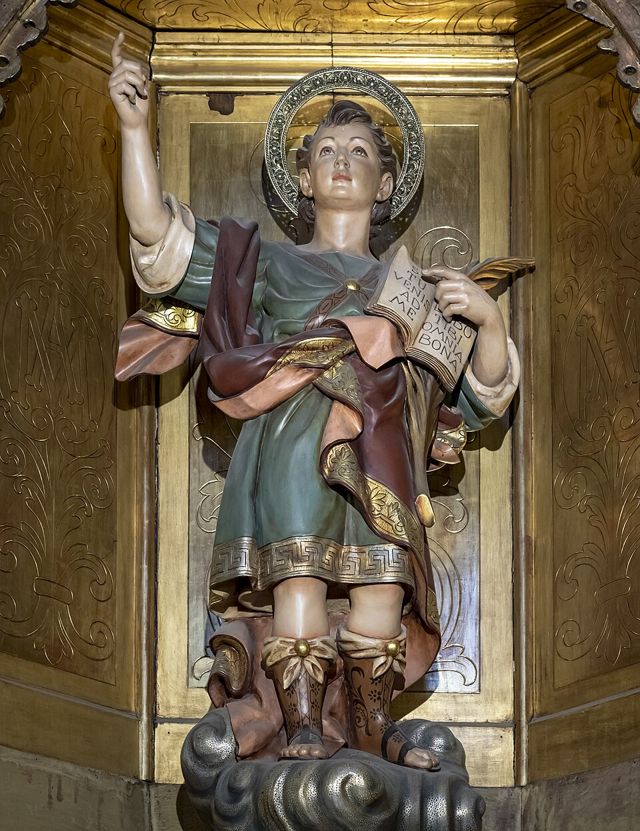
Born 17 December, 1642; died 11 May, 1716. His birthplace was Grottaglie, a small town in Apulia, situated about five or six leagues from Taranto. At the age of sixteen he entered the college of Taranto, which was under the care of the Society of Jesus. He studied humanities and philosophy there, and was so successful that his bishop sent him to Naples to attend lectures in theology and canon law at the celebrated college of Gesu Vecchio, which at that time rivalled the greatest universities in Europe. He was ordained there, 18 March, 1666. After spending four years in charge of the pupils of the college of nobles in Naples, where the students surnamed him the holy prefect, il santo prefetto, he entered the novitiate of the Society of Jesus, 1 July, 1670. At the end of his first year's probation he was sent with an experienced missioner to get his first lessons in the art of preaching in the neighborhood of Otranto. A new term of four years spent labouring in towns and villages at missionary work revealed so clearly to his superiors his wonderful gift of preaching that, after allowing him to complete his theological studies, they determined to devote him to that work, and sent him to reside at Gesù Nuovo, the residence of the professed fathers at Naples. Francis would fain have gone and laboured, perhaps even laid down his life, as he often said, amidst the barbarous and idolatrous nations of the Far East. He wrote frequently to his superiors, begging them to grant him that great favour. Finally they told him to abandon the idea altogether, and to concentrate his zeal and energy on the city and Kingdom of Naples. Francis understood this to be the will of God, and insisted no more. Naples thus became for forty years, from 1676 until his death, the centre of his apostolic labours.
He first devoted himself to stirring up the religious enthusiasm of a congregation of workmen, called the "Oratio della Missione", established at the professed house in Naples. The main object of this association was to provide the missionary father with devoted helpers amidst the thousand difficulties that would suddenly arise in the course of his work. Encouraged by the enthusiastic sermons of the director, these people became zealous co-operators. One remarkable feature of their work was the multitude of sinners they brought forth to the feet of Francis. In the notes which he sent his superiors concerning his favorite missionary work, the saint takes great pleasure in speaking of the fervour that animated the members of his dear "Oratory". Nor did their devoted director overlook the material needs of those who assisted him in the good work. In the Oratory he succeeded in establishing a mont de piété. The capital was increased by the gifts of the associate. Thanks to this institute they could have each day, in case of illness, a sum of four carlines (about one-third of a dollar); should death visit any of the members, a respectable funeral was afforded them costing the institute eighteen ducats; and they had the further privilege, which was much sought after, of being interred in the church of the Gesù Nuovo (see Brevi notizie, pp. 131-6). He established also in the Gesù one of the most important and beneficial works of the professed house of Naples, the general Communion on the third Sunday of each month (Brevi notizie, 126). He was an indefagitable preacher, and often spoke forty times in one day, choosing those streets which he new to be the centre of some secret scandal. His short, energetic, and eloquent sermons touch the guilty consciences of his hearers, and worked miraculous conversion. The rest of the week, not given over to labour in the city, was spent visiting the environs of Naples; on some occasions passing through no less than fifty hamlets a day, he preached in the streets, the public squares, and the churches. The following Sunday he would have the consolation of seeing at the Sacred Table crowds of 11,000, 12,000, and even 13,000 persons; according to his biographer there were ordinarily 15,000 men present at the monthly general Communion.
But his work par excellence was giving missions in the open air and in the low quarters of the city of Naples. His tall figure, ample brow, large dark eyes, and aquiline nose, sunken cheeks, pallid countenance, and looks that spoke of his ascetic austerities produced a wonderful impression. The people crushed forward to meet him, to see him, to kiss his hand, and to touch his garments. When he exhorted sinners to repetence, he seemed to acquire a power that was more than natural, and his feeble voice became resonant and awe-inspiring. "He is a lamb, when he talks", the people said, "but a lion when he preaches". Like the ideal popular preacher he was, when in the presence of an audience as fickle and impressionable as the Neapolitans, Francis left nothing undone that could strike their imaginations. At one time he would bring a skull to the pulpit, and showing it to his hearers would drive home the lesson he wished to impart; at another, stopping suddenly in the middle of his discourse, he would uncover his shoulders and scourge himself with an iron chain until he bled. The effect was irresistible: young men of evil lives would rush forward and follow the example of the preacher, confessing their sins aloud; and abandoned women would cast themselves before the crucifix, and cut off their long hair, giving expression to their bitter sorrow and repentance. This apostolic labour in union with the cruel penance and the ardent spirit of prayer of the saint worked wonderful results amid the slaves of sin and crime. Thus the two refuges in Naples contained in a short time 250 penitents each; and in the Asylum of the Holy Ghost he sheltered for a while 190 children of these unfortunates, preserving them thereby from the danger of afterwards following the shameful tradition of their mothers. He had the consolation of seeing twenty-two of them embrace the religious life. So also he changed the royal convict ships, which were sinks of iniquity, into refuges of Christian peace and resignation; and he tells us further that he brought many Turkish and Moorish slaves to the true faith, and made use of the pompous ceremonials at their baptisms to strike the heart and imaginations of the spectators (Breve notizie, 121-6).
Read the rest of the article
Whatever time was unoccupied by his town missions he devoted to giving country or village missions of four, eight, or ten days, but never more; here and there he gave a retreat to a religious community, but in order to save his time he would not hear their confessions [cf. Recueil de lettres per le Nozze Malvezzi Hercolani (1876), p. 28]. To consolidate the great he work tried to establish everywhere an association of St. Francis Xavier, his patron and model; or else a congregation of the Blessed Virgin. For twenty-two years he preached her praises every Tuesday in the Neapolitan Church, known by the name of St. Mary of Constantinople. Although he engaged in such active exterior work, St. Francis had a mystical soul. He was often seen walking through the streets of Naples with a look of ecstasy on his face and tears streaming from his eyes; his companion had constantly to call his attention to the people who saluted him, so that Francis finally decided to walk bear-headed in public. He had the reputation at Naples of being a great miracle-worker, and his biographers, as those who testified during the process of his canonization, did not hesitate to contribute to him a host of wonders and cures of all kinds. His obsequies were, for the Neopolitans, the occasion of a triumphant procession; and had it not been for the intervention of the Swiss Guard, the zeal of his followers might have exposed the remains to the risk of desecration. In all the streets and squares of Naples, in every part of the suburbs, in the smallest neighboring hamlets, everyone spoke of the holiness, zeal, eloquence, and inexhaustible charity of the deceased missionary. The ecclesiastical authorities soon recognized that the cause of his beatification should be begun. On 2 May, 1758, Benedict XIV declared that Francis de Geranimo had practiced the theological and cardinal virtues in a heroic degree. He would have been beatified soon afterwards only for the storm that assailed the Society of Jesus about this time and ended in its suppression. Pius VII could not proceed with the beautification until 2 May, 1806; and Gregory XVI canonized the saint solemnly on 26 May, 1839.
St. Francis de Geronimo wrote little. Some of his letters have been collected by his biographers and inserted in their works; for his writings, cf. Sommervogel, "Bibl. de la Comp de Jésus", new ed., III, column 1358. We must mention by itself the account he wrote to his superiors of the fifteen most laborious years of his ministry, which has furnished the materials for the most striking details of this sketch. The work dates from October 1693. The saint modestly calls it "Brevi notizie della cose di gloria di Dio accadute negli exercizi delle sacri missioni di Napoli da quindici anni in quâ, quanto si potuto richiamare in memoria". Boero published it in S. Francesco di Girolamo, e le sue missioni dentro e fuori di Napoli", p. 67-181 (Florence, 1882). The archives of the Society of Jesus contain a voluminous collection of his sermons, or rather developed plans of his sermons. It is well to recall this proof of the care he took in preparing himself for the ministry of the pulpit, for his biographers are wont to dwell on the fact that his eloquent discourses were extemporaneous.
Among his chief biographers the following are worthy of particular mention: Stradiotti, who lived twenty-five years with the saint on the professed house at Naples and had been his superior; he wrote his life in 1719, just three years after the death of St. Francis. Six years later, a new life appeared, written by a very remarkable Jesuit, Bagnati. He lived with St. Francis for he last fifteen years of his life and was his ordinary confessor [in old usage, a saint who was not martyred, or who suffered for the faith without being killed]. The most popular biography is that written by de Bonis, who composed his work at the time the process of the beautification of the saint was being drawn up. Worthy of note also is the Summarium de virtutibus ven. Francisci de Hieronymo (1751). It is a work to be used with caution; the postulator of the saint's cause, Muzzarelli, extracted from it a great number of important facts relating to the labours and miracles of the saint, "Raccolta di avveminenti singolari e documenti autentici spettanti alla vita del B. Francesco di Geronimo" (Rome, 1806). Lastly, the Historie de S. François de Geronimo, ed. Bach (Metz, 1851) is the most complete work on the subject, but strives too much after the edification of the reader. C. Carayon, Bibliographie historique de la Compagne de Jesus, nn. 1861-89 (Paris, 1864).