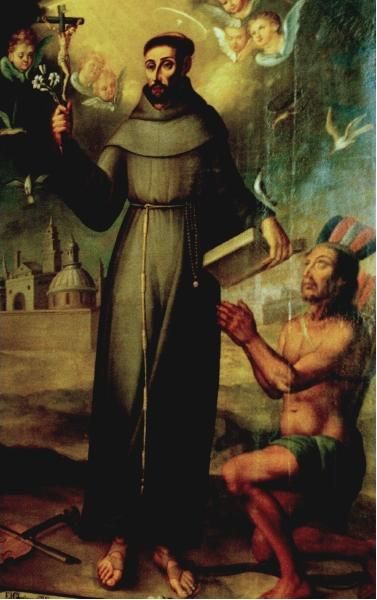
Baring-Gould’s sources: Roman and Franciscan Martyrologies. Beatified by Clement X., and canonized by Benedict XIII., in 1755. Authority: — A Life by Tiburtius Navarrez, O.M., Rome, 1671.] S. Francis Solano was born at Monsilia in Andalusia, in the diocese of Cordova, in March, 1549. His father and mother, distinguished alike for their rank and piety, inspired him from earliest infancy with the love and fear of God. He made his first studies with the Jesuits, and at school was conspicuous for his love of peace, and guilelessness. One day, seeing two men engaged in a duel, the boy rushed between them, exclaiming, “For the love of God! put away those swords or you will hurt one another. Amused and touched, the combatants drew back, unwilling to injure the child; and their anger cooling, they sheathed their swords, and shook hands.
The young Francis spent his leisure in gardening, and over his work his bright, cheerful voice could be heard singing. Under his tender nurture the garden flowered as a patch of Paradise.
At the age of twenty he entered his noviciate among the Franciscans of Monsilia, and indulged in all the vehement austerities which young and inexperienced enthusiasm suggested. After his profession, he studied philosophy and theology, and was appointed master of the novices. Later, he became superior of the convent, but feeling strongly a vocation to labour for souls, he obtained his discharge from the duties of superior, that he might absent himself from the convent preaching. When the plague broke out, Francis ministered to the sick, assisted by another friar, with the utmost assiduity. His companion was stricken. He nursed him, and received his last breath. Then he went about his work, doing all alone, till one day he fell, dizzy and sick, and the plague boil having appeared, he crawled back to the hospital, and laid himself down to die.
But God had other work for his servant. Francis recovered,' and as soon as he was restored, returned to his labours among the sick.
The New World at this time opened a field of conquest for souls to the adventurous missionaries who dared to explore it. The craving for the work came on Francis like a mighty wind filling a sail, and driving it over the ocean. The breath of God filled his great heart with unspeakable charity for the souls of the poor Peruvians, and, having received permission to depart, in 1589 he sailed for South America. As the ship, after having doubled Cape Horn, was coasting Chili, it was caught by a storm, and driven upon a sand-bank. All hope of saving the vessel having been abandoned, the captain ordered the Spanish sailors and passengers into the long boat. There were negroes on board, slaves for the colony, they might perish, — a loss of capital, nothing more. But Francis Solano looked on the poor black men with a very different eye. They too had been made in the image of God, and had souls to be saved. He refused to enter the boat. He would remain on the wreck with the negroes. There was no time for delay, the painter was cast off, and the straining eyes of those on the ship saw the boat, and with it, as they deemed, every chance of life, disappear over the waves.
Huge billows thundered against the stern, or catching the vessel midships lifted her, and threw her farther up the bank. In the midst of the storm, Solano, cross in hand, hurried from one cowering group of negroes to juiy 24.] Francis Solano * 543 another, briefly explained to them the outlines of the faith, and baptized them in a scud of foam. The vessel parted, and some of her living freight went down in the sea. Francis Solano and the remainder clung to the bows, grounded on the sands. Morning broke, and the sea began to go down. He continued his pious instructions to the trembling, stupefied negroes, cheered them with hope, and pointed to the breaking clouds and retreating waves. The fall of the tide and the abatement of the storm exposed a long sandy shore, on which, among the sad wrecks of human bodies and spars of the vessel, Francis found his habit, from which he had divested himself, to assist in manoeuvring the vessel during the storm.
Three days after, the boat returned and picked up the survivors. On their arrival at Lima, Francis was sent to the Rio de la Plata. He found the Indian tribes there speaking various languages, but having a great natural facility for tongues, he speedily mastered their languages, sufficiently at least to make himself understood by the natives.
He is said to have had the gift of prophecy, and to have foretold the destruction of Truxillo by earthquake fifteen years before the event took place • but in a country where earthquakes are of daily occurrence, there is nothing extraordinary in the accomplishment of a threat of punishment on a careless town by earthquake shock. Scarce a year elapses in Peru without serious devastation being caused by the subterranean agitations.
In r6o4 he was preaching at Lima, on the text “All that is in the world, the lust of the flesh, the lust of the eyes, and the pride of life.,? He attacked the pre-. valent vices of the Peruvian Spaniards with such vehemence, uttered such lofty truths, denounced such dire woes in the event of morals being unreformed, that a panic fell on his hearers. The alarm, the contrition, were catching; the whole population of Lima trembled, wailed over the past, and promised amendment. The friars of S. Francis and S. Dominic vied with one another in public scourgings of their bare and bleeding shoulders, to appease Divine wrath. Litanies were chanted in procession. The report spread that Francis had foretold the speedy ruin of the city by earthquake. Every vibration of the soil sent a chill to the hearts of the citizens, and redoubled their alarm; alarm grew to agony of terror. The magistrates interfered. The viceroy of Peru took counsel at night with the archbishop of Lima how to appease the general excitement. A commission was appointed to investigate the causes. S. Francis was summoned before it, and remonstrated with. He assured the commissioners that he had not prophesied the overthrow of the city, he had denounced the ruin of individual souls, not of material buildings. He was required to put this statement in writing on his oath, and sign it. It was published; and by degrees the excitement was appeased.
He died, July 14th, of fever. It was the feast of S. Bonaventura, and mass was being.sung in the convent church. The sick man lay on his hard pallet, murmuring his wonted exclamation, “ God be glorified ! ” The friars nursing the saint were singing the Credo in the infirmary. Some little birds perched on the infirmary window were twittering joyously. Those attending the sick man thought — -it was a pleasant fancy — that the birds also were chanting their Credo. Then through the thin hot air came the clang of the bell, as >S. Francis Solano.
the words, “And He was incarnate by the Holy Ghost of the Virgin Mary,” were being sung by the friars round the bed; for at that moment the elevation was made in the convent church. The sick man at the same moment clasped his crucifix, looked at it, sighed “God be glorified ! ” laid it on his breast, folded his hands over it, and was dead.