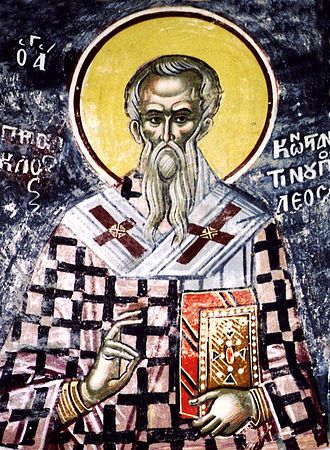
Baring-Gould’s sources: Ado, Usuardus, Hrabanos. Gallican and Roman Martyrologies. Authority: — The Apocryphal Acts attributed to Sebaldus, B. of Perigueux, in the 10th cent, but probably later. There are other and still later, but hardly more worthless, versions.] The ambition of some of the Churches in Gaul to claim as their founders delegates from S. Peter, has led them to antedate the first bishops of their sees by several centuries. Thus S. Dionysius of Paris, S. Martial of Limoges, S. Regulus of Senlis, S. Lucian of Beauvais, S. Nicasius of Rheims, S. Taurinus of Evreux, have been thrown back from their proper centuries, the 3rd or 4th, to the times of the Apostles.
There is no date of any bishop of Perigueux that can be determined before Patemus, an Arian [followers of Arius, who taught that the Son is a created being, not fully God], who assisted at the Council of Beziers in 356. He was deposed in 362. Gregory of Tours [bishop and historian of the Franks (d. 594)] mentions a Pegasius, but the first Catholic bishop who has a fixed date is Chronopius, who built a church in honour of his predecessor, S. Fronto, in 511. It is probable, as Perigueux had an Arian bishop in 356, that Fronto preceded him by a few years, the succession being S. Fronto, Aignan, and then Patemus. However, the legend writers of Perigueux have spun a web of romance about Fronto, which in outline is as follows: — S. Fronto, of the tribe of Juda, was bom of a father named Simeon, and a mother, Frontonia, in the region of Lycaonia. Hearing of our Lord’s miracles, he came to Him, believed, and was baptized by S. Peter, and was one of the seventy-two disciples of Christ. He was present at the Last Supper and was a witness of the Resurrection. After [Oct. as.
the Assumption of Our Lady, he accompanied S. Peter to Antioch, and thence to Rome. He was sent by the Prince of the Apostles to preach the Word in Aquitain, and went thither accompanied by his disciple George, who, however, died on the way. Fronto returned in distress to S. Peter, who gave him his stick, and bade him lay it on the body of the dead man. He did so, and George revived. The same story is told of S. Maternus of Trfeves, another disciple of S. Peter, according to fable, and of S. Martial of Limoges.1 On arriving at Valence, George was left there as bishop, and S. Fronto went forward to Perigueux with another disciple, S. Aignan. Arrived at his destination, he liberated a maniac from the demon who possessed him, and a noble matron, named Maximilla, was so impressed by this miracle that she requested to be baptized. Her husband, Chilperic, had long been suffering from paralysis, but at the prayer of Fronto he was healed. Many others believed, and Fronto thereupon built and dedicated the church of S. Stephen, and established in it seventy-two clerks, who should sing the praises of God therein, day and night.
In Perigueux was a temple of Venus. Fronto entered it and broke down the idol of the goddess; whereupon a dragon flew out of the image, and seven men were suffocated by the pestilential breath of the monster. The dragon then proceeded to whip all the worshippers of Venus with its tail, till Fronto, by the sign of the cross, forced it to decamp. Then he cured the bruises of those whom the dragon had scourged, and revived those killed by its breath. Shortly after, a.d. 44, the island of Britain was subjected to the Roman arms. Claudius sent his kinsman, called Squire,2 son of the Roman senator, Amabilis, into Aquitain, 1 See Sept. 14, p. 930. Some rivalry is exhibited by the churches of Trives, Limoges, and Perigueux as to which possessed and gave credence to this story originally, each apparently being jealous of the honour of having concocted the apocryphal incident. S. Fronto.
to reduce that island to obedience to the empire. Squire, on reaching Perigueux, was much shocked to see the ruin which had befallen the temples, and by his command Fronto, and his companions, Frontasius, Severinus, Severian, and Silanus, were brought before him, and he ordered the immediate execution of the bishop. But when the executioner hacked, the neck of Fronto became as marble, and turned the edge of the sword. The executioner went raving mad, and tore himself to pieces with his own teeth. A blaze of light surrounded the confessors, and Squire and his company, in a panic, scampered out of the theatre as fast as their legs could carry them. There was prospect of a riot, as the people were devoted to Fronto; accordingly, the bishop deemed it advisable to depart, leaving Calepodius the priest in charge during his temporary absence.
Having preached at Brantome, Angouleme, and Saintes, Fronto came to Bordeaux, where he was arrested by the Count Sigebert, but as the Saint cured him of paralysis the Count allowed him to build and consecrate there a church to S. Stephen, and at Blaye one to S. Saviour. He slew a dragon at Neuilly Saint-Front, and there the saint built a church. On the day of Pentecost, as he was about to say mass, it was ascertained that there was no wine. Then he prayed, and suddenly there came in glory a dazzling white dove, bearing a vial full of wine in its beak, and gave it to the saint.1 The vial was ever after retained in the church of Neuilly as a sacred relic.
Going east he fell in with a Duke of Lorraine,2 and converted him. Then Clement, Bishop of Metz, in Lorraine, invited him to his city. After having stayed some while with him, Fronto went on to Limoges, and slew another dragon at Nogent. After this he retired to a desert, where 1 An incident adapted from the myth of the Sangreal. See S. Remigius [bishop of Reims who baptized Clovis, king of the Franks], p. 19. 3 Dux nomine Lotharingus; probably for Dux Lotharingiae, the proper name would be Lotharius.
COet. »j. he soon became very hungry, and would have perished, had not his old persecutor, Squire, being forewarned of God in a dream, laden seventy camels with provisions, and sent them to him. Squire, brought at last to his senses, now received baptism. Sigebert of Bordeaux was not slow to follow his lead, for an astonishing miracle served to convince the most sceptical On the day that Fronto re-entered Perigueux, a woman was engaged in washing her baby. After the custom of the period, happily now discontinued, she put it in a kettle over the fire, intending, of course, to remove the vessel with water and baby when warmed to a blood-heat. But as Fronto passed, the woman rushed forth and forgot her baby, and, excited by the procession and concourse, did not return for half an hour, and then it was to find the water boiling furiously in the kettle, and the baby sitting up and crowing unconcerned in its scalding bath.
One day S. Fronto saw in vision his master, S. Peter, dying on his cross, and S. Paul laying down his head for the sword. He accordingly built a church to their honour, and shortly after died, as the Acts say, “ forty-two years after the Resurrection of our Lord, in the second year of Vespasian.” The second year of Vespasian is a.d. 70; but this is a trifle. It is noteworthy that in the Life of S. Fronto we have nobles with Frank names, Sigebert and Chilperic, and a Duke of Lotharingia, or Duke Lothair. The Franks [the Germanic people who ruled Gaul and gave France its name] had hardly established themselves in Gaul [roughly modern France and Belgium] with dukes and counts till the end of the 4th century. Lotharingia received its name from Lothair II., who died in 869. But the Life is so full of absurdities and impossibilities that no conclusions as to date can be drawn from the names introduced, except to discredit the whole.
Some relics [the bodily remains of a saint, or objects they used, kept with honor] are still preserved in the Cathedral of Perigueux. •S'. Gaudentius.