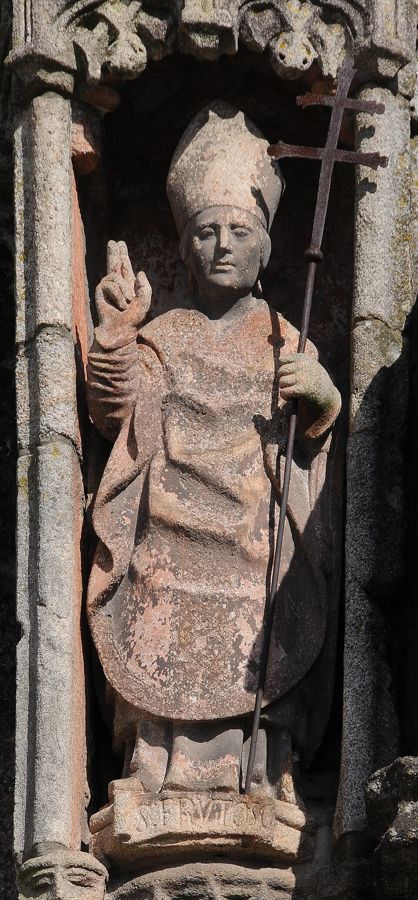
St. Fructuosus of Braga

A shepherd who stayed with his people through hard times.

Read the essentials →
April 16 · Bishop

St. Fructuosus of Braga

St. Fructuosus of Braga

A shepherd who stayed with his people through hard times.

Traditional feast

April 16
1914 / pre-1969 calendar, per Baring-Gould (1897)

Current feast

April 16
Secondary source · Wikipedia

Represents

Bishop

Their story

Adapted in modern English from the Catholic Encyclopedia (1913) · original text below · little is known

Fructuosus was the son of a Gothic general. After his parents died he became a hermit in Galicia. So many disciples gathered round him that the monastery of Compludo grew up, and he went on to found nine more, including one for eighty nuns.

He became Bishop of Dumium in 654 and Archbishop of Braga on 1 December 656. He died on 16 April about 665. Two of his monastic rules survive. He is shown with a stag, which tradition says he saved from hunters.

Early life

The book says little or nothing about early life. This is how the account begins.

What they represent

How they teach us to live

Drawn from themes in the original account

Learn from the kind of life it was. A shepherd who stayed with his people through hard times.

Keep their day. Remember them on April 16 with a short prayer, and ask for their help.

From the Catholic Encyclopedia

1913 · 228 words

An Archbishop, d. 16 April, c. 665. He was the son of a Gothic general, and studied in Palencia. After the death of his parents he retired as a hermit to a desert in Galicia. Numerous pupils gathered around him, and thus originated the monastery of Complutum (Compludo) over which he himself at first presided, later, he appointed an abbot and again retired into the desert. In the course of time, he founded nine other monasteries, also one for 80 virgins under the saintly abbess Benedicta. In 654, Fructuosus was called to the Bishopric of Dumium, and on 1 December, 656, to the Archbishopric of Braga. The life of this greatest of Spanish monastic bishops was written by Abbot Valerius, and based on the accounts of his pupils. In 1102, his relics [the bodily remains of a saint, or objects they used, kept with honor] were transferred to Compostela. The feast day is the 16 of April. Fructuosus is depicted with a stag, which was devoted to him, because he had been saved by Fructuosus from the hunters. There are still extant two monastic rules written by Fructuosus. The first (25 chapters) was destined for the monastery of Complutum, it has an appendix (called pactum), containing the formulae of consecration and the vows. The second, called the "common" rule, which consists of chapters and refers to a union of monasteries governed by an abbot-bishop, is addressed chiefly to superiors of monasteries.
Read more

The full original · 0 words

Read Baring-Gould’s full account

Baring-Gould’s sources: Roman and Spanish Martyrologies. Authority: — A life by a contemporary.] S. Fructuosus descended from the Visigothic kings. All his goods he gave to churches and the poor except what he required for the foundation of the monastery of Compulta, between Galicia and the mountains of L£on. After having given a rule to this house, he retired into the wilderness, and lived in great privations. He was first ordained bishop of Duma, but in 656 he was translated by the fathers of the 10th Council of Toledo, to the archiepiscopal see of Braga. a MAGNUS, M.

Feast days

Feast: April 16

Nine days · Free

Pray the novena
with us.

One short email a day for nine days. The day's prayer, a line from St. Fructuosus of Braga's story, and a nudge to keep going.

Also on April 16
Sts. Maro, Eutyches and Victorinus

Sts. Maro

April 16 · Martyrs
O

Sts. Olympias and Maximus

April 16 · Martyrs
St. Padarn of Vannes

St. Padarn of Vannes

April 16 · Bishop
← All 1726 saints in the library
Sources & notes

Feast-day sources

Story sources

Sources

Credits

Image: Sao Frutuoso.JPG · Joseolgon · CC BY-SA 3.0, via Wikimedia Commons

From Sabine Baring-Gould, The Lives of the Saints, new edition in 16 vols. (London: John C. Nimmo, 1897–98); text from the Internet Archive scan (OCR, lightly cleaned; errors possible). Public domain.

Image: Joseolgon, Wikimedia Commons (CC BY-SA 3.0)

From “Catholic Encyclopedia (1913)/St. Fructuosus of Braga,” The Catholic Encyclopedia (New York: Robert Appleton Company, 1907–1914), via Wikisource. Public domain. Matched by name and feast date; text unedited except for our bracketed notes in grey.

From Sabine Baring-Gould, The Lives of the Saints, new edition in 16 vols. (London: John C. Nimmo, 1897–98); text from the Internet Archive scan (OCR, lightly cleaned; errors possible). Public domain in the United States. Reproduced unedited, except for short bracketed notes in grey that we added to explain names and terms (“S.” is the old abbreviation for Saint). Some history and judgments reflect 19th-century scholarship.