An Abbot of Lagny, near Paris, d. 16 Jan., about 650. He was the son of Fintan, son of Finloga, prince of South Muster, and Gelgesia, daughter of Aedhfinn, prince of Hy-Briuin in Connaught. He was born probably amongst the Hy-Bruin, and was baptized by St. Brendan the Traveller, his father's uncle, who then ruled a monastery in the Island of Oirbsen, now called Inisquin in Lough Corrib. He was educated by St. Brendan's monks, and when of proper age he embraced the religious life in the same monastery under the Abbot St. Meldan, his "soul-friend" (anam-chura). His great sanctity was early discerned, and there is a legend that here, through his prayers, twin children of a chieftain related to King Brendinus were raised from the dead. After some years he founded a monastery at Rathmat on the shore of Lough Corrib which Colgan identifies as Killursa, in the deanery of Annadown. Aspirants came in numbers to place themselves under his rule, but he wished to secure also some of his relatives for the new monastery. For this purpose he set out with some monks for Munster, but on coming near his father's home he was seized with an apparently mortal illness. He fell into a trance from the ninth hour of the day to cock-crow, and while in this state was favoured with the first of the ecstatic visions which have rendered him famous in medieval literature.
In this vision were revealed to him the state of man in sin, the beauty of virtue. He heard the angelic choirs singing "the saints shall go from virtue to virtue, the God of Gods will appear in Sion". An injunction was laid on him by the two angels who restored him to the body to become a more zealous labour in the harvest of the Lord. Again on the third night following, the ecstasy was renewed. He was rapt aloft by three angels who contended six times with demons for his soul. He saw the fires of hell, the strife of demons, and then heard the angel hosts sing in four choirs "Holy, holy, holy Lord God of hosts". Among the spirits of the just made perfect he recognized Sts. Meldan and Beoan. They entertained him with much spiritual instruction concerning the duties of ecclesiastics and monks, the dreadful effects of pride and disobedience, the heinousness of spiritual and internal sins. They also predicted famine and pestilence. As he returned through the fire the demon hurled a tortured sinner at him, burning him, and the angel of the Lord said to him: "because thou didst receive the mantle of this man when dying in his sin the fire consuming him hath scarred thy body also." The body of Fursey bore the mark ever after. His brothers Foillan and Ultan then joined the community at Rathmat, but Fursey seems to have renounced the administration of that monastery and to have devoted himself to preaching throughout the land, frequetly exorcising evil spirits. Exactly twelve months afterwards he was favoured with a third vision. The angel remained with him a whole day, instructed him for his preaching, and prescribed for him twelve years of apostolic labour. This he faithfully fulfilled in Ireland, and then stripping himself of all earthly goods he retired for a time to a small island in the ocean. Then he went with his brothers and other monks, bringing with him the relics [the bodily remains of a saint, or objects they used, kept with honor] of Sts. Meldan and Beoan, through Britain (Wales) to East Anglia where he was honourably received by King Sigebert in 633. The latter gave him a tract of land at Cnobheresburg on which he built a monastery within the enclosure of a Roman fort—Burghcastle in Suffolk—surrounded by woods and overlooking the sea. Here he laboured for some years converting the Picts and Saxons. He also received King Sigebert into the religious state. Three miracles are recorded of his life in this monastery. Again he retired for one year to live with Ultan the life of an anchorite [a hermit, sometimes walled into a cell beside a church].
When war threatened East Anglia, Fursey, disbanding his monks until quieter times should come, sailed with his brothers and six other monks to Gaul [roughly modern France and Belgium]. He arrived in Normandy in 648. Passing through Ponthieu, in a village near Mézerolles he found grief and lamendation on all sides, for the only son of Duke Hayson, the Lord of that country, lay dead. At the prayer of Fursey the boy was restored. Pursuing his journey to Neustria he cured many infirmities on the way, by miracles he converted a robber and his family, who attacked the monks in the wood near Corbie, and also the inhospitable worldling Ermelinda, who had refused to harbour the weary travellers. His fame preceded him to Péronne, where he was joyfully received by Erkinoald, and through his prayers obtained the reprive of six criminals. He was offered any site in the king's dominions for a monastery. He selected Latiniacum (Lagny), close to Chelles and about six miles from Paris, a spot beside the Marne, covered with shady woods and abounding in fruitful vineyards. Here he built his monastery and three chapels, one dedicated to the Saviour, one to St. Peter, and the third, an unpretending structure, afterwards dedicated to St. Fursey himself. Many of his countrymen were attracted to his rule at Lagny, among them Emilian, Eloquius, Mombulus, Adalgisius, Etto, Bertuin, Fredegand, Lactan, Malguil. Having certain premonitions of his end, he set out to visit his brothers Foillan and Ultan who had by this time recruited the scattered monks of Cnobheresburg and re-established that monastery but his last illness struck him down in the very village in which his prayer had restored Duke Haymon's son to life. The village was thence-forward called Forsheim, that is, the house of Fursey. In accordance with his own wish his remains were brought to Péronne, many prodigies attending their transmission,and deposited in the portico of the church of St. Peter to which he had consigned the relics of Sts. Meldan and Beoan. His body lay unburied there for thirty days pending the dedication of the church, visited by pilgrims from all parts, incorrupt and exhaling a sweet odour. It was then deposited near the altar. Four years later, on 9 February, the remains were translated with great solemnity by St. Eligius, Bishop of Noyon, and Cuthbert, Bishop of Cambrai, to a chapel specially built for them to the east of the altar. In the "Annals of the Four Masters", Péronne is called Cathair Fursa.
Read the rest of the article
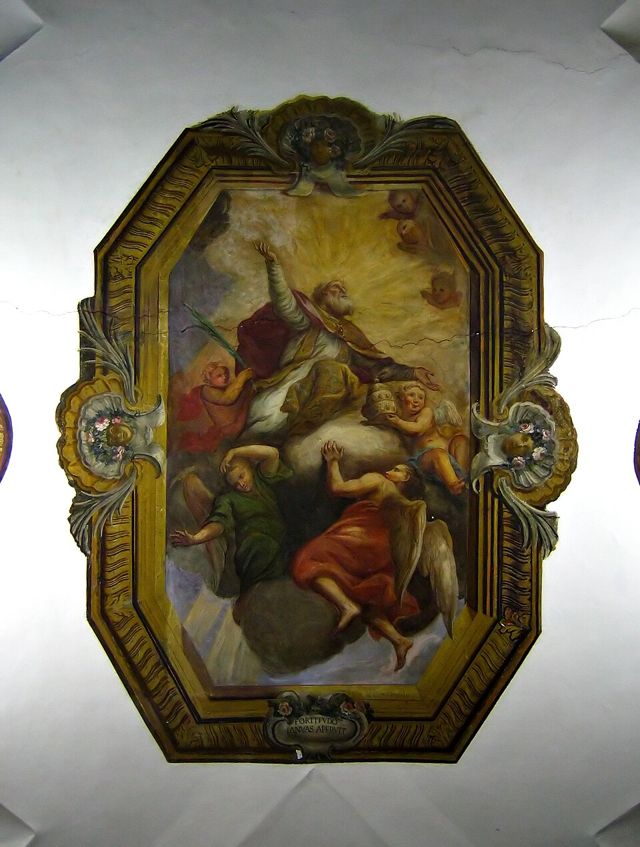
In art St. Fursey is represented with two oxen at his feet in commemoration of the prodigy by which, according to legend, Erkinoald's claim to his body was made good; or he is represented striking water from the soil at Lagny with the point of his staff; or beholding a vision of angels, or gazing at the flames of purgatory and hell. It is disputed whether he was a bishop; he may have been a chorepiscopus. A litany attributed to him is among the manuscripts in Trinity College Dublin. An Irish prophecy is attributed to him by Harris.