Baring-Gould’s sources: Roman Martyrology. By the Greeks on March 4th and 20th. Authorities:—Mention in the lives of S. Euthymius and S. Quiriacus, by Cyril the Monk, fl. 548
S. Gerasimus embraced the monastic life in Lycia; he afterwards passed into Palestine, at a time when Eutychianism [followers of Eutyches, who said Christ had only a divine nature; condemned at Chalcedon in 451] prevailed, and he had the misfortune to embrace the errors of that heresy; but S. Euthymius (Jan. 20th) visited him, and restored him to the unity of the faith. He expiated his error by the most rigorous fasting. He became very intimate with S. Euthymius, S. John the Silentiary, S. Sabas, and S. Theoctistus.
A great number of disciples placed themselves under his conduct, and he built a laura near Jordan, consisting of seventy cells, amidst which was a monastery for the lodging of those who were to live in community, and disciplined those who afterwards occupied the hermitages of the laura. The anchorites assembled in the church on the Sabbath and the Sunday to participate in the sacred mysteries, and on these two days they ate common food that had been cooked, and drank a little wine; on other days they ate only bread and dates, and drank water. Fires were never lighted in the cells, and the hermits slept on rush mats.
S. Gerasimus carried his abstinence further than his brethren. Throughout Lent [the forty days of fasting before Easter] he took no other nourishment than the Divine Eucharist.
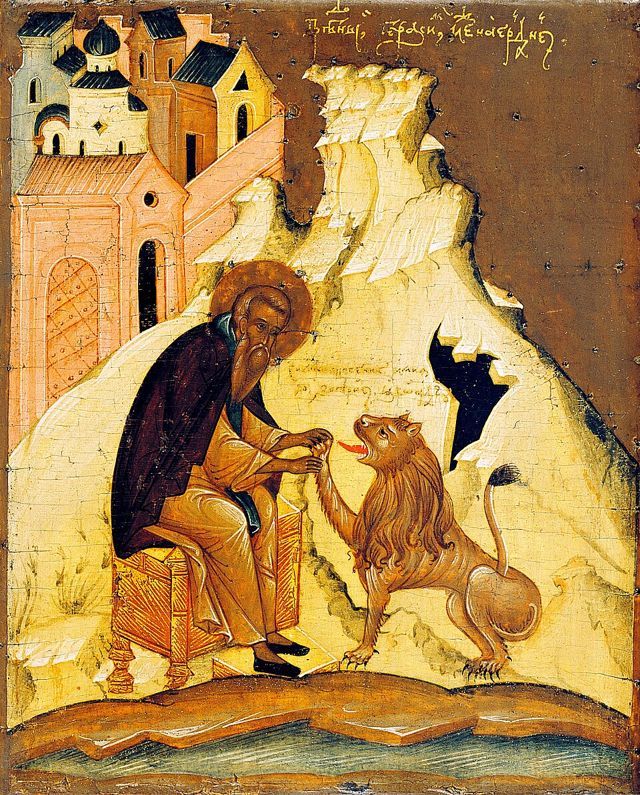
One day as the old abbot was walking on the banks of the Jordan, he saw a lion limping, and roaring with pain. The lion, instead of attempting to escape, held up its paw, which was much swollen, and Gerasimus taking it on his lap, examined it, and saw that a sharp splinter had entered the flesh. He withdrew the piece of reed, and bathed the paw. The lion afterwards gratefully followed him to his cell, and never after left him, but was fed by the abbot. There was an ass belonging to the monastery which brought water from the Jordan, for the necessities of the brethren; and Gerasimus sent the ass out to pasture under the guardianship of the lion. One day the lion had gone away from his charge, and an Arabian camel driver passing by, stole the ass. In the evening the lion returned depressed in spirits to the monastery, without the ass. Gerasimus naturally concluded that the lion had eaten the animal, and he cried out, "Sirrah, where is the ass?" The lion stood still, and looked back over his shoulder. "You have eaten him!" said the abbot; "Let us praise God. Well, what the ass did, you shall do now." And thenceforth the lion carried the water for the brethren.
Now one day a certain soldier came to the monastery, and seeing the lion toiling under the water bottles, he pitied the lordly beast, and gave some money to the abbot to buy an ass on the next opportunity, and release the lion from its office of water-carrier. Some days after this, as the lion was near Jordan, there came by the driver who had stolen the ass, with three camels, and the stolen beast itself. The lion set up its mane and roared, and made towards the man, whereupon the driver took to his heels. Then the lion caught the end of the ass's halter, and drew it along with the camels to the door of the monastery. And thus the abbot learned that he was wrong in accusing his dumb friend of having devoured his charge.
For five years the lion was the constant companion of the old abbot, going in and out among the monks; and at the expiration of that time Gerasimus died. Now the lion was out when he departed to his rest; but when the lion returned home, he went about searching for the old man. Then the abbot Sabbatius, a disciple of the dead saint, seeing the uneasiness of the lion, said to him "Jordan, (for by that name the lion was called), our old friend has gone away and left us orphans, and has migrated to the Lord; but here is food, take and eat." But the lion would not and paced to and fro seeking the dead man, and every now and then throwing up his head, and roaring. Then Sabbatius and some of the other brethren came and rubbed his neck, and said, "The old man is departed to the Lord, and has left us." But this did not appease the lion; and the more they caressed him, and spake to him, the more agitated he became, and the louder he roared, "showing with mouth and eyes how great was his distress, because he saw not the old man."
Then the abbot Sabbatius said to him, "Come along with me, as you will not believe me, and I will show you where our old friend is laid." And he led the lion to the place where Gerasimus was buried; and the abbot Sabbatius, standing at the tomb, said, "See here is where he is buried." And then he knelt and wept upon the grave. So when the lion saw this, he went, and stretched himself on the grave, with his head on the sand, and moaned, and remained there, and would not leave the place, but was found there dead, a few days after.
It is almost needless to say that this beautiful incident has given to the abbot Gerasimus his symbol of a lion, in art.