Baring-Gould’s sources: Roman and Gallican Martyrologies. The Martyrology of Bede on Aug. 1st. Several of the ancient Martyrologies on Oct. 1st.; but Ado on July 31st. Other Martyrologies on Sept. 22nd. The Authorities for the Life of S. Germain are, (1) the contemporary mention of him in the Chronicle of Prosper of Aquitaine, (2) Constantius, who wrote between 483 and 492, (3) mention by Bede in his Ecclesiastical ( Hist., a.d. 732, (4) British Legends of the 9th century in Nennius, Hist. Brit.J HIS great Saint was bom at Auxerre, about a.d. 378, of noble parents, and was brought up; as a Christian, and educated, it is said, partly: at Rome. But he gave in his youth no tokens of that spiritual greatness which made him afterwards distinguished. He was devotedly attached to the chase, and inclined to tolerate, if not to partake in, the heathen customs which still lingered in Gaul. In the midst of Auxerre grew a stately pear-tree, on which it. was the usage of the hunters to suspend the heads and antlers of the game killed in hunting. It was a heathen custom, these were offerings to Odin - although to themselves and to others the huntsmen might disguise the signification of their act Germain invariably suspended his trophies on the branches of the sacred tree, regardless of the reproof of the bishop, Amator. The bishop took the opportunity of the absence of the young chief in the forest chase to cut down the tree. Germanus on his return was furious, he seized and threatened the bishop with death. But his anger exploded in words.
When Amator was old, and looking about for a worthy successor, he resolved that the eager huntsman, Germain, should succeed him. His scheme was whispered among the people. Germain was the chief of Auxerre, rich and powerful. Who so fit to be their prelate as he who was their hereditary ruler ? Suddenly, when Germain least expected it, the people rose, caught him, dragged him into the church, the bishop plucked off his secular habit; in vain did the chief struggle in the hands of his captors, he was forced to his knees before the altar, and with pious precipitancy Amator consecrated him priest. 1 On the death of S. Amator, Simplicius filled his room, but only for a brief period, and on his death, Germain was elected bishop.
From the day of his ordination, the life of Germain was altered. He abandoned the chase, and adopted a course of study; instead of riotous banquets, his meals were frugal, his gay clothing was exchanged for the sombre habit of a monk; his wife, Eustacia, thought fit, or was obliged, to retire into another hbuse.
One winter day, S. Germain was travelling with a few attendants. At night-fall they rested in a ruined house. Whilst reciting the office with a clerk, a crash of stones showed that the wall was falling; and next moment a train of ghastly spectres stood before them. Germain asked why they appeared to scare the living. They replied that their bodies lay unburied among the ruins. Germain bade T The story has been already told in the life of S. Amator, May 1st. S. Germanus.
them lead the way, and he followed to where the ghostly visitants pointed out a spot covered with stones and brambles. The bishop next morning sought at the spot, found the corpses, and gave them Christian burial. A message having come to the bishops of Gaul [roughly modern France and Belgium] from those of Britain, imploring their aid against the Pelagian [followers of Pelagius, who taught people could be good without God’s grace] heresy, which was spreading rapidly through their island, in 429, S. Germain of Auxerre, and S. Lupus of Troyes, were chosen to go on an embassy to Britain to oppose Pelagianism. 1 On their way to Britain, S. Germain passed through Paris, and then occurred that touching incident of the dedication of S. Genoveva, already narrated in the life of that saint (Jan. 3rd). Arriving in Britain after a stormy passage, 2 the two bishops attended a council of the British bishops held, apparently, at Verulam; and there they spoke with vehemence against those who denied original sin and affirmed their capability of serving God unassisted by Divine grace. A Romano-British tribune and his wife brought their blind daughter to them out of the crowd, and Germain at once restored her sight by touching her eyes with his reliquary.
The British suffered severely at this time from the inroads of the Piets and Scots; and as news reached the bishops that a fresh incursion of these barbarians had burst through the wall of Severus, Germanus and Lupus accom*? panied the British army that marched to arrest their progress. On their march they preached to the soldiers, 1 This is the date given by Prosper of Aquitain, himself in Rome, a.d. 431, on a mission to Pope Caelestine, and writing shortly after 455, he is certainly the best evidence for the date. That of 446, given by Matthew of Westminster, following Sigebert of Gemblours, rests on Constantius and Bede [English monk and historian (d. 735)], who give a vague general date, and on an inference groundlessly drawn from the mention of Saxons as well as Piets in Constantius* account of the Hallelujah battle fought in Britain under the leading of Germanus.
2 In winter according to the Lire ol Lupus. and most of them, who were not yet Christians, moved by the exhortations of the holy bishops, received baptism. The army, wet with baptismal water, as Bede says, went against the heathen foe in the strength of the Lord. S. Germain picked out the most active among the Britons, examined the country, and finding a valley encompassed by hills, drew up his inexperienced troops in it. The fire of his old military ardour awoke, and he took the command of the helpless, feeble Britons, and endeavoured to infuse into them some energy, some courage. When the Piets came on, the Britons remained in ambush till their foes were well in the midst of the valley, then Germain, bearing the standard, started from his hiding place, the. > priests thundered the joyful Paschal cry, Hallelujah, — it was Easter-tide, the Britons rose, repeated the cry, and burst from their concealment. The Piets and Scots fled in disorder, casting away their arms, and many were drowned in the river. The Britons without loss of a man, almost without striking a blow, found themselves in the unwonted position of victors, instead of flying before the naked savages, and attributed their triumph to the merits and generalship of their holy leader. To pursue fhe flying foe, and turn a panic into a rout, and thus strike a serious blow at the power of the invaders, was an effort beyond their capabilities. They were content to gather up the miserable spoil, and return rejoicing to their camp. The site of this bloodless victory is said to have been Maes Garmon, near Mold in Flintshire. But the historian may ask how it was that the Piets and Scots should have penetrated so far, and turned their forces on needy Wales instead of the more wealthy and populous parts of Britain. And the absence of all trace of this victory in the Welsh historians, may make us question whether the story be not the legend of some skirmish, picked up and exaggerated iS. Germanus. 685 by Constantius. Bede knew nothing of it but what he read in the account of the priest of Lyons, whose words he quotes almost verbatim.
Several churches in Wales bear the name of S. Germain, or Garmon; but as he visited this country twice, only one of them can be distinctly referred to the date of this his first mission, namely, Danarmon in Jal, Denbighshire. It is singular that the parish attached to it adjoins that of Mold, in which the Allelujatic victory is said to have been gained; and if 'Archbishop Usher has correctly determined ' the locality of the engagement, the church in question is possibly situated on the spot where S. Germain is described as having raised a sacred edifice, formed of the branches of trees interwoven together, in which he and his followers celebrated the Easter festival, and baptized the greater part of the army. ( After having successfully combated Pelagianism, and taught the timorous Britons a lesson in resistance to their barbarous foes, Germain and Lupus returned to Gaul. He visited Arles, where he was warmly received by S. Hilary. It is remarkable that, at this very time, the bishops of Gaul, S. Hilary among them, at Rome were labouring under suspicion of dangerous sympathy with Pelagian doctrines. They — at least those of Aquitain — having felt themselves obliged to call in question the teaching of S. Augustine on Predestination and Grace, were thought and charged by the fiery Prosper with semi-Pelagianism. In reality they protested against the exaggeration of the doctrines of Augustine, which left no place for human effort and the exercise of free-will. It is remarkable that Germain, who must have been under the influence of the prevailing antiAugustinian views of the Gallican Church, should have so triumphantly refuted Pelagianism in its British stronghold. It shows how opposed the Gallican Church was to exaggeration on either side, in the direction of emancipation of man from dependence on grace, or the crushing out of his activity beneath a fatally constraining Divine will. In 447, the year before his death, Germanus was again sent to Britain, together with Severus of Treves [Trier in Germany], the disciple of S. Lupus. At Paris he again visited S. Genoveva. 1 On their arrival in Britain he healed the son of Elaphius, a governor, of a contracted leg by the power of his touch. The multitude were amazed, and expelled the Pelagians from among them. Several fables are related by Nennius, in ther 9th cent., concerning this second mission. Ketelus or Cadell, the swineherd of Benly, king of Powys, opened his doors to the bishops, when in cold and hunger they were turned from the king’s gates with contempt. In consequence of this hospitality the saint deposed the king, and elevated the swineherd in his room. It so happens that the Welsh accounts mention the name of Benlli-Gawr, who was a chieftain in Denbigh about that time, but he was succeeded by his son Beli. By Ketelus is meant Cadell Deymllug, “ a prince of the Vale Royal and part of Powys, 7 ' who rose into power about the same period. These facts show that there is some foundation for the legend, which may contained a confused remembrance of some real event. It is remarkable that there is a church dedicated to S. Germain in the district, Dyffryn Ceiriog Llanarmon, which might have been part of the possessions of either Cadell or Benlli, and a chapel, subject to an adjoining parish, also dedicated to him. Another story describes a meeting between S. Germain and Vortigern, at a council held in Gwrtheyrnion or Builth, in Radnorshire, when the saint publicly and boldly rebuked the king for the licentiousness. S. Germain was treated with insolence, and he cursed Yortigern and departed. But Vortimer, son of Vortigern, threw himself at the feet of S. Germain, and gave him the lands on which he had been insulted, to be' his for ever. It is curious that a church dedicated to S. Germain is on this spot. That the saint effected a great change in the religious condition of the Britons is not unlikely, from the respect so generally paid to his name; and it may be observed that there are no parish churches in Wales which can be traced to a higher date than his first visit. It is probable that S. Germain may have endeavoured to regulate the British Church after the model of the Gallican, by the institution of parochial divisions, such as had been ordered in Gaul by the council of Vaison, in a.d. 442. Yortigern was at the time of the second visit of S. Germain a chief in Radnor and Brecon; but in 448, he became, by treachery or otherwise, the Pendragon, or chief ruler in Britain.
The Saint was on his road back to Auxerre, when he met a deputation of the inhabitants of Armorica [Brittany in north-west France], or Brittany, sent to entreat his interference to save them from the vengeance of Eocaric, king of the Alemanni, who had been sent against them by Aetius, the Roman general in Gaul, to chastise them for having revolted.
S. Germain undertook the difficult, if not dangerous, task of stepping between the barbarian and his prey. He rode to meet him, and boldly accosted Eocaric. The king, knowing or guessing his object, would have pushed by. S. Germain caught his bridle, and before all his army arrested him. The ferocious German endeavoured to shake himself free, would not listen, dug his long spiked spurs into the flanks of his steed. The horse reared, but the venerable prelate did not let go his hold. He would have been thrown from his horse and trampled under foot, von. vm. xy Eocaric was not prepared to see himself the murderer of so great a bishop, and he restrained his foaming steed. Then the grand old man addressed him. Germain painted to him the woes of wailing widows and orphan children; desolated farms and burning houses, and tears wetting the smoking ashes of once happy homes. He warned him of judgment on those who do wrong and rend with cruel hand asunder the ties that God has knit, who bring tears to the cheeks of the widow, and extinguish lives which God has breathed into the nostrils of men made, after his image. Eocaric listened. The rough German heart has always a softness, tenderness under the rudest crust; it was moved. He drew off his troops, on condition that Germain should proceed to the emperor, and obtain pardon for the Bretons. On his return home, S. Germain found his people suffering wrong from the local governors, to redress which, and to obtain what he had promised to Eocaric, he went to Ravenna to see the emperor, and plead before him the cause of the oppressed. On his way, at Autun, he visited the tomb of S. Cassian (Aug. 5th). He was received at Ravenna with respect by Yalentinian III., and his mother, Placida. They granted him what he desired. His entry into Ravenna took place at night. It was noised that Germanus of Auxerre was drawing nigh. His fame had reached Ravenna, and Germanus heard that the emperor and the people were preparing to receive him with honour. His humility took fright, and he hasted forward to reach the city at night, before he was expected. But when it was known that he had entered the gates, crowds with lights lined the streets, and greeted the old man with respectful and enthusiastic acclamations, whilst S. Peter Chrysologus, the bishop, came forward at the head of his clergy to meet and embrace him.
The empress Placida, when she heard that Germanus S. Germanus. had arrived, sent to his lodging a great silver dish filled with dainties, without meat, which she knew he would not touch. The saint sent her in return a barley loaf upon a wooden platter. The empress received it respectfully, ordered the dish to be enchased with gold, and kept the loaf as a precious relic. The saint was continually attended at Ravenna by six bishops, and wrought there many miracles. The son of Yolusian, chancellor or secretary to the. patrician Sigisvultus, being dead and cold, the saint was called, and having put all the company out of the chamber he prostrated himself near the corpse and prayed with tears. After some time the dead man began to stir, open his eyes, and move his fingers. S. Germanus raised him, he sat up, and, by degrees, was restored to perfect health. One day after matins, as the saint was talking with the bishops of religious matters, he said to them, “Mybrethren, I recommend my passage to your prayers. Metbought 1 saw this night our Saviour, who gave me provision for a journey, and told me I was to go into my native country, and to receive eternal rest.” A few days after, he fell sick. All the city was alarmed. The empress went to see him, and he took the opportunity to request her to send back his corpse to his own country; she assented, though very unwillingly. He died at Ravenna on the seventh day of his illness, which was the last of July in 448, having held his see thirty years and twenty-five days. The empress Placidia took his reliquary, S. Peter Chrysologus his cowl and hair shirt, and the six other bishops divided his clothes among them. The eunuch Acholius, prefect of the emperor's chamber, one of whose servants, when sick, the saint had cured, had his corpse embalmed; the empress clothed it with a rich habit and gave a coffin of cypress wood; the emperor furnished carriages and the expense of the journey. The clergy of Auxerre went as far as the Alps to receive the body, which was brought into that city fifty days after the death of the Saint, and after having been exposed tor six days, was buried, on October 1st, in the oratory of S. Maurice he had founded.
The hymn of S. Fiech, besides later tradition, both Irish and British, connects S. Patrick [apostle of Ireland (5th century)] personally with S. Germain. And the scholiast on that hymn brings him with S. Germain to Britain. The confession of S. Patrick himself is conclusively silent on the subject. This mistake has arisen through a confusion having been made between S. Patrick and S. Palladius, the latter of whom was certainly connected with S. Germain.
A Cornish mass of S. Germain, probably of the 9th century, claims S. Germain as having preached in Cornwall. It also contains an allusion to the legend of his interview with Vortigern.
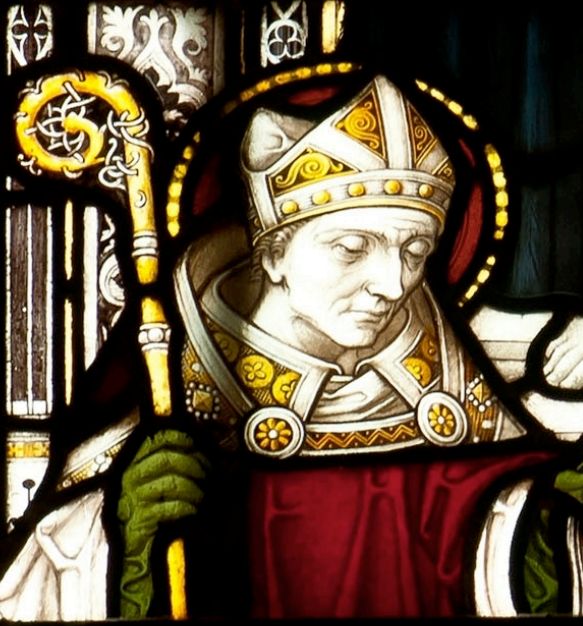
In Art he is represented with an ass at his feet, as he is said to have raised his ass to life when it had died during the time he dined with the Empress Placida. Numerous as are the miracles recorded of Germanus during his life, the number of those after his death is far greater, and they are of the usual kind. For instance, a greedy rustic who stole an apple that had been placed as a votive offering at his tomb, was struck dumb. And in other places that were fortunate enough to possess any of his relics [the bodily remains of a saint, or objects they used, kept with honor] many such things came to pass. In a.d. 859, the church at Auxerre, having been rebuilt on a scale of great splendour, the body of S. Germanus was translated and enshrined. The shrine was demolished by the Huguenots in 1567, and the bones mixed with others, and thrown away or burnt. The Bollandist discusses the genuineness of some which were kept after this in quodam sacco at Auxerre; but is obliged to own that they are not genuine. Some, however, which had been removed from the shrine previous to its demolition, he thinks undoubt’ edly are. But no account of S. Germanus for English readers would be complete without some special notice of his connection with Selby, in Yorkshire, and how it came about. The story is given in a History of Selby Abbey, printed from a MS. by Labbe, in his Bibliotheca MSS., and also contained in the Acta Sanctorum [the Bollandists’ huge collection of saints’ lives]. The account occupies fourteen closely printed pages of the Acta SS., but will here be as much condensed as possible: — About the middle of the nth century, there was a monk of Auxerre, who had a special devotion for S. Germanus, and an overwhelming desire to possess for himself a relic of this patron. One night he stole away to the sacred body, and bit off or cut off the middle finger of the right hand. No sooner had he done this, than he was seized with a horror and trembling, and began to smite his breast with tears and lamentations, beseeching S. Germanus to have mercy on him. Then compelled by a certain necessity, he placed the finger on the altar. The horror-stricken brethren after this secured the body by walls and iron doors, and prepared an ivory case for the finger, in which it was kept over the altar instead of the body, which appears to have been there before. About that time there was a brother named Benedict, to whom S. Germanus appeared three times in the visions of the night, and said to him, “ Go from thy land and from thy kindred, and from this thy father's house, and come into a land which I shall shew thee. There is a place in England, and it is called Selby, provided for my honour, predestined for the rendering of my praise, to be famous for the titles and glory of my name, situated on the bank of the river Ouse, not far distant from the city of York. There I have provided and chosen a founder for my name, and thon shalt found for thyself a cell upon the royal land, which pertains to the right of the king. And fear not to undertake alone so great and such a peregrination * for, believe me, thou shalt be comforted by my companionship, strengthened by my counsel, defended by my protection. My finger, which is over the altar, thou shalt carry with thee in memory of me, and that thou mayest be able to do this securely and without fear of losing it, thou shalt with a knife make an opening in thy arm between the elbow and the shoulder, and therein place the finger. Nor do thou tremble to do this, for thou shalt neither shed blood nor suffer pain.” Benedict disregarded the vision the first and second time, but the third time the saint reproved him so severely for his negligence, that he set off at once, commending himself to God and S. Germanus, and carrying off. the finger without saying a word to any one. Great was the consternation, loud the lamentation, long and diligent the search, when it was found the finger had disappeared. Then it occurred to the monks to pursue Benedict, and at last they overtook and questioned him. He altogether denied having been guilty of any sacrilege \ but nevertheless they searched his clothes. And not being able to find the relic, they returned in confusion to Auxerre, while he made a prosperous journey to England with his precious treasure. But the result of his enquiries on the road was his finding himself at Salisbury instead of Selby. Here he was most honourably entertained by a citizen named Edward, who loaded him with many precious gifts, the chief of which was a gold reliquary of wonderful workmanship, in which the finger was to be kept, and at which it was kept at Selby when the account was written. When, however, he began to ask where York was, and which was the river Ouse, he discovered that he had not yet reached the place of which he had S. Germcmus.
been told in the vision. And being sorely troubled thereat, he was comforted by another vision of S. Germanus appearing to him with a smiling countenance, and saying, “I said not unto thee Salisbury, but that thou shouldest ask for Selby.” And then, says the chronicler, “whether in the body or whether out of the body I cannot tell; God knoweth,” Benedict was transported to Selby, where the Saint said to him, “ Here shall be my rest for ever, here will I dwell, for I have a delight therein.” However, in the morning Benedict was still at Salisbury. A few days after, he was shown the way to Lymington by a priest named Theobald, and there he found a ship bound for York, in which he sailed. They had a prosperous voyage, and no sooner did they approach Selby than Benedict at once recognized it as the placs he had seen in the vision. Here, said he, is the place which the Lord hath chosen; here let me land. And no sooner had he set his foot on the bank, than he set up the Cross under a great oak, called by the natives Strihac, about a.d. 1069, the fourth year of William the Conqueror. Here the chronicler expatiates on the beauties of the situation, the sweetness of the waters, the abundance of fish,, the commodity of water transport The very best of stone can easily be brought for building, and everything that goes to York from foreign parts, or from any port in England, has to go by Selby. And first Benedict built a little cell, where he offered continually praises to the most sacred finger, which had since his arrival made a dumb man speak. One day, a nobleman named Hugh, passing that way, asked him what the cross meant. This led to a firm friendship between them, and they built an oratory in honour of S. Germanus. Then Hugh took Benedict and introduced him to king William, who received him most kindly, and gave him one carucate of land at Selby, the wood Flaxey, the vill Rawcliffe, half acarucate in Braydon, and the fishery of Whitgift. 1 Benedict now returned, set up workshops, about his chapel, and many left their worldly employments to help in the construction of greater buildings. At this time there was in the neighbouring woods a gang of robbers, led by one Sevam, the son of Sigge. Sevam tried to break into Benedict's cell at night • but his hand stuck to the wall, and there he remained trembling till morning, when he was only set at liberty on making a vow that he would never offend the blessed Germanus again. A nobleman's son was cured of epilepsy by a touch of the holy finger. In the ninth year of Henry I. there was a great flood in the river Ouse, after a sudden thaw. It came on so rapidly that when the bell rang for matins there was nothing of it to be seen; but before the office was over, the cloisters were flooded. The chapel being nearer the river was in great danger of being washed away, for water continued to rise for fifteen days. But within the chapel it never prevailed further than the altar step, though it had been two cubits higher outside than in. In the time of the Abbot Helias (cir. 1150), one who sacrilegiously tried to break into the church, died of a torturing sickness in three days. A similar chastisement overtook a soldier named Foliot, who stole a horse from the churchyard. Another soldier who kidnapped a captive from the church, was afflicted with contracted limbs, and in fact no one who presumed in any way to offend S. Germanus escaped his scourge. In an attack upon the “ castle" it was set fire to, and the chapel of the saint only with the greatest difficulty. All captives who had faith in S. Germanus soon escaped by his help. A furrier of Pon1 Compare the foundation charter, printed in Dugdale Mon. It mentions Benedict as first abbot, and Edward of Salisbury as a witness. But it may, like the foundation charters of Durham and many other monasteries, be a forgery of early date.
tefract found his fetters drop off, so also a little boy detained as a hostage, and a cleric in bonds for his father, and others. In the time of the Abbot Germanus, circ. 1160, one Martin, who was nearly tortured to death, was made quite well in three days. A pack-horse crossing the bridge with some of the brethren who were going out on a preaching tour, slipped into the river, and when with great labour they had pulled him out, the vestments, relics, &c., in the chests on his back were found to have been miraculously preserved from wetting. Another time they were carrying the feretory on a waggon, which ran over a child of two years old and killed it on the spot. The Lord Prior exclaimed, a Holy Germanus, what hast thou done? We preach that thou dost raise the dead; but now, on the contrary, thou killest the living/' They fell to prayers, the child was placed on the ground under the feretory, and was very soon as well as if nothing had happened. While on this journey they passed the night in a certain church where a recluse dwelt in a cell in the wall. To her the saint appeared in her sleep, and described his home at Selby, especially the churchyard planted with nut-trees, all which she was able to relate in the morning to one of the Selby brethren named Ralph, and by this token to prove a commission she had from S. Germanus to rebuke him for dissoluteness and levity. To a hostess who entertained them, the saint appeared and rebuked her for not treating his servants with sufficient consideration. And a certain canon who had nearly died of a quartan ague was cured by drinking water in which the relics had been washed. The last chapter of the history contains other miracles up to the time when it ends, viz., 1174, namely, the following: — A girl of fifteen, who could not walk without two sticks, came to the shrine, which was then stationed in the church of S. John at Donwick (?). The first day she was able to throw away one stick, the next day the other. A little boy was cured of contracted legs by a touch of the relics. A girl was so nearly at the point of death that extreme unction was going to be administered; but, at the suggestion of a monk, the mother went and offered a candle at the shrine on her behalf, and spent the night in prayer. In the morning the daughter sprang out of bed quite well, and went to mass. In the year 1167 a man named Kettel, of “ Caiteford ” (?), who had been in a languor for five years, was brought and laid down in the choir. Here he became worse until the second nocturn, when his limbs and viscera were disturbed by a violent commotion, and it appeared to us, says the narrator, as if all his interior parts were undergoing a revolution. After labouring long and painfully under an irresistible nausea, at last he vomited and fell asleep. When he awoke he was quite recovered. On the morrow of S. Germanus’s day, namely, the feast of S. Peter ad Vincula, the Gleemen (joculatares) who come to “our” feast, are accustomed to offer a taper at vespers, which while they did in the year aforesaid, with wanton performances of actors and dancers, with all the vulgar sort following them, a demon suddenly seized the servant of a certain monk, and threw him down on the floor of the church, where he lay in violent convulsions. The brethren placed on his head the handkerchief of S. Germanus, and on his breast a reliquary with the flesh of S. Agatha. Then the man vomited forth the demon, who, in his flight, left a horrible stench behind him. The man went to sleep, and awoke quite well. In the following year a countryman in Elmet, who went to work in his garden on S. Germanus’s day, found that his hand stuck to his shovel, and he could not be liberated till he made a vow to offer an oblation at Selby, and devoutly to observe S. Neot, the day for the rest of his life. Lastly, a man from Dwighim (?), in the wood, went out to work within the octave of S. Germanus. Being very hot and thirsty he drank a great quantity of rain water which happened to be at hand, after which he swelled up and seemed likely to die. A pious matron told him if he had faith and would make an oblation to S. Germanus, he would be healed. So measuring out a candle wick, he vomited, within three days was quite well, and himself related the circumstances to the writer.
Thus ends this remarkable history. It affords a characteristic example of the sort of r things that were regarded as miraculous, of the sort of miracle-stories that passed current in the 12th century. Again, it is full of interest in connection with the foundation and fame of one of the grandest of the monasteries of the North, the mitred Abbey of Selby.