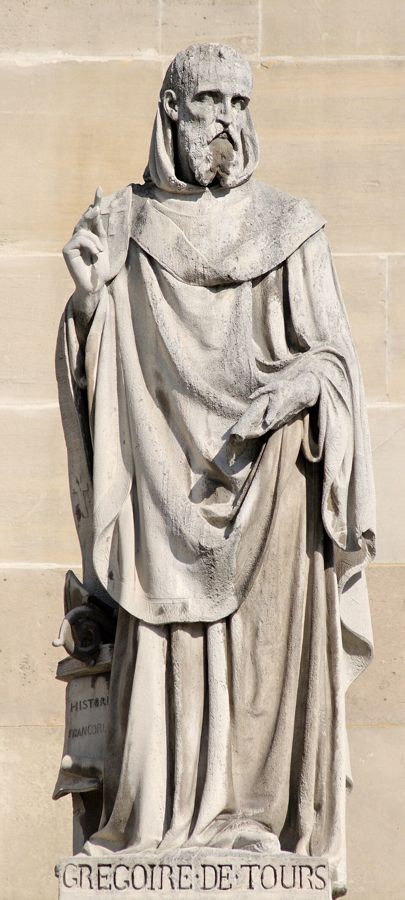
Baring-Gould’s sources: Roman, Gallican, and Benedictine Martyrologies. Authorities: — A Life written by the clergy of Tours, “omnium quidem sanctorum,” in Surius. Another Life by Odo of Clugni (d. 942), in Ruinart’s edition of S. Gregory of Tours, and also in Surius. This meagre Life is almost entirely composed of anecdotes collected from the writings of S. Gregory, which he has abridged. It is only in the last chapters that anything occurs which is not found in the writings of S. Gregory. The best authority for the life of this remarkable man is himself; and, fortunately, he has given us some particulars about his own life.] Gregory of Tours came of a family as distinguished for its sanctity as for its nobility. His grandfather George was married to Leocadia, granddaughter of Leocadius, senator of Berri, who was the first of his family to embrace Christianity. Leocadius was closely related to Vettius Epagathus, who was a martyr for the faith.
George had two sons, Gallus and Florentius. Gallus became bishop of Clermont; Gregory of Tours [bishop and historian of the Franks (d. 594)] wrote his Life. He is honoured as a saint. Florentius lived on his estates. He had one in Auvergne, another in Burgundy. His wife was Armentaria, granddaughter of S. Gregory, bishop of Langres. Gregory of Langres had two brothers, uncles of the subject of this memoir, S. Nicetius (Nizier), bishop of Lyons; and the other, a duke under Childebert II., and governor of Marseilles.
S. Gregory of Tours was born on S. Andrew’s day, 539. He was named George Florentius, but afterwards, when made bishop, he adopted instead the name of Gregory, in honour of his uncle, the bishop of Langres. He was very young when his father died; he was brought up by his mother, towards whom he always manifested the most tender and respectful love.
He was educated by Avitus, archdeacon of Clermont, till he reached manhood, when his mother made over to him the estate in Auvergne, and retired to that in Burgundy. Gregory at once received Orders, but before he settled anywhere permanently he made several journeys to Burgundy, to visit his mother, who resided then at Chalons-sur-Saone.1 In 573 S. Euphronius, bishop of Tours, died, and S. Gregory was chosen to succeed him. Two months after he was ordained, he was attacked with bowel-complaint; he cured it by drinking the dust of S. Martin [St. Martin of Tours (d. 397), soldier turned bishop]’s tomb mixed with water; the lime, no doubt, corrected the acidity which disturbed his stomach. Meroveus, son of Chilperic, married his aunt Brunehild, widow of Sigebert. Chilperic, highly incensed, and completely under the influence of Fredegund, who wished to clear the way to the throne for her son Clothair, forced his son to separate from Brunehild, and be tonsured in the abbey of Anisole. Meroveus, suspecting that Fredegund was waiting an opportunity to put him to death, took refuge at Tours, at the tomb of S. Martin. In that asylum he asked to be communicated, and threatened to kill several of the servants of the bishop unless Gregory would give him the Holy Eucharist. Gregory consulted with Ragnmod, bishop of Paris, and they communicated Meroveus to save him the guilt of murder. Meroveus waited his opportunity of escaping to Brunehild, and casting to the winds his enforced monastic restraints. But as the roads were watched, he lingered on at Tours, telling the bishop 1 On one of these journeys a storm threatened. Gregory pulled some relics [the bodily remains of a saint, or objects they used, kept with honor] out of his bosom, and held them towards the clouds. They parted, and no rain fell. Gregory could not help thinking, and saying to his companions, that it was quite possible the clouds might have been controlled by his virtues as much as by those of the relics. Shortly after his horse fell, and pitched Gregory on his head in the mud. This brought him to a more sober estimate of himself. S. Gregory.
all the scandalous stories about his father which had come to his ears. Gregory told him that though these might be true, it was not proper for a son to proclaim his father’s iniquities. Meroveus, shortly after, asked the bishop to consult the Sortes Sacrae for him. Gregory did so, and opened the Scriptures at the words, “ The eye that mocketh at his father, and despiseth to obey his mother, the ravens of the valley shall pick it out, and the young eagles shall eat it ” Meroveus thought the verse inappropriate, but not so Gregory. He consulted the oracles again more solemnly. He laid the Psalter, the Book of Kings, and the Gospels on the tomb of S. Martin, and after three days of fasting besought that the fate in store for him might be disclosed. On opening the Book of Kings, he read, “ Because they forsook the Lord their God, who brought forth their fathers out of the land of Egypt, and have taken hold upon other gods.... therefore hath the Lord brought upon them all this evil” (1 Kings, ix. 9). In the Psalter he found, “Thou dost set them in slippery places, and castest them down, and destroyest them. O how suddenly do they consume, perish, and come to a fearful end” (Ps. lxxii. 18, 19; A. V. lxxiii. 17, 18). On opening the Gospels he read, “ Ye know that after two days is the feast of the passover, and the Son of Man is betrayed to be crucified ” (Matt. xxvi. 2). The texts were sufficiently dismal of import to depress the mind of the young prince, and he went away weeping. He escaped, and at the head of five hundred men made his way to the arms of Brunehild, but finding it impossible to escape his father and the implacable enmity of his stepmother, Fredegund, the unhappy prince either committed suicide, or, more probably, was assassinated by his stepmothers orders, and it was given out that he had killed himself.
A council was then assembled at Paris to try S. Prsetextatus of Rouen, who was charged with having married Meroveus to his aunt. Forty-five bishops attended. The king himself appeared as accuser. The account of how Gregory conducted himself in this transaction has been already given (S. Praetextatus, Feb. 24, pp. 403-5), and need not therefore be repeated here.
Fredegund could not forgive S. Gregory for opposing her wishes with such dauntless courage, and rejecting so sternly her offered bribes. She stirred up Leudast, count of Tours, to vex the saintly bishop without showing him open violence. Leudast (Leudegast) was a native of Poitou, son of a slave girl. He was employed in the royal kitchen, but as his eyes could not stand the smoke, he was exalted to the bakehouse. He ran away two or three times, and in punishment had one of his ears cut off. He ran away again, and took refuge with Queen Marcoveva,1 who accorded him her protection, and made him count of her stables. On her death he succeeded in retaining his place with Charibert. Charibert sent him to Orleans, with the title of count. When Orleans fell to Sigebert, Leudast joined the side of Chilperic, and Sigebert accordingly plundered his possessions. On the murder of Sigebert, Leudast returned to Orleans, but Meroveus prevented him from recovering his property. When Meroveus left, Leudast accused Gregory of having favoured the unfortunate prince. The count sent word to the king that the bishop had spoken disrespectfully of Fredegund, his queen, and had said she was a bad woman. It was perfectly true that she was wicked and unscrupulous, and it is possible that Gregory may have allowed some such a re1 Marcoveva was daughter of a serf, a weaver. Her sister Merofleda was servant to Ingoberga, wife of Charibert. The king fell in love with Merofleda, put away his wife, and married her. Marcoveva was a nun. When Merofleda died, Charibert took her from her convent, and married her. S. Germanus excommunicated them. Marcoveva died before Charibert, i.e. before 572. mark to have escaped him in private conversation. Chilperic was, however, getting tired of his queen, her beauty was losing its hold over him, and he gave ear to the countercharges against Leudast made by the bishop and citizens of Tours. He sent to the city, and gave the inhabitants permission to choose a count for themselves. They at once elected Eunoinius. Leudast, exasperated to the last degree, hastened to Paris, burst in on the king, and said, “ Hitherto I have kept the city of Tours; now the office is taken from me, and this at a time when the bishop, Gregory, is plotting to deliver it over to the son of Sigebert.” “ Bah ! your disappointment has made you invent this tale.”
“ Not at all, sire ! Moreover, Gregory dares to affirm that your queen is living in adultery with Bishop Bertrand of Bordeaux.”
This was going too far. The king sprang at him, gave him blows on each ear, and kicked him vigorously out of the room. What the count had said rankled, however, in the breast of Chilperic, and he recalled Leudast, and asked what evidence he could produce. Leudast named Riculf, the subdeacon, Plato, the archdeacon, and a certain Gallienus, a friend of Gregory. The king sent Leudast to Tours to bring them before him. The ex-count bound Plato and Gallienus with chains, and carried them to Paris. Riculf continued to spread reports that Gregory had slandered the queen, and was in league with Gontram against Chilperic. The king summoned a council to assemble at Bemi, near Soissons, to hear the charges against the bishop of Tours.1 Bertrand, bishop of Bordeaux, accused Gregory of having declared that he lived in adultery with the queen. Gregory answered that he had never imagined such a thing. 1 Not Braine, as is generally thought, but Berni, where the king had a domain Vhe date cannot be fixed. It was between 577 and 581 Chilperic said, “ An accusation brought against my wife is an outrage upon me. If it please you that witnesses should be produced against the bishop, they are here. But if not, speak, I shall be satisfied with your decision.” The bishops decreed that the word of an inferior could not be valued above that of a bishop, and that Gregory should take oath he had not circulated this scandal, and should say mass at three altars to justify himself of the accusations. This he did readily. Then the bishops decided that Leudast, having brought this false accusation against Gregory, should be excommunicated, and otherwise punished, as the wisdom of the king decided. Leudast had, however, taken flight. Apparently Chilperic put his son to death, and certainly banished his wife. The clerk Riculf was tortured on the wheel, and hung to a tree by his hands tied behind his back.
Chilperic had a theological discussion with S. Gregory during the council, or just after it. The king fancied himself a theologian; he composed collects, hymns, and treatises on divinity, all great rubbish. These he had read to the bishop of Tours, who was candid enough to give his opinion of their worthlessness. The collects of Chilperic were intolerable. His hymns halted; he put short feet where there should be long, and long where the metre required short feet. A treatise on the doctrine of the Trinity, in which he argued against the word “ person ” as applied to each member of the Trinity, called for severer animadversion. “ Give up this doctrine, O king,” said Gregory, “and cleave to that which Hilary and Eusebius [Eusebius of Caesarea (d. c. 339), the first historian of the Church] have taught.”
Chilperic knew nothing of S. Hilary of Poitiers and S. Eusebius of Vercelli, and thinking that Gregory spoke of living persons, “ I see,” said the king, “ this Hilary and this Eusebius are my enemies, I must have to do with them.” “They are saints,” said Gregory, “and you cannot fight S. Gregory.
against them. There are in truth three Persons, not corporally but spiritually, in one glory, one eternity, and one power.”
The king, in a rage, said, “ I will submit my treatise to wiser men than you, and they will approve it.” “ He would be not a wise man but a fool who would approve it,” answered Gregory, boldly. The king was furious, and showed it to Salvius, bishop of Albi, who spurned it from him, and wanted to tear it to pieces. Having met with such poor success in theology, Chilperic turned his attention to other matters.
The country abounded with deranged men, whose madness had taken a religious turn, and who led about troops of deluded peasants after them. One poor wretch who had gone mad after having been stung by a swarm of bees, ran through the Gevaudan and Velai with a woman named Mary, working miracles, and calling himself Christ. S. Aurelius, bishop of Le Puy, by a discreditable bit of dissimulation, got possession of the man, had him cut to pieces, and his wife tortured. It is pleasant to find S. Gregory of Tours behaving very differently towards another fanatic of the same type. This poor wretch went about carrying a cross, from the arms of which hung little bottles full of oil, which he said was sacred. He pretended also to possess relics of S. Vincent and S. Felix of Gerona. He came to Tours one evening, when S. Gregory was at table, and invited the bishop to come out in procession and venerate the relics. Gregory declined. It was late. Let the relics be deposited during the night on an altar.
Next morning at daybreak the man came into Gregory’s bed-room bearing aloft his cross, and threatening to report him to the king for having so ill received his bottles of oil and relics. Then he went into the bishop’s oratory, said some prayers, hoisted up his cross again, and marched forth. VOL. xiv. 2 His language was ordinary, his pronunciation vulgar, and his ideas disconnected, so that Gregory did not form a high opinion of the man. The fanatic went on to Paris, where he arrived during the Rogation procession on the eve of the Ascension. The train of the man bearing his tall cross and jingling oil-bottles met that of the bishop of Paris, with his cross and tapers. Both processions chanted, both were large, and neither would yield to the other. The bishop bade him place his relics in one of the churches, and fall in with his episcopal procession. The fanatic began to rate him soundly, and without careful choice of expressions; whereupon Ragnbod had him arrested and examined. In a pouch at his waist were found roots of medicinal plants, moles’ teeth, bones of mice, the claws and grease of bears. The bishop concluded that these were used for necromantic purposes, pitched them into the Seine, despoiled the man of his cross and oil-bottles, and had him thrust out of the gates of Paris. But he made himself another cross and began again his extraordinary practices; whereupon he was taken by the archdeacon of Paris* and cast, heavily chained, into prison. In the night he got out of the jail, and crept into the church of S. Julian, when he fell down asleep' — or drunk, as Gregory thinks. At that time Gregory had come to Paris, and was lodged close to the church of S. Julian. The bishop rose in the middle of the night to go into the church and sing prime and lauds. But the smell in the church was so dreadful that he could not enter. A clerk, stopping his nose, ran in to the sleeping man, and tried to waken him, but was unable to do so. He was obliged to call three others to his assistance, and they dragged him out. After this the pavement on which he had lain was soused with water, and the floor was strewn with rosemary and other fragrant herbs, and after a while Gregory was able to enter and perform the accustomed offices. The poor creature did not wake till morning. Nfc * Gregory sent him to the bishop of Paris, readily pardoning him for the annoyance he had caused him. At that time other bishops were assembled in Paris, and Gregory obtained as a punishment for the man that he should be present whilst he and they were breakfasting, and whilst he related to the bishops the story of how he had found the man, and the trouble it had given him to sweeten the atmosphere of the church which he had polluted with his heretical presence, or disordered internal condition. One of the bishops, Amelius of Bigorre (Tarbes) fixing his eyes on the poor wretch, suddenly exclaimed that he knew the man, he was one of his serfs who had run away. He was pardoned, and Amelius took him back with him to Bigorre. Gregory gives interesting discussions he had with a Jew, with an Arian [followers of Arius, who taught that the Son is a created being, not fully God], and with a priest who denied the Resurrection, which we are obliged to omit from want of space. He wrote the Ecclesiastical History of the Franks [the Germanic people who ruled Gaul and gave France its name]; and this work is the most precious memorial we possess of the history ot his times, obtaining for him the title of the Father of French History. Thierry says of him, “ By an accidental but singularly happy coincidence, this period (500 to 650), so complex and of such mixed colour, is that of which original documents provide the most characteristic details. It met with a historian marvellously suited to describe it, a contemporary, an intelligent and saddened witness in the midst of this confusion of men and events, of crimes and catastrophes, in the midst of which the old civilization followed its irresistible declension. One must descend to the century of Froissart to find a historian equal to Gregory of Tours in the art of producing characters on his stage and painting them by means of dialogue. All that the conquest of Gaul [roughly modern France and Belgium] had brought to clash on the same soil, races, classes, conditions, figure pell-mell in his narrative, always true and always animated.”1 1 Recits Merovingiens, preface.