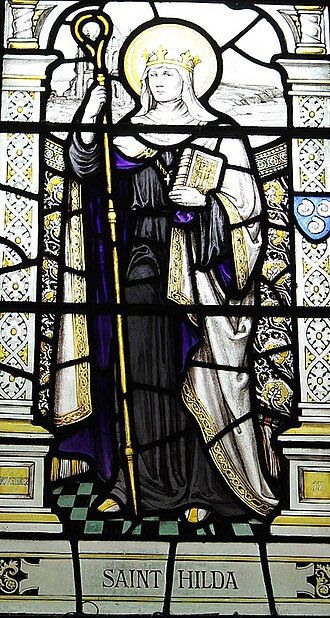
Baring-Gould’s sources: Gallican Martyrologies on this day. York Kalendar on Aug. 25. The Horae B.V.M., probably belonging to Coldingham (Harl. MSS. 1804), and the Durham Missal “ad altare S. Joh. B. et S. Margaretae, ad ix altaria in eccl. cath. Dunelm” (Harleian MSS. 5289), on Nov. 17. Authority: — Bede, Hist. Eccl.] The monastery of Hartlepool was founded about the year 645 by Heiu, a Northumbrian lady, the first woman of her race who embraced conventual life. She received the veil from the hands of Bishop Aidan. After a few years she retired to a solitude, and Aidan replaced her by Hilda, a princess of the blood-royal and of the Deirian dynasty. She was grand niece of Edwin, the first Christian king of Northumbria, father of the queen who had shared the throne of Oswy. This illustrious lady seemed to be called by her genius and character, even more than by her rank, to exercise a great influence over religious and political movements in her time. Bom in exile, during the sovereignty of Ethelfrid, among the West Saxons, where her mother died a violent death, she returned with her father, on the restoration of his race in 617. In her early youth she had been baptized, with her uncle King Edwin, by the Roman missionary Paulinus, which did not, however, prevent her from leaning during her whole life to the side of the Celtic missionaries. Before consecrating her virginity to God, she had lived thirty-three years “ very nobly,” says Bede, among her family and her fellows. When she understood that God called her, she desired to make to Him a complete sacrifice, and forsook at once the world, her family, and her country. She went immediately into East Anglia, the king of which had married her sister, and whence she designed to cross over S. Hilda.
…to France, in order to take the veil either at Chelles, where her widowed sister was one day to devote herself to God, or in one of the monasteries on the banks of the Marne, which sprang from the great Irish colony of Luxeuil, and whither the Saxon virgins already began to resort. Gallican martyrologists commemorate Hilda as having been some time at Chelles; but Bede [English monk and historian (d. 735)] says nothing of the sort. He implies that she did not go thither, but only wished to do so, and before she left East Anglia for Chelles received her recall to Northumbria [the Anglo-Saxon kingdom of northern England and south-east Scotland] from Bishop Aidan. She was only a year in all away from her native province. Aidan gave her lands by the Wear, and there she spent a twelvemonth with a few companions, till Heiu retired from governing Hartlepool, when Aidan made Hilda superior of the monastery. Probably Heiu had not ruled very well, for we are told that one of the first things done by Hilda was to introduce order into the monastery.
Nine years later, when the peace and freedom of Northumbria had been secured by the final victory gained by King Oswy over the Mercians, Hilda took advantage of a gift of land granted her by that prince to establish a new monastery at Streaneshalch (the Beacon Headland), now Whitby. There, as at Hartlepool, and during the thirty years that she passed at the head of her two houses, she displayed a rare capacity for the government of souls, and for the consolidation of monastic institutions. This special aptitude, joined to her love of monastic regularity, and her zeal for knowledge and ecclesiastical discipline, gave her an important part to play, and great influence. Her society was sought by S. Aidan [Irish monk, founder of Lindisfarne (d. 651)], and all the religious who knew her, that they might be guided by her clear judgment and wise experience. Kings even, and princes of her blood, or of the adjacent provinces, often came to consult her, asking enlightenment, which they afterwards j oyfully acknowledged themselves to have received. But she did not reserve the treasures of her judgment and charity for the great ones of the earth. She scattered round her everywhere the benefits of justice, piety, peace, and temperance. She was ere long regarded and honoured as the mother of her country, and all who addressed her gave her the sweet name of Mother, which she well deserved. Not only in Northumbria, but in distant regions, to which the fame of her virtue and enlightenment had penetrated, she was to many the instrument of their salvation and conversion. And in her two communities especially she secured, during a rule of more than thirty years, the supremacy of order, union, charity, and equality, so much, that it became usual to say to the proud Northumbrians, that the image of the primitive Church, wherein was neither rich nor poor, and where all was common among the Christians, was realized at Whitby.
But the most touching particular of all in the enthusiastic narrative of the Venerable Bede, is that which proves the passionate tenderness felt for her by her daughters, especially by the young girls whom she prepared for religious life in a separate house, by the discipline of a novitiate establishment regularly constituted and attentively superintended. Nor did the royal abbess confine herself to the government of a numerous community of nuns. According to a usage then very general, but principally prevailing in the Celtic countries, a monastery was joined to the nunnery. And Hilda inspired the monks subject to her authority with so great a devotion to the rule, so true a love of sacred literature, so careful a study of the Scriptures, that this monastery, ruled by a woman, became a school of missionaries and bishops. Bosa of York, Hedda of Dorchester, Oftgar of Worcester, S. John of Beverley, Bishop of York, and Wilfrid, the disturber of her declining days, issued from her nursery of great men.
3. HILEA. The poor cowherd Caedmon was reared into an ecclesiastical poet under her care, and became the father of English poetry.
In 664, Oswy convoked the council of Whitby to regulate and terminate the dispute raised by Wilfrid. This saint was fired with ambition to bring the Northumbrian Church into conformity with Roman practices. When appointed abbot of Ripon by Alcfrid, he turned out the monks because they would not give up their customs for those which he wished to introduce. Chief among the differences was the time for the observance of Easter. The Celtic Church had their calendar out of gear, and observed the queen of feasts before the time when it was celebrated by the Roman Church.
Hilda was fifty years old when the gathering at Whitby took place. She and her whole community clung to the Celtic tradition, and the national party was headed by Colman, bishop of Lindisfarne, supported by S. Cedd, then only a monk. Alcfrid and the queen favoured Wilfrid and Roman observance. An account of the assembly has been given elsewhere. King Oswy decided in favour of Wilfrid; Colman protested, refused to recognize the decision, and returned to Lindisfarne, collected the bones of S. Aidan, and departed for Iona. Wilfrid triumphed. He was appointed bishop of Northumbria, and then, to show his scorn for the Anglo-Saxon bishops, went to France to receive ordination from the Bishop of Paris. On his way back he was shipwrecked. When he returned, he found that his conduct had roused disgust and opposition. King Oswy had appointed in his room the holy bishop Chad. The Northumbrians, though they observed the decree of Whitby as to the celebration of Easter, refused to have such a firebrand as Wilfrid among them as bishop. There can be little doubt that this, to a great extent, was due to the advice of S. Hilda, who, as long as she lived, never relaxed her opposition to Wilfrid. Chad was afterwards removed to Mercia [the Anglo-Saxon kingdom of the English Midlands], and Wilfrid reinstated. But his violence and pride made his presence intolerable, and S. Theodore, archbishop of Canterbury, divided his diocese' into three, a.d. 678, and gave York to Bosa, one of the disciples of S. Hilda, who in her monastery at Whitby, was now at a great age, but had not lost her influence, or her antipathy to Wilfrid. Wilfrid, incensed to the last degree, went to Rome to appeal to Pope Agatho against this subdivision of his huge diocese into workable parcels. It was done for the good of the Church, but it offended Wilfrid’s pride. S. Hilda, the abbess, and S. Theodore, the archbishop, sent messengers to Rome to complain of Wilfrid’s insolence. The council of Rome confirmed the division of the diocese, but ordered the reappointment of Wilfrid to one of the sees, that of York. King Egfrid called a council, the pontifical bulls were read, but instead of submitting, with the consent of Archbishop Theodore, the king imprisoned Wilfrid, and refused to carry out the orders of the Pope.
Hilda was dead before the strife ended. During the last six years of her life she suffered much from fever. But “ during all this while she never failed either to return thanks to her Maker, or publicly and privately to instruct the flock committed to her charge.” When dying, she called her monks and nuns around her, at early cock-crow, and, after exhorting them to preserve evangelical peace among themselves and towards all men, she passed by death to life eternal.
S. JOHN OF BEVERLEY, ABP. OF YORK. (See May 7.) Nov.Part II. 6'. Fergus.