St. Hildegard

Hildegard was born at Böckelheim on the Nahe in 1098.

Read the essentials →
September 17 · Virgin, Abbess

St. Hildegard

St. Hildegard

Hildegard was born at Böckelheim on the Nahe in 1098.

Traditional feast

September 17
1914 / pre-1969 calendar, per Baring-Gould (1897)

Current feast

September 17
Verified · General Roman Calendar

Represents

Virgin
Abbess

Their story

Adapted in modern English from the Catholic Encyclopedia (1913) · original text below

Hildegard was born at Böckelheim on the Nahe in 1098. Her early biographers name her parents as Hildebert and Mechtildis, of noble and wealthy family; her father served Count Meginhard of Spanheim. She was a weak, sickly child, and her parents promised her to God. At eight she was placed with Jutta, the count's sister, who lived as a recluse on the Disibodenberg. Illness often left her barely able to walk or see. She learned to read and chant the Latin psalms, but never learned to write. In time she took the Benedictine (monks following the Rule of St. Benedict) habit and made her profession.

When Jutta died in 1136, Hildegard became superior. So many women came to join that she moved, as she said at a divine command, to the Rupertsberg near Bingen on the Rhine, settling there with eighteen sisters. Probably in 1165 she founded a second convent at Eibingen across the river.

From early childhood she had visions. She said that up to her fifteenth year she saw much and spoke of it, until she noticed others did not see such things and grew more reticent. At about forty she received a command to make known what she saw. She hesitated, afraid of what people would say, but the inner voice kept pressing her. She told her director and abbot, and a monk wrote down what she related. The Archbishop of Mainz and his clergy judged the writings to come from God, and Pope Eugene, then at Trier, had them examined by the Bishop of Verdun, who reported favourably.

Her first and greatest work, the Scivias, was begun in 1141 and took ten years. Crowds came to her from all over Germany and Gaul for counsel and help, among them archbishops and abbots; St Elizabeth of Schönau was a close friend. She wrote many letters and travelled widely, visiting Emperor Frederick at Ingelheim and going to Würzburg, Bamberg, Cologne, Trier and Metz. The Catholic Encyclopedia says the stories of a visit from St Bernard and of journeys to Paris and Tours are probably not correct.

In the last year of her life she faced a severe trial. A young man who had once been excommunicated was buried in her convent cemetery, and Mainz demanded the body be removed. She refused, because he had received the last sacraments and so was reconciled to the Church. The chapter of Mainz put her convent under interdict, and the archbishop confirmed it. After much worry and correspondence she had the interdict lifted. She died in 1179 and was buried at the Rupertsberg. She was never formally canonized (officially declared a saint by the pope), but her name is in the Roman Martyrology (the Church's official list of saints for each day).

Struggles & surrender

What they wrestled with, and how they gave it to God

  • Interdict in her last year ·
    In the last year of her life Mainz demanded she remove the body of a once-excommunicated young man buried in her cemetery. She refused, since he had received the last sacraments. Her convent was put under interdict, and only after much worry and correspondence was it lifted.
  • Afraid to speak ·
    When told to make her visions known she hesitated for fear of what people would say, until the inner voice kept pressing her.

Early life

Selected sentences from the original account, unaltered.

She was born in 1098; her father was a knight in attendance on Meginhard, Count of Spanheitn 3 his name was Hildebert, and the place of her birth Bockelheim. Even from my childhood, when my limbs were not full-grown, to now in my seventieth year, my soul has seen visions.

What they represent

How they teach us to live

Drawn from themes in the original account

Build up the community you belong to. This life was lived with and for a community.

Feed your mind with Scripture and good books. Learning and the Scriptures matter in this life.

Share your faith, in words and by example. Preaching and conversion are central here.

From the Catholic Encyclopedia

1913 · 2186 words

Born at Böckelheim on the Nahe, 1098; died on the Rupertsberg near Bingen, 1179; feast 17 September. The family name is unknown of this great seeress and prophetess, called the Sibyl of the Rhine. The early biographers give the first names of her parents as Hildebert and Mechtildis (or Mathilda), speak of their nobility and riches, but give no particulars of their lives. Later writers call the saint Hildegard of Böckelheim, of Rupertsberg, or of Bingen. Legends would make her a Countess of Spanheim. J. May (Katholik. XXXVII, 143) shows from letters and other documents that she probably belonged to the illustrious family of Stein, whose descendants are the present Princes of Salm. Her father was a soldier in the service of Meginhard, Count of Spanheim. Hildegard was a weak and sickly child, and in consequence received but little education at home. Her parents, though much engaged in worldly pursuits, had a religious disposition and had promised the child to the service of God. At the age of eight she was placed under the care of Jutta, sister of Count Meginhard, who lived as a recluse on the Disenberg (or Disibodenberg, Mount of St. Disibod) in the Diocese of Speyer. Here also Hildegard was given but little instruction since she was much afflicted with sickness, being frequently scarcely able to walk and often deprived even of the use of her eyes. She was taught to read and sing the Latin psalms, sufficient for the chanting of the Divine Office, but never learned to write. Eventually she was invested with the habit of St. Benedict and made her religious profession. Jutta died in 1136, and Hildegard was appointed superior. Numbers of aspirants flocked to the community and she decided to go to another locality, impelled also, as she says, by a Divine command. She chose Rupertsberg near Bingen on the left bank of the Rhine, about fifteen miles from Disenberg. After overcoming many difficulties and obtaining the permission of the lord of the place, Count Bernard of Hildesheim, she settled in her new home with eighteen sisters in 1147 or 1148 (1149 or 1150 according to Delehaye). Probably in 1165 she founded another convent at Eibingen on the right side of the Rhine, where a community had already been established in 1148, which, however, had no success.

The life of Hildegard as child, religious, and superioress was an extraordinary one. Left much to herself on account of her ill health, she led an interior life, trying to make use of everything for her own sanctification. From her earliest years she was favoured with visions. She says of herself:

Up to my fifteenth year I saw much, and related some of the things seen to others, who would inquire with astonishment, whence such things might come. I also wondered and during my sickness I asked one of my nurses whether she also saw similar things. When she answered no, a great fear befell me. Frequently, in my conversation, I would relate future things, which I saw as if present, but, noting the amazement of my listeners, I became more reticent.

Read the rest of the article

This condition continued to the end of her life. Jutta had noticed her gifts and made them known to a monk of the neighbouring abbey, but, it seems, nothing was done at the time. When about forty years of age Hildegard received a command to publish to the world what she saw and heard. She hesitated, dreading what people might think or say, though she herself was fully convinced of the Divine character of the revelations. But, continually urged, rebuked, and threatened by the inner voice, she manifested all to her spiritual director, and through him to the abbot under whose jurisdiction her community was placed. Then a monk was ordered to put in writing whatever she related; some of her nuns also frequently assisted her. The writings were submitted to the bishop (Henry, 1145-53) and clergy of Mainz, who pronounced them as coming from God. The matter was also brought to the notice of Eugene II (1145-53) who was at Trier in 1147. Albero of Chiny, Bishop of Verdun, was commissioned to investigate and made a favourable report. Hildegard continued her writings. Crowds of people flocked to her from the neighbourhood and from all parts of Germany and Gaul [roughly modern France and Belgium], to hear words of wisdom from her lips, and to receive advice and help in corporal and spiritual ailments. These were not only from the common people, but men and women of note in Church and State were drawn by the report of her wisdom and sanctity. Thus we read that Archbishop Heinrich of Mainz, Archbishop Eberhard of Salzburg and Abbot Ludwig of St. Eucharius at Trier, paid her visits. St. Elizabeth of Schönau was an intimate friend and frequent visitor. Trithemius in his "Chronicle" speaks of a visit of St. Bernard of Clairvaux, but this probably was not correct. Not only at home did she give counsel, but also abroad. Many persons of all stations of life wrote to her and received answers, so that her correspondence is quite extensive. Her great love for the Church and its interests caused her to make many journeys; she visited at intervals the houses of Disenberg and Eibingen; on invitation she came to Ingelheim to see Emperor Frederick; she travelled to Würzburg, Bamberg, and the vicinity of Ulm, Cologne, Werden, Trier, and Metz. It is not true, however, that she saw Paris or the grave of St. Martin at Tours. In the last year of her life Hildegard had to undergo a very severe trial. In the cemetery adjoining her convent a young man was buried who had once been under excommunication. The ecclesiastical authorities of Mainz demanded that she have the body removed. She did not consider herself bound to obey since the young man had received the last sacraments and was therefore supposed to have been reconciled to the Church. Sentence of interdict was placed on her convent by the chapter of Mainz, and the sentence was confirmed by the bishop, Christian (V) Buch, then in Italy. After much worry and correspondence she succeeded in having the interdict removed. She died a holy death and was buried in the church of Rupertsberg.

Hildegard was greatly venerated in life and after death. Her biographer, Theodoric, calls her saint, and many miracles are said to have been wrought through her intercession. Gregory IX (1227-41) and Innocent IV (1243-54) ordered a process of information which was repeated by Clement V (1305-14) and John XXII (1316-34). No formal canonization has ever taken place, but her name is in the Roman Martyrology and her feast is celebrated in the Dioceses of Speyer, Mainz, Trier, and Limburg, also in the Abbey of Solesmes, where a proper office is said (Brev. Monast. Tornac., 18 Sept.). When the convent on the Rupertsberg was destroyed in 1632 the relics [the bodily remains of a saint, or objects they used, kept with honor] of the saint were brought to Cologne and then to Eibingen. At the secularization of this convent they were placed in the parish church of the place. In 1857 an official recognition was made by the Bishop of Limburg and the relics were placed on an altar specially built. At this occasion the town of Eibingen chose her as patron. On 2 July, 1900, the cornerstone was here laid for a new convent of St. Hildegard. The work was begun and completed through the munificence of Prince Karl of Löwenstein and Benedictine [monks following the Rule of St. Benedict] nuns from St. Gabriel's at Prague entered the new home (17 Sept., 1904).

All the manuscripts found in the convent at Eibingen were in 1814 transferred to the state library at Wiesbaden. Of this collection the first and greatest work of St. Hildegard is called "Scivias" (Scire or vias Domini, or vias lucis), parts of which had been shown to the Archbishop of Mainz. She began it in 1141 and worked at it for ten years. It is an extraordinary production and hard to understand, prophetic throughout and admonitory after the manner of Ezechiel and the Apocalypse. In the introduction she speaks of herself and describes the nature of her visions. Then follow three books, the first containing six visions, the second giving seven visions, and about double the size of the first; the third, equal in size to both the others, has thirteen visions. The "Scivias" represents God on His Holy Mountain with mankind at its base; tells of the original condition of man, his fall and redemption, the human soul and its struggles, the Holy Sacrifice of the Mass, the times to come, the son of perdition and the end of the world. The visions are interspersed with salutary admonitions to live in the fear of the Lord. Manuscripts of the "Scivias" are also at Cues and Oxford. It was printed for the first time at Paris (1513) in a book which contains also the writings of several other persons. It was again printed at Cologne in 1628, and reproduced in Migne, PL 197. The "Liber vitae meritorum" written between 1158 and 1163, is a picturesque description of a Christian's life of virtue and its opposite. It was printed for the first time in Pitra, "Analecta Sacra", VIII (Monte Cassino, 1882). The "Liber divinorum operum" (1163-70) is a contemplation of all nature in the light of faith. Sun, moon, and stars, the planets, the winds, animals, and man, are in her visions expressive of something supernatural and spiritual, and as they come from God should lead back to Him (Migne, loc. cit.). Mansi, in "Baluzii Missell." (Lucca, 1761), II, 337, gives it from a manuscript lost since then. Her "Letter to the Prelates of Mainz" in regard to the interdict placed upon her convent is placed here among her works by the Wiesbaden manuscript; in others it is bound among her letters. To it the Wiesbaden manuscript annexes nine small essays: on the Creation and fall of man; God's treatment of the renegade; on the priesthood and the Holy Eucharist; on the covenant between Christ and the Church; on the Creation and Redemption; on the duties of secular judges; on the praises of God with intermingled prayers. "Liber Epistolarum et Orationum"; the Wiesbaden manuscript contains letters to and from Eugene III, Anastasius IV, Adrian IV, and Alexander III, King Conrad III, Emperor Frederick, St. Bernard, ten archbishops, nine bishops, forty-nine abbots and provosts of monasteries or chapters, twenty-three abbesses, many priests, teachers, monks, nuns, and religious communities (P. L., loc. cit.). Pitra has many additions; L. Clarus edited them in a German translation (Ratisbon [Regensburg in Bavaria], 1854). "Vita S. Disibodi" and "Vita S. Ruperti"; these "Vitae", which Hildegard claims also to be revelations, were probably made up from local traditions and, especially for St. Rupert, the sources being very meagre, have only legendary value. "Expositio Evangeliorum" fifty homilies in allegory (Pitra, loc. cit.). "Lingua Ignota"; the manuscript, in eleven folios ves a list of nine hundred words of an unknown language, mostly nouns and only a few adjectives, a Latin, and in a few cases a German, explanation, together with an unknown alphabet of twenty-three letters printed in Pitra. A collection of seventy hymns and their melodies. A manuscript of this is also at Afflighem, printed in Roth (Wiesbaden, 1880) and in Pitra. Not only in this work, but elsewhere Hildegard exhibits high poetical gifts, transfigured by her intimate persuasion of a Divine mission. "Liber Simplicis Medicinae" and "Liber Compositae Medicinae"; the first was edited in 1533 by Schott at Strasburg as "Physica S Hildegardis", Dr. Jessen (1858) found a manuscript of it in the library of Wolfenbuttel. It consists of nine books treating of plants, elements, trees, stones, fishes, birds, quadrupeds, reptiles, metals, printed in Migne as "Subtilitatum Diversarum Naturarum Libri Novem". In 1859, Jessen succeeded in obtaining from Copenhagen a manuscript entitled "Hildegardis Curae et Causae", and on examination felt satisfied that it was the second medical work of the saint. It is in five books and treats of the general divisions of created things, of the human body and its ailments, of the causes, symptoms, and treatment of diseases. "38 Solutiones Quaestionum" are answers to questions proposed by the monks of Villars through Gilbert of Gembloux on several texts of Scripture (P. L., loc. cit.). "Explanatio Regulae S. Benedicti", also called a revelation, exhibits the rule as understood and applied in those days by an intelligent and mild superior. "Explanatio Symboli S. Athanasii", an exhortation addressed to her sisters in religion. The "Revelatio Hildegardis de Fratribus Quatuor Ordinum Mendicantium", and the other prophecies against the Mendicants, etc., are forgeries. The "Speculum futurorum temporum" is a free adaptation of texts culled from her writings by Gebeno, prior of Eberbach (Pentachronicon, 1220). Some would impugn the genuineness of her writings, among others Preger in his "Gesch. der deutchen Mystik", 1874, but without sufficient reason. (See Hauck in "Kirchengesch. Deutschl.", IV,398 sqq.). Her correspondence is to be read with caution; three letters from popes have been proved spurious by Von Winterfeld in "Neue Archiv", XXVII, 297.

The first biography of St. Hildegard was written by the contemporary monks Gottfried and Theodoric. Guibert of Gembloux commenced another.

Read more

The full original · 2939 words

Read Baring-Gould’s full account

Baring-Gould’s sources: Roman and German Martyrologies. Authorities: — A Life by Theodoric the monk, not the abbot of S. Tron, wbo flourished in 1110; but a contemporary and friend of S. Hildegard, and by her constant attendant and secretary, Godefried. But much more may be learned from her own writings, and something from the chroniclers of the time.] This extraordinary woman, who stands out amidst the miseries and min of temporal and spiritual affairs in the 1 2th century, like the figure of Huldah the prophetess when the kingdom of Judah was tottering to its fall, or like Cassandra in ancient Troy, properly deserves to be studied in connexion with the political and ecclesiastical history of her times, with which she was intimately mixed up, and which she influenced by her prophecies, her warnings, and exhortations. But space forbids us giving her as full an article as she deserves.

She was born in 1098; her father was a knight in attendance on Meginhard, Count of Spanheitn 3 his name was Hildebert, and the place of her birth Bockelheim. At the age of eight she was placed under the charge of Jutta, Abbess of S. Disibod, a sister of the Count of Spanheim. From her sixth year the child was subject to visions, which appeared to her, as she describes, not externally, but within her soul. They continued till she was fifteen, without her venturing to publish them. On the death of Jutta in 1136, Hildegard, then aged thirty-eight, succeeded her. Her visions had attracted so much attention that numerous women came to place themselves under her direction, and finding the buildings too small, she erected a new convent on the Rupertsberg near Bingen, in 1147, and moved into it with eighteen sisters.

S. Hildegard was known throughout Europe by her writings 3 not that she could write in Latin herself, but she dotted down her visions and communications to various people of the town, in a jumble of German and Latin, and her secretary Gottfried put them for her into shape. She denounced the vices of society, of kings, nobles, of bishops and priests in unmeasured terms. If a prelate, even a Pope, wrote to her, however humbly, she sent him a stinging lecture in reply. She told home truths without varnishing them, so plainly as to make every one wince. She was courted by emperors and bishops, but she never yielded to their fascinations. No one approached her without receiving a rap over the knuckles, and, what was more, it was felt to be well deserved. In 1148 Pope Eugenius III. was at Treves [Trier in Germany], when he heard every one talking of the prophecies of the famous abbess of S. Rupert. He sent Adelbert, S. Hildegard, Bishop of Verdun, to examine her, and he studied her writings himself whilst at Treves. He even wrote her a letter, and received in return a lecture. About this time she completed the first part of her work called “ Scivias,” a fantastic name corrupted from “ nosce vias,” — know the ways (of the Lord), — which gives us the measure of her knowledge of Latin. The entire work was not completed till 1151. S. Hildegard thus describes her gift of visions: “ I raise my hands to God, and then I am wafted by Him, like a feather without weight, before the wind, as far as it lists.... Even from my childhood, when my limbs were not full-grown, to now in my seventieth year, my soul has seen visions. My spirit is, as God chooses, borne into the highest firmament, or among all sorts of peoples, and into the furthest lands, far away from my body. And when my inner eye by this means sees the truth, the sights which appear to me vary according to the nature of the vapours and creatures presented to me. These things I see not with my bodily eyes, nor through my understanding or thoughts, but through my spirit, yet with open eyes, and so that they never stir in me an emotion, but I see these sights waking by day or by night alike."

S. Bernard, who had the greatest respect for her, and valued her influence, urged her repeatedly to exert herself to stir up enthusiasm for the Crusade which he preached. She caught the flame, prophesied and exhorted, and contributed not a little towards sending to humiliation and death the thousands of Germans who started on that most unfortunate and disgraceful of all the Crusades. Whilst Bernard preached on the Rhine, she ascended the Feldberg, the highest peak of the Rhenish hills, and prayed on its summit, with outstretched arms, for the success of the ! undertaking. She held her arms so long extended that at last she fainted with exhaustion.

The condition of the Church in Germany was deplorable to the last degree. Charlemagne [king of the Franks, crowned emperor in 800] and the Frank Emperors had made the bishops into electoral princes, with vast territories; they were, therefore, at the same time temporal and spiritual sovereigns. This caused the position of bishop to be sought by men of rank utterly unqualified for filling a spiritual office. The bishops were constantly at war with their neighbours, or rising in armed revolt against the Emperors. They kept splendid retinues, rode in armour at the head of their troops, and had the turbulence and ambition of temporal princes.

An instance must suffice. Henry I. had been a gentle but feeble ruler of the archiepiscopal see of Mainz [a bishop’s “see” is his diocese, named from his seat (Latin sedes)], in which was situated the convent of S. Hildegard. A party in the chapter, moved by ambition and disgusted at his un warlike character, raised some paltry accusations against him, which they carried to Rome. Archbishop Henry had a friend and confidant, the provost of S. Peter's, named Arnold von Selnhoven, who owed his advancement to the favour of the archbishop. Henry gave Arnold a large sum of money, and sent him to Rome to plead his cause. Arnold secretly visited the Emperor Frederick I., secured his sanction to his treachery, and then, hastening to Rome, used the gold Archbishop Henry had given him to bribe those around the Pope to persuade his Holiness to depose Henry, and elevate him (Arnold) to the archiepiscopal throne in his room. Two cardinals were sent to Mainz to investigate the case. Henry saw that they had prejudged it, having been bribed by Arnold. He said to them, “ I might appeal from your judgment to the Pope in person; but 1 appeal to a higher Judge — to Jesus Christ Himself — and I summon you both before His throne to answer for this injustice/' They answered scoffingly, “ You lead the way, and we will follow/1 Both cardinals died suddenly S. Hildegard.

before the close of the year. Arnold now returned in triumph to assume the office of his friend and benefactor, whom he had so treacherously supplanted. His arrogance knew no bounds. The people of Mainz writhed under his harsh rule, and the insolence with which he treated the nobles in his diocese embittered them against him. He waged incessant war with all the neighbouring princes, especially with the Palatine Herman II., of the Rhine. The Emperor interfered, and the Archbishop and the Palatine were ordered, as disturbers of the public peace, to carry a dog through the camp. The Archbishop escaped as being an ecclesiastic, but the Prince Palatine was obliged to submit to the ignominious and ridiculous sentence. This stirred up against the Archbishop numerous and implacable enemies. The people of Mainz, unable to endure his tyranny, plotted revolt. S. Hildegard wrote him a letter of warning: — “ The Living Light saith to thee, Why art thou not strong in fear ? Thou hast a sort of zeal, trampling down all that opposes thee. But I warn thee, cleanse the iniquity from the eye of thy soul. Cut off the injustice wherewith thou affiictest thy people Turn to the Lord, for thy time is at hand.” A friend also of the Archbishop, the Abbot of Erbach, cautioned him against incensing his subjects beyond endurance. “ The Mainzers,” said Arnold, “are dogs that bark, but bite not.” When S. Hildegard heard this, she sent word to him, “ The dogs are slipped, and will tear thee to pieces.” This prophecy came true. In 1160 the Archbishop was besieged in the Abbey of S. James, outside Mainz, by a party of the citizens. The monastery was broken into, and a butcher cut the Archbishop down with his axe. The body was flung into a ditch, and the market women as they passed pelted it with eggs.

It was in sight of all this violence that Hildegard uttered her denunciations of the pride and lawlessness of the German prelates. “ He who was, and is, and will be, speaks to the shepherds of His Church. He who was sought to form His creatures after His own likeness, that man might obey His will. He that is has brought all creatures into being, in token that all proceeds from His will. He that will be will search out all that is hidden, and will renew all things. O my sons, saith the Lord, ye who pasture my sheep, why blush ye not at the warning voice of your Master ? The ignorant creatures fulfil their Master’s commands, but ye do not. I have called you, as the sun, to illumine men, but ye are dark as black night. Woe to you ! Ye should resemble Mount Zion, on which God dwells; but, instead, ye are lostrels who do not that which is right, but that which pleases your fancies, and ye follow but your own lusts. Instead of being like apostles, ye are so sunk in worldly indolence that your time is spent in waging wars, or with buffoons and singers, or in chasing flies. Ye ought to be pillars of the Church, learned in Scripture, filled with the Spirit j but, instead, ye ruin the Church by grinding down your subjects to satisfy your avarice and ambition. Therefore will the people rise, and will turn from you to the lay-princes, and will cry to them, We can no more endure these men, who befoul the land with every crime. They are drunkards and lovers of pleasure, who are sapping the foundations of the Church. Now, when the cries of the people have entered into the ears of the great Judge, then will He execute His wrath on these despisers of His laws, and give them over to the will of their enemies, who cry, How long shall we endure these ravening wolves ? They should be the physicians of our souls, but they heal us not. They are given the power to bind and loose, but they bind us down as if we were wild beasts. Their sins rise up and make the Church to stink. They teach not, but rend the sheep. Although they are drunkards, adulterers, and fornicators, they judge us harshly. How does it become these shaven heads, with stole and chasuble, to call out better harnessed and larger armies than we ? The priest should not be a soldier, nor the soldier a priest. Therefore will we take from them what they hold against right and decency, and only leave them what is necessary for the welfare of souls. “At that time the honour, power, and authority of the German Emperor, whereby the empire is protected, will be lessened by their fault, because they rule so basely and neglectfully, and do not live as heretofore. They will continue to exact from their subjects obedience, but not peaceableness and uprightness. Wherefore many kings, and princes, and peoples, who were before subject to the Roman empire, will separate from it, and submit no longer. Every land, every nation, will choose its own prince, and obey him, saying, The Empire is a burden and not an honour to us. And when the Roman empire is thus broken up, so will also the power of the papal throne be shattered; for when princes and other men find no more religion in Rome, they will despise the papal dignity, and will choose their priests and bishops, giving them other names, so that only a small part of Germany will remain subject to the Popes — namely, that nearest to his seat and diocese. And this will come to pass partly through war, partly through the energy of those who exhort the princes to rule their people themselves, and the bishops to hold their subjects in better order.”

The clear intelligence of S. Hildegard no doubt foresaw that some events such as the Reformation and the Thirty Years’ War must ensue, if matters were not mended. The falling away of the greater part of Germany from the Church three centuries later was caused by the political situation rather than by desire of religious change. German exasperation, which had brooded long, burst into a flame, not against the Catholic religion so much as against the misgovernment of the episcopal electors and princely abbots. The Catholic religion was rejected only because it was entangled with the cause of these bishops. Of the frightful misgovernment and subordination of ecclesiastical character to that of temporal sovereignty there can be no doubt. Csesarius of Heisterbach, who lived in the same age as S. Hildegard, quotes with approval the saying of a monk, “ I can believe in any miracle and marvel except one — I cannot believe in the possibility of the salvation of a German bishop.’7 S. Hildegard wrote to Conrad I., Bishop of Worms, “ Thou sittest in the throne of Christ, but thou holdest a rod of iron for the controlling of the sheep.’7 To the Bishop of Spires, “ Rise, O man, wallowing in blackness, rise, and build up the ruins, lay up store in heaven, that the black and filthy may blush at thy elevation when thou risest out of thy filth; for thy soul scarce lives on account of thy evil deeds.” To the Archbishop of Treves, “ Watch, and restrain thyself with an iron rod; and anoint thy wounds that thou mayest live.” She wrote to Popes Eugenius II., Anastasius IV., and Adrian IV., advising them of the dire state in which spiritual affairs stood in Germany. She wrote to the Emperors Frederick I. and Conrad III. There is scarcely a person of note throughout the empire to whom she did not address letters. She studied theology and medicine; she was consulted on questions of divinity and on cases of conscience. Her writings on medical science have attracted the attention of recent writers.1 Jessen; iiber Ausgaben und Handschriften d. medicinische-historischen Werke der h. Ihldegardis, in Sitzungsberichte der Mathcmat. u. Naturwiss. Classe d. k. Acade* mie der Wiss. zu Wien. 1862. And an article by F. A. Reuss in Annalen des Vereins fur nassauische Alterthumskunde, Wiesbaden, 1859, p. 50-106. S. Hildegard.

S. Hildegard was engaged in a singular controversy with the choir-bishop of Mainz, wnu acted in spiritual affairs for the archbishop. During the quarrel between the Emperor Conrad III. and Pope Alexander III. there were rival archbishops claiming the see — Cuno, supported by the Pope, and Christian, nominated by the Emperor. In 1179 peace was made between Conrad and Alexander, and the Pope then confirmed Christian in the see. Before the Lateran [St. John Lateran, the pope’s cathedral in Rome] Council of 1179, which saw the close of the schism, a certain youth died who had been excommunicated by one of the archbishops, probably Christian. He was buried in the cemetery attached to S. Rupert's convent. The choirbishop and chapter of Mainz at once wrote to S. Hildegard, ordering her to dig up the body and eject it from consecrated ground. She refused, alleging that she had seen a vision in which Our Lord Himself had forbidden her. Moreover, as she said, the young man had confessed, been anointed, and had communicated before his death. And lest force should be used to disturb and throw out the body, she went to the cemetery, and removed all external traces of where the grave was. An interdict was launched against the convent. She abstained therefore from singing the offices in the chapel, and was debarred from receiving the Holy Communion. This went on for more than a month, and she began to be impatient. She wrote to the ecclesiastical directors of the see a glowing account of the advantage of choral hymnody and psalmody, which put devils to flight, and not obscurely hinted that she would not submit much longer to an unjust sentence, for she had heard a voice from heaven enjoining song. She went to Mainz herself, and appeared before the chapter, but could obtain no redress. Then she turned to the Archbishop of Cologne, and by his intervention the interdict was removed. However, Archbishop Christian, then in Italy, heard of the affair, and not pleased at the intermeddling of a neighbouring archbishop, and perhaps moved by rancour against Hildegard, who had supported Cuno against him before his recognition by the Pope, he renewed the interdict S. Hildegard then wrote him a long letter, arguing the case of the young man, who, as she asserted, certainly had been absolved and communicated by the parish priest of Bingen, when he lay on his deathbed, and pointing out the piteousness of her case, deprived of the sacraments and of the recitation of the daily offices. The archbishop accepted her act of submission, thought that she had been punished sufficiently, and removed the interdict. Christian was not a man of a religious spirit 3 he had invaded the see at the head of a body of armed retainers in 1165, and expelled Cuno the rightful archbishop. When he was acknowledged by the Pope, he took up his residence in Italy; Hildegard in vain wrote to him, entreating him to return to his see and rule it as its bishop 3 he never revisited it, but remained fighting in Italy, was taken prisoner, and died in captivity in 1 183.

S. Hildegard travelled about a great deal. She visited the Emperor Frederic I. at Ingelheim, and traversed a portion of Germany preaching and prophesying to the people. She is known to have been at Treves, Metz, in Swabia, Franconia, at Paris and Tours. S. Hildegard died in 1170, and was buried in her convent church 3 but this convent was destroyed by the Swedes in 1632, when her relics [the bodily remains of a saint, or objects they used, kept with honor] wex<? removed to Eibingen, S. Ferreolus.
Feast days

Feast: September 17

Nine days · Free

Pray the novena
with us.

One short email a day for nine days. The day's prayer, a line from St. Hildegard's story, and a nudge to keep going.

Also on September 17
S

Sts. Socrates and Stephen

September 17 · Martyrs
S

St. Satyrius

September 17 · Confessor
St. Lambert

St. Lambert

September 17 · Bishop, Martyr
← All 1726 saints in the library
Sources & notes

Feast-day sources

Story sources

Sources

Credits

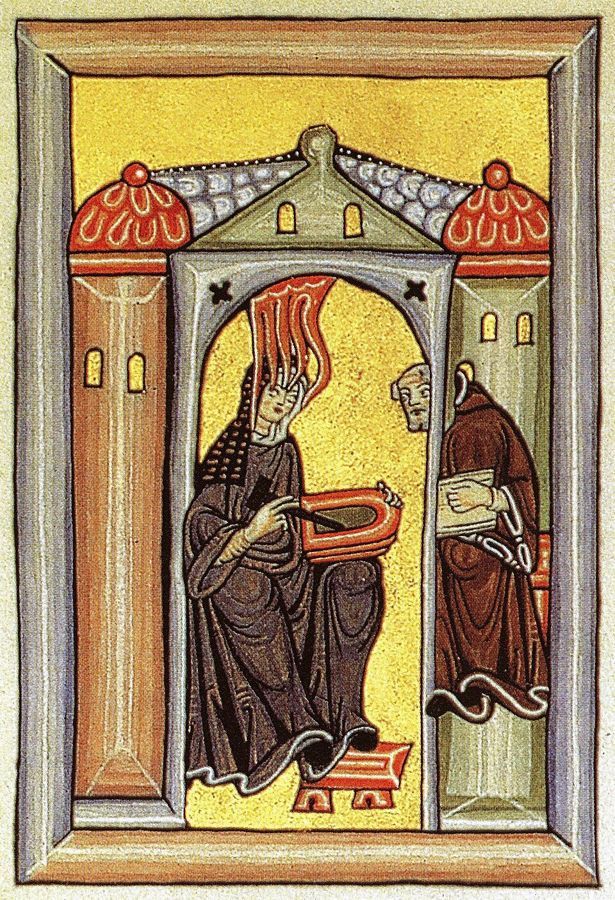
Image: Hildegard von Bingen.jpg · Unknown authorUnknown author · Public domain, via Wikimedia Commons

From Sabine Baring-Gould, The Lives of the Saints, new edition in 16 vols. (London: John C. Nimmo, 1897–98); text from the Internet Archive scan (OCR, lightly cleaned; errors possible). Public domain.

Image: Unknown authorUnknown author, Wikimedia Commons (Public domain)

From “Catholic Encyclopedia (1913)/St. Hildegard,” The Catholic Encyclopedia (New York: Robert Appleton Company, 1907–1914), via Wikisource. Public domain. Matched by name and feast date; text unedited except for our bracketed notes in grey.

From Sabine Baring-Gould, The Lives of the Saints, new edition in 16 vols. (London: John C. Nimmo, 1897–98); text from the Internet Archive scan (OCR, lightly cleaned; errors possible). Public domain in the United States. Reproduced unedited, except for short bracketed notes in grey that we added to explain names and terms (“S.” is the old abbreviation for Saint). Some history and judgments reflect 19th-century scholarship.