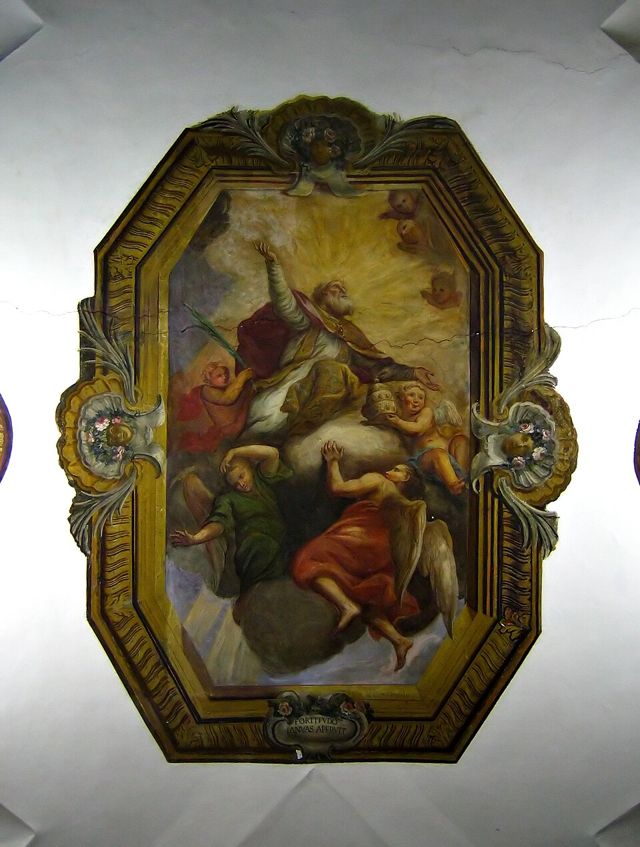
H

Honoratus probably came from a distinguished pagan family in northern Gaul.

Read the essentials →
January 16 · Bishop

St. Honoratus of Arles

St. Honoratus of Arles

Honoratus probably came from a distinguished pagan family in northern Gaul.

Traditional feast

January 16
1914 / pre-1969 calendar, per Baring-Gould (1914)

Current feast

January 16
Secondary source · Wikipedia

Represents

Bishop

Their story

Adapted in modern English from the Catholic Encyclopedia (1913) · original text below

Honoratus probably came from a distinguished pagan family in northern Gaul. He and his brother Venantius became Christians and, about 368, sailed from Marseilles with a holy man named Caprasius to visit the monks of Palestine, Syria and Egypt. Venantius died suddenly in Greece, and the travellers turned back.

Encouraged by Bishop Leontius of Frejus, Honoratus settled on the wild island of Lerins to live alone. Disciples gathered, and the monastery of Lerins grew from them. In the fifth and sixth centuries it trained many famous bishops and writers. Cassian dedicated several of his Conferences to him.

In 426 he was called from Lerins to be Archbishop of Arles, a see troubled by Arian (followers of Arius's teaching that the Son is a created being, not fully God) and Manichaean (followers of Mani, who taught that the world is a battle between equal powers of good and evil) teaching. He seems to have restored order while still guiding his monks. He died in the arms of his disciple Hilary, who succeeded him.

Early life

Selected sentences from the original account, unaltered.

Descended from a consular race, educated and eloquent, but devoted from his youth to great piety; he desired to be made a monk. His father charged his eldest brother, a gay and impetuous young man, to turn him from the ascetic life; but, on the contrary, it was he who gained his brother.

What they represent

How they teach us to live

Drawn from themes in the original account

Make time for silence. Solitude and withdrawal to pray shape this life.

Keep their day. Remember them on January 16 with a short prayer, and ask for their help.

From the Catholic Encyclopedia

1913 · 366 words

Archbishop of Arles; b. about 350; d. 6 (or, according to certain authors, 14 or 15) January, 429. There is some disagreement concerning his place of birth, and, as already seen, the date of his death is also contested. It is believed that he was born in the north of Gaul [roughly modern France and Belgium] and that he belonged to an illustrious pagan family. Converted to Christianity with his brother Venantius, he embarked with him from Marseilles about 368, under the guidance of a holy person named Caprasius, to visit the holy places of Palestine and the lauræ of Syria and Egypt. But the death of Venantius, occurring suddenly at Methone, Achaia, prevented the pious travellers from going farther. They returned to Gaul through Italy, and, after having stopped at Rome, Honoratus went on into Provence and, encouraged by Leontius, Bishop of Fréjus, took up his abode in the wild island of Lérins with the intention of living there in solitude. Numerous disciples soon gathered around him and thus was founded the monastery, which has enjoyed so great a celebrity and which was during the fifth and sixth centuries a nursery for illustrious bishops and remarkable ecclesiastical writers. Honoratus's reputation for sanctity throughout the south-eastern portion of Gaul was such that in 426 after the assassination of Patroclus, Archbishop of Arles, he was summoned from his solitude to succeed to the government of the diocese, which the Arian [followers of Arius, who taught that the Son is a created being, not fully God] and Manichaean heresies had greatly disturbed. He appears to have succeeded in re-establishing order and orthodoxy, while still continuing to direct from afar the monks of Lérins. However, the acts of his brief pontificate are not known. He died in the arms of Hilary, one of his disciples and probably a relative, who was to succeed him in the See of Arles. His various writings have not been preserved, nor has the rule which he gave to the solitaries of Lérins. Cassian, who had visited his monastery, dedicated to him several of his "Conferences".

PIERRUGUES, Vie de S. Honorat, fondateur de Lérins et eveque d'Arles (Grasse, 1874); GALBERT, Saint Honorat et son monastere in Bullet. de l'Acad. delphin., Doc. X (Grenoble, 1896-97), 97-110; ALBANES AND CHEVALIER, Gallia Christ. noviss. (Arles, 1900), 25-29.

Read more

The full original · 604 words

Read Baring-Gould’s full account

Baring-Gould’s sources: Honoratus, in French Honoré, is commemorated in almost all the Western Kalendars. His life by his kinsman and successor, S. Hilary. Another life of him is apocryphal. "A tissue," says Bollandus, "of fables and crazes;" "which," says Baronius, "cannot be read without nausea, except by those with iron stomachs, and wits covered with the rust of ignorance." This life, therefore, must be completely put aside, as worthless, and we must draw all our information from that by S. Hilary, Bishop of Arles.

The sailor who proceeds from the roadstead of Toulon towards Italy or the East, passes among two or three islands, rocky and dry, surmounted here and there by a slender cluster of pines. He looks at them with indifference, and avoids them. However, one of these islands has been, for the soul and for the mind, a centre purer and more fertile than any famous isle of the Greek sea. It is Lerins, formerly occupied by a city, which was already ruined in the time of Pliny, and where, at the commencement of the fifth century, nothing more was to be seen than a desert coast, rendered unapproachable by the number of serpents which swarmed there.

In 410 a man landed and remained there; he was called Honoratus. Descended from a consular race, educated and eloquent, but devoted from his youth to great piety; he desired to be made a monk. His father charged his eldest brother, a gay and impetuous young man, to turn him from the ascetic life; but, on the contrary, it was he who gained his brother. After many difficulties, he at last found repose at Lerins; the serpents yielded the place to him; a multitude of disciples gathered round him. A community of austere monks and indefatigable labourers was formed there. The face of the isle was changed, the desert became a paradise; a country bordered with deep woods, watered by streams, rich with verdure, enamelled with flowers, revealed the fertilizing presence of a new race. Honoratus, whose fine face was radiant with a sweet and attractive majesty, [58] opened the arms of his love to the sons of all countries who desired to love Christ. A multitude of disciples of all nations joined him.

There is, perhaps, nothing more touching in monastic annals than the picture traced by S. Hilary, one of the most illustrious sons of Lerins, of the paternal tenderness of Honoratus for the numerous family of monks whom he had collected round him. He could reach the depths of their souls to discover all their griefs. He neglected no effort to banish every sadness, every painful recollection of the world. He watched their sleep, their health, their food, their labours, that each might serve God according to the measure of his strength. Thus he inspired them with a love more than filial. "In him," they said, "we find not only a father, but an entire family, a country, the whole world." When he wrote to any of those who were absent, they said, on receiving his letter, written according to the usage of the time, upon tablets of wax, "It is honey which he has poured back into that wax, honey drawn from the inexhaustible sweetness of his heart."

In that island paradise, and under the care of such a shepherd, the perfume of life breathed everywhere. These monks, who had sought happiness by renouncing secular life, felt and proclaimed that they had found it; to see their serene and modest joy, their union, their gentleness, and their firm hope, one would have believed one's self, says S. Eucher, in the presence of a battalion of angels at rest. [59] How S. Honoratus converted S. Hilary by his prayers, as told by S. Hilary himself, shall be related when we speak of that Saint. Honoratus was, by compulsion, made to assume the direction of the see of Arles [a bishop’s “see” is his diocese, named from his seat (Latin sedes)], and was consecrated Bishop in 426. He died in the arms of S. Hilary, who succeeded him in 429.

Relics, at S. Honoré, formerly Lerins.

In art, he appears expelling serpents from the isle with his staff.
Feast days

Feast: January 16

Nine days · Free

Pray the novena
with us.

One short email a day for nine days. The day's prayer, a line from St. Honoratus of Arles's story, and a nudge to keep going.

Also on January 16
St. Priscilla, Matron at Rome

St. Priscilla

January 16 · Feast
St. Marcellus, Pope

St. Marcellus

January 16 · Martyr
M

St. Melas of Rhinoclusa

January 16 · Bishop, Confessor
← All 1726 saints in the library
Sources & notes

Feast-day sources

Story sources

Sources

Credits

From Sabine Baring-Gould, The Lives of the Saints, new and revised edition (Edinburgh: John Grant, 1914; first edition 1872). Public domain.

From “Catholic Encyclopedia (1913)/St. Honoratus,” The Catholic Encyclopedia (New York: Robert Appleton Company, 1907–1914), via Wikisource. Public domain. Matched by name and feast date; text unedited except for our bracketed notes in grey.

From Sabine Baring-Gould, The Lives of the Saints, new and revised edition (Edinburgh: John Grant, 1914; first edition 1872). Public domain in the United States. Reproduced unedited, except for short bracketed notes in grey that we added to explain names and terms (“S.” is the old abbreviation for Saint). Some history and judgments reflect 19th-century scholarship.