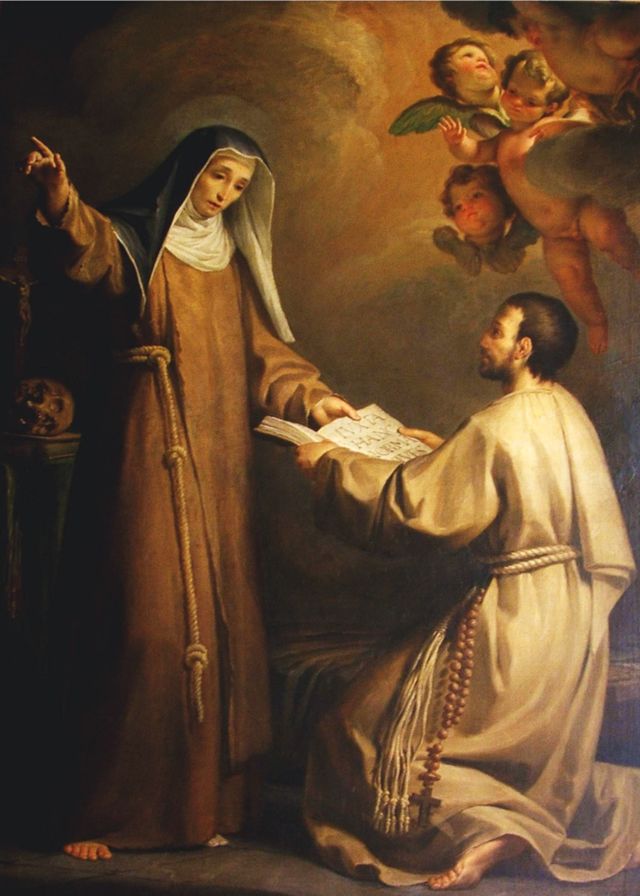
Baring-Gould’s sources: Roman Martyrology. Authority: the Bull of her Canonization.
S. Hyacintha was the daughter of Mark Anthony Mariscotti, Count of Vignanello, and of Octavia Orsini; she was born in 1588, and received in baptism the name of Clarissa, which she exchanged for that of Hyacintha on entering the cloister.
In her earliest childhood she was remarkable for her piety, but as she grew older she became giddy and frivolous. In her 17th year she was, one day, playing with the rope of a well at Vignanello, when she slipped over the edge, and hung, entangled in the rope, which held her some minutes suspended above the horrible pit, till a servant, observing her peril, from the castle window, ran to her assistance, and rescued her. The shock of this accident seemed for a while to steady her. She shortly after fell in love, and a marriage was projected, but when, through family circumstances, it was broken off, Clarissa would hear of nothing but of taking the veil, and burying her broken heart in a convent. Her father refused at first, but yielding at length to her sentimental vehemence, which he mistook for real vocation, allowed her to take the veil in the convent of S. Bernardine at Viterbo.
In the convent her heart soon healed, and she became an annoyance to the whole sisterhood by her vanity and frivolity. After ten years, she fell ill, and sent for her confessor [in old usage, a saint who was not martyred, or who suffered for the faith without being killed]. He, knowing her character, and wearied with her shallowness, sharply rebuked her with, "Beware, Hyacintha, heaven is no place for giddy-pates!" His words startled her, and she cried out, "Am I then lost for ever."
"No," he answered, "not if you seek pardon for your sins of the just and merciful God, with sincere resolution of amendment, and cease to be a scandal and worry to the poor sisters of this house, by your emptiness and light talk, and worldly ways." Bursting into a flood of tears, she promised amendment, sent for all the sisters, and humbly asked their pardon, and prayers. Then she cast herself at her confessor's feet, and made a sincere confession. She now completely changed her life; she would not wear shoes, and only put on the meanest dress. She strove manfully to overcome the purposelessness of her life and the feebleness of her will; and as she gradually mastered herself and her vanity, there broke on that soul, so long entangled in a fog of petty cares and pleasures, the burning sun of the love of Jesus, filling her with reality, earnestness, and devotion. In after years her character was completely the reverse of what it had been, was full of dignity and meekness, and above all, had a purpose in it. In a time of want, she founded two institutions, one for the secret relief of decayed gentlefolks, suffering, but too proud to ask alms, or display their misery; the other a hospital for old people. Both societies, known under the name of the Oblates of S. Mary, exist to this day at Viterbo.
The mercy of God rewarded this poor servant, and she was given singular privileges, a remarkable gift of prayer, and a discernment of spirits, that is, she could read the troubles of hearts. She died in the year 1640, calling on the sacred names of Jesus and Mary, in the 55th year of her age.
She was beatified by Benedict XIII., in 1726, and canonized by Pius VII., on May 24th, 1807.
This is one of those instances of the love and fore-thought of the Church in holding up to every class of mind and sort of temptation, an example of salvation in it. We have seen her fearlessness in exhibiting S. James the hermit to the fallen religious, here she shows to the thoughtless and giddy female mind, that for it Jesus thirsts in spite of its emptiness, and that for it there is sanctity if it will try to seek it.
Virgin in Crescent, after Albert Durer.
S.S. Cyrus, John, Athanasia and Others , MM. in Egypt a.d. 250. S. Geminian , B. of Modena, in Italy . S. Julius P. , and Julian D. , at Novara, in Italy, beginning of 5th cent. S. Marcella , W., at Rome , a.d. 410. S. Patroclus , B.M. in France . S. Gaud , B., of Evreux in Normandy, circ. a.d. 531. S. Aidan [Irish monk, founder of Lindisfarne (d. 651)] or Maidoc , B., of Ferns, in Ireland, beginning of 7th cent. S. Adamnan , P., of Coldingham, end of 7th cent. S. Ulphia , V., at Amiens, 8th cent. S. Athanasius [bishop of Alexandria (d. 373), great defender of the Nicene faith] , B., of Methone in the Peloponesus, 9th cent. S. Eusebius [Eusebius of Caesarea (d. c. 339), the first historian of the Church] , Monk of S. Gall [Irish companion of Columbanus, founder of the Swiss monastery that bears his name] in Switzerland , a.d. 884. S. Martin [St. Martin of Tours (d. 397), soldier turned bishop] , P., of Soure near Coimbra, in Portugal , a.d. 1147. S. Serapion , M., among the Moors [the Muslims of North Africa and Spain] , a.d. 1240. S. Peter Nolasco , C., in Spain , a.d. 1256.