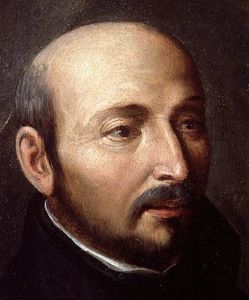
Baring-Gould’s sources: Roman Martyrology. Canonized by Pope Gregory XV., in 1622. Authorities: — Vita antiquissima, a Ludovico Consalvo, ex ore Sancti excepta.” Another Life by Peter Ribadineira, iriend and companion of the saint. The original in Spanish, Madrid, 1570. In Latin, Naples, 1572. Malleus: — “De vita el moribns S. Ignatii Loyolse libri tres,” Romae, 1585. Chr Stein, (under the pseudonym of Simon Lithus), Vita Ignatii. s. 1. 1598. There are other and later lives, which need not be specified.] Scarcely a sadder period can be traced in the history of the Church of Rome than that which saw the rise of Ignatius Loyola. Never, probably, was the Church brought to such straits, did her last end seem more near. Her sovereign pontiff, Alexander VI., had sent a shudder through Christendom by his infamous crimes. Bishops were everywhere careless, worldly, greedy of advancement and gain, heedless of the souls committed to their charge; the religious Orders had lost their ancient enthusiasm, had grown rich and luxurious, and sometimes caused great scandals. Faith seemed dead. And at the same time, throughout the West, men were rising, zealous, despairing of reformation in the Church, who separated themselves, and called on all who were in earnest about their souls to £ Ignatius Loyola.
…come out, to desert the city-^the Jerusalem of the living God, which seemed given over to evil, beyond hope of recovery — as the Nazar enes of old escaped from Jerusalem before its fall and complete destruction. But it is always darkest before dawn. The promise of God standeth sure. He will not desert His Church, but when all seems lost, when the head of Christ is laid in sleep on a pillow, and the ship is covered with the violence of the waves, He is still in the vessel, and He will save it The chivalry of Spain was the only one that had preserved a certain remnant of its religious character, down to the period of which we write. The war with the Moors [the Muslims of North Africa and Spain], but just concluded in the Peninsula, and still proceeding in Africa; the presence of the subjugated Moriscoes still remaining, ever threatening insurrection, and the adventurous expeditions undertaken against the infidels beyond the seas; — all combined to perpetuate this spirit In such books as the “Amadis of Gaul [roughly modern France and Belgium]/' full of a simple, enthusiastic loyalty and bravery, that spirit was idealized. Don Inigo Lopez de Recalde, the youngest son of the house of Loyola, was bom in a castle of that name, between Azpeitia and Azcoitia, in Guipuscoa. He was of a race that belonged to the noblest m the land, and its head claimed the right of being summoned to do homage by special writ. Educated at the court of Ferdinand the Catholic, and in the train of the duke of Najara, Inigo was deeply imbued with the spirit of his nation and class. He aspired to knightly renown, and for none of his countrymen had the glitter of arms, the fame of heroism, the adventures of single combat and of love, more attractive charms than for him; but he also displayed an extraordinary fervour of religious enthusiasm, and had already celebrated the first of the apostles, in a romance of chivalry, at this early period of his life. The profession of arms seemed to open to him a field in which every desire of his heart, the noblest impulses of bis nature, would find their legitimate scope. Generous, just and honourable, he was beloved by the soldiers he commanded; nevertheless, probably, his name would have become known to us, only as one of those many brave and noble Spanish leaders, to whom the wars of Charles V. gave opportunities so numerous for distinguishing themselves, had he not been wounded in bath legs, at the defence of Pampeluna, at the age of twenty-nine, in 1521. Of these wounds he was never completely cured; twice were they re-opened, and such was his fortitude that, in these severe operations, the only sign of pain he permitted to escape him was the firm clenching of his hands. His sufferings were, unhappily, unavailing; the cure remained deplorably incomplete. He was much versed in, and equally attached to, the romances of chivalry, more especially to the Amadis. During his long confinement he read these glowing stories of love and heroism, interspersed with the graver study of the life of Christ, and of some of the Saints, in Spanish, the only language with which he was then acquainted. Visionary by. nature, and excluded from a career which seemed to promise him the most brilliant fortunes, condemned to inaction, and at the same time rendered sensitive and excitable by his sufferings, he fell into the most extraordinary state of mind that can be conceived. The deeds of S. Francis and S. Dominic, set forth in his favourite books in all the lustre of their saintly renown, not only seemed to him worthy of imitation, but, as he read, he believed himself possessed of courage and strength sufficient to follow their footsteps. “ Why l” exclaimed he, “should not I do that which Francis and Dominic wrought ?” But these exalted dreams alternated with others of a less spiritual sort, as his slow convalesj“‘ysio 6. Ignatius Loyola. 711 cence afforded him alternative hopes of worldly or spiritual aggrandisement. Of all the vain things that offered themselves to his mind, one remained — the devotion he purposed to show to the lady of his choice. “ She was no countess,” he afterwards said, “ no duchess, but a lady of yet higher degree.” He pictured himself repairing to the city where she dwelt, he imagined the gay and graceful discourses with which he would address her, how he would prove his devotion, the knightly exploits he would perform in her honour.
But as his recovery was protracted, and his hope of ultimate cure was deferred, and the obstinate protuberance on his leg caused by fracture and bad setting of the bone, would not subside — a protuberance sadly marring manly grace in days of long silk stockings — his mind was forced slowly, sadly, to forego his aspirations after fame in love and war, and to turn' to more sacred fields. Steadily the spiritual reverie gained ascendancy over the worldly vision. An earthquake, which shook the castle of Loyola and rent the chamber wall where he lay, confirmed his ardour for a religious career.
When fully healed, he mounted his horse, in full harness of war, pretending that he was about to visit the duke of Najare, under whom he had fought, to resume his warlike career in the field; but instead of turning his horse's head towards Navaretta, where the duke then was, he rode to Montserrat.
Let us follow Inigo on his ride, and we shall be able to judge of the effect produced on his mind by that mysterious mountain.
From far away, on the horizon may be seen the lofty serrated mountain, the mons serrata, Montserrat. The earth is dark red, showing through the thin foliage of the olives, as the hills draw nearer, and finally gives colour to the landscape. The vines covering the levels and lower slopes are wonderfully luxuriant, hedges of aloe and cactus divide them; here and there some underground cavern has tumbled in, letting down irregular tracts of soil, and the vines still flourish at the bottom of the pits thus made. And overhead, as Inigo approaches, the great mountain rises higher, breaking into a wilder confusion of pinnacles. It stands alone, planted across the base of a triangular tract of open country, — a strange, solitary, exiled peak, drifted away in the beginning of things from its brethren of the Pyrenees, and stranded in a different geological period. It is a mountain to impress the mind. The effect it has produced in Christian ages may be traced in the traditions that surround it. The story goes that the mountain was rent and shattered at the moment when Christ breathed his last on the cross of Calvary. This is still the popular belief; but the singular formation of Montserrat, independent of it, was sufficient to fix the anchorite [a hermit, sometimes walled into a cell beside a church] tastes of earnest men in the Middle Ages. It is an irregular cone, about 3,500 feet in height, and cleft down the middle by a torrent which breaks through its walls on the north-eastern side. It presents a perpendicular face, which seems inaccessible, for the shelves between the successive elevations when seen from below, appear as narrow fringes of vegetation growing out of one unbroken wall. They furnish, indeed, but scanty room for the bridle-path, which at various points is both excavated and supported by arches of masonry.
When this crest is attained, the traveller stands between the tom and scarred wilderness of Montserrat on the one hand, and the broad, airy sweep of landscape, bounded by the blue sea, on the other, to the East; and to the North by the glorious snowy wall of the Pyrenees. But the summit of Montserrat is not yet attained, the July 3 i.] S. Ignatius Loyola. 7x3 holy, awful spot, consecrated by legend and religion. Emerging from a tangled growth of thickets, the road or track bursts suddenly upon one of the wildest and most wonderful pictures conceivable. A tremendous wall of rock rises in front, crowned by colossal turrets, pyramids, pillars, and ninepin shaped masses, drawn singly, or in groups of incredible distortion, against the deep gentianblue of the sky. At the. foot of the rock, the buildings of the monastery, huge and massive, the church, the houses for pilgrims, and the narrow gardens completely fill and almost overhang a horizontal shelf of the mountain, under which it again falls sheer away, down, down into misty depths, the bottom of which is hidden from sight. 1 The description of Montserrat must have made a powerful impression on Goethe’s mind, since he deliberately appropriated the scenery for the fifth act of the Second Part of Faust.
The monastery owes its foundation to a miraculous statue of the Virgin, sculptured by S. Luke, and brought to Spain by S. Peter. In the year 880, some shepherds, who had climbed the mountains in search of stray goats, heard celestial harmonies among the rocks. This phenomenon coming to the ears of Bishop Gondemar, he climbed to the spot, and was led by the music to the mouth of a cave, where, enshrined in light, lay the sacred statue. Gondemar and his priests, chanting as they went, set out for Manresa, carrying it with them; but on reaching a. certain spot, they found it impossible to move farther. This was taken as a sign that there, and nowhere else, the shrine should be built. Just below the monastery there still stands a cross, with the inscription, “ Here the holy image declared itself immovable, 880.” 1 Not having visited Montserrat myself, 1 have used for this sketch the description by Mr. Bayard Taylor in his “Byeways of Europe." ft- ft 714 Lives of the Samts. U“*rsi.
The chapel when built was intrusted to the pious care of Fray Juan Garin, whose hermitage is pointed out on a peak which seems accessible only to the eagle. The devil, however* interfered, as he always does in such cases. He first entered into Riquilda, the daughter of the count of Barcelona, and then declared through her mouth, that he would not quit her body except by the order of Juan Garin, the hermit of Montserrat. Riquilda was therefore sent to the mountain and given into the hermit's charge. A temptation similar to that of S. Antony followed, but with exactly the opposite result. In order to conceal his sin, Juan Garin cut off Riquilda's head, buried her, and fled. Overtaken by remorse he made his way to Rome, confessed himself to the pope, and prayed for a punishment proportioned to his crime. He was ordered to become a beast, never lifting his face towards heaven, until the hour when God himself should signify his pardon. ^ Juan Garin went forth from the Papal presence on his hands and knees, crawled back to Montserrat, and there lived seven years as a wild animal, eating grass and bark, and never lifting his face towards heaven. At the end of this time his body was covered with hair, and it so happened that the hunters of the count ensnared him, put a chain round his neck, and brought the strange beast to Barcelona. In the mansion of the count there was an infant only five months old, in its nurse's arms. No sooner had the child beheld the supposed animal, than it gave a loud cry and exclaimed, “Rise up, Juan Garin, God has pardoned thee !" Then, to the astonishment of all, the beast arose and spoke in a human tongue. He told his story, and the count set out at once with him to the spot where Riquilda was buried. They opened the grave, and the maiden rose up alive, with only a rosy mark, like S. Ignatius Loyola a thread, round her neck. In commemoration of so many miracles, the count founded the monastery. Such was the scene, such the legends, acting on the mind of Inigo, when he entered the guest house of Montserrat. No other place could have so influenced his mind working with chivalrous ideas, labouring to bring religious conceptions to their birth. He at once sought a director, and was engaged for three days in making a general confession. That ended, he was a changed man. It was the eve of the Annunciation (1522). He was about to enter on a new knighthood, he would pass vigil in the church like a knight of chivalry before donning the sword and buckler as described in his favourite romance of Amadis. 1 The virgin blade and harness of the aspirant after knighthood was wont to repose all night on the altar. Inigo had bought a pilgrim’s staff and wallet and coarse brown habit. These were the insignia of his new knighthood, the weapons of his spiritual warfare. He laid them on the altar, hung his sword before the image of the Blessed Virgin, gave his horse to the monks, and kneeling alone in the church whilst the ghostly moonlight wandered over the floor, the tombs, the speaking images, prayed and prepared himself for a life new in aim, and whither tending God only knew. Did spectral forms haunt that night watch? Riquilda, with the red line round her throat, the beast-like Friar, covered with hair; the knight who vowed himself to the devil, and was only saved by the holy image stepping, blazing white, between him, shrieking and flying, and the black pursuing Satan — for that is another of the legends of the holy mount? It is possible. Considering the visionary state of mind into which his sickness had plunged him — it is probable.
On the morrow he communicated, thanked God for the 1 Acta antiqmssima. change wrought in him, and departed. He was now enrolled — he had solemnly enrolled himself in a great army or the champions of Christendom. In his spiritual exercises, the origin of which was coincident with the first extatic meditation of his awakened spirit, he imagines two camps, one at Jerusalem, the other at Babylon; the one belonging to Christ, the other to Satan; in the one is everything good — in the other, whatever is depraved and vicious. These are prepared for combat. Christ is a king who has signified his resolve to subjugate all unbelievers; whoever would fight beneath his banners must be fed with the same food, and clad in like garments with him; he must endure the same hardships and vigils; and according to the measure of his deeds, shall he be admitted to share in the victory and rewards. Before Christ, the Virgin, and the whole court of heaven, shall each man then declare that he will truly follow his Lord, will share with him in all adversities, and abide by him in true poverty of body and spirit.
Inigo set off, intending to go to Jerusalem; but he did not purpose going through Barcelona, lest he should be recognized on the highways. He made a round by Manresa, whence, after new penances, he meant to gain his post of embarkation for the Holy Land. He found a hospital dedicated to S. Luke, outside the gates of Manresa, and into that he retired. He ministered to the sick there, beat himself, fasted, watched, and tortured his body, in a long ecstasy of ascetic fervour. Finding a convenient cave in one of his rambles, he crawled into it, lashed his bare back with an old iron chain he had dragged after him, and fed on the leaves and roots he could find. A few days after he was discovered at the mouth of his cave, in a fainting fit, and was carried back to the hospital. The work in the hospital was repugnant to him. Poor wretches swarming with vermin occupied the beds, and those who attended them could not escape with impunity. The odours turned his stomach. The coarse language shocked a sensitive, refined taste. He began to doubt his own ability to persevere in his life of self-abnegation and sacrifice to the good of others. But what was more serious, he found that his self torture brought him no peace of mind. Not satisfied with the general confession made at Montserrat, he made another at Manresa, his scrupulous conscience having recalled sins and trifling errors which had escaped his former self examination. He began to despair. He doubted that he could be accepted by or justified before God. Exhaustion from excessive abstinence, nervous irritation from harrassing duties, had brought him to this distressing condition. Having read that a total absence from food had once moved the compassion, and obtained the favour of the Almighty, he kept rigid fast from one Sunday to another; but his melancholy only deepened, his despair grew darker. His whole life seemed to him to be but one continuous series of sin after sin, and he not unfrequently felt tempted to throw himself out of the window.
This relation cannot fail to remind us of the nearly similar sufferings endured by Luther some twenty years before, when he also was assailed by similar doubts. But out of this darkness, this labyrinth of difficulty, Ignatius and Luthe* emerged by very different paths. The latter, flinging away all hope of finding peace in obedience, cast the conscience into paralysis before God, who freely justifies through faith. To him who believes effort is over, struggle against sin there is none, good works are worthless, observance of the commandments may adorn a Christian life, but do not constitute it. With Ignatius it was otherwise. In obedience he sought rest, in the execution of duty he found what he needed. God had set to each man a work in the world, not for himself alone, but for his brother men, meshes in the same net, members of the same household, brothers in the same family. I^o man must live and die to himself only — he is his brother's keeper, to some extent In the sense of his obligation to fulfil the work God had set him among other men, for the revival of true religion, for the conversion of lost souls, for the guidance of the erring into clear light — in this Ignatius Loyola found repose, a repose which was perfect and wholesome; whereas that of Martin Luther was false and unreal. The Saint found his rest in fulfilling the obligation laid upon him, the Heresiarch in denying that there is any obligation, and proclaiming that the sole function of the conscience is slumber. In their agonies of doubt, the souls of Loyola and of Luther groped for a sure foundation on which to support themselves. Luther anchored all on the pages of Scripture. Loyola went deeper. He dived to the lowest depths of his nature, and found in the very constitution of his soul, his conscience, his affections, a living witness to Christianity. Thenceforth neither the testimony of antiquity nor Scripture were essential to his faith; had none such existed he would have gone without hesitation to die for the faith now become a living reality to him. 1 How could it be thus with a faith resting solely on Scripture, subject to the constant erjfosion of criticism. But “ Ad majorem Dei gloriam/' the motto chosen by Ignatius, might equally have been elected by Luther. Each was inspired with enthusiasm for the honour of God, but each sought it differently. Luther denied that forgiveness was conditional, for how, said he, condition the free1 “ Saepeetlam id cogitarit, quodetsi nulla Scriptura mysteria ilia fidei doceret, tamen ob ea ipsa quae viderat, ste-tuerefc sibi pro ea esse moriendum.” Acta antlquissima.
J^y 31J 6 1. Ignatius Loyola. 719 dom of God’s purposes by the measure of man’s scanty penitence; it is against the dignity, the glory of God so to esteem His mercy. There are no ifs with Him. He wills to save, absolve, sanctify, not if man be willing to co-operate with grace, struggle against sin, weep over his transgressions, but royally, magnificently, unconditionally. It was the contrary with Ignatius. The glory of God was manifest in the free submission of the will of man. The love of God falls like dew and melts the hard heart; it had drenched his through and through, and like Gideon’s fleece he would wring it out over a thirsty world. The work of the Incarnate Son was a gentle one; his voice no longer spake in thunder, shattering the rocks, it whispered, it touched, and the free will rose and unbarred the door, under no constraint, but acting in the plenitude of its freedom. The glory of God is manifest on earth, therefore, in the conversion of the sinner from the error of his ways to the humble path of God’s commandments, in the strong man in his strength counting all the vain things of earth as dung if he may but win Christ through obedience, in the wandered Israelite ready to go back “by the way of the Red Sea,’ 7 retrace his steps to the cool, calm walks of childish simplicity, thence to start again on the pilgrimage to the Promised Land.
If we have clearly comprehended the origin and development of the state of mind of Ignatius, of this chivalry of abstinence, this pertinacity of enthusiasm, this wrestle with doubt and despair, we shall not need to follow him through every step of his progress. He did, indeed, proceed to Jerusalem, in the hope of confirming the faith of the believers as well as that of converting the infidel. But how was the last purpose to be accomplished, uninstructed as he was, without associates, without authority? Even his intention of remaining in the Holy VOL. VIII. 21 Land was frustrated by an express prohibition from the heads of the Church at Jerusalem, who had received from the Pope the privilege of granting or Refusing permissions of residence there.
Returning to Spain, he had further trials to encounter. He was accused of heresy on attempting to teach, and inviting others to participate in those spiritual exercises on which he had now entered.
He was then aged thirty-three. He settled for awhile at Barcelona, to take lessons in grammar. There was in that city a convent dedicated to the Angels, the nuns of which scarcely emulated the innocence of those pure spirits. The young gallants of Barcelona found their way too frequently past the grilles or over the walls. It was a joke among the godless, a scandal to the pious. Ignatius interfered, remonstrated, threatened, entreated. The guilty nuns promised amendment. The young cavaliers assaulted Inigo, and left him for dead in the street. At Alcala he was imprisoned on account of the imprudent devotion of some noble ladies whom he had ' converted, and who had set off alone, and without money, upon a long pilgrimage; at Salamanca he was again imprisoned, on suspicion of being one of the sect of the Illuminati or alumbrados. These mystics — sect they can hardly be called — held that by prayer and meditation they were exalted into such union with the Deity that sacraments were no more needful to them. Why the symbols when they enjoyed the substance ? The first of these mystics were Juan de Willalpando, a native of Teneriffe, and a Carmelite nun, named Catharine of Jesus. 1 That there was some analogy between the proceedings of Inigo and those of the Alumbrados cannot be doubted, but it was 1 The Alumbrados were seized and executed in great numbers by the Inquisition.
superficial. They gave themselves up, like him, to ecstacies, spent their nights in long prayer, beheld visions, and lay in trances; they made general confession a condition to absolution, and insisted as earnestly as did Loyola on the necessity for inward, mental prayer. But on the other hand they believed themselves to be exalted by the claims of the spirit, above all the common duties of life; he, on the contrary, still impressed by his early habits, placed the soldier’s virtue, obedience, before all others; his every conviction and whole enthusiasm of feeling he compelled himself to place in subjection to the Church, and to all who were invested with her authority. He had made as yet no progress towards the formation of that society which was to be inseparably connected with his name. His first companions, men who had known him at Barcelona, had gone with him to Alcala, and who had shared his persecutions there, had fallen away from him. These troubles and obstacles had meanwhile a decisive influence on his future life. In his then circumstances, without learning or profound theological knowledge, and without political support, his existence must have passed and left no trace. The utmost effect he would have produced would have been the conversion of some two or three Spaniards; but being enjoined, by the Universities of Alcala and Salamanca, to study theology for four years before attempting to expound doctrine, he was compelled to enter on a path which gradually led him forward to an unexpected field for the exercise of his religious activity.
He proceeded to Paris, at that time the most celebrated university of the world, and arrived there in the February of 1528. He studied at first in the College Montaigu; but after a year moved to the College of S. Barbara, and there found his two first — and in some sense the two 722 Lives oj the Saints. [,My 3 i.
greatest — of his spiritual disciples, who had studied there together for some years before the arrival of Inigo, or Ignatius as he was thenceforth called, as close and tender friends, sharing even the same room.
These two men were Pierre Lefhvre, a native of Valleret, in the diocese of Geneva, and Francis Xavier, a native of Navarre, born fifteen years after Ignatius. Ignatius shared the rooms of these two men. Pierre Lefhvre proved an easy conquest; growing up among his father’s flocks, he had one night solemnly devoted himself, beneath the canopy of heaven, to study and to God. Piety and simplicity were combined in this young Savoyard with a singular love of learning, and veneration for intellectual or moral power in others. At the age of eighteen he had gone to the University of Paris, and begun his philosophical studies under Juan Peria, at the college of S. Barbara. He became at once the most distinguished and favourite pupil of his master, and when Ignatius presented himself for the same purpose, and took up his abode in the same room with Pierre Lefhvre and Francis Xavier, Pierre was selected by Peria to repeat his lectures on philosophy to the new student. Ignatius in return for the pains taken with him by Lefhvre, communicated to him his own enthusiasm. He taught him to combat his temptations, prudently taking them not altogether, but one by one. He kept him strictly to confession and frequent participation in the holy Eucharist. They lived in the closest intimacy. His character, commanding by nature, assumed ascendency over that of Lefhvre, and Ignatius was reverenced — almost worshipped — by 'his pupil in the spiritual life.
Francis Xavier was by no means so easily won. His most earnest ambition was to ennoble still further the long Series of his ancestors, renowned in war during five hunJ»iy 31O S. I gnatms Loyola. 725 dred years, by adding to their names his own, rendered illustrious by learning.
Xavier was a man of singular delicacy and purity of mind, and of great nobility of aim. He was handsome and rich, possessed high talent, and had already gained a footing at court. It was not without difficulty that Ignatius prevailed on Xavier to join him in his spiritual exercises. He was by no means indulgent with his disciples; three days and three nights did he compel them to fast. During the severest winters, when carriages might be seen traversing the frozen Seine, he kept Lefevre long hours, by night as well as by day, praying and meditating in a court-yard open to the sky. He allowed him no fire in his room, and bade him make his bed on the heap of sticks prepared for fuel. But Ignatius was wise beside his sternness. He prevented his disciples from indiscreet and excessive asceticism. At the right moment he relaxed the harsh order, lightened the intolerable strain. Finally Ignatius succeeded in making these two young men entirely his own, and shared with them his most intimate thoughts and dearest projects.
Pierre Lefkvre and Francis Xavier stand by themselves at the head of the famous six men who formed with Ignatius the first members of the Society of Jesus. The other four had high qualities enough to interest us intensely, if they were not somewhat cast into the shade by these two. Simon Rodriguez was the first in order of time to form acquaintance with Ignatius. To him we owe a special debt of gratitude, as he alone of the first disciples of Ignatius has left us in writing an account of the early years of the society. After Simon, we find James Laynez, Alfonso Salmeron, and Nicolas Bobadilla, joining the silently formed company, the great destiny of which none of them could then imagine possible.
It takes but a short time to run through the few particular details which require notice during seven years (15281535) which were passed by Ignatius at Paris, and which witnessed the quiet and deliberate formation of the first Fathers of the Society. We catch glimpses of his visit to Flanders and England, for the purpose of obtaining alms, of the wide-spread influence he exercised in Paris over many besides those who became his intimate companions, of the opposition which a character and a work like his was certain to encounter, of heroic deeds of charity, of persecution and public suspicion, and of one or two attempts at violence against him.
The anecdotes which remain to us of this period show us how he was perpetually on the watch to do good in any form that presented itself. His charity was remarkable for its refined ingenuity. He brought the victim of a criminal passion to abandon the occasion of sin, by placing himself up to the neck in water under a bridge, over which the man had to pass in his evening visits, and calling out to him that he was doing penance for him. He won back to strictness a lax religious, by making to his ear a general confession of his own life. He converted a prelate of worldly life, by accepting his challenge at a game of chance, that the loser should become the servant of the winner for a month.
By the side of records of opposition and deafness to his influence, we find evidence of the deep general respect in which Ignatius was held, and we are told of large numbers whom he induced to lead a more perfect life, or to enter the religious state in various institutions. On the feast of the Assumption, 1534, the little band of zealous men proceeded to the church of Montmartre. Lefevre, who was a priest, said mass. They took the vows of chastity and obedience, and swore to proceed to Jeru•S'. Ignatius Loyola, Salem, after the completion of their studies, there to live in poverty, and dedicate their days to the conversion of the Saracens [medieval Christian name for Arab and Muslim peoples]. Or, should they find it impossible to reach that place, or to remain there, they were next to offer their services to the Pope, agreeing to 1 go withersoever he might assign them their labours, without condition, and without reward. Having taken this oath, each received the blessed Sacrament Here we see a league formed between enthusiastic young men, of which the purposes were absolutely unobtainable; still in accordance with the original ideas of Ignatius, or departing from them only so far as, on a calculation of probabilities, they might find themselves unable to carry them into effect In the beginning of the year 1537, Ignatius and his little band started for Venice, with the intention of taking ship there for Palestine. They wore the long dress and hat of the Parisian students. Each had his pilgrim's staff, his leather satchel on his shoulders containing his Bible and Breviary, and a rosary round his neck. They gave their money to the poor on leaving Paris; but it was afterwards agreed that they should accept as alms, and carry with them, a sufficient sum of money for their journey.
The first stage or the travellers - was Meaux. Two or three days’ journey beyond the town they were pursued and overtaken by friends from Paris, urging them, in vain, to return. The hostels along the route were full of heretics, from whom the devotions practised by the pilgrims called forth frequent remarks, either of amusement or astonishment.
Owing to the war between Spain and France, the pilgrims were constrained to make a circuit through Lorraine and Switzerland. They reached Venice in the Epiphany season of 1537. Several months were to pass before they could sail to Jerusalem, and it was determined to spend part of the time among the poor in the hospitals at Venice, and the rest in a journey to Rome, to obtain the blessing of the Pope on their undertaking. At Venice Ignatius became acquainted for the first time with the recently founded Order of Theatines. He served in the hospitals which Cardinal Caraffa superintended; but not entirely content with the institution of the Theatines, he proposed to Caraffa certain changes in its mode of action, and this led to the dissolution of their intimacy. When, after nine weeks, the little company of the disciples of Ignatius set out on foot for Rome, it was deemed most prudent that Ignatius should not himself accompany them. The hostility of Cardinal Caraffa was roused by the amendments proposed by Ignatius, his jealousy of an Order which was so much like his own was awakened, and it was thought that Caraffa would actively oppose the sanction of the society by the Holy Father.
The suppliants were kindly received by the Pope, Paul III., who bade them dispute on theology before him whilst he ate his dinner, and pleased with their skill in controversy, he gave them ready leave to go to Jerusalem if they were able to do so. The party of pilgrims returned to Venice, where they were admitted to holy Orders. But the war then threatening between the Venetians and the Turks prevented their sailing for Palestine.
Finding their prospect of preaching to the Saracens become remote, the young society resolved to exert itself in doing what it could in Italy. After forty days of prayer, Ignatius began to preach in Vicenza, together with three others of his society. On the same day, and at the same hour, they appeared in different streets, mounted on luiy 3 * j S % Ignatius Loyola. 727 stones, waved their hats, and with loud cries exhorted the people to repentance.
Preachers of a very unwonted aspect were these; their clothing in rags, their looks emaciated, and their language a mixture of Spanish and Italian well nigh unintelligible; but their zeal, the enthusiasm that spoke from their countenances, and burned in their eyes, appealed to men's hearts better than the words themselves. They remained in this neighbourhood until the year had expired, and then, seeing the door closed to their passage into the East, they resolved to go to Rome, and there receive the formal recognition of the new society by the pope. Having determined to make this journey by different roads, they were now about to separate; but first they established certain rules by means of which they might observe a fixed uniformity of life, even when apart; next came the question, What reply should be made to those who might inquire their profession ? They pleased themselves with the thought of making war as soldiers against Satan, and in accordance with the old military propensities of Loyola, they assumed the name of the Company of Jesus, exactly as a company of soldiers takes the name of its captain.
Ignatius, with his two companions, Laynez and Lefhvre, arrived in Rome in the course of November, 1537. The Pope received him graciously, and appointed Lefevre to lecture on positive theology, Laynez on scholastic theology in the University of Sapienza. Ignatius occupied himself chiefly in giving the spiritual exercises— the drill of recruits for the Company of Jesus, and many men of distinction placed themselves in his hands for this purpose. The ordinary abode of the little party was in a vineyard, near the Trinita di Monti, but when, about Easter, they were rejoined by the rest of the company, they removed into the heart of the city. When they were all assembled Ignatius addressed them. They had found that it was not possible for them to pass to Palestine according to their vow, but they had seen that in Italy was a vast field God had laid open to their apostolic labours, and that thence an abundant harvest might be gathered in. This, then, was the enterprise to which God's finger now manifestly pointed. They must go forth from Rome, the heart of Christendom, everywhere labouring to root up and to plant, to combat heresy and' vice, and to extend the faith, of Jesus Christ The means of doing this most surely was to bind themselves by a permanent bond, by adding the vow of obedience to vows of chastity and poverty they had already taken. They would thus perpetuate, beyond the span of their own lives, the bond of charity which united them, erecting the company into an Order which might multiply, itself in all countries, and until the end of time. But cold looks and obstacles at once began to meet and distress them. The soil of Rome, said Ignatius sadly, “is sterile of good fruits, and fertile* of bad ones.' 7 He thought he saw every door closed against him, and he had much ado to defend himself once more against accusations of heresy. But finally the mode of life of the little company, their zeal, their self-sacrifice, attracted respect and admiration. It is said that on his way to Rome, at the little village of La Storta, Ignatius had seen in vision our Lord, his great captain, going before him, and cheering him with this promise, “Ego vobis Romse propitius ero" (I will favour you at Rome).
Paul III. went to Nice in May, 1538, to meet Charles V. and Francis I., to persuade these contending princes to sign a truce for ten years, and to negotiate a marriage between his own grandson, Octavio Farnese, and Margaret of Austria, the daughter of the emperor. During his absence July 3i-] 6". Ignatius Loyola. 729 Cardinal CarafFa was left as Legate at Rome. He gave Ignatius and his companions leave to preach and hear confessions, but he would not hear of their founding an Order which would tread so closely on the heels of his favourite Theatines. Accusations of heresy against Ignatius were eagerly listened to. The legate [an official representative sent by the pope] would not give distinct sentence in favour of the orthodoxy of the Company of Jesus. Ignatius persisted in demanding a full trial and public decision, and produced many persons of consequence, Spaniards and Venetians,, then present in Rome, to testify to the innocence of their lives, and the orthodoxy of their teachings. The Pope’s return to his States in the autumn saved Ignatius and his companions from the blight on their reputations which- CarafFa, with unworthy jealousy, was labouring to cast Ignatius had a long interview with Paul III., at Frascati. He offered to bind the Society “ to perform whatsoever the reigning Pontiff should command, to go forth into all lands, among Turks, heathens, or heretics, wherever he might please to send them, without hesitation or delay, as without question, condition, or reward.” Paul III. was a keen politician, a sharp-sighted man. He perceived at once the advantage to the Holy See of having such a body of men absolutely at its disposal. Whilst from every other side the Pope met only opposition or defection, and had only continued desertions to expect; here was a company of men, earnest, enthusiastic, and zealous, uniting to devote themselves exclusively to his service; there could be no hesitation in such a case for the Pontiff. In the year 1540, he gave his sanction to their institute, at first with certain restrictions, but afterwards, in 1543, the Society of Jesus was absolutely and unconditionally established. The Cardinal Caraffa, seeing the resolution of the Pope, the impossibility of carrying on successful opposition, withdrew his objections, saying, “ Digitus Dei hie est,” (the finger of God is here).
And now the members of the Society made their final arrangements; six of the oldest associates met to choose their president; who, according to the first sketch of their plan presented to the Pope, “ should dispense offices and grades at his own pleasure, should form the rules of their constitution, with the advice and aid of the members, but should alone have the power of commanding in every instance, and should be honoured by all, as though Christ himself were present in his person.” It was the idea of military organization still dominating.the constitution of the Society. The general of the Order was the commander of the company under the sovereign Christ, acting in his name, issuing his orders, executing his designs. The choice fell unanimously on Ignatius, “to whom,” as Salmeron expressed it in the letter declaring his assent, “they were all indebted for their birth in Christ, and for the milk of the Word.”
At length then, the Society of Jesus had acquired its form. This association was a company of clerks regular, its duties were a combination of the clerical and monastic, but the members were nevertheless broadly distinguished from those of other congregations. The Theatines had freed themselves from many of the less important obligations of conventual life, but the Jesuits went much further, they dispensed entirely with the monastic habit, exempted themselves from all those devotional exercises in common, by which so much time was consumed in convents, and abstained from singing their offices together in choir.
Exempted from these restraints, they devoted all their energies, and every hour of their lives, to the essential duties of their office; not to one only, as did the BarnaJuly 3tJ S. Ignatius Loyola.
bites, although they also sedulously attended to the sick, nor with the restrictions that fettered the Theatines; but to all the greater duties equally, and with whatever force they could command. First to preaching: before separating in Vicenza, they had mutually agreed to preach chiefly to the common people, to think more of making an impression on their hearers than of shining themselves by display of eloquence, and to this system they adhered. Secondly to confession: for by this they were to hold the immediate guidance and government of consciences. The spiritual exercises by which they had themselves become united with Ignatius afforded them important aid. Finally they devoted themselves to the education of youth. They had intended to bind themselves to this last by a special clause in their vows; and although they had not done so, yet the practice of this duty was made imperative by the most stringent rules; to gain the rising generation was among the purposes most earnestly pursued. They laid aside, in short, all secondary matters, devoting themselves wholly to such labours as were essential, bringing about an immediate result, and calculated to extend the influence of the Church.
Thus was a system pre-eminently practical evolved by the genius of Ignatius; and from those first visionary raptures on Montserrat, and the extasies of self-torture at Manresa, had resulted an institution, framed with all that skilful adaptation of means to their end which the most consummate worldly prudence could suggest.
His most sanguine hopes were now more than fulfilled, — he held the uncontrolled direction of a society, soon to become numerous, mighty with the power of numbers, influential beyond any other, by the intelligence and education of its members, and wielded with the prompt energy of one man, having an autocratic head, its General. The Jesuit Order, infinitely above every other, served to stem the tide of the Reformation, to roll back its waves, and to recover, throughout Germany at least, many tracts of land apparently lost for ever to Catholic Christianity. The darling plan of Ignatius relating to Jerusalem was not, indeed, to be carried out, for nothing useful could now be obtained by it; but in other directions the company he ruled went forth on the most remote, and above all, most successful missions. The care of souls which he had so earnestly enforced, was entered on with a zeal that he could not have hoped for, and to an extent surpassing his most sanguine expectations.
Thenceforth Ignatius left Rome only 1 twice; once to Reconcile the inhabitants of San Anplo with the citizens of Tivoli; the other to re-establish concord between Ascanio Colonna and his wife Joanna of Aragon. He also effected other reconciliations; especially that of Don John III. of Portugal with Pope Paul III. and the Cardinal de Silva, bishop of Visieu. In Rome he built a house in which to receive converted Jews, another as penitentiary for women. When some one complained that he took too much pains over these unhappy persons, and that their repentance was rarely wholly satisfactory; “ Even if I could prevent them but once from offending God, I should think myself well employed,” was his answer.
He built another establishment for the reception of young girls neglected by their parents, in which they might be educated to work at some honest business. He erected as well two orphanages; but perhaps his most important establishment was the German college, for the instruction of youths destined to become parish priests in a country devastated by heresy, where keen controversial knowledge, great earnestness of purpose and integrity of life, could alone command respect and recover lost ground. July 3i.] Jesuit Martyrs in Canada. 733 I In July, 1556, he sickened, and felt that his end drew near. On the 30th, he sent his secretary to the pope? “Tell him that my hour has come, and that I ask his benediction. Tell him that if I go to a place where my prayers are of any avail, as I trust, I shall not fail to pray for him, as I have indeed unfailingly, even when I had most occasion to pray for myself.”
The pope sent him his benediction and a plenary indul^ sixty-five, the glorious confessor [in old usage, a saint who was not martyred, or who suffered for the faith without being killed] surrendered his soul into the hands of his Creator. He lived to see his Order divided into twelve provinces, and number a hundred colleges.
The body of S. Ignatius reposes in the G^/esu church at Rome.