D
St. Dorothy
M
Sts. Mael
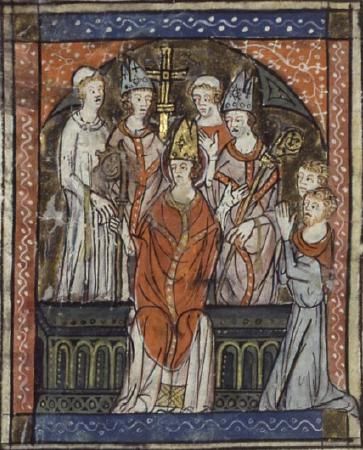
Trying to rule as a Christian, not just in name.
February 6
Not verified yet
King
Confessor
Ina, king of Wessex, which consisted of Wiltshire, Hampshire, Gloucestershire, Dorsetshire, and Oxfordshire, was the son of Cerdic, and his wife was Ethelburga.
Learn from the kind of life it was. Trying to rule as a Christian, not just in name.
Keep their day. Remember them on February 6 with a short prayer, and ask for their help.
Ina, king of Wessex [the Anglo-Saxon kingdom of southern England], which consisted of Wiltshire, Hampshire, Gloucestershire, Dorsetshire, and Oxfordshire, was the son of Cerdic, and his wife was Ethelburga. He reigned as much as thirty-eight years; from 688 to 726. He put together the laws of the West Saxons, so as to form a code, and this is the oldest code of West Saxon laws that we have, though there are Kentish laws which are older still. He also divided the kingdom into two bishoprics. Hitherto all Wessex had been under the bishops of Winchester; but now that the kingdom was so much larger, Ina founded another bishopric at Sherborne in Dorsetshire. He also in 704, founded S. Andrew's Church in Wells, which is now a Cathedral. And at Glastonbury Ina did great things. He built the monastery and richly adorned it, he also translated to it the bodies of SS. Indract and his companions.
Ina fought with the Welsh under their King Gerent, and also with the other English kings. He fought against the men of Kent, and made them pay him much gold for his kinsman Mul, whom they had slain. He had also wars in Sussex and East Anglia, and in 714 he fought a great battle with Ceolred, king of the Mercians, in which neither gained the victory, at Wanborough in Wiltshire. Towards the end of his reign, Ina seems to have been troubled by some rebellions among his own people, and also to have been less successful than before in his wars with the Welsh. In 726 he gave up his kingdom and went to Rome and died there. William of Malmesbury relates a curious story about the occasion of this which is deserving of record. [23]
Ina once made a feast to his lords and great men in one of his royal houses; the house was hung with goodly curtains, and the table was spread with vessels of gold and silver, and Ina and his lords ate and drank and were merry. Now on the next day, Ina set forth from that house to go to another that he had, and Ethelburga, his queen, went with him. So men took down the curtains and carried off the goodly vessels and left the house bare and empty. Moreover, Ethelburga, the queen spake to the steward who had care of that house, saying "When the king is gone, fill the house with rubbish, and with the dung of cattle, and lay in the bed where the king slept a sow with her litter of pigs." So the steward did as the queen commanded. And when Ina and the queen had gone forth, about a mile from the house, the queen said to Ina, "Turn back, my lord, to the house whence we have come, for it will be greatly for thy good so to do." So Ina hearkened to the voice of his wife, and turned back to the house. There he found all the curtains and the goodly vessels gone, and the house full of rubbish and defiled with the dung of cattle, and a sow and her pigs lying in the bed where Ina and Ethelburga his queen had slept. So Ethelburga spake to her husband, saying, "Seest thou, O king, how the pomp of this world passeth away? Where are all thy goodly things? How foul is now the house which but yesterday was thy royal abode! Are not all the things of this life as a breath, yea as smoke, and as a wind that passeth away?"
Then the old king entered into himself, and he resolved to lay aside his dignity and rule, and to devote the rest of his days to the custody of his soul. So he and his wife went to Rome to pray at the tomb of the Apostles, and Pope Gregory II. received them gladly; and he died there.
Feast: February 6
One short email a day for nine days. The day's prayer, a line from St. Ina's story, and a nudge to keep going.
From Sabine Baring-Gould, The Lives of the Saints, new edition in 16 vols. (London: John C. Nimmo, 1897), digitized text from Project Gutenberg. Public domain.
From Sabine Baring-Gould, The Lives of the Saints, new edition in 16 vols. (London: John C. Nimmo, 1897), digitized text from Project Gutenberg. Public domain in the United States. Reproduced unedited, except for short bracketed notes in grey that we added to explain names and terms (“S.” is the old abbreviation for Saint). Some history and judgments reflect 19th-century scholarship.