St. Isidore

Witnessing to Christ by the way of life, not by death.

Read the essentials →
May 10 · Confessor

St. Isidore

St. Isidore

Witnessing to Christ by the way of life, not by death.

Traditional feast

May 10
1914 / pre-1969 calendar, per Baring-Gould (1897)

Current feast

May 15 (also listed: October 25, March 22)
Secondary source · Wikipedia

Represents

Confessor

Their story

In our own words · little is known

Isidore was a farm laborer born around 1070 near Madrid, who worked for the landowner Juan de Vargas. He married Maria Torribia, also venerated as a saint. Their only son died young.

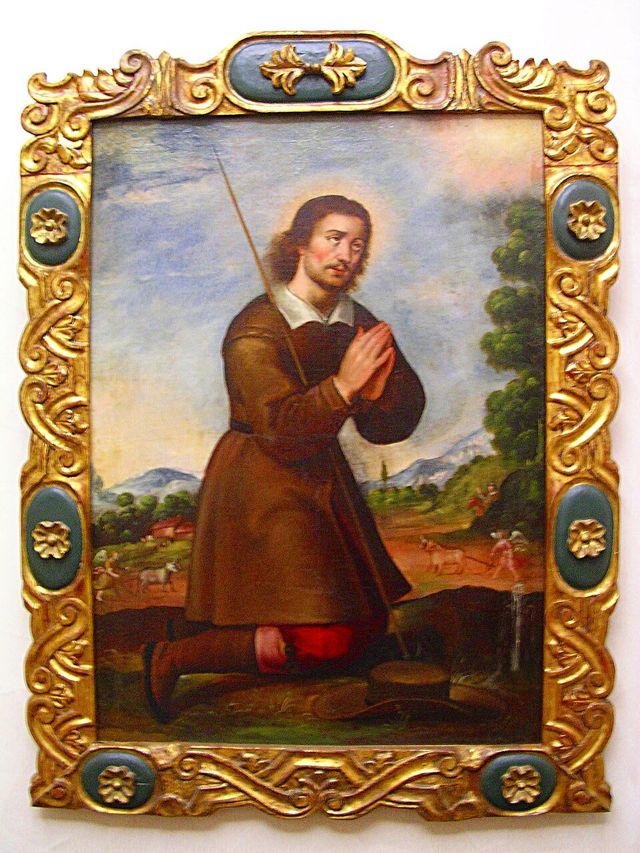
He went to Mass each morning before work. Stories told later say angels were seen ploughing beside him so his work did not suffer, and that he shared even scraps of food with birds in winter. He died around 1130. He was canonized (officially declared a saint by the pope) in 1622 in the same ceremony as Ignatius, Francis Xavier, Teresa of Ávila and Philip Neri.

Why they’re the patron of…

  • Farmers and Madrid ·
    He was a farmworker, and Madrid's patron saint.

Early life

The book says little or nothing about early life. This is how the account begins.

Thin entry · the 1897 book gives only 0 words. We have not filled the gap with invented detail.

What they represent

How they teach us to live

Drawn from themes in the original account

Learn from the kind of life it was. Witnessing to Christ by the way of life, not by death.

Keep their day. Remember them on May 10 with a short prayer, and ask for their help.

From the Catholic Encyclopedia

1913 · 480 words

A Spanish daylabourer; b. near Madrid, about the year 1070; d. 15 May, 1130, at the same place. He was in the service of a certain Juan de Vargas on a farm in the vicinity of Madrid. Every morning before going to work he was accustomed to hear a Mass at one of the churches in Madrid. One day his fellow-labourers complained to their master that Isidore was always late for work in the morning. Upon investigation, so runs the legend, the master found Isidore at prayer, while an angel was doing the ploughing for him. On another occasion his master saw an angel ploughing on either side of him, so that Isidore's work was equal to that of three of his fellow-labourers. Isidore is also said to have brought back to life the deceased daughter of his master and to have caused a fountain of fresh water to burst from the dry earth in order to quench the thirst of his master. He was married to Maria Torribia, a canonized saint, who is venerated in Spain as Maria della Cabeza, from the fact that her head (Spanish, cabeza) is often carried in procession especially in time of drought. They had one son, who died in his youth. On one occasion this son fell into a deep well and at the prayers of his parents the water of the well is said to have risen miraculously to the level of the ground, bringing the child with it, alive and well. Hereupon the parents made a vow of continence and lived in separate houses. Forty years after Isidore's death, his body was transferred from the cemetery to the church of St. Andrew. He is said to have appeared to Alfonso of Castile, and to have shown him the hidden path by which he surprised the Moors [the Muslims of North Africa and Spain] and gained the victory of Las Nevas de Tolosa, in 1212. When King Philip III of Spain was cured of a deadly disease by touching the relics [the bodily remains of a saint, or objects they used, kept with honor] of the saint, the king replaced the old reliquary by a costly silver one. He was canonized by Gregory XV, along with Sts. Ignatius, Francis Xavier, Teresa, and Philip Neri, on 12 March, 1622. St. Isidore is widely venerated as the patron of peasants and day-labourers. The cities of Madrid, Leon, Saragossa, and Seville also, honour him as their patron. His feast is celebrated on 15 May.

His Life, as first written in 1265 by John, a deacon of the church of St. Andrew, at Madrid, and supplemented by him in 1275, is printed in Acta S.S., May, III, 515-23. It served as the basis for LOPE DE VEGA's religious poem San Isidro (1599). Acta SS., loc. cit., 512-559; BUTLER, Lives of the Saints, 10 May; BARING-GOUID, Lives of the saints, 10 May; TAMAYO Martyrologium Hispanicum, III (Lyons, 1655), 191-98; QUARTINO, Vita di, S. Isidoro agricola (Turin, 1882).
Read more

The full original · 0 words

Read Baring-Gould’s full account

Baring-Gould’s sources: Canonized by Pope Gregory XV. in 1622. Roman and Spanish Mar tyrologies. The Bollandists on May 15. Authority: — His life written in the year 1261, an amplification and continuation of an earlier life. This life was again added to in 1275. The additions are miracles wrought at the tomb or by the intercession of the saint.] The traveller, visiting Madrid on May 15th, would find the city keeping high festival. Church bells ringing, the streets lined with tapestries and coloured curtains, banners streaming, and a procession winding through the streets Normans in 886, and left no successor. Bernard left a son Bernard, the murderer of Solangia, who was Count of Poitiers, and also of Auvergne, after the death of his brother Stephen. He was killed id 886 in a battle against Boso, King of Arles., May io.3 S. Isidore. 147 with military band, and cross and lights and song of clergy. Why this joyous festival? the traveller would ask; and he would be told that the capital was observing the feast of its patron. And who is the patron of this royal city, the capital of great Spain ? A king, a prelate, a doctor ? No ! only a poor ploughman. God 44 taketh up the simple out of the dust: and lifteth the poor out of the mire; that he may set him with the princes: even with the princes of his The story of this good man is short and very simple. It is merely that of a devout peasant serving God faithfully in that condition of life to which God had called him. The Church, to show models to all in every condition of life, has enrolled in her sacred calendar the servant girl Veronica of Milan, the shepherd Wendelin, the beggar Cuthman, and the ploughman Isidore, as well as saintly kings, wise prelates, learned doctors and valiant martyrs. Isidore was a day-labourer in the employment of a gentleman of Madrid, engaged on his farm outside the town. He was a hard-working faithful servant, yet he did not escape the voice of slander, and he was accused to his master of coming late to his work in the mornings on account of his going early into Madrid to attend Mass in one of the churches. His master sent for him and charged him with it. 44 Sir,” said the simple ploughman, 44 it may be true that I am later at my work than some of the other labourers, but I do my utmost to make up for the few minutes snatched for prayer; I pray you compare my work with theirs, and if you find I have defrauded you in the least, gladly will I make amends by paying you out of my private store.” The gentleman was ashamed and said nothing; nevertheless he was not satisfied, and one morning he rose before daybreak to watch for himself and see if Isidore was really late at his work. He hid himself beside the farm, and saw the steady peasant go to church as the first pale streaks of light appeared in the east, and he returned to his work certainly after the other workmen had gone to theirs. The master saw him enter the field and take the plough, and he left his retreat that he might rate him soundly. But suddenly he stood still. In the field was a second plough, drawn by white oxen, urged on by an angel. He saw it in the slant rays of the rising sun through the thin vapours rising from the dewy soil. Up the field and then down again went the strange team, cutting a clean furrow and cutting it rapidly. Then the gentleman ran towards the field * but as he opened the gate the vision disappeared, and he saw Isidore bowed upon his plough, and his little son running by the head of the red oxen. Then he went to him and asked him who were his assistants. u Sir ! ” said Isidore in surprise, “ I work alone and know of none save God to whom I look for strength. v Now this Isidore was a man of a very kind heart, and he never omitted doing an act of kindness when the opportunity offered; and though he was poor, and could not give much to the needy, what he did give was given ■ without grudging and with so much sympathy and readiness, that to the recipient it was worth more than the gift of many a rich man. One pretty instance of this charity is told, to show that it extended to the dumb creation as well as to men. One morning when the snow was sparkling on the ground and the trees and hedges were covered with hoar frost, he set out to the mill with a sack of corn, his wife’s gleanings, that he wished to have ground. Presently he passed a tree on which a number of woodpigeons were sitting, whilst others fluttered over the glistening surface of the snow vainly searching for food. “ Stop,” called Isidore to his boy, who was leading the ass that S. ISIDORE. Alter Cahier.

Feast days

Feast: May 15
Traditional: May 10

Nine days · Free

Pray the novena
with us.

One short email a day for nine days. The day's prayer, a line from St. Isidore's story, and a nudge to keep going.

Also on May 10
C

Sts. Calepodius and…

May 10 · Priest, Martyr, Martyrs
Sts. Gordian and Epimachus

Sts. Gordian and…

May 10 · Martyrs
C

St. Comgall

May 10 · Abbot
← All 1726 saints in the library
Sources & notes

Feast-day sources

Story sources

Sources

Credits

Image: Saint Isidor Farmer (18th cen, anon).jpg · Unknown · CC BY 2.0, via Wikimedia Commons

From Sabine Baring-Gould, The Lives of the Saints, new edition in 16 vols. (London: John C. Nimmo, 1897–98); text from the Internet Archive scan (OCR, lightly cleaned; errors possible). Public domain.

Image: Unknown, Wikimedia Commons (CC BY 2.0)

From “Catholic Encyclopedia (1913)/St. Isidore the Labourer,” The Catholic Encyclopedia (New York: Robert Appleton Company, 1907–1914), via Wikisource. Public domain. Matched by name and feast date; text unedited except for our bracketed notes in grey.

From Sabine Baring-Gould, The Lives of the Saints, new edition in 16 vols. (London: John C. Nimmo, 1897–98); text from the Internet Archive scan (OCR, lightly cleaned; errors possible). Public domain in the United States. Reproduced unedited, except for short bracketed notes in grey that we added to explain names and terms (“S.” is the old abbreviation for Saint). Some history and judgments reflect 19th-century scholarship.