St. James de La Marca

James was born in 1391 to a poor family at Monteprandone in the March of Ancona.

Read the essentials →
November 28 · Martyr

St. James de La Marca

St. James de La Marca

James was born in 1391 to a poor family at Monteprandone in the March of Ancona.

Traditional feast

November 28
1914 / pre-1969 calendar, per Baring-Gould (1897)

Current feast

November 28
Secondary source · Wikipedia

Represents

Martyr

Their story

Adapted in modern English from the Catholic Encyclopedia (1913) · original text below

James was born in 1391 to a poor family at Monteprandone in the March of Ancona. He took a doctorate in civil law at Perugia. On 26 July 1416 he joined the Friars Minor ('lesser brothers', the Franciscans' official name) at the Portiuncula and studied theology under St. Bernardine of Siena. He was ordained priest on 13 June 1420.

For half a century he preached across Italy and as legate in Germany, Austria, Scandinavia, Bohemia, Poland, Hungary and Bosnia. He refused the bishopric of Milan. He suffered from envy within his own order. In 1462 a sermon about the Precious Blood brought him before the inquisitor, and the case went to Rome without a decision.

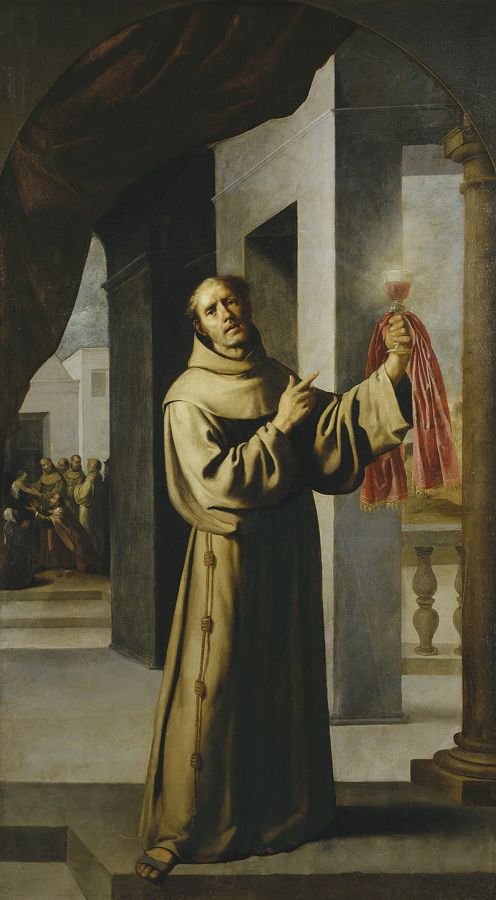
He spent his last three years at Naples and died there on 28 November 1476. He was canonized (officially declared a saint by the pope) in 1726. He is shown with a chalice from which a snake escapes, said to recall attempts to poison him.

Early life

The book says little or nothing about early life. This is how the account begins.

He accompanied S. John Capistran in some of the inquisitorial missions of that saint in Germany, Bohemia, and Hungary; and the two holy men were well matched in their zeal for the advance of the reform of their Order, instituted by S. Bernardin of Siena, their hatred of heresy, and indifference to human suffering. The enthusiasm and relentless severity with which James de la Marca proceeded against the heretics drove them to desperation. The Fraticelli, an offshoot of his own Order, which had fallen into error, incurred his liveliest hostility.

What they represent

How they teach us to live

Drawn from themes in the original account

Share your faith, in words and by example. Preaching and conversion are central here.

Keep their day. Remember them on November 28 with a short prayer, and ask for their help.

From the Catholic Encyclopedia

1913 · 894 words

Franciscan, b. of a poor family named Gangala, at Monteprandone, March of Ancona, Italy, 1391; d. at Naples, 28 Nov., 1476. He is generally represented holding in his right hand a chalice, out of which a snake is escaping —an allusion to some endeavours of heretics to poison him or, less likely, to the controversy about the Precious Blood. He began his studies at Offida under the guidance of his uncle, a priest, who soon afterwards put him to school at Ascoli. At the University of Perugia he took the degree of Doctor in Civil Law. After a short stay at Florence as tutor in a noble family, and as judge of sorcerers, James was received into the Order of the Friars Minor, in the chapel of the Portiuncula, Assisi, 26 July, 1416. Having finished his novitiate at the hermitage of the Carceri, near Assisi, he studied theology at Fiesole, near Florence, under St. Bernardine of Siena. On 13 June, 1420, be was ordained priest, and soon began to preach in Tuscany, in the Marches, and Umbria; for half a century he carried on his spiritual labours, remarkable for the miracles he performed and the numerous conversions he wrought. From 1427 James preached penance, combated heretic, and was on legations in Germany, Austria, Sweden, Denmark, Bohemia, Poland, Hungary, and Bosnia. In the last-mentioned country he was also commissary of the Friars Minor. At the time of the Council of Basle he promoted the union of the moderate Hussites with the Church, and that of the Greeks it the Council of Ferrara-Florence. Against the Turk, he preached several crusades, and at the death of St. John Capistran, in 1456, James was sent to Hungary as his successor. In Italy he fought the Fraticelli, instituted several , and preached in all the greater cities; Milan offered him the bishopric in 1460, which he declined. St. James belonged to the Observant branch of the Friars Minor, then rapidly spreading and exciting much envy. How much he suffered on this account is shown in a letter written by him to St. John Capistran, published by Nic. Dal-Gal, O.F.M., in "Archivum Franciscanum Historicum", I (1908), 94-97. Under Callistus III, in 1455, he was appointed an arbiter on the questions at issue between Conventuals and Observants. His decision was published 2 Feb., 1456, in a papal Bull, which pleased neither part . A few years later, on Easter Monday, 1462, St. James, preaching at Brescia, uttered the opinion of some theologians, that the Precious Blood shed during the Passion was not united with the Divinity of Christ during the three days of His burial. The Dominican James of Brescia, inquisitor, immediately cited him to his tribunal. James refused to appear, and after some troubles appealed to the Holy See. The question was discussed at Rome, Christmas, 1462 (not 1463, as some have it), before Pius II and the cardinals, but no decision was given. James spent the last three years of his life at Naples, and was buried there in the Franciscan church of S. Maria la Nuova, where his body is still to be seen. Beatified by Urban VIII, 1624, he was canonized by Benedict XIII, 1726. Naples venerates him as one of its patron saints (feast, 28 Nov.).

The works of St. James of the Marches have not as yet been collected. His library and autographs are preserved in part at the Municipio of Monteprandone (see Crivellucci, "I codici della libreria raccolta da S. Giacomo della Marca nel convento di S. Maria delle Grazie presso Monteprandone", Leghorn, 1889). He wrote "Dialogus contra Fraticellos" printed in Baluze-Mansi, "Miscellanea", II, Lucca, 1761, 595-610 (cf. Ehrle in "Archiv für Litt. u. Kirchengeschichte", IV, Freiburg im Br., 1888, 107-10). His numerous sermons are not edited. For some of them, and for his treatise on the "Miracles of the Name of Jesus", see Candido Mariotti, O.F.M., "Nome di Gesù ed i Francescani", Fano, 1909, 125-34. On his notebook, or "Itinerarium", See Luigi Tasso, O.F.M., in "Miscellanea Francescana", I (1886), 125-26: "Regula confitendi peccata" was several times edited in Latin and Italian during the fifteenth century. "De Sanguine Christi effuse" and some other treatises remained in manuscript.

PETRUCCI, Vita et res gesitæ B. Jacobi Piceni, edited by WADDING (Lyons, 1641). Other original information is found in B. Bernardini Aquilani Chronica Fratrum Minorum Observuntiæ, ed. LEMMENS (Rome, 1902), 66 sqq.; GLASSBERGER in Analecta Franciscana, II (Quaracchi, 1887), 393-96. Much material and papal documents are given in WADDING, Annales, 2nd ed., IX-XVI (Rome, 1724-36), See also WADDING , Scepters (Rome 1806), 126; SBARALEA, Supplementum ad Scriptores (Rome 1806), 375 ARTUR, Martyrologium Franciscanum, 2nd ed (Paris 1653), 578-80. Lives: LÉON (de Clary), Lives of the Saints and Blessed of the three orders of St. Francis, IV (Taunton 1887), 125 -51; JOS. Ma. d'Evora , Compendio della vita di S, Giacomo della Marca (Rome, 1726); GASPARE DA MONTE SANTO, Gesta dell' apostolico San Giacomo della Marca Anconitana (Ascoli,1804); GIUSEPPE ARCANGELO Di FRATTA MAGGIORE, Vita dell' apostolico eroe S. Giacomo della Marca, 2nd ed. (Naples, 1851); CELSO MARIA Di FFLTRE, Compendia Storico delta vita di S. Giacomo della Marca (Venice, 1876): CIACINTO NICOLAI, Vita Storica di San Giacomo della Marca (Bologna, 1876); LÉON, Vita de St-Jacques de la Marche, Franciscain de l'Observance (1391-1476) (Paris, 1894); GAETANO ROCCO DA NAPOLI, Compendio delta Vita di San Giacomo della Marca (Naples, 1909).
Read more

The full original · 299 words

Read Baring-Gould’s full account

Baring-Gould’s sources: Roman and Franciscan Martyrologies. Beatified by Urban VIII., canonized by Benedict XIII. in 1726. Authorities A Life by Mark de Lisboa, B. of Porto.] S. James was born at Montebrandone in the Marches of Ancona, of poor parents. He was sent to Perugia to be educated, and he was there appointed tutor to a Florentine young man of rank. He joined the Franciscan Order in the Portiuncula at Assisi. For forty years he never passed a day without lashing his back with a knotted scourge; he wore a hair shirt, which was, no doubt, conducive to his health, which otherwise might have suffered from want of ablutions. Sometimes he varied his mortifications by putting on a mail coat set with spikes, in place of the hair shirt. He never touched meat, and slept only three hours. Had his mind been active, more sleep would indubitably have been necessary, but as his brain was apparently little exercised, a very slight amount of repose refreshed it after its slight labours. He was so scrupulous in the matter of obedience, that having once received an order to go on a certain mission, when he had raised a cup to his mouth full of water, for the purpose of drinking, he started on his errand without tasting the water.

He accompanied S. John Capistran in some of the inquisitorial missions of that saint in Germany, Bohemia, and Hungary; and the two holy men were well matched in their zeal for the advance of the reform of their Order, instituted by S. Bernardin of Siena, their hatred of heresy, and indifference to human suffering.

The enthusiasm and relentless severity with which James de la Marca proceeded against the heretics drove them to desperation.

The Fraticelli, an offshoot of his own Order, which had fallen into error, incurred his liveliest hostility. Many, trembling for their lives, made an enforced and dissembled submission. His conduct even excited the indignation of Catholic bishops and clergy, and they preached against him, and his manner of dealing with the refractory sheep of the fold of Christ, which they thought resembled rather that of the wolf than of the shepherd. He was even denounced to the Pope as tainted with heresy himself, but as he was arguing his case before the Inquisition, an image of the Blessed Virgin was seen to nod its head at him, and either the miracle, or the conviction that he was too useful a servant to be lost, moved the Inquisition to acquit him.

He died of colic, at the age of ninety, in Naples. His body was buried in the church of S. Maria Nuova, but was dug up and exposed to the veneration of the faithful by permission of Pope Sixtus IV. He is regarded as one of the patrons of the city of Naples. In 1631, when Vesuvius was in eruption, some imaginative persons believed they saw him thrusting back the flames into the crater and arresting the streams of lava. His association with pyres in which heretics were burnt may have suggested this apparition. vS\ Saturnisms.

Feast days

Feast: November 28

Nine days · Free

Pray the novena
with us.

One short email a day for nine days. The day's prayer, a line from St. James de La Marca's story, and a nudge to keep going.

Also on November 28
S

St. Sosthenes

November 28 · Confessor
St. Secundinus in Meath

St. Secundinus in Meath

November 28 · Bishop
St. Gregory III., Pope

St. Gregory III.

November 28 · Feast
← All 1726 saints in the library
Sources & notes

Feast-day sources

Story sources

Sources

Credits

Image: Francisco de Zurbaran James of the Marches.JPG · Francisco de Zurbarán · Public domain, via Wikimedia Commons

From Sabine Baring-Gould, The Lives of the Saints, new edition in 16 vols. (London: John C. Nimmo, 1897–98); text from the Internet Archive scan (OCR, lightly cleaned; errors possible). Public domain.

Image: Francisco de Zurbarán, Wikimedia Commons (Public domain)

From “Catholic Encyclopedia (1913)/St. James of the Marches,” The Catholic Encyclopedia (New York: Robert Appleton Company, 1907–1914), via Wikisource. Public domain. Matched by name and feast date; text unedited except for our bracketed notes in grey.

From Sabine Baring-Gould, The Lives of the Saints, new edition in 16 vols. (London: John C. Nimmo, 1897–98); text from the Internet Archive scan (OCR, lightly cleaned; errors possible). Public domain in the United States. Reproduced unedited, except for short bracketed notes in grey that we added to explain names and terms (“S.” is the old abbreviation for Saint). Some history and judgments reflect 19th-century scholarship.