Baring-Gould’s sources: By the Greeks on April 30th, as also by the Russians, Copts, Maronites, Abyssinians. But in the ancient Carthaginian Calendar on May 27th. The little Roman Martyrology on July 25th, and so all Latin Martyrologies. Roman Martyrology, Ado, Usuardus, &c. Reformed Anglican, &c.] |F the early life of this apostle we know nothing. He was the son of Zebedee, and the brother of S. John the Divine. In the spring or summer of the year 27, Zebedee, a fisherman, 1 was out on the Sea of Galilee fishing, with his two sons, James and John, and some boatmen. Their partners, Simon and Andrew, were in another fishing-boat near. After a night spent in dragging the water with their nets, no doubt with torches set up in the boat to allure the fish to the light, they came towards shore, and began to gather up and wash their nets. Then Jesus appeared on the beach, and bade them, “ Come, and I will make yon fishers of men.” Then straightway James and John left their father S, JAMES THE GREAT.
From the Vienna Missal. July *J0 6 ". James the Great. Zebedee in the boat with the * hired servants and followed Him. With this call was connected the first miracle of the miraculous draught of fishes. Neither S. Matthew nor S. Mark mention this, when narrating the call of the sons of Zebedee, but it is related by S. Luke. 1 “ And it came to pass, that, as the people pressed upon him to hear the word of God, he stood by the lake of Gennesaret, and saw two ships standing by the lake; but the fishermen were gone out of them, and were washing their nets. And he entered into one of the ships, which was Simon’s, and prayed him that he would thrust out a little from the land. And he sat down, and taught the people out of the ship. Now when he had left speaking, he said unto Simon, Launch out into the deep, and let down your nets for a draught. And Simon answering said unto Jiim, Master, we have toiled all the night, and have taken nothing; nevertheless at thy word I will let down the net. And when they had this done, they inclosed a great multi tude of fishes: and their net brake. And they beckoned unto their partners, which were in the other ship, that they should come and help them. And they came, and filled both the ships, so that they began to sink. When Simon Peter saw it, he feel down at Jesus’ knees, saying, Depart from me; for I am a sinful man, O Lord. For he was astonished, and all that were with him, at the draught of the fishes which they had taken: and so was also James, and John, the sons of Zebedee, which were partners with Simon. And Jesus said unto Simon, Fear not; from henceforth thou shalt catch men. And when they had brought their ships to land, they forsook all, and followed him.” fjuljr 3$.
For a full year we lose sight of S. James. When next we hear of him it is in the spring of a.d. 28, when he is called to the apostleship with the eleven others. In the list of the Apostles given us by S. Mark, and in the book of Acts, his name occurs next to that of Simon Peter; in the Gospels of S. Matthew and S. Luke it comes third. It is worthy of notice that with one exception, 1 the name of S. James is put before that of S. John, and that S. John is twice described as " the brother of James. ” 2 This would appear to imply that S. James was the older of the two brothers. It would seem to be about the same time that the name Boanerges was given to the sons of Zebedee. The " Sons of Thunder ” had a burning and impetuous spirit, which twice exhibits itself in its unchastened form. Once, when a village of the Samaritans would not receive our Lord, SS. James and John exclaimed, u Lord,.wilt thou that we command fire to come down from heaven, and consume them, even as Elias did ?” But Jesus turned and rebuked them, saying, "Ye know not what manner of spirit ye are of; for the Son of Man is not come to destroy men’s lives, but to save them.” And they went to another village. 3 On another occasion u James and John, the sons of Zebedee, come unto him, saying, Master, we would that thou shouldest do for us whatsoever we shall desire. And he said unto them, What would ye that I should do for you ? They said unto him, Grant unto us that we may sit, one on thy right hand, and the other on thy left hand, in thy glory. But Jesus said unto them, Ye know not what ye ask: can ye drink of the cup that I drink of? and be baptised with the baptism that S. James the Great I am baptized with ? And they said unto him, We can. And Jesus said unto them, Ye shall indeed drink of the cup that I drink of; and with the baptism that I am baptised withal shall ye be baptised; but to sit on my right hand and on my left hand is not mine to give; but it shall be given to them for whom it is prepared. And when the ten heard it, they began to be much displeased with James and John. But Jesus called them to him, and saith unto them, Ye know that they which are accounted to rule over the Gentiles exercise lordship over them; and their great ones exercise authority upon them. But so shall it not be among you; but whosoever will be great among you, shall be your minister: and whosoever of you will be chiefest, shall be servant of all. For even the Son of man came not to be ministered unto, but to minister, and to give his life a ransom for many.” 1 According to the account given by S. Matthew, Salome, the mother of SS. James and John urged this ' request as well. 2 When our Blessed Lord retired to the mountain, in the spring of a.d. 2 9, He took with him S. James as well as S. Peter and S. John, and these three apostles witnessed His transfiguration. 3 S. James was also one of those privileged to be admitted to the room where Our Lord raised the daughter of Jairus to life. 4 On the night of the Crucifixion he was present in the Garden when our Lord was taken. 5 On the day of the Ascension he is mentioned as persevering with the rest of the Apostles and disciples in prayer. 6 In the year 44, Herod Agrippa I., son of Aristobulus, was ruler over the dominions which, at the death of his grandfather, Herod the Great, had been divided between Archelaus, Antipas, Philip, and Lysanias. Policy and inclination would alike lead such a monarch to “ lay hands on certain of the Church,” 1 and accordingly when the Passover of the year a.d. 44 had brought S. James and S. Peter to Jerusalem, he seized them both, probably as being the oldest, and those who were of most authority in the growing Church. Shortly before the day of Passover, Herod put him to death 41 with the sword.”
S. Clement, in his Institutions, relates an incident of his death, which Eusebius [Eusebius of Caesarea (d. c. 339), the first historian of the Church] has adopted into his Ecclesiastical History. 3 He says that the man who had brought S. James to judgment was so moved by his constancy, that he also confessed his faith in Christ, and was condemned to death. As both were on their way to execution, the new convert asked S. James to pardon him the evil he had brought upon him. The apostle paused, said 11 Peace to thee,” and kissed him. Both were executed together. The PseudoAbdias relates many apocryphal details of the martyrdom.
The Spanish historians and martyrologists pretend that between the Ascension and the death of S. James, that apostle travelled to Spain, and there preached. 3 There is not a shadow of evidence to support the assertion. They say also that after his death, Hermogenes and Philetus, his disciples, put his body in a boat, spread sail, and feel asleep. Next morning the ship 8 The earliest mention of his having preached in Spain is by S. Isidore of Seville, in the 9th cent.; but he makes a mistake, for he calls him the author of the Catholic Epistle. His words are: “Jacobus films Zebedaei, frater Joannis, quartus in ordine duodecim tribubus, quae sunt in dispersione gentium, scripsit, atque Hispaniae et Occidentalium locorum gentibus evangelium praedicavit.” July S. James the Great.
was off the coast of Spain. 1 And so the body of S. James the Great found its way to that country, and was finally lodged at Compostella. The story does not deserve serious discussion. At Saragossa is shown an image of the Blessed Virgin, which S. James is said to have set up there, when he made his apostolic tour in Spain !
But it is not only at Compostella that the body of S. James the Great reposes, along with the relics [the bodily remains of a saint, or objects they used, kept with honor] of S. James the Less; his body is, or was, also shown at Toulouse, along with that of S. James the - son of Alphseus, brought there by S. Heliodorus, bishop of Altino, from Jerusalem, in the 4th cent. On the other hand, there was an u invention ” of the body of S. James, in 1395, on Monte Grigiano in Italy, and the church containing it was indulgenced by pope Boniface IX. But another body of S. James the Great was translated — or is said to have been translated — to Italy in the 4th cent. It reposes in the church of Zibili, near Milan. It is entire, except that it has lost one arm. The heads of S. James are very numerous. One at Toulouse, two at Venice, one in the church of S. George, the other in the monastery of SS. Philip and James. Another skull in the church of the Apostles at Rome, where also is shown a vessel full of his blood, still red and liquid. Again, another skull at Valentia, on the Po, covered with flesh and skin, and with the hair still on the head. Another head at Amalfi; but according to some it is that of S. James the Less. Another head at S. Vast in Artois. A part of one of these, or of another head, at Pistoja. The authenticity of this having been attested by miracles, 1 The Spaniards are unhappy in their choice. S. Paul mentions Hermogenes and Philetus in his Epistle to Timothy, i. as deserting him. pope Eu genius III. gave indulgence to all visiting and performing devotions at the altar when the relics were enshrined.
An arm at Troyes in France, brought from Constantinople in 1209; another arm at Monte-regale in Sicily; a finger at Messina; on the island of Capri another arm; an arm again at Pavia — the right arm; in S. Paolo fuori Muri at Rome another arm; armbones at Andechs in Bavaria; another right arm at Torcelli. At Liege an arm brought from Compostella, where, however, the skeleton is shown entire; a jaw in the church of S. Panthaleon at Cologne. Roger Hoveden says that in 1116, Mathilda, widow of the emperor Henry II., sent a hand of S. James to her father, king Henry of England, who gave it to the abbey of Redding. But whether this was the hand of S. James the Great or S. James the Less he does not specify. The staff of S. James the Great is shown and venerated at Compostella.
Some bones of S. James the Great are in theEscurial. An arm-bone in the church of S. Loup at S. Martin [St. Martin of Tours (d. 397), soldier turned bishop]-esAires; a bone in the cathedral of Nevers 5 another arm-bone in the Christ-aux-Reliques at Nolay. The relics at Toulouse are two portions of the skull, a jaw with teeth, part of a foot, and other bones. At Saragossa is the famous Notre Dame d’el Pilar, an image of the Blessed Virgin on a pillar. She is said to have appeared thus to S. James in Spain, long before her death, to encourage him in his mission work. A hundred lamps are always burning on this celebrated spot.
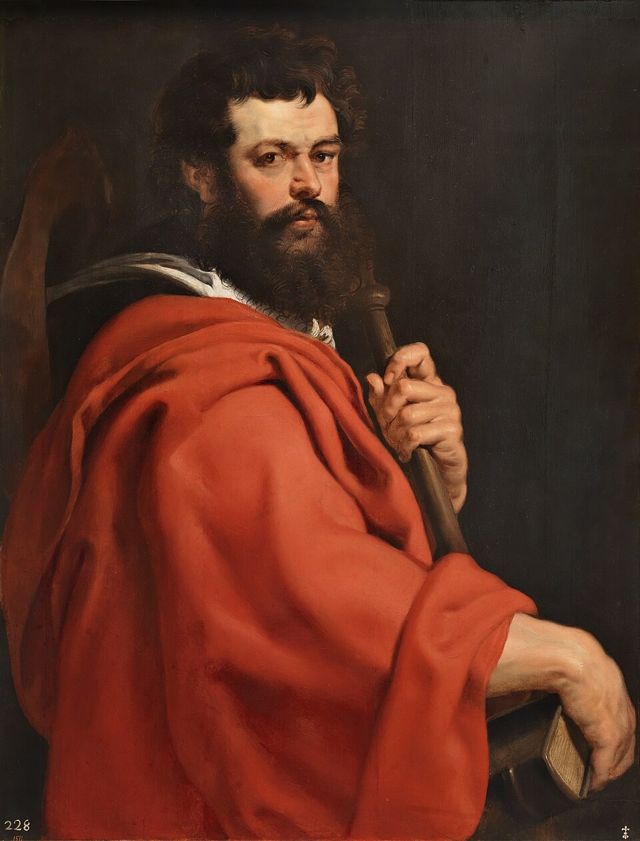
S. James the Great is represented in Art with the sword. Previous to the twelfth century, in artistic represenS. Christopher.
tations S. James is only distinguished among the Apostles by his place, which is the fourth in the series, the second after SS. Peter and Paul, S. Andrew being the third in order. From the thirteenth century he always bears in one hand the Holy Gospels, and in the other a long pilgrim’s staff, sometimes with a gourd or a scrip attached to it; as the first of the Apostles who departed to fulfil his mission of evangelization. Frequently he wears the flapped hat and cloak of a pilgrim, adorned with escallop-shells, in allusion to the pilgrimages made to his shrine at Compostella. He is usually portrayed with a family likeness to our Lord, his kinsman (though not so strong as that borne by S. James the Less), with brown hair parted in the middle and flowing down each side, and with a thin beard. In the Greek paintings he has a pointed beard, and, what is curious, is represented as a young man, while in the West he always appears somewhat advanced in years. S. James in Spanish is S. Jago; in French, S. Jacques; in Latin, Jacobus.