St. James the Less

The Apostle James, son of Alphaeus, is most probably the same person as James 'the brother of the Lord' and Bishop of Jerusalem.

Read the essentials →
May 1 · Apostle

St. James the Less

St. James the Less

The Apostle James, son of Alphaeus, is most probably the same person as James 'the brother of the Lord' and Bishop of Jerusalem.

Traditional feast

May 1
1914 / pre-1969 calendar, per Baring-Gould (1897)

Current feast

Not verified yet

Represents

Apostle

Their story

Adapted in modern English from the Catholic Encyclopedia (1913) · original text below

The Apostle James, son of Alphaeus, is most probably the same person as James 'the brother of the Lord' and Bishop of Jerusalem. The Catholic Encyclopedia notes that this identification has been contested and is perhaps not beyond doubt, but most Catholic interpreters hold it as certain. 'Brother of the Lord' here means a close kinsman.

He was likely raised, with his brother Jude, in a devout Jewish home, grounded in Scripture and strict observance of the Law. Three years after his conversion, St Paul went up to Jerusalem and met only two of the Twelve, Peter and James. In 44, when Peter escaped from prison, he asked that word be sent to James, who already held a leading place in the Jerusalem church.

At the Council of Jerusalem (the apostles' meeting in Acts 15 that freed Gentile converts from the law of Moses) in 51 he spoke after Peter, agreeing that Gentile converts were not bound to circumcision or the ceremonial Mosaic Law. Early writers, among them Josephus and Hegesippus, agree that James was Bishop of Jerusalem.

Early life

Selected sentences from the original account, unaltered.

Of the birth-place of S. James the sacred story makes no mention. On the day appointed, being advantageously placed upon a pinnacle or wing of the Temple, the Scribes thus addressed him: “Tell us, O Justus I whom we have all the reason in the world to believe, that seeing the people are thus generally led away with the doctrine of Jesus that was crucified, tell us what is this institution of the crucified Jesus.” To which the apostle answered in an audible voice, “Why do ye inquire of Jesus, the Son of Man? He sits in heaven, on the right hand of the Majesty on High, and will come again in the clouds of heaven.” The people below hearing this, glorified the blessed Jesus, and shouted, “Hosanna to the Son of David !”

What they represent

How they teach us to live

Drawn from themes in the original account

Keep their day. Remember them on May 1 with a short prayer, and ask for their help.

From the Catholic Encyclopedia

1913 · 1193 words

The name "James" in the New Testament is borne by several:

The identity of the Apostle James (2), the son of Alpheus and James (3), the brother of the Lord and Bishop of the Church of Jerusalem (Acts 15, 21), although contested by many critics and, perhaps, not quite beyond doubt, is at least most highly probable, and by far the greater number of Catholic interpreters is considered as certain (see BRETHREN OF THE LORD, where the chief argument, taken from Galatians 1:19, in favour of the Apostleship of St. James, the brother of the Lord, is to be found). The objection moved by Mader (Biblische Zeitschrift, 1908, p. 393 sqq.) against the common statement that "Apostles" in Galatians 1:19 is to be taken strictly in the sense of the "Twelve" has been strongly impugned by Steinmann (Der Katholik, 1909, p. 207 sqq.). The James (5) of Jude 1:1 must certainly be identified with James (3), the brother of the Lord and the Bishop of Jerusalem. The identification of James (3), the brother of the Lord and James (4), the son of Mary, and probably of Cleophas or Clopas offers some difficulty. This identification requires the identity of Mary, the mother of James (Matthew 27:56; Mark 15:40), with Mary the wife of Cleophas (John 19:25), and, consequently, the identity of Alpheus (2) and Clopas (4). As Clopas and Alpheus are probably not two different transcriptions of the same Aramaic name Halpai (see CLEOPHAS), it must be admitted that two different names have been borne by one man. Indeed, there are several examples of the use of two names (a Hebrew and a Greek or Latin name) to designate the same person (Simon-Petrus; Saulus-Paulus), so that the identity of Alpheus and Cleophas is by no means improbable.

On the whole, although there is no full evidence for the identity of James (2), the son of Alpheus, and James (3), the brother of the Lord, and James (4), the son of Mary of Clopas, the view that one and the same person is described in the New Testament in these three different ways, is by far the most probable. There is, at any rate, very good ground (Galatians 1:19, 2:9, 2:12) for believing that the Apostle James, the son of Alpheus is the same person as James, the brother of the Lord, the well-known Bishop of Jerusalem of the Acts. As to the nature of the relationship which the name "brother of the Lord" is intended to express, see BRETHREN OF THE LORD.

Read the rest of the article

Had we not identified James, the son of Alpheus with the brother of the Lord, we should only know his name and his Apostleship. But the identity once admitted, we must consequently apply to him all the particulars supplied by the books of the New Testament. We may venture to assert that the training of James (and his brother Jude), had been that which prevailed in all pious Jewish homes and that it was therefore based on the knowledge of the Holy Scripture and the rigorous observance of the Law. Many facts point to the diffusion of the Greek language and culture throughout Judea and Galilee, as early as the first century B.C.; we may suppose that the Apostles, at least most of them, read and spoke Greek as well as Aramaic, from their childhood. James was called to the Apostolate with his brother Jude; in all the four lists of the Apostles, he stands at the head of the third group (Matthew 10:3; Mark 3:18; Luke 6:16; Acts 1:13). Of James individually we hear no more until after the Resurrection. St. Paul (I Corinthians 15:5-7) mentions that the Lord appeared to him before the Ascension.

Then we lose sight of James till St. Paul, three years after his conversion (A.D. 37), went up to Jerusalem. Of the Twelve Apostles he saw only Peter and James the brother of the Lord (Galatians 1:19; Acts 9:27). When in the year 44 Peter escaped from prison, he desired that news of his release might be carried to James who held already a marked preeminence in the Church of Jerusalem (Acts 12:17). In the Council of Jerusalem (A.D. 51) he gives his sentence after St. Peter, declaring as Peter had done, that the Gentile Christians are not bound to circumcision, nor to the observance of the ceremonial Mosaic Law, but at the same time, he urged the advisability of conforming to certain ceremonies and of respecting certain of the scruples of their Jewish fellow-Christians (Acts 15:13 sqq.). On the same occasion, the "pillars" of the Church, James, Peter, and John "gave to me (Paul) and Barnabas the right hands of fellowship; that we should go unto the Gentiles, and they unto the circumcision" (Galatians 2:9). He publicly commended the great charter of Gentile freedom from the Law, although he still continued the observance in his own life, no longer as a strict duty, but as an ancient, most venerable and national custom, trusting to "be saved by the grace of the Lord Jesus Christ" (Acts 15:11). When afterwards some came from James to Antioch and led Peter into dissimulation (Galatians 2:12), his name was used by them, though he had given them no such commandment to enforce their interpretation of the concordat which, on his proposal, had been adopted at the Council of Jerusalem. When St. Paul after his third missionary journey paid a visit to St. James (A.D. 58), the Bishop of Jerusalem and "the elders" "glorified the Lord" and advised the Apostle to take part in the ceremonies of a Nazarite vow, in order to show how false the charge was that he had spoken of the Law as no longer to be regarded. Paul consented to the advice of James and the elders (Acts 21:1 sqq.). The Epistle of St. James reveals a grave, meek, and calm mind, nourished with the Scriptures of the Old Testament, given to prayer, devoted to the poor, resigned in persecution, the type of a just and apostolic man.

Traditions respecting James the Less are to be found in many extra-canonical documents, especially Josephus (Antiq., XX, ix, 1), the "Gospel according to the Hebrews" (St. Jerome, De vir. ill., II), Hegesippus (Eusebius [Eusebius of Caesarea (d. c. 339), the first historian of the Church], "Hist. eccl.", II, xxiii), the pseudo-Clementine Homilies (Ep. of Peter) and Recognitions (I, 72, 73), Clement of Alexandria (Hypot., vi, quoted by Eusebius, "Hist. eccl.", II, i). The universal testimony of Christian antiquity is entirely in accordance with the information derived from the canonical books as to the fact that James was Bishop of the Church of Jerusalem. Hegesippus, a Jewish Christian, who lived about the middle of the second century, relates (and his narrative is highly probable) that James was called the "Just", that he drank no wine nor strong drink, nor ate animal food, that no razor touched his head, that he did not anoint himself or make use of the bath, and lastly that he was put to death by the Jews. The account of his death given by Josephus is somewhat different. Later traditions deserve less attention.

For bibliography see EPISTLE OF SAINT JAMES; Protoevangelium Jacobi and Liturgy of St. James.

Read more

The full original · 1438 words

Read Baring-Gould’s full account

Baring-Gould’s sources: Roman Martyrology, Anglican Reformed Kalendar. By Copts on Feb. 4th, by Maronites on Oct. 9th. In the Egyptian Kalendars, published by Selden, on the 10th and 12th Feb. By the Russian Church on Oct. 9th, and on the same day by the Greeks. By the ancient Roman and almost all the old Latin Martyrologies on June 22nd. He is sometimes called “James the Lord's Brother," and sometimes “James the son of Alphseus.’' Some think that these were two distinct persons, and that the festivals are for each. S. James the Great was the son of Zebedee, and was a third person. Authorities: — Besides mention in the Gospels, Hegesippus quoted by Eusebius.] The parentage of S. James is so confused that it is impossible to decide with, anything approaching to certainty who was his father, and what was his relationship to our Blessed Lord. The term brother, applied to him by the Evangelists, is of wide significance, and it may mean that he was a son of Joseph by a former wife, or that he was a cousin, the son of Alphseus, who married the sister of the [May i.

Blessed Virgin Mary. The reader is referred to what has already been said on this topic in the article on Mary the wife of Cleopas (April 9th). Of the birth-place of S. James the sacred story makes no mention. In the Talmud he is more than once styled “a man of the town of Sechania.” No distinct account is given of him during our Saviour's ministry until after His Resurrection, when S. James was honoured with a special appearance of our Lord to him, which, though silently passed over by the Evangelists, is recorded by S. Paul — next to the manifesting Himself to the five hundred brethren at once, “He was seen of James.'7 Of this S. Jerome [translator of the Bible into Latin (d. 420)] (September 30th) gives a fuller relation out of the Hebrew Gospel of the Nazarenes (see Life of S. Matthew, September 21st), viz.: That S. James had solemnly sworn that from the time that he had drunk of the Cup at the Last Supper, he would eat bread no more till he saw the Lord risen from the dead. Our Lord, therefore, being returned from the grave, came and appeared to him, commanded bread to be set before him, which He took, blessed, and brake, and gave to S. James, saying, “ Eat thy bread, my brother, for the Son of Man is truly risen from among them that sleep.'7 After Christ's Ascension he was chosen bishop of Jerusalem, preferred before all the rest for his near relationship unto Christ • and this was afterwards the reason why Simeon was chosen to be his immediate successor in that see, because he was, after S. James, our Lord's next kinsman. This consideration made S. Peter and the two sons of Zebedee, though they had been peculiarly honoured by our Saviour, not contend for this high and honourable place, but freely choose James the Just to be its bishop. It was to S. James that S. Paul made his address after his conversion, and was by him honoured with the right hand of fellowship ■ to him S. Peter sent the news of his miraculous deliverance out of way i.] S. James the Less.

prison, “Go show these things unto James and to the brethren.” S. James presided at the Synod at Jerusalem in the great controversy about the Mosaic rites; and thereat passed the final and decretory sentence that the Gentile converts were not to be troubled with the bondage of the J ewish yoke. He exercised his office with all possible care and industry, omitting no part of a diligent and faithful guide of souls, strengthening the weak, informing the ignorant, reducing the erroneous, reproving the obstinate, and by the constancy of his preaching, conquering the stubbornness of that perverse and refractory generation with which he had to deal, many of the nobler and the better sort being brought over from Judaism to the Christian Faith. He was so careful, so successful in his charge, that it stirred up the malice of enemies to conspire his ruin. Not being able to affect this under the government of Festus, they more effectually attempted it before the assumption of the procuratorship by his successor, Albinus. Ananias the Younger, then high priest, and of the sect of the Sadducees, resolved to despatch him before the new governor could arrive. To this end a council was hastily summoned, and the apostle, with some others, arraigned and condemned as violators of the law. But that the thing might be carried on in a more plausible way, they set the Scribes and Pharisees at work to ensnare him; and they, coming to him, began by flattering insinuations to entrap him. They told him that they all had great confidence in him, and that the whole nation as well as themselves regarded him as a most just man, and one who was no respecter of persons; that, therefore, they desired he would correct the errors into which the people had fallen, who regarded Jesus as the Messiah, and they desired to take the opportunity of the congress to the Paschal solemnity, to have them set right in their notions about these things. For this purpose they undertook to place him on the top of the Temple, where he might be seen and heard by all. On the day appointed, being advantageously placed upon a pinnacle or wing of the Temple, the Scribes thus addressed him: “Tell us, O Justus I whom we have all the reason in the world to believe, that seeing the people are thus generally led away with the doctrine of Jesus that was crucified, tell us what is this institution of the crucified Jesus.” To which the apostle answered in an audible voice, “Why do ye inquire of Jesus, the Son of Man? He sits in heaven, on the right hand of the Majesty on High, and will come again in the clouds of heaven.” The people below hearing this, glorified the blessed Jesus, and shouted, “Hosanna to the Son of David !”

The Scribes and Pharisees perceiving now that they had overshot their mark, and that instead of reclaiming, they had confirmed the people in their reverence for Christ, saw that there was no way left but to despatch James at once, in order that by his sad fate others might be warned not to believe him. Whereupon, suddenly crying out that Justus himself was seduced and become an impostor, they threw him down from the place where he stood. Though bruised, he was not killed by the fall, but recovered sufficient strength to get upon his knees and pray for them. A Rechabite who stood by, who Epiphanius says was Simeon, the apostle's kinsman and successor, then stepped in and entreated the Jews to spare him, a just and righteous man, and who was then praying for them. But they cast a shower of stones upon S. James, till one, more mercifully cruel than the rest, beat out his brains with a fuller’s club. Thus died the holy apostle in the year of grace 62, in the ninety-sixth year of his age, and about twenty-four years after our Lord's Ascension, taken away, as we are told by Josephus, to the great grief and regret of all good men, yea^ May i.] S. James the Less.

of all sober and just persons, even among the Jews themselves. S. Gregory, of Tours, relates that S. James was buried upon Mount Olivet in a tomb which he had built for himself, and wherein he had buried Zacharias and S. Simeon.

The Catholic Epistle of S. James, his only authentic work, was probably written not long before his martyrdom, as appears by some passages in it relating to the near approaching ruin of the Jewish nation. Besides this Epistle there is a Gospel ascribed to him, called the Protevangelium, containing the early life of our Lord and of His Mother. This book is, however, certainly apocryphal. It can in no case have been written before the 2nd century, and in its actual form it belongs to a later century. It is full of blunders and inconsistencies.

S. James the Less is generally represented with a club of peculiar shape, called the fuller's bat, which was the instrument of his martyrdom. According to an early tradition he so nearly resembled our Lord in person, in features, and in deportment, that it was difficult to distinguish them, and a touching legend says that this exact resemblance rendered necessary the kiss of the traitor Judas in order to point out his Victim to the soldiers.

The body of S. James the Less was taken from Jerusalem, where it was buried, and carried to Constantinople. The head is now shown at Compostella, in Spain, brought from Jerusalem by the Bishop Didacus Gelmirez in the 13th century.

But the head is claimed as possessed also by the church of S. Marrie de Mare, at Camargo, in Provence. A jaw is preserved at Forli, in Italy; another portion of the head at Ancona; an arm at Gembloux, in Belgium. But the relics [the bodily remains of a saint, or objects they used, kept with honor] of S. James are said to have been found in 1395 on Monti Grigiano, near Verona. The body is preserved in the [May i.

church of SS. Philip and James at Rome, together with that of S. Philip, in the high altar, but the arm is separately enshrined, and is exhibited there on this day. The head and other relics, according to Saussaye, were at Toulouse, and at Langres was an arm of S. James. Three portions of the skull are in the church of S. Charles, at Antwerp.
Feast days

Feast: May 1

Nine days · Free

Pray the novena
with us.

One short email a day for nine days. The day's prayer, a line from St. James the Less's story, and a nudge to keep going.

Also on May 1
St. Philip

St. Philip

May 1 · Apostle, Martyr
St. Amator of Auxerre

St. Amator of Auxerre

May 1 · Bishop
O

St. Oriens of Auch

May 1 · Bishop
← All 1726 saints in the library
Sources & notes

Feast-day sources

Story sources

Sources

Credits

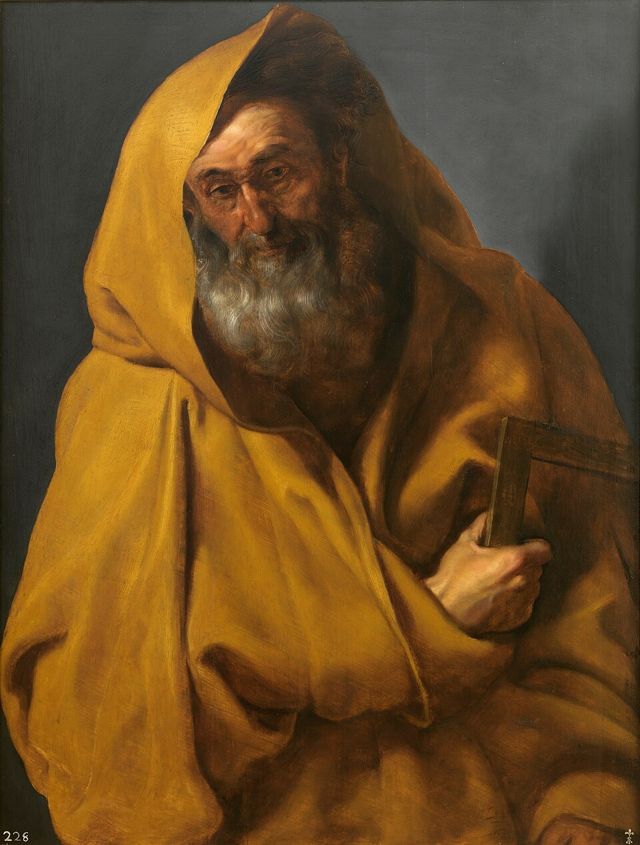
Image: Rubens apostel jakobus mindere grt.jpg · Peter Paul Rubens · Public domain, via Wikimedia Commons

From Sabine Baring-Gould, The Lives of the Saints, new edition in 16 vols. (London: John C. Nimmo, 1897–98); text from the Internet Archive scan (OCR, lightly cleaned; errors possible). Public domain.

Image: Peter Paul Rubens, Wikimedia Commons (Public domain)

From “Catholic Encyclopedia (1913)/St. James the Less,” The Catholic Encyclopedia (New York: Robert Appleton Company, 1907–1914), via Wikisource. Public domain. Matched by name and feast date; text unedited except for our bracketed notes in grey.

From Sabine Baring-Gould, The Lives of the Saints, new edition in 16 vols. (London: John C. Nimmo, 1897–98); text from the Internet Archive scan (OCR, lightly cleaned; errors possible). Public domain in the United States. Reproduced unedited, except for short bracketed notes in grey that we added to explain names and terms (“S.” is the old abbreviation for Saint). Some history and judgments reflect 19th-century scholarship.