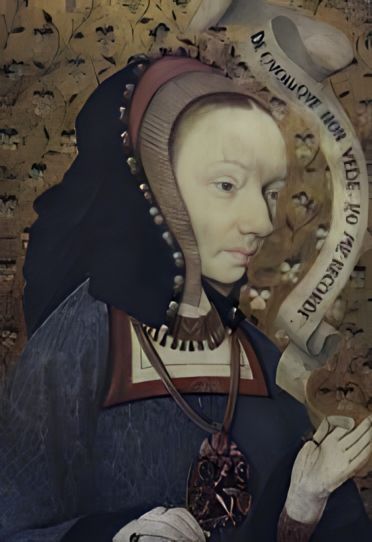
Baring-Gould’s sources: French Martyrology. The process of her canonization began under Clement XII., and was completed by Pius VI. in 1775; but she was venerated at Bourges from the time of her death.
Before Louis the son of Charles VII, ascended the throne of France, his wife, Charlotte of Savoy, bore him a daughter, called Anne of France. When he succeeded his father, with the title of Louis XI., he desired greatly to become the father of a son, and when his wife became pregnant in the third year after his coronation, his hopes were at the highest. When, however, she gave birth to a daughter, his disgust manifested itself in bitter antipathy towards the child, who was baptized Jeanne, or Joan. When she was eight days old, she was betrothed, May 19th, 1464, according to the custom of the time, to Louis, son of the Duke of Orleans and Mary of Cleaves, and sent to the house of her father and mother-in-law. At the expiration of four years, she was ordered to appear before her father at Plessis-le-Tours, where she was received by her mother with love, but when she was brought before her father, Louis turned from her with contempt, saying, "Bah! I did not think she was so ugly;" and he thrust her away. She was in fact somewhat deformed, and plain in face. It will be remembered that Sir Walter Scott has introduced her into his novel of Quentin Durward, taking, however, considerable liberties with her history. To such an extent did the spite of the king manifest itself, that when he saw how devout his daughter was, and that in her loneliness, she found comfort in the House of God, he forbade her frequenting churches and even the castle chapel.
When Joan was six years old, a son was born to Louis XI., and this was to her a day of good fortune, for her brother became her friend and protector; and because she was now once more permitted to frequent the churches. Louis XI. then visited Paris, to thank God for the birth of his son. Joan was in the splendid retinue which on this occasion entered the cathedral church of Notre Dame. She cast herself before an image of Our Lady, and taking her gold crown from her head, besought the holy Virgin to be her protector. Then a voice made itself heard in her soul, "My daughter, thou shalt found an Order in mine honour!"
The dislike of Louis XI. for Joan increased every day: the Countess of Linières was allowed to treat her with gross contempt; and the king, once so far forgot himself as to rush into her room sword in hand, and threaten to kill her. The Count of Linières threw himself between the king and his daughter, and saved her life, but could not prevent her receiving a wound, the scar of which never disappeared. The king retired in shame, and for a while gave her greater liberty.
In her twelfth year Joan was married, against her will, to Duke Louis of Orleans; however she fulfilled her duties, as wife, to the best of her ability. But her husband, who had married her for political reasons, made no scruple of treating her with coldness and contempt; deserting her almost entirely, that he might spend his time amidst the pleasures of the court, scornfully remarking that there was no risk to his honour in leaving his young bride unprotected, as her diminutive stature and plain face would be her defence.
Louis XI. died in August, 1483, and his son succeeded him, as Charles VIII., under the regency of his elder sister Anne, who was married to Peter of Bourbon. The husband of Joan, thinking that the regency ought to have been entrusted to him, endeavoured to stir up an insurrection; but was unsuccessful; and knowing that his life was threatened, fled to Duke Francis II. of Brittany, the bitter foe of France, and entered into league with him against Charles VIII. War broke out, and Joan stood as an angel of peace and reconciliation between the contending parties. Twice she obtained pardon for her captured and imprisoned husband, and as often he returned to his perfidy,—once against his sovereign, and once against his wife.
After the death of Charles VIII., on April 7th, 1498, the Duke of Orleans ascended the throne, as Louis XII. He at once obtained a divorce from Pope Alexander VI., by taking an oath that his marriage with Joan was not complete. Joan offered no opposition, rejoicing to see herself at liberty; and her husband at once concluded another marriage with Anne of Brittany, the widow of the young king. As some recompence to his divorced wife, Louis XII. gave her the Duchy of Berry, besides Pontoise, and other townships. She resided at Bourges, where she spent her time in the exercise of charity, to which she devoted her large revenues.
In 1500, she founded the order of the Annunciation, for women. S. Joan took the habit herself in 1504, but died on the 4th of February, 1505; and was buried at Bourges. Her body was torn from its resting place, in 1562, and burned by the Calvinists.