St. John of Beverley, Abr

John was born at Harpham in the East Riding of Yorkshire.

Read the essentials →
May 7 · —

St. John of Beverley

St. John of Beverley, Abr

John was born at Harpham in the East Riding of Yorkshire.

Traditional feast

May 7
1914 / pre-1969 calendar, per Baring-Gould (1897)

Current feast

May 7
Secondary source · Wikipedia

Represents

Feast

Their story

Adapted in modern English from the Catholic Encyclopedia (1913) · original text below

John was born at Harpham in the East Riding of Yorkshire. He was educated under Archbishop Theodore at Canterbury and became a monk at St. Hilda's monastery at Whitby (the 664 synod where Northumbria adopted the Roman date of Easter), where he was known as a preacher and teacher of Scripture.

He was consecrated Bishop of Hexham on 25 August 687. In Lent he would withdraw to Erneshowe across the Tyne. After eighteen years he moved to York, where he visited his diocese faithfully, cared for the poor, and trained students. Bede (the English monk-historian, d. 735), whom he ordained, is said to have been one of them.

He bought Inderawood, later called Beverley, and founded a monastery there. After handing York to his pupil Wilfrid, he retired to Beverley and died there on 7 May 721. Benedict IX canonized (officially declared a saint by the pope) him in 1037.

Early life

The book says little or nothing about early life. This is how the account begins.

Thin entry · the 1897 book gives only 85 words. We have not filled the gap with invented detail.

He founded the monastery of Beverley, in the midst of the wood then called Deirwald, or the Forest of Deira, among the ruins of the deserted Roman settlement of Petuaria. This monastery, like so many others of the Anglo-Saxons, was a double community of monks and nuns. In 717, broken with age and fatigue, S. John ordained his chaplain, Wilfred the Younger, and having appointed him to govern the see of York, retired for the remaining years of his life to Beverley, where he died

What they represent

How they teach us to live

Drawn from themes in the original account

Build up the community you belong to. This life was lived with and for a community.

Make time for silence. Solitude and withdrawal to pray shape this life.

From the Catholic Encyclopedia

1913 · 467 words

Bishop of Hexham and afterwards of York; b. at Harpham, in the East Riding of Yorkshire; d. at Beverley, 7 May, 721. In early life he was under the care of Archbishop Theodore, at Canterbury, who supervised his education, and is reputed to have given him the name of John. He became a member of the Benedictine [monks following the Rule of St. Benedict] Order, and for a time was an inmate of St. Hilda's monastery at Streaneshaleh (Whitby). Afterwards he won renown as a preacher, displayed marked erudition in expounding Scripture, and taught amongst other subjects. On 25 August, 687 was consecrated Bishop of Hexham, a district with which he was not unfamiliar, as he had for a period led a life of retreat at Erneshowe (Herneshou), on the opposite bank of the Tyne. Here, too, he was afterwards wont to resort for seclusion, especially during Lent [the forty days of fasting before Easter], when the cares of his episcopal ministration permitted of his so doing. John was present at the synod on the Nidd in 705, convened by Osred, King Of Northumbria [the Anglo-Saxon kingdom of northern England and south-east Scotland], to decide on Wilfrid's case. In the same year (703), on the death of Bosa, John was translated to York after eighteen years of labour in the See of Hexham, where he was succeeded by Wilfrid. Of his new activity little is known beyond that he was diligent in visitation, considerate towards the poor, and exceedingly attentive to the training of students whom he maintained under his personal charge. His little company of pupils is said to have included: Bede [English monk and historian (d. 735)], whom he ordained; Berethume, afterwards Abbot of Beverley; Herebald, Abbot of Tynemouth; and Wilfrid "the Younger", John's successor (718) in the See of York. Having purchased a place called Inderawood, to which a later age has given the name of Beverley, John established a monastery there and also handsomely endowed the place, which became even in its founder's day an important ecclesiastical centre. To this monastery of Beverley, after resigning the See of York to his pupil Wilfrid, John retired and spent the remainder of his life with Abbot Berethune, a one time favourite scholar. In 1037 he was canonized by Benedict IX; His bones were translated by Ælfric, Archbishop of York, and placed in a costly shrine. A second translation took place in 1197. The remains were discovered in 1664 and again brought to light in 1736. (See BEVERLEY MINSTER.)

Acta SS. Bolland., II, 165 sqq.; Sanct. Dunelm. et Beverlac., edited by SURTEES SOCIETY, P. 98; DUGDALE, Monasticon, II, 127; WILKINS, Concilia, III, 379; RAINE in Dict. Christ. Biog., s. v. Joannes Beverlacensis, JOCHAM in Kirchenlex., s. v. Johannes von Beverley; HUNT in Dict. Nat. Biog., s. v.; BIHLMEYFR in BUCHBERGER, Kirchliches Handlex., s. v. J. v. Beverley. The authenticity of the works ascribed to John of Beverley in BALE, Script. Illustr. Brit. Catal., is doubtful.
Read more

The full original · 85 words

Read Baring-Gould’s full account

Baring-Gould’s sources: Roman and Anglican Martyrologies. York and Sarum Kalendars, October 28th, as the day of his Translation. Authority: — A life by Folcard, monk of Canterbury (fl. 1066), at the request of Aldred, Arch bishop of York; too late to contain much that is life-like and of great interest. Bede also mentions S. John in several places. Bede is an excellent authority, for he was a pupil of S. John, and was ordained by him.J S. John was educated at the famous school of S. Theodore, Archbishop of Canterbury, under the holy abbot Adrian (January 9th.) On his return to the North of England, his native country, he entered the monastery of Whitby, governed by the abbess Hilda. On the death o* Eata, he was appointed and consecrated to the bishopric of Hagulstad, or Hexham, by Archbishop Theodore. When S. Wilfred was recalled from banishment in 68£, by Aldfrid, King of Northumbria, all the bishops appointed by Archbishop Theodore in the province of York, viz., three, Hexham, Ripon, and York, were displaced. S. Cuthbert volunI IO tarily resigned his see of Lindisfarne, and for a brief space S. Wilfred recovered what he considered to be his rights. But the restoration lasted only a year, and Wilfred was again driven into banishment. Probably S. John then resumed the government of the see of Hexham. But this is uncertain. On the death of Wilfred, Bosa was appointed to the see of York, and when Bosa died, John was chosen to fill the see.

He founded the monastery of Beverley, in the midst of the wood then called Deirwald, or the Forest of Deira, among the ruins of the deserted Roman settlement of Petuaria. This monastery, like so many others of the Anglo-Saxons, was a double community of monks and nuns. In 717, broken with age and fatigue, S. John ordained his chaplain, Wilfred the Younger, and having appointed him to govern the see of York [a bishop’s “see” is his diocese, named from his seat (Latin sedes)], retired for the remaining years of his life to Beverley, where he died

Feast days

Feast: May 7

Nine days · Free

Pray the novena
with us.

One short email a day for nine days. The day's prayer, a line from St. John of Beverley's story, and a nudge to keep going.

Also on May 7
F

St. Flavia Domitilla

May 7 · Virgin, Martyr
D

St. Domitian of…

May 7 · Bishop
B

St. Benedict II.

May 7 · Feast
← All 1726 saints in the library
Sources & notes

Feast-day sources

Story sources

Sources

Credits

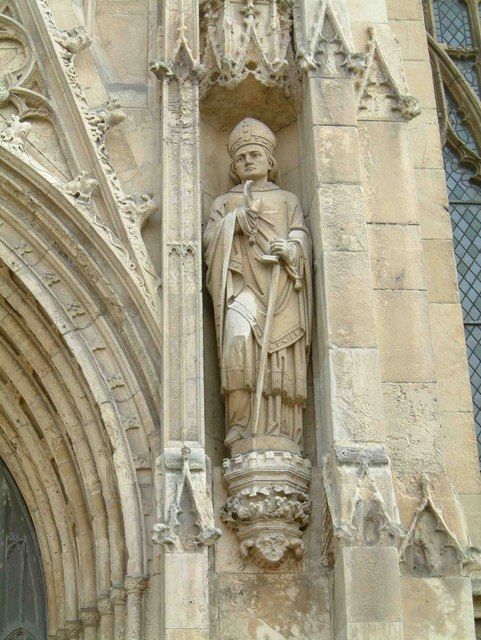
Image: Statue - St John of Beverley on the Minster.jpg · Graham Hermon · CC BY-SA 2.0, via Wikimedia Commons

From Sabine Baring-Gould, The Lives of the Saints, new edition in 16 vols. (London: John C. Nimmo, 1897–98); text from the Internet Archive scan (OCR, lightly cleaned; errors possible). Public domain.

Image: Graham Hermon, Wikimedia Commons (CC BY-SA 2.0)

From “Catholic Encyclopedia (1913)/St. John of Beverley,” The Catholic Encyclopedia (New York: Robert Appleton Company, 1907–1914), via Wikisource. Public domain. Matched by name and feast date; text unedited except for our bracketed notes in grey.

From Sabine Baring-Gould, The Lives of the Saints, new edition in 16 vols. (London: John C. Nimmo, 1897–98); text from the Internet Archive scan (OCR, lightly cleaned; errors possible). Public domain in the United States. Reproduced unedited, except for short bracketed notes in grey that we added to explain names and terms (“S.” is the old abbreviation for Saint). Some history and judgments reflect 19th-century scholarship.