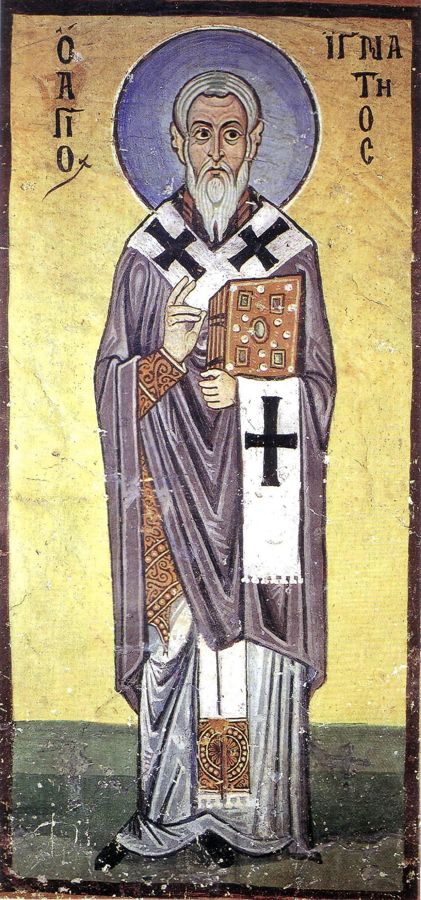
Baring-Gould’s sources: His festival is observed as a double by the Church of S. Malo, in Brittany. His name is inserted in Saussaye's supplement to the Gallican Martyrology. Authorities:—The letters of S. Bernard and Nicolas of Clairvaux.
The illustrious prelate S. John, commonly called "Of the Grate," because of an iron grating which surrounded his sepulchre, was a Breton, the son of parents in a middle class of life. He was born about the year 1098; and from an early age gave indications of piety. In the schools to which he was sent, in a short time he made rapid progress. Peter, abbot of Celle, speaking of him, calls him "the holy bishop, faithful servant of God, a man of courage, loving poverty, a brilliant light, dissipating the densest darkness." His life, as a bishop, was spent in a series of lawsuits with the monks of Marmoutiers. His episcopal seat was at Aleth on the main land, but he desired to transfer it to the island of Aaron, now called S. Malo, on account of the peril to which Aleth was exposed through pirates, and the intestine wars which devastated Brittany. He claimed the island as belonging to the episcopal property of Aleth, but was opposed by the monks of Marmoutiers, who claimed the Church of S. Malo. The case was referred to the Pope, who ordered a commission of French bishops to try the case, and they decided against John. He considered that his cause had been prejudged by them, and visited Rome to carry his appeal in person to the Pope. But Lucius II. would not listen to him, and he was condemned to lose his see. He then retired under the protection of S. Bernard, to Clairvaux, till, on the decease of Lucius II., a monk of Clairvaux was elevated to the papal throne, under the title of Eugenius III. John at once appealed again, and was heard; a fresh commission was appointed, and he was restored to all his rights, and the monks of Marmoutiers were obliged to cede the Church of S. Malo to the bishop. John obtained decisions conformable to that of Eugenius III., from his successors, Anastasius IV. and Adrian IV. That the claim of John was reasonable appears certain. Only three years before he made it, the inhabitants of Aleth had been obliged to take refuge in the island of Aaron to escape the ravages of the Normans, who had already twice pillaged and burnt the city; and it is certain that several of the predecessors of John of the Grate had borne the title of bishop of S. Malo, as well as of Aleth.
During his reign a strange heresy broke out. Eon de l'Etoile, a fanatic, took to himself the title of "Judge of the quick and dead," and armed with a forked stick, shared with God the empire of the universe. When he turned upwards the two prongs of his stick, he gave to the Almighty the government of two-thirds of the world, and when he turned the prongs downwards, he assumed them as his own. This poor visionary was followed by a number of peasants who pillaged churches, and committed all sorts of disorders. They were condemned, in 1148, by the Council of Rheims, and were reduced to submission by the temporal power. John exerted himself, by persuasion and instruction, to disabuse of their heresy such of the fanatics as over-ran his diocese, and succeeded in converting many of his wandering sheep.
He died in the odour of sanctity on Feb. 1st, 1163, and was buried on the Gospel side of the altar in the Church of S. Malo. His reputation for virtue was so well established, that almost immediately he received popular reverence as a Saint. Numerous miracles augmented the devotion of the people. In 1517, one of his successors, Denis Brigonnet, ambassador of the king to Rome, obtained from Pope Leo X. permission for him to be commemorated in a solemn office, as a confessor [in old usage, a saint who was not martyred, or who suffered for the faith without being killed] bishop. This was the year in which began the schism of Luther.
On the 15th October, 1784, Mgr. Antoine-Joseph des Laurents, last bishop of S. Malo but one, examined the relics [the bodily remains of a saint, or objects they used, kept with honor] of the blessed one. He found the bones of S. John enveloped in his pontifical vestments, his pastoral staff at his side, and ring on his finger. During the Revolution the relics of the Saint were ordered to be cast into the sea, but the order was countermanded, and the sexton was required to bury them on the common fosse in the cemetery. The grave-digger, whose name was Jean Coquelin, being a good Catholic, disobeyed the order so far as to lay the bones apart in a portion of the new cemetery as yet occupied by no other bodies. In November, 1799, he announced the secret to M. Manet, a priest who had remained through the Reign of Terror, in S. Malo; and this venerable ecclesiastic assisted by another priest and some religious, verified the relics. A sealed box received the precious deposit, and it was restored to its ancient shrine on 7th March, 1823. Unfortunately the loss of a document which supplied one necessary link in the chain of evidence authenticating the relics was missing, consequently they could not be exposed to the veneration of the faithful. By a strange accident this document was recovered later; whereupon the bishop wrote to Rome to state the proofs which were now complete. The necessary sanction having been received, the sacred relics were enshrined on the 16th November, 1839, with great ceremony; and are now preserved in the Church of S. Malo.
In French, S. John is called S. Jean de la Grille; in Latin, S. Joannes de Craticula.