Their story
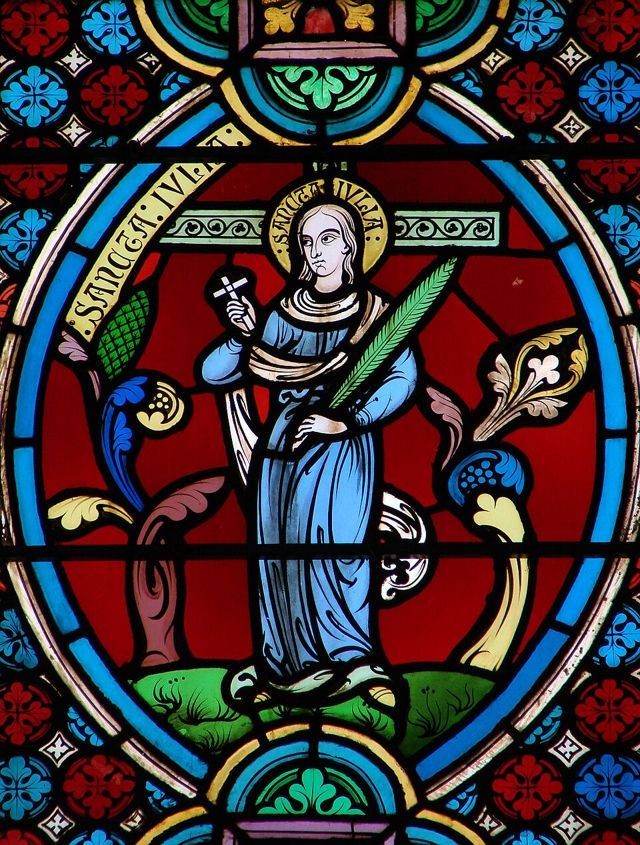
Butler's account comes from her acts as published by Ruinart. Julia was a noble girl of Carthage. When Genseric took the city in 439, she was sold as a slave to a pagan merchant from Syria named Eusebius (bishop of Caesarea, d. c. 339, the first historian of the Church). She served him faithfully, spent every free moment in prayer and reading, and fasted every day except Sunday.
On a voyage to Gaul the ship anchored at the northern tip of Corsica, and her master went ashore for a pagan festival. Julia openly refused to take part. The governor, Felix, offered four slave women in exchange for her, but Eusebius refused to part with her. While the merchant lay drunk and asleep, Felix tried to force her to sacrifice, promising her freedom. She answered that she was free enough so long as she could serve Christ. He had her struck and her hair torn out, then hanged her on a cross until she died.
Monks of the isle of Gorgon took away her body. In 763 Desiderius, king of the Lombards, moved her relics to Brescia. Butler dates her to the fifth century; Baring-Gould, the text on this page, says the sixth or seventh. The sources differ.