As a nun, Julia proved herself a burning and shining light; she walked in such an atmosphere of supernatural [Oct. xz sanctity that the sisters regarded her with awe and called her
Read the essentials →As a nun, Julia proved herself a burning and shining light; she walked in such an atmosphere of supernatural [Oct. xz sanctity that the sisters regarded her with awe and called her
Read the essentials →As a nun, Julia proved herself a burning and shining light; she walked in such an atmosphere of supernatural [Oct. xz sanctity that the sisters regarded her with awe and called her
October 10
May 22 (also listed: July 16)
Virgin
Abbess
Thin entry · the 1897 book gives only 78 words. We have not filled the gap with invented detail.
As a nun, Julia proved herself a burning and shining light; she walked in such an atmosphere of supernatural [Oct. xz sanctity that the sisters regarded her with awe and called her the “ Little Sister of Jesus.” When Benedicta died, there was but one opinion among them all, that Julia must succeed her, and so the servant girl became abbess over nuns of noble birth.
Keep their day. Remember them on October 10 with a short prayer, and ask for their help.
As a nun, Julia proved herself a burning and shining light; she walked in such an atmosphere of supernatural [Oct. xz sanctity that the sisters regarded her with awe and called her the “ Little Sister of Jesus.” When Benedicta died, there was but one opinion among them all, that Julia must succeed her, and so the servant girl became abbess over nuns of noble birth.
Her body was translated to Montreuil along with that of S. Austreberta.
Feast: May 22
Traditional: October 10
One short email a day for nine days. The day's prayer, a line from St. Julia's story, and a nudge to keep going.
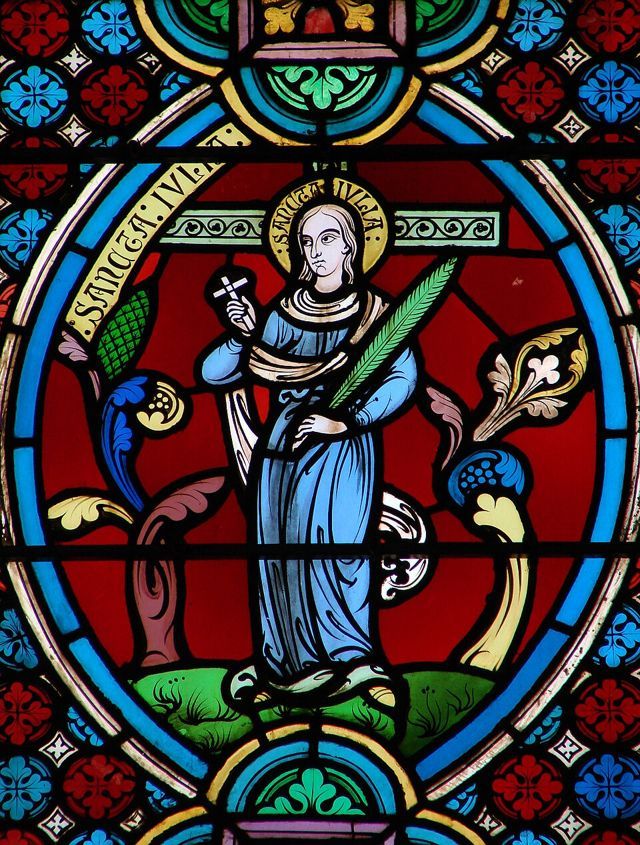
Image: Meaux Vitrail 1867 30808 2.jpg · Vassil · Public domain, via Wikimedia Commons
From Sabine Baring-Gould, The Lives of the Saints, new edition in 16 vols. (London: John C. Nimmo, 1897–98); text from the Internet Archive scan (OCR, lightly cleaned; errors possible). Public domain.
Image: Vassil, Wikimedia Commons (Public domain)
From Sabine Baring-Gould, The Lives of the Saints, new edition in 16 vols. (London: John C. Nimmo, 1897–98); text from the Internet Archive scan (OCR, lightly cleaned; errors possible). Public domain in the United States. Reproduced unedited, except for short bracketed notes in grey that we added to explain names and terms (“S.” is the old abbreviation for Saint). Some history and judgments reflect 19th-century scholarship.